Table of Contents
- Why Is PVC Pipe Testing Necessary?
- What Is the Difference Between Gravity and Pressure Pipe Testing?
- How Is the Low-Pressure Air Test (LPAT) Performed?
- How Is the Hydrostatic Pressure Test (HPT) Performed?
- How Is Pressure-Pipe Constant-Pressure Testing (CPT) Performed?
- Which Standards Govern PVC Pipe Testing (ASTM, ISO, GB/T, AS/NZS)?
- Why Is Compressed-Air Testing Dangerous in Large PVC Pipes?
- FAQ
- Our PVC Pipe Testing Capabilities
Why Is PVC Pipe Testing Necessary?
PVC pipe testing verifies that a newly installed pipeline — every joint, valve, bend, tee, and fitting — will hold pressure without leaking before it goes into service. A pipeline that passes its pre-commissioning test has proven that the construction is sound: joints were made correctly, components were installed per spec, and the pipe can handle its operating pressure with margin. A pipeline that has not been tested is a pipeline whose first leak will be discovered by the customer, by water damage, or by a sewer-treatment plant receiving infiltration it was not designed for.
The test exists because construction defects are invisible once the pipe is buried. A poorly made rubber-ring joint, a cracked fitting, or a valve installed backwards will not show on the surface — only a controlled pressure or leakage test will reveal them while repair is still cheap. For gravity pipelines (stormwater, sanitary sewer) the test confirms the pipe holds water in and keeps groundwater out, because leaky gravity joints let infiltration into the wastewater system and overload treatment plants. For pressure pipelines (water main) the test confirms the pipe holds its rated pressure without losing water. Pre-commissioning testing is not a substitute for the product-standard pressure test done at the factory — it is a separate, installation-quality test run on the completed pipeline in the trench.
What Is the Difference Between Gravity and Pressure Pipe Testing?
The two pipeline types are tested with different methods because they fail in different ways, and the methods are not interchangeable:
| Aspect | Gravity Pipe | Pressure Pipe |
|---|---|---|
| Service condition | Flow by gravity (stormwater, sewer) | Pressurized flow (water main) |
| Test focus | Joint water-tightness; infiltration / exfiltration | Sustained pressure-holding; no water loss |
| Primary methods | Low-pressure air test (LPAT), hydrostatic pressure test (HPT) | Constant-pressure test (CPT) by water-loss method |
| Test pressure | Low (25 kPa air; 20–60 kPa water) | Up to 1.25 × rated pressure |
| Safety hazard | Air-test pressure strictly capped (50 kPa) — plug blow-out | High-pressure compressed air never permitted — explosion risk |
A gravity pipeline is tested at low pressure because it never sees more than a few metres of static head in service; the test only needs to prove joint integrity. A pressure pipeline is tested much closer to its operating pressure because it must prove it will not burst or weep under the pressures the system will impose. The selection of method follows from this: gravity testing prioritizes detecting infiltration paths, pressure testing prioritizes quantifying water loss against an allowed makeup volume.
How Is the Low-Pressure Air Test (LPAT) Performed?
The low-pressure air test (LPAT) is the quickest field test for joint water-tightness on gravity PVC pipelines. The principle: seal the test section (typically between manholes), pressurize it with air to a low set pressure, shut off the supply, and measure how much pressure drops over a calculated time interval — a pressure drop means air is escaping through a leak.
| Parameter | Value |
|---|---|
| Test pressure | 25 kPa (raised to maintain 25 kPa differential if pipe is below water table) |
| Absolute pressure cap | Never exceed 50 kPa (plug blow-out / bulkhead failure hazard) |
| Pass criterion | Pressure drop less than 7 kPa from the 25 kPa start over the required minimum test time |
| Test-section limit | ≤ 250 m length, ≤ 1500 mm diameter |
| Allowable air loss | ≤ 0.0009 m³/(min·m²) of pipe wall area; or ≤ 0.056 m³/min (lowest detectable single leak) |
The required minimum test time is a function of pipe diameter and test-section length, given by the standard air-test formula:
T = 1.02 × Di / (k × L × q)
where T is the time for a 7 kPa pressure drop (seconds), Di is internal diameter (m), L is test-section length (m), q is the allowable volume loss (0.0009 m³/min/m²), and k is a coefficient-loss factor (k = 0.054 × DL, minimum 1.0). The test is pressurized slowly to avoid temperature-induced measurement error (rapid compression heats the air and biases the gauge).
A failed LPAT is resolved by re-pressurizing to 25 kPa and hunting leaks with a soap-solution pour over accessible joints and fittings, then repairing and re-testing. If a pipeline fails the air test repeatedly, it should be checked by the hydrostatic method — air-test failures do not always localize as cleanly as water leaks.
How Is the Hydrostatic Pressure Test (HPT) Performed?
The hydrostatic pressure test (HPT) is the water-based alternative for gravity pipelines — more representative of actual service than an air test, because water leakage can be directly seen and measured. The procedure fills the test section with water, applies a low hydrostatic pressure, and holds it for a defined period while checking for visible leaks and measuring any makeup water needed to maintain pressure.
| Parameter | Value |
|---|---|
| Test pressure | 20 kPa minimum, or 20 kPa above groundwater pressure at the pipe invert, whichever is greater |
| Pressure cap at lowest point | Not exceed 60 kPa |
| Hold time | Minimum 2 hours, adding measured water volumes to maintain pressure |
| Allowable makeup water (if unspecified) | 0.5 litres per hour per metre length per metre diameter |
| Pressurization | Slow; bleed all air off during filling |
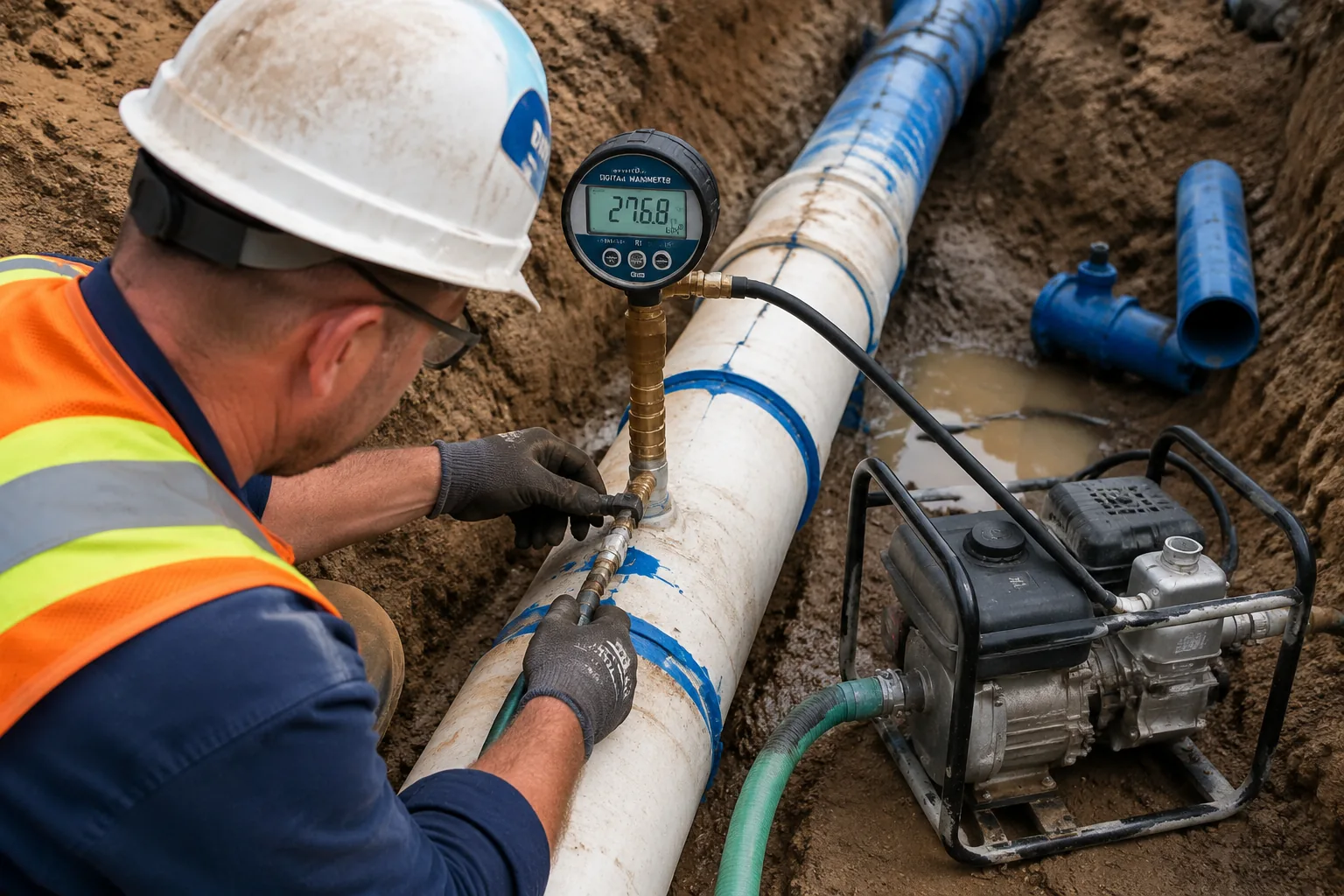
If no visible leaks appear and the makeup-water volume stays within the allowed allowance over the hold period, the section passes. Visible leaks must be repaired and the test repeated. The HPT is preferred over the LPAT where the pipeline runs below the water table, because it tests against the real external hydrostatic head and confirms the joint resists infiltration, not just exfiltration. For steeply graded pipelines, the section may need to be split into stages so that the pressure at the lowest point does not exceed the 60 kPa cap.
How Is Pressure-Pipe Constant-Pressure Testing (CPT) Performed?
Pressure pipelines (water mains) are tested by the constant-pressure test (CPT) with the water-loss method, which holds a sustained hydrostatic pressure and measures how much makeup water must be added to hold that pressure over the test duration. Water loss = leakage. The procedure is water-based only — high-pressure compressed air is explicitly forbidden (see next section).
| Parameter | Value |
|---|---|
| Test pressure | ≥ design pressure; ≤ 1.25 × rated pressure of any pipeline component |
| Fluid | Water only (air prohibited) |
| Pre-test | Bleed all air, stabilize thrust restraints / anchor blocks, verify gauge accuracy |
| Measurement | Makeup water volume added to hold constant pressure, over test duration |
| Test-section length | Whole pipeline or isolated section; pipelines > 1000 m may be sectioned |
The design pressure used as the test floor is the maximum system pressure the pipe will see in service — static pressure + dynamic pressure + an allowance for short-term surge (water hammer). The 1.25 × rated-pressure ceiling protects valves, fittings, and hydrants from overpressure during the test. The result is reported as a water-loss rate compared against an allowed value (commonly the 0.5 L/h/m/m allowance, or a project-specified limit); a section within the allowance passes, one over it leaks and must be located and repaired.
Which Standards Govern PVC Pipe Testing (ASTM, ISO, GB/T, AS/NZS)?
PVC pipe is governed by parallel product and installation standards across regions. The product standards define the pipe's rated pressure and factory test; the installation standards define the field (pre-commissioning) test:
| Standard | Region | Scope |
|---|---|---|
| ASTM D2241 | United States | PVC pressure pipe, IPS-diameter series, PN-rated |
| ISO 1452 (Parts 1–7) | International | PVC-U piping systems for water supply and pressure drainage/sewerage |
| GB/T 10002.1-2006 | China | PVC-U pipes for water supply |
| GB/T 20221-2023 | China | PVC-U piping systems (effective 2024-04-01) |
| AS/NZS 1477 | Australia / New Zealand | PVC-U pressure pipes and fittings |
| NZS 4404:2010 (Appendix C) | New Zealand | Land development field-test procedures for pipelines |
A complete qualification has two layers: the factory product-standard test (e.g., the sustained hydrostatic test that ASTM D2241 / ISO 1452 / GB/T 10002 require of the pipe as manufactured) and the field installation test (e.g., NZS 4404 Appendix C, or the project's specification) that proves the installed pipeline was assembled correctly. They are not substitutes for each other — a pipe that left the factory within standard can still fail its field test if the joints were made badly, and a perfectly jointed pipeline cannot redeem pipe that was out of compliance at manufacture.
Why Is Compressed-Air Testing Dangerous in Large PVC Pipes?
The single most important safety rule in PVC pipe testing is: do not use high-pressure compressed air to test pressure pipelines, and do not exceed 50 kPa on a low-pressure air test. Both rules exist because of the physics of compressed-gas energy release, which is categorically different from a water-pressure failure.
Compressing a gas stores energy in the gas itself (it heats and pressurizes the volume). When a fitting, plug, or bulkhead fails under compressed air, that stored energy releases explosively — propelling fragments and the plug itself at high velocity. Water, by contrast, is nearly incompressible: a water-pressure failure releases a small, brief spurt, because almost no energy is stored in the fluid. The documented incidents make the point bluntly: a contractor who tested a 150 mm water main with compressed air beyond 700 kPa blew the pipe apart; another using an uncalibrated gauge that read 9 bar when the true pressure was 31 bar also destroyed the pipe. Both could have caused serious injury or death.
The 50 kPa cap on the low-pressure air test is the engineering mitigation: at 50 kPa and below, the stored air energy in typical test-section volumes is low enough that a plug or bulkhead failure is survivable. Above that pressure, the forces on temporary plugs (especially in large diameters) become dangerous. Every air-pressurization setup must include a relief valve set at a 50 kPa maximum. For pressure-pipe qualification, water is always the test fluid — the energy stored in a water-filled pressure pipe at test pressure is orders of magnitude lower than the equivalent air-filled pipe at the same pressure.
FAQ
Can I use an air test instead of a water test on a PVC pressure pipeline?
No. High-pressure compressed air is never permitted for pressure-pipe testing — the stored compressed-gas energy makes a fitting or plug failure explosive and lethal. Pressure pipelines are tested with water only. Low-pressure air tests (≤ 50 kPa) are used only on gravity pipelines, and only as a quick joint-integrity screen.
What pressure should a PVC pressure pipe be tested at?
At a minimum, the design pressure (static + dynamic + surge allowance); at a maximum, 1.25 × the rated pressure of any pipeline component. The test must be high enough to prove the pipe holds its service pressure, but not so high as to over-pressurize valves and fittings.
What is the allowable water loss in a hydrostatic test?
Where not specified by the project, the standard allowance is 0.5 litres per hour per metre of length per metre of diameter. For gravity-pipeline HPT, this is the makeup-water limit; for pressure-pipeline CPT, a project-specific or regulatory limit typically applies.
Why might a pipeline pass an air test but fail a water test?
Air and water leak at different rates through the same defect, and air pressure loss cannot be directly related to water leakage volume. A joint that holds air at 25 kPa may still weep water in service. For this reason, a pipeline that fails the air test should be confirmed by the hydrostatic method, and below-water-table installations should default to hydrostatic testing.
How long should a PVC pipeline test section be?
For the low-pressure air test: ≤ 250 m, and ≤ 1500 mm diameter. For pressure-pipeline CPT: the whole pipeline, or an isolated section; pipelines over 1000 m may be tested in several sections. Very steep gravity lines may need to be staged so the lowest-point pressure stays under the 60 kPa cap.
Which standard applies to PVC water-supply pipe in China?
GB/T 10002.1-2006 governs PVC-U pipes for water supply; GB/T 20221-2023 (effective April 2024) governs the broader PVC-U piping system. ISO 1452 is the international equivalent. Field installation testing follows the project specification or the relevant installation standard.
Our PVC Pipe Testing Capabilities
Beijing ZKGX Research Institute provides third-party field and laboratory testing for PVC and PVC-U pipelines and pipe products. Our testing covers both the factory product-standard layer and the field installation layer, following the validated ASTM, ISO, GB/T, and AS/NZS frameworks.
Standards / Methods Our Testing Covers
| Test Endpoint | Method Reference |
|---|---|
| PVC-U pressure pipe product | ASTM D2241 / ISO 1452 / GB/T 10002.1 / AS/NZS 1477 |
| PVC-U piping system | GB/T 20221-2023 / ISO 1452 |
| Sustained hydrostatic strength (factory) | ASTM D2241 / ISO 1452 |
| Low-pressure air test (field, gravity) | NZS 4404:2010 Appendix C |
| Hydrostatic pressure test (field, gravity) | NZS 4404:2010 Appendix C |
| Constant-pressure test (field, pressure pipe) | Project spec / water-loss method |
| Ring stiffness, flattening, density, volatile content | GB/T 9647 / ISO 1452 / GB/T 10002 |
What We Can Test
- PVC-U water-supply and pressure pipe — product-standard qualification (rated pressure, sustained hydrostatic strength)
- PVC-U drainage and sewer pipe — ring stiffness, joint integrity, infiltration resistance
- Installed gravity pipelines — field LPAT and HPT for joint water-tightness
- Installed pressure pipelines — field CPT (water-loss method) against design pressure
Sample Types We Accept
Pipe product samples (cut sections for laboratory hydrostatic and mechanical testing) and complete installed pipeline sections (field test points between manholes or isolation valves). Field test equipment includes calibrated pressure gauges, air compressors with 50 kPa relief valves, and hydrostatic pump rigs.
Get a Testing Quote
If you need product-standard qualification of PVC pipe, or field pre-commissioning testing of an installed PVC pipeline — our team will confirm the applicable standard, sample/section requirements, and a quotation. Contact Beijing ZKGX Research Institute to start.