Table of Contents
- Why Is Scaffolding Testing Necessary?
- What Are the Main Scaffolding Test Methods?
- How Is the Static Load Test Performed?
- How Are Stability and Wind Resistance Tested?
- What Are the Fall-Protection Force Thresholds?
- Which Standards Govern Scaffolding (EN, OSHA, GB, AS/NZS)?
- How Are Scaffold Components Individually Tested?
- FAQ
- Our Scaffolding Testing Capabilities
Why Is Scaffolding Testing Necessary?
Scaffolding testing verifies that a temporary work structure will support its design loads without collapsing, because a scaffold failure does not damage property — it kills or injures the workers on it and the pedestrians below. Every scaffold in service carries personnel, tools, and materials at height, and the structural consequence of a shortfall is immediate: a bent standard, a failed coupler, or an overstressed ledger can drop the entire platform. Testing to the relevant standard before a scaffold enters service, and periodically afterward, is how the supplier, the contractor, and the regulator prove the structure has the strength and stability margin its design assumes.
The regulatory driver is direct. In Europe, any commercial scaffolding must pass certification to the relevant EN standard before being placed on the market, and any structural change to a certified scaffold invalidates its certificate — the modified scaffold must be re-tested. In the US, OSHA holds the employer responsible for scaffold capacity and fall protection. The Italian National Institute for Insurance against Accidents at Work (INAIL), which safeguards workers against occupational injuries, commissioned a dedicated full-scale scaffolding validation system precisely because the safety margin of these structures can only be confirmed by loading a representative assembly to failure and measuring the result. Testing is not a formality; it is the evidence base that a scaffold is fit for service.
What Are the Main Scaffolding Test Methods?
Scaffolding testing is organized by failure mode — each test targets one way a scaffold can fail, and a complete qualification program runs all of them:
| Test | What It Evaluates | Typical Apparatus |
|---|---|---|
| Static load test | Load-bearing capacity of the assembled structure to collapse | Hydraulic jacks, load cells, data acquisition |
| Stability test | Resistance to lateral / wind loads and overturning | Inclinometers, wind-load simulator |
| Component test | Strength, hardness, corrosion resistance of individual parts (couplers, planks, brackets) | Universal testing machine, durometer, salt-spray chamber |
| Fall-protection test | Guardrail, toeboard, and anchor-point strength | Force application on each component |
| Environmental stress test | Degradation under corrosion, moisture, and weathering | Salt spray, humidity, UV |
The methods scale from full-structure tests (the static load test runs on a complete multi-bay scaffold assembly) down to single-component tests (a coupler on a universal testing machine). The static load test and the stability test are the two structural-level tests that qualify a system; the component and fall-protection tests qualify the parts that the structure is assembled from.
How Is the Static Load Test Performed?
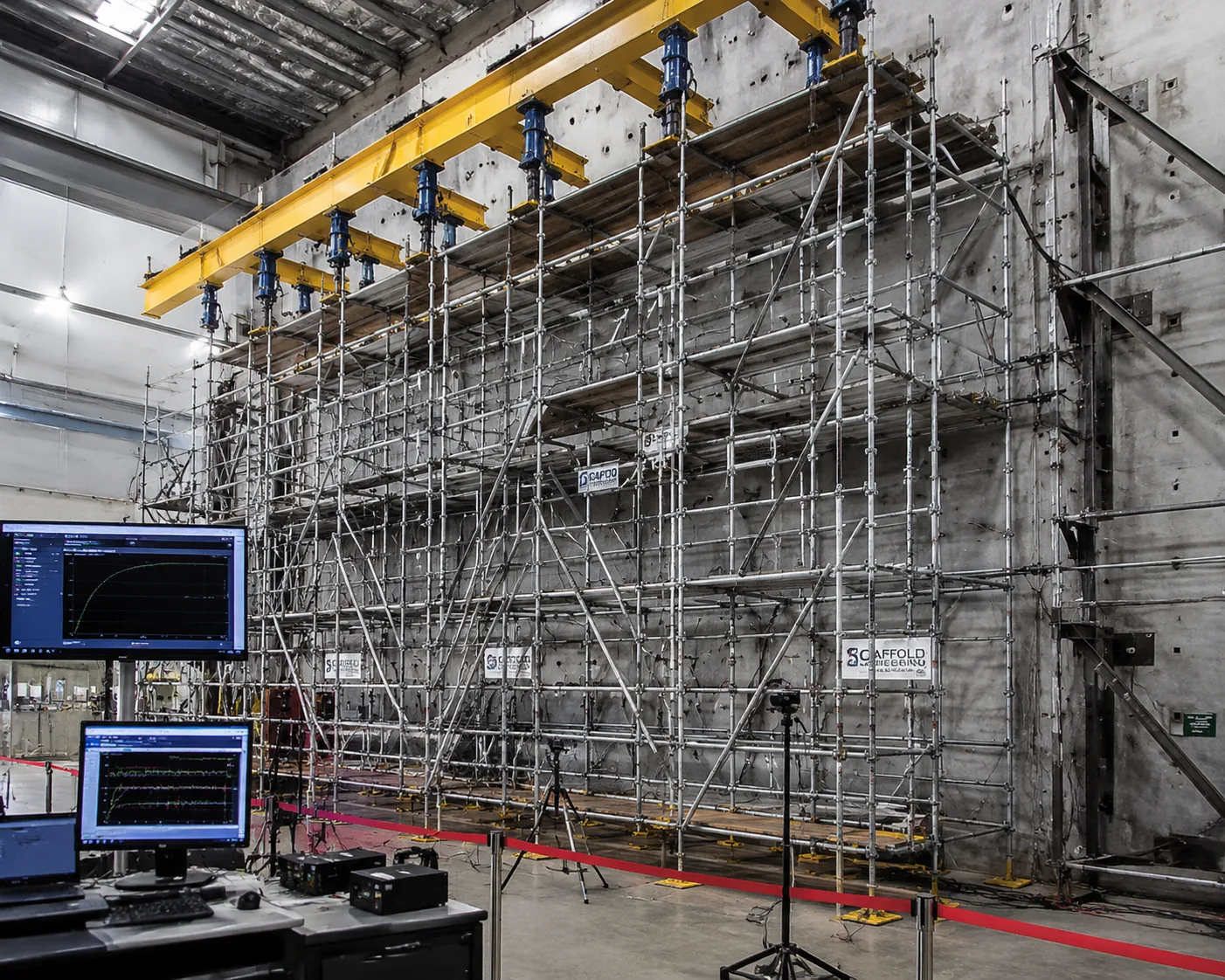
The static load test is the definitive structural test — it applies a controlled vertical load to a representative scaffold assembly and increases it until the structure either reaches its specified capacity or collapses. The INAIL/Dewesoft validation system illustrates the state of the art: a four-arch scaffold standing on five pairs of feet, with a hydraulic piston beneath each pair, connected by steel wires to the top of the structure so that pressure on the piston applies a downward force on the scaffold.
| Parameter | Value |
|---|---|
| Test structure | Multi-arch assembly (4 arches, 5 pairs of feet) |
| Loading | Hydraulic pistons at each foot, force transmitted to scaffold top via steel wires |
| Control | PID-controlled proportional valves, one per piston, for equal load distribution |
| Instrumentation | Load cell per piston, pressure sensors, 50+ cable-extension displacement transducers for deformation |
| Pass criterion (INAIL) | Each arch must withstand ≥ 8,000 kg without collapsing |
| Test endpoint | Load to collapse (implosion); load and deformation recorded throughout |
The test is performed in increments: the load is raised step by step (starting at 5–10% of anticipated maximum), and at each step the load cells record the applied force while the cable-extension transducers measure horizontal and vertical deformation of every beam. The PID controller keeps the load equal across all pistons, so every arch is loaded identically — a critical control, because uneven loading would produce a premature, non-representative failure. The test ends when the scaffold collapses; if each arch withstood at least 8,000 kg before collapse, the scaffold passes. The deformation data also reveals the weakest components and the critical stability threshold, giving the designer the information needed to improve the next iteration.
How Are Stability and Wind Resistance Tested?
The stability test evaluates the scaffold's resistance to lateral forces — wind, incidental impact, and the overturning moment that any tall structure experiences. It complements the vertical load test, because a scaffold that holds vertical weight can still topple sideways.
| Parameter | Description |
|---|---|
| Apparatus | Inclinometers at multiple points, wind-load simulator (or lateral-force actuator), load cells |
| Procedure | Apply lateral force in increments (starting at ~10% of maximum), record inclinometer reading and load at each step |
| Pass observation | No tilt, displacement, or instability below the design lateral load |
| Failure observation | Record the force at which the scaffold begins to overturn, sway, or lose plumbness |
Lateral stability is especially critical for tall scaffolds, scaffolds in high-wind or seismic regions, and scaffolds clad in sheeting (which dramatically increases wind area). The test identifies the weakest components contributing to instability — often the bracing arrangement, base plate bearing, or anchor-tie spacing — and confirms the scaffold meets the lateral-load requirement of its design standard.
What Are the Fall-Protection Force Thresholds?
Fall-protection systems — guardrails, toeboards, and personal fall arrest anchor points — are tested by applying a defined force to each component and confirming it holds. The OSHA force thresholds are the most widely referenced criteria:
| Component | Force Threshold | Application |
|---|---|---|
| Guardrail (top rail) | ≥ 200 lbf (90 kgf) | Applied in any outward/downward direction, at any point along the rail |
| Toeboard | ≥ 50 lbf (22 kgf) | Holds tools/materials from rolling off the platform edge |
| Personal fall arrest system (PFAS) anchor | ≥ 5,000 lbf (2,268 kgf) per worker attached | Each anchor point independently rated |
These thresholds exist because the guardrail is the primary barrier preventing a worker from stepping off the edge, and the PFAS is the backup if that barrier fails. A guardrail that deflects or fails below 200 lbf cannot be relied on; an anchor below 5,000 lbf cannot arrest a fall safely. Testing applies the force (by dead load, hydraulic actuator, or drop test) and records whether the component holds — a pass is binary. The test is run on the installed system, not just on the component as manufactured, because anchor integrity depends on what the anchor is fastened to as much as on the anchor itself.
Which Standards Govern Scaffolding (EN, OSHA, GB, AS/NZS)?
Scaffolding is governed by parallel regional frameworks that specify structural design, load classification, component requirements, and fall protection. A globally traded scaffold system must satisfy the framework of each market it enters:
| Region | Primary Standard | Scope |
|---|---|---|
| Europe | EN 12810 (façade scaffolds, parts 1–2) / EN 12811-1 (performance, 6 load classes) | Structural design and product specification for prefabricated façade scaffolds |
| Europe | EN 131 (ladders) / EN 1004 (mobile scaffold towers) / EN 280 (MEWPs) | Adjacent product-specific standards |
| United States | OSHA 29 CFR 1926 Subpart L (§1926.450–454) | Construction scaffold capacity, platform, fall protection |
| China | GB 55023-2022 (general code, effective 2022-10-01) / GB/T 15831-2023 (steel tube couplers, 48.3 mm) / JGJ 130-2011 (coupler-tube scaffolds) | General code + coupler specification + technical safety code |
| Australia / NZ | AS/NZS 1576 (6-part series) | Scaffolding general requirements, couplers, prefabricated, suspended, trestle |
The most important cross-regional difference is how each framework classifies load. EN 12811-1 defines six explicit load classes, from Class 1 (0.75 kN/m², light inspection) through Class 3 (2.00 kN/m², the standard façade-work class) to Class 6 (6.00 kN/m², very heavy duty) — a scaffold is certified to a specific class, and cannot be used above it. OSHA 1926.451 instead requires every scaffold and component to support its own weight and at least 4× the maximum intended load without failure (suspension ropes: 6×), a single safety-factor approach rather than a graded class system. GB 55023-2022 governs general construction scaffolding in China and references load combinations per the building-load standard, while GB/T 15831-2023 specifies the couplers used with 48.3 mm steel tube — the defining connection component of the dominant Chinese scaffold system. A complete test program cites the standard of the target market, and a globally traded scaffold carries test reports against all applicable frameworks.
How Are Scaffold Components Individually Tested?
Beyond the assembled-structure tests, every critical component is tested individually to confirm it contributes its share of the structure's capacity. The component test battery uses laboratory instrumentation:
| Component Test | Apparatus | What It Verifies |
|---|---|---|
| Strength / load capacity | Universal testing machine (UTM) | Coupler, bracket, or plank holds its rated load without failure or excessive deformation |
| Dimensional / thickness | Micrometer | Component matches specified dimensions within industry tolerance |
| Hardness | Durometer (metal: Rockwell / Brinell) | Material resists deformation under load |
| Corrosion resistance | Salt-spray chamber | Metal component survives simulated environmental exposure without degradation |
A coupler is the component most often singled out for component testing, because in a tube-and-coupler scaffold every connection depends on it. The coupler is mounted in the UTM and loaded to its specified capacity; the load at which deformation or failure occurs is recorded and compared to the standard (e.g., GB/T 15831-2023 for the 48.3 mm Chinese coupler). Planks are tested for flexural strength and resistance to splitting; brackets for their rated cantilever load. The corrosion test runs a defined salt-spray exposure (per ASTM B117 / ISO 9227) and measures how the metal surface degrades, because in coastal or industrial environments long-term corrosion is the silent failure mode that a one-time load test cannot capture.
FAQ
What load must a scaffold be able to support?
It depends on the framework. Under OSHA 1926.451, every scaffold and component must support at least 4× the maximum intended load without failure. Under EN 12811-1, a scaffold is certified to one of six load classes (0.75–6.00 kN/m²) and cannot be loaded above its class. In both cases the scaffold is tested to confirm it holds its rated load with the required margin.
What is the difference between EN 12810 and EN 12811?
EN 12810 specifies the product and structural-design requirements for prefabricated façade scaffolds (the system as a product). EN 12811-1 specifies the general performance requirements for scaffolds, including the six load classes (1–6) that scaffold performance is graded against. EN 12810 references EN 12811-1's load classes, so the two work together.
How often should scaffolding be inspected?
A scaffold should be inspected before first use (initial inspection), periodically during use (routine, typically daily or weekly), after any event that could affect its integrity (storm, impact, modification), and at project completion. The inspection covers assembly correctness, component condition, load limits, and environmental hazards, and is documented per OSHA or the relevant regional standard.
What force must a scaffold guardrail withstand?
Under OSHA, a scaffold guardrail (top rail) must withstand at least 200 lbf (90 kgf) applied in any outward or downward direction at any point along the rail. Toeboards must withstand at least 50 lbf (22 kgf). Personal fall arrest system anchor points must withstand at least 5,000 lbf (2,268 kgf) per worker attached.
Which standard governs scaffolding in China?
GB 55023-2022 (General Code for Construction Scaffolding, effective 2022-10-01) is the mandatory general code. GB/T 15831-2023 governs the steel-tube couplers used with 48.3 mm tube, and JGJ 130-2011 is the technical safety code for coupler-tube scaffolds. Together they define the structural, component, and safety requirements for the dominant Chinese scaffold system.
Can a scaffold that passes its load test still fail in service?
Yes — if the conditions of service differ from the test conditions. A scaffold tested to a vertical-load class may still be vulnerable to wind overturning (the stability test covers this), or to long-term corrosion in a coastal environment (the corrosion test covers this), or to a fall-protection component that was not tested on its actual anchor substrate. This is why a complete qualification program runs the static load, stability, component, fall-protection, and environmental tests together, not just the load test alone.
Our Scaffolding Testing Capabilities
Beijing ZKGX Research Institute provides third-party structural and component testing for scaffolding systems and scaffold components. Our testing follows the validated EN, OSHA, GB, and AS/NZS frameworks, applied to each product's target market.
Standards / Methods Our Testing Covers
| Test Endpoint | Method Reference |
|---|---|
| Façade scaffold structural design & product | EN 12810-1/-2 / EN 12811-1 (load classes 1–6) |
| Ladders / mobile towers / MEWPs | EN 131 / EN 1004 / EN 280 |
| US construction scaffold capacity & fall protection | OSHA 29 CFR 1926 Subpart L |
| Construction scaffolding (general code) | GB 55023-2022 |
| Steel tube couplers (48.3 mm) | GB/T 15831-2023 |
| Coupler-tube scaffold safety | JGJ 130-2011 |
| Scaffold general requirements (AU/NZ) | AS/NZS 1576 |
| Component corrosion | ASTM B117 / ISO 9227 (salt spray) |
What We Can Test
- Complete prefabricated scaffold systems — static load test to collapse, stability test with wind-load simulation
- Scaffold couplers, brackets, and planks — UTM strength testing, dimensional verification, hardness
- Fall-protection components — guardrail (200 lbf), toeboard (50 lbf), PFAS anchor (5,000 lbf) per OSHA
- Metal components for corrosion resistance — salt-spray exposure per ASTM B117 / ISO 9227
- Modified or re-certification scaffolds — re-test after any structural change invalidates the original certificate
Sample Types We Accept
Complete scaffold assemblies (for full-scale structural testing at a dedicated rig) and individual components (couplers, planks, brackets, tubes) for laboratory testing. Structural tests use hydraulic loading with PID-controlled load cells and displacement transducers; component tests use UTM, durometer, and salt-spray apparatus.
Get a Testing Quote
If you need to certify a scaffold system for the European, US, Chinese, or Australasian market — or to re-test a modified scaffold whose certificate has been invalidated — our team will confirm the applicable standard, sample/assembly requirements, and a quotation. Contact Beijing ZKGX Research Institute to start.