Table of Contents
- What Makes Shape Memory alloy testing Different?
- How Are Transformation Temperatures Measured (ASTM F2004, F2082)?
- How Is Superelastic Tensile Behavior Tested (ASTM F2516)?
- What Is the Shape Memory Effect and How Is It Tested?
- How Are Joule-Heating Actuator Characteristics Tested?
- What Are Cycling, Fatigue, and Training Tests?
- Which Standards Govern SMA Testing (ASTM, ISO, GB/T)?
- FAQ
- Our Shape Memory Alloy Testing Capabilities
What Makes Shape Memory Alloy Testing Different?
Shape memory alloy (SMA) testing measures properties that no other metal exhibits — a reversible solid-state phase transformation that lets the alloy recover imposed strain either by unloading (superelasticity) or by heating (shape memory effect). The dominant engineering SMA is binary nickel-titanium (NiTi, trade name Nitinol), first characterized at the U.S. Naval Ordnance Laboratory in 1963. Its functional behavior — the reason it is specified for medical guidewires, actuators, and couplings — is governed by a thermo-elastic martensitic transformation between a high-temperature austenite phase (B2 cubic) and a low-temperature martensite phase (B19′ monoclinic). Testing an SMA therefore is not conventional mechanical testing; it requires measuring a coupled thermo-mechanical-electrical behavior that ordinary tensile or hardness testing cannot capture.
The four characteristic transformation temperatures — Ms (martensite start), Mf (martensite finish), As (austenite start), and Af (austenite finish) — define the temperature window in which each functional property operates. A material that is superelastic at body temperature (Af below 37 °C) is the basis of self-expanding stents; a material that actuates at 80 °C (Af near 80 °C) is the basis of a thermal valve. Getting these temperatures right, and confirming them by standardized test, is the entry qualification for any SMA application. Conventional testing infrastructure (a tensile frame, a DSC) addresses part of the characterization, but the full picture — phase transformation, plateau stresses, recoverable strain, cycling stability, and electrical-resistance self-sensing — requires the integrated test methods described below.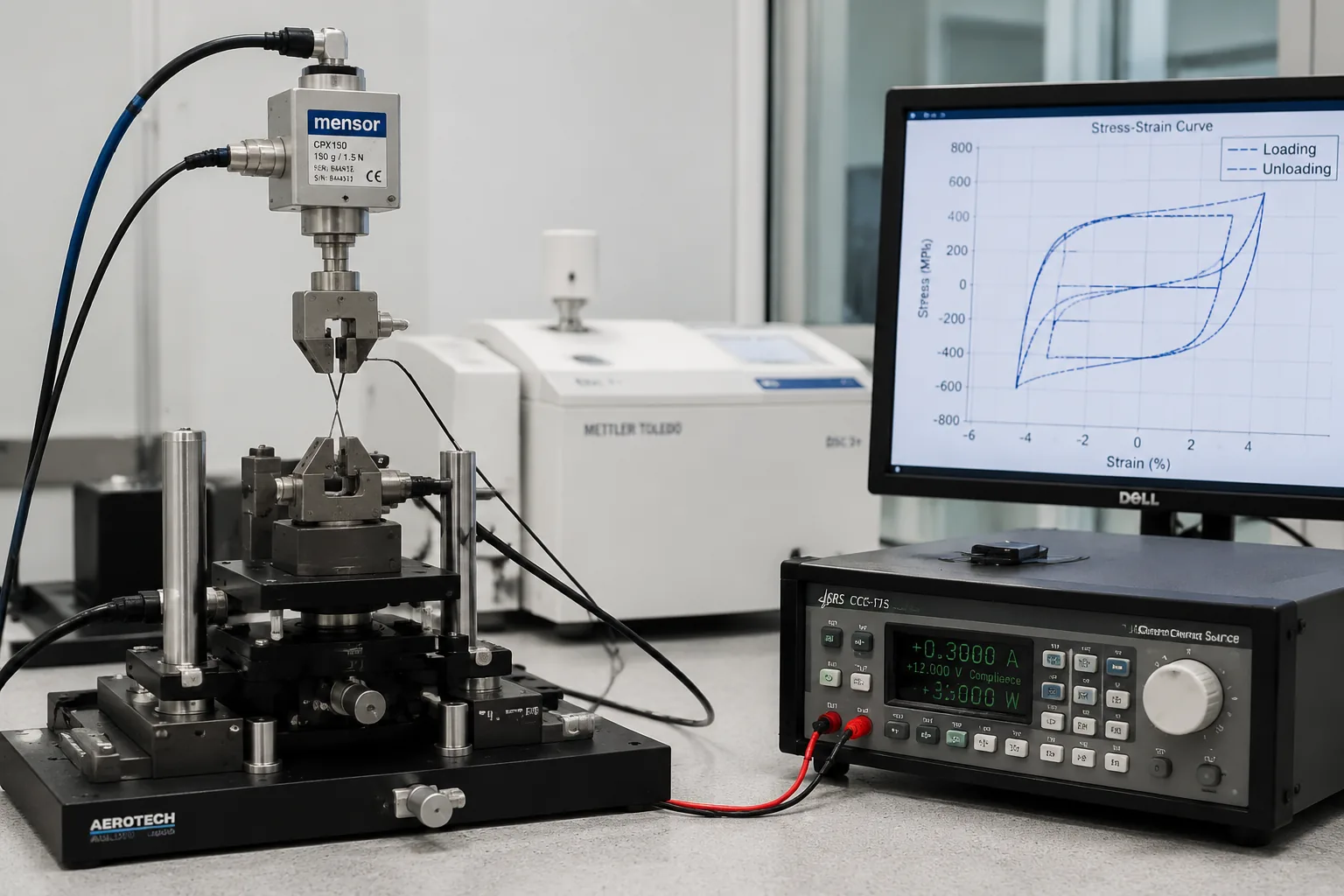
How Are Transformation Temperatures Measured (ASTM F2004, F2082)?
The transformation temperatures are the single most important SMA characterization, because they define the operating window. Two standardized methods measure them, each with a different trade-off:
| Method | Standard | Principle | Best For |
|---|---|---|---|
| DSC (Differential Scanning Calorimetry) | ASTM F2004 | Measures heat flow during the exothermic/endothermic phase transformation on heating and cooling | Most precise; the reference method |
| Bend and Free Recovery (BFR) | ASTM F2082 / F2082M | Deform the sample in martensite, then heat it and observe the temperature at which it recovers its shape | Fast, low-cost; practical for wire and tube |
In a DSC test (ASTM F2004), a small NiTi sample (typically 10–30 mg) is heated and cooled at a controlled rate, and the DSC thermogram shows the transformation as an exothermic peak (austenite → martensite on cooling) and an endothermic peak (martensite → austenite on heating). The onset and finish of each peak give Ms, Mf, As, and Af. DSC is the reference method because it measures the thermodynamic transformation directly, independent of sample geometry.
In a BFR test (ASTM F2082), the sample is bent around a mandrel in the martensitic state (below Mf), then slowly heated while the recovery of its original shape is tracked. The temperature at which recovery begins and completes gives As and Af. BFR is faster and cheaper than DSC and is FDA-recognized for medical-device characterization, but it is geometry-dependent and less precise for absolute thermodynamic values. The two methods are complementary: DSC for material certification, BFR for rapid production-line checks.
How Is Superelastic Tensile Behavior Tested (ASTM F2516)?
Superelasticity is the property that lets a NiTi component (with Af below the test temperature) recover large strains — up to about 8% — simply by unloading. It is the property exploited in self-expanding stents, orthodontic wires, and eyeglass frames. The standardized test for it is ASTM F2516 (Standard Test Method for Tension Testing of Nickel-Titanium Superelastic Materials), which defines the loading-unloading tensile protocol and the properties reported:
| Property (ASTM F2516) | Definition |
|---|---|
| Upper plateau strength | Stress at 3% strain on loading — the stress to induce martensite from austenite |
| Lower plateau strength | Stress at 3% strain on unloading — the stress at which the reverse transformation occurs |
| Residual elongation | Permanent strain remaining after unloading (should be near zero for true superelasticity) |
| Tensile strength | Ultimate tensile strength at fracture |
| Elongation | Total strain at fracture |
The test is run at a temperature above Af (typically room temperature or body temperature, 37 °C). The characteristic stress-strain curve shows a loading plateau (stress-induced martensite formation at the upper plateau stress), a large recoverable strain, and an unloading plateau (reverse transformation at the lower plateau stress). The upper and lower plateau stresses define the hysteresis width — the energy dissipated per cycle — which is a design parameter for damping applications and a quality metric for the material. The residual elongation must be low; a material that does not recover its strain is not truly superelastic and will not function in service.
What Is the Shape Memory Effect and How Is It Tested?
The shape memory effect is the complementary property: a Ti-rich NiTi alloy deformed in the martensitic state at room temperature recovers its original shape when heated above Af. Unlike superelasticity, recovery here is thermally triggered, not mechanically triggered. Recoverable strains of 5% or more are typical.
Testing the shape memory effect combines mechanical deformation with thermal recovery:
- Deform in martensite — stretch or bend the sample at room temperature (below As) to a target strain
- Heat through transformation — heat the sample past Af while constraining or monitoring its shape
- Measure recovery — quantify the fraction of imposed strain that is recovered
The recovery ratio (recovered strain ÷ imposed strain) is the reported result. A well-trained NiTi wire recovers close to 100% of strains up to about 5%. The shape-memory effect is the basis of one-shot actuation (couplings that shrink onto a tube on heating), thermal valves, and deployable structures. The test setup differs from superelastic testing in that the recovery step requires controlled heating, so the rig must integrate thermal and mechanical control — a requirement that drives the design of dedicated SMA test benches.
How Are Joule-Heating Actuator Characteristics Tested?
For SMA used as an electrical actuator — a wire that contracts when a current is passed through it (Joule heating) — the characterization goes beyond the standard tensile and transformation-temperature tests. A dedicated actuator test bench measures the electro-mechanical-thermal behavior under realistic actuation:
| Measurement | What It Reveals |
|---|---|
| Strain vs. electrical power | The power required to start and complete the phase transformation (austenite start/finish power); hysteretic strain-power loop |
| Resistance vs. strain | The self-sensing signal — resistance changes predictably with phase and strain, enabling position feedback without an external sensor |
| Stroke under bias load | How the actuator stroke changes with constant load (constant-stress bias) or spring bias (variable-stress bias) |
| High-temperature performance | How transformation behavior shifts at elevated ambient temperature (e.g., 60 °C automotive conditions), where the power needed for transformation drops and the control margin narrows |
| End-stop interaction | How the actuator behaves when travel is limited by mechanical end stops — critical for valve applications |
A state-of-the-art test bench (as described in recent research) clamps the SMA wire on air bearings for friction-free linear motion, drives it with a linear direct drive, measures force with a high-resolution load cell, heats it with a precision constant-current source, and runs the whole test inside an isolated, temperature-controlled chamber — all without removing the sample between experiments. This integrated setup is what allows a single wire specimen to be characterized for transformation behavior, plateau stresses, self-sensing resistance curves, and cycling stability in one session.
What Are Cycling, Fatigue, and Training Tests?
An SMA's functional properties evolve with cycling. On the first few cycles, the stress-strain hysteresis shifts, residual strain accumulates, and the plateau stresses change — a phenomenon called functional fatigue. After stabilization (typically tens to hundreds of cycles), the behavior reaches a steady state that is the design-relevant one. Two related test types address this:
Training. Fresh NiTi wire is "trained" by cycling it through repeated transformation (mechanical cycling or thermal cycling) until its behavior stabilizes. A typical mechanical training protocol applies 50 cycles at 5% maximum strain at a strain rate of 0.005 s⁻¹. The training process narrows the hysteresis, decreases the upper-plateau stress, and accumulates a small residual strain (around 0.45% after 50 cycles in a representative test). A trained wire is the form in which NiTi actuator wire is commercially supplied.
Cycling stability / functional fatigue. After training, the wire is cycled under the application's actual conditions (load, temperature, heating profile) for thousands or millions of cycles to quantify how its stroke, force, and resistance degrade over service life. Key observations: residual strain builds up, maximum stroke decreases slightly with ongoing cycling, and at stresses above the training level (e.g., above 200 MPa) the behavior becomes unstable. The cycling test is the basis of fatigue-life prediction for SMA actuators and is essential for any application where the actuator must survive a defined number of cycles.
Which Standards Govern SMA Testing (ASTM, ISO, GB/T)?
SMA testing is governed primarily by the ASTM F-series (developed for the dominant medical-device application), with Chinese and international counterparts:
| Measurement | ASTM | GB/T (China) |
|---|---|---|
| Transformation temperature (DSC) | F2004 | GB/T 24230 |
| Transformation temperature (BFR) | F2082 / F2082M | — |
| Superelastic tension (plateau, residual) | F2516 | — |
| Wrought NiTi specification (medical) | F2063 | — |
| SMA terminology | F2005 | — |
The ASTM standards are the de facto international reference — they are FDA-recognized consensus standards and are cited globally for medical-device qualification. GB/T 24230 is the Chinese national standard for NiTi SMA test methods, methodologically aligned with the ASTM approaches. A complete characterization report for a globally traded SMA product cites ASTM F2004 (transformation temperature), F2516 (superelastic tension), and F2063 (material specification) as the core trio, with F2082 BFR added when rapid production checks are needed.
FAQ
What are the four transformation temperatures and why do they matter?
Ms (martensite start), Mf (martensite finish), As (austenite start), and Af (austenite finish) define the temperature window of the phase transformation. Af below body temperature enables superelastic medical devices; Af at a higher temperature enables thermal actuators. Getting these right, measured per ASTM F2004 (DSC) or F2082 (BFR), is the entry qualification for any SMA application.
What is the difference between superelasticity and the shape memory effect?
Superelasticity (Af below test temperature) recovers strain on unloading — up to about 8%, the basis of self-expanding stents. The shape memory effect (Ti-rich, tested below As) recovers strain on heating — up to about 5%, the basis of thermal actuators and couplings. Both arise from the same reversible martensite ↔ austenite transformation; the difference is whether recovery is mechanically or thermally triggered.
Why is ASTM F2516 tension testing specific to Nitinol?
Because the Nitinol stress-strain curve is unlike any other metal's — it has loading and unloading plateaus (stress-induced transformation and reverse transformation), not the linear-elastic-then-plastic curve of ordinary metals. F2516 defines how to measure the upper and lower plateau strengths and the residual elongation that define superelastic quality. A conventional tensile standard (ASTM E8) does not capture these properties.
Can SMA wire act as its own position sensor?
Yes. During the phase transformation, the wire's electrical resistance changes predictably with its crystal phase, length, and cross-section. A typical NiTi wire's resistance falls from about 12 Ω (martensite) to about 10.2 Ω (austenite) over the transformation. By measuring resistance, the wire's position can be inferred without an external sensor — the self-sensing feature exploited in compact SMA actuators.
Why does SMA behavior change with cycling?
Each transformation cycle leaves a small amount of permanent microstructural change — residual strain accumulates, plateau stresses shift, and the hysteresis narrows. After a training period (tens of cycles) the behavior stabilizes. A test that runs only one or two cycles measures the untrained, unstable behavior; a test that runs hundreds of cycles captures the design-relevant steady state. Cycling tests are the basis of functional-fatigue-life prediction.
Which standard applies to NiTi SMA testing in China?
GB/T 24230 is the Chinese national standard for NiTi shape memory alloy test methods, covering transformation temperature and mechanical property measurement. It is methodologically aligned with the ASTM F-series (F2004, F2082, F2516). For medical-device qualification, the ASTM standards remain the FDA-recognized global reference.
Our Shape Memory Alloy Testing Capabilities
Beijing ZKGX Research Institute provides third-party characterization testing for shape memory alloys — primarily binary NiTi (Nitinol) in wire, tube, sheet, and component form. Our testing follows the ASTM F-series and GB/T frameworks, applied to medical-device, actuator, and industrial applications.
Standards / Methods Our Testing Covers
| Test Endpoint | Method Reference |
|---|---|
| Transformation temperature by DSC (Ms, Mf, As, Af) | ASTM F2004 |
| Transformation temperature by Bend and Free Recovery | ASTM F2082 / F2082M |
| Superelastic tensile (plateau, residual elongation, UTS) | ASTM F2516 |
| Wrought NiTi material specification | ASTM F2063 |
| SMA test methods (China) | GB/T 24230 |
| Cycling / functional fatigue | Custom protocols per application |
| Joule-heating actuator characterization | Custom electro-thermo-mechanical test bench |
What We Can Test
- NiTi wire and tube (medical grade) — transformation temperature, superelastic plateau, residual elongation for stent and guidewire qualification
- NiTi actuator wire — Joule-heating strain-power characterization, resistance self-sensing curves, cycling stability
- SMA sheets and components — shape-memory recovery ratio, clamping-force testing for couplings
- Custom and high-temperature SMA (Ti-Nb, Cu-Al-Ni) — transformation-temperature and mechanical characterization beyond binary NiTi
Sample Types We Accept
Wire (20 µm diameter and up), tube, sheet, and finished components. DSC uses 10–30 mg samples; tensile tests use standard wire/tube specimens per ASTM F2516; actuator tests use 100 mm wire lengths in a Joule-heating rig.
Get a Testing Quote
If you need to characterize a NiTi SMA for medical-device qualification, actuator design, or industrial application — or to verify transformation temperatures and superelastic properties for a specific lot — our team will confirm the applicable standard, sample requirements, and a quotation. Contact Beijing ZKGX Research Institute to start.