What Is Waterproof Membrane Testing and Why Does It Matter?
Waterproof membranes are a critical component of building enclosure systems. Once installed, they are permanently covered by landscaping, green roofs, topping slabs, pavers, or structural backfill. Excavating to expose and repair a failed membrane can be prohibitively expensive and sometimes impossible. This is why verifying membrane integrity before coverage is not optional — it is essential.
Waterproof membrane testing serves three core purposes:
- Quality control during installation — identify breaches, pinholes, thickness deficiencies, and seam defects before the membrane is covered
- Product qualification and certification — verify that membrane materials meet performance specifications under standardized test conditions
- System compatibility assurance — confirm that membranes bond properly to substrates and work harmoniously with primers, adhesives, sealants, and topcoats
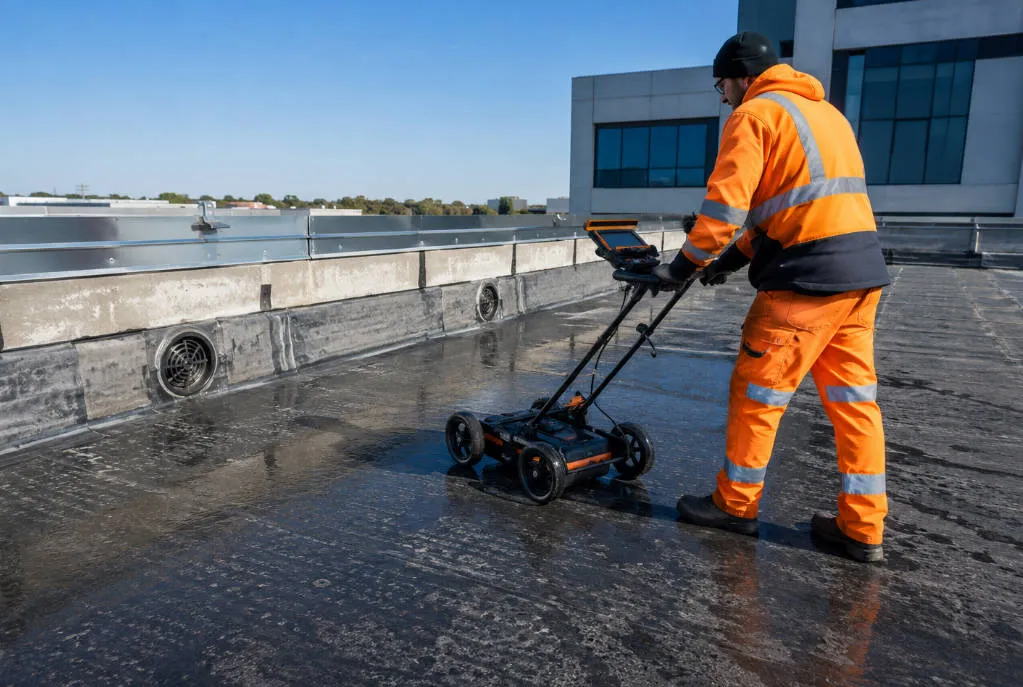
Testing spans four main domains: on-site integrity verification (leak detection), laboratory material characterization, durability assessment, and system compatibility evaluation. Each domain uses different methods and standards, and understanding which applies to your project is the first step toward a watertight installation.
Key Waterproof Membrane Testing Standards
The following table summarizes the most important international standards for waterproof membrane testing:
| Standard | Scope | Key Parameters |
|---|---|---|
| ASTM D5385 | Hydrostatic pressure resistance of waterproofing membranes | Water pressure resistance up to 100 psi (231 ft head) |
| ASTM D7877 | Electronic methods for detecting/locating leaks in waterproof membranes | Guide covering 4 ELD methods |
| ASTM D8231 | Low-voltage electronic scanning for breach detection in roofing/waterproofing membranes | Practice standard for LVELD scanning |
| ASTM D5957 | Flood testing of horizontal waterproofing installations | Guide for flood test procedures |
| ISO 10582 | PVC waterproofing membrane impermeability testing | Hydrostatic pressure, water penetration resistance |
| ISO 13007-5 / 13007-6 | Waterproof membranes beneath ceramic tiling (liquid/sheet) | Tensile adhesion, crack bridging, water impermeability |
| EN 13707 | Reinforced bitumen membranes for roof waterproofing | Tensile strength, elongation, flexibility, ageing |
| AS/NZS 4858 | Internal wet area membranes | Chemical resistance, heat ageing, water vapour transmission |
| AS 4654.1 | External above-ground waterproofing membranes | Durability, cyclic movement, UV, puncture, tear, abrasion |
Electronic Leak Detection (ELD) Methods
Electronic Leak Detection has gained widespread acceptance as the preferred method for on-site membrane integrity verification. ELD is faster, more precise, and uses far less water than traditional flood testing. ASTM D7877 identifies four categories of ELD testing:
1. High Voltage ELD (HVELD) / Spark Testing / Holiday Testing
HVELD works on dry surfaces by delivering an adjustable stabilized DC voltage through an electrode brush. When the probe passes over a breach, the voltage discharges through the membrane to the grounded substrate (concrete, metal decking), completing an electrical circuit. An audible beep or visible spark alerts the technician.
The test voltage is calibrated based on membrane thickness. For liquid-applied membranes, properly calibrated HVELD can even detect areas where the membrane thickness falls below the minimum specified — even without an actual breach.
Best for: Horizontal and vertical surfaces, dry conditions
Limitations:
- Cannot be performed on conductive membranes (e.g., black EPDM)
- Requires a conductive substrate (concrete, metal decking); non-conductive substrates need an embedded mesh/screen
- Must be performed in perfectly dry conditions — no rain, dew, or moisture on the surface
- Incorrect calibration can miss breaches in thin liquid-applied coatings or damage the membrane
- Sheet membrane seams are difficult to test accurately (doubled thickness at seams prevents lateral current travel)
2. Low Voltage Field Vector Mapping (EFVM)
A perimeter conductor loop is installed around the test area. Grounded objects (drains, pipe penetrations, fasteners) must be isolated. The area is charged to approximately 40 volts, and the membrane surface is wetted to create a continuous conductive water film. Two probes trace the direction of current flow to locate breaches.
Best for: Large horizontal field areas under uniform wet conditions
Limitations:
- Cannot test vertical surfaces reliably
- Multiple breaches require iterative testing — the system always directs probes to the strongest breach first
- Continuous water coverage is critical; puddles alone create an incomplete circuit
- Unreliable through overburden (drainage cells, geotextiles, protection boards interrupt the signal)
3. Low Voltage Horizontal Membrane Scanning Platform (IntegriScan)
A portable scanning unit with two metal sweeps passes over a pre-wetted membrane surface. The outer sweep isolates the test area while the inner sweep produces audible and visible alerts when passing over a breach. This method is the only ELD technique that meets the full criteria of ASTM D8231-19.
Best for: Horizontal surfaces, semi-conductive membranes, rapid large-area scanning
Advantages: Tests both non-conductive and semi-conductive membranes (carbon-black tinted polyurethanes, butyl); faster setup than vector mapping; no perimeter wire needed
4. Low Voltage Vertical Surface Scanning Roller
A moistened roller sleeve is rolled upward along vertical substrates. Water forced ahead of the roller into any breaches completes the circuit. This method forms the basis for ASTM D8231-19 vertical testing capability.
Best for: Vertical flashings, walls, transitions between horizontal and vertical surfaces
Hydrostatic Pressure Testing
Hydrostatic pressure testing evaluates the waterproof membrane's ability to resist water penetration under pressure — simulating the conditions it will face from groundwater, ponding water, or hydrostatic head in below-grade applications.
ASTM D5385 — Standard Hydrostatic Test
ASTM D5385 tests a fresh membrane specimen under water pressure up to 100 psi (231 feet of head). While this establishes a baseline resistance rating, it has a significant limitation: the specimen is unaged and not immersed prior to testing, which does not replicate the real-world condition of a below-grade membrane under constant groundwater exposure throughout the building's service life.
Lateral Water Migration Resistance (LWMR) Test
The LWMR test was developed to address the gap in standard hydrostatic testing. It evaluates whether a pre-applied waterproofing membrane can prevent water from migrating laterally between the membrane and the structural concrete when a breach exists. This is critical because water that bypasses a membrane without intimate concrete bonding can travel far from the breach point, causing leaks at distant locations that are extremely difficult to trace and repair.
Key requirements for effective LWMR performance:
- The membrane must maintain an intimate, continuous bond to the concrete cast against it
- Under hydrostatic pressure, the adhesive layer must prevent lateral water migration even when the membrane is breached
- Performance should be verified after long-term water immersion, not just on fresh specimens
- Independent testing has demonstrated LWMR capability at 231 feet of head after extended water immersion for certain advanced bonded membrane systems
ISO 10582 — PVC Membrane Hydrostatic Testing
ISO 10582 evaluates PVC waterproofing membrane impermeability by placing specimens in a pressure chamber that applies controlled hydrostatic pressure. The standard specifies pressure duration, increase rate, and monitoring requirements. Continuous measurement of both applied pressure and any water penetration determines compliance with impermeability requirements.## Mechanical Property Testing
Mechanical tests quantify the physical strength and deformation characteristics of waterproof membranes, which determine their ability to withstand installation stresses, structural movement, and in-service loading.
| Test Property | Typical Standard | What It Measures |
|---|---|---|
| Tensile strength | EN 13707, ISO 13007 | Maximum force before membrane rupture |
| Elongation at break | EN 13707 | Maximum stretch before failure (%) |
| Tear resistance | AS 4654.1 | Resistance to propagating tears |
| Puncture resistance | AS 4654.1 | Resistance to penetration by sharp objects |
| Seam strength | AS 4654.1 | Strength of overlapped sheet membrane joints |
| Dimensional stability | AS 4654.1 | Shrinkage or expansion after thermal exposure |
| Bond strength to substrate | AS ISO 13007-5/6 | Adhesion pull-off strength to concrete or primed substrate |
For tile-backed waterproofing systems, ISO 13007-5 and 13007-6 provide comprehensive mechanical testing including tensile adhesion, post-immersion adhesion strength, adhesion after heat ageing, after freeze-thaw cycles, and after contact with lime water. These tests are critical for wet areas (bathrooms, kitchens, laundries) where membrane failure beneath tiles leads to hidden water damage.
Durability and Weathering Tests
Waterproof membranes are exposed to temperature extremes, UV radiation, chemical exposure, and wet-dry cycling throughout their service life. Durability testing simulates these conditions to predict long-term performance.
Key Durability Test Methods
| Test | Standard | Purpose |
|---|---|---|
| Heat ageing | AS/NZS 4858, ISO 13007 | Resistance to thermal degradation at elevated temperature |
| UV exposure | AS 4654.1 | Resistance to ultraviolet radiation degradation |
| Water vapour transmission | AS/NZS 4858, AS 4654.1 | Moisture permeability of membrane material |
| Water absorption | AS/NZS 4858 | Water uptake capacity and retention |
| Cyclic movement | AS/NZS 4858, AS 4654.1 | Crack-bridging ability under repeated flexing |
| Chemical resistance | AS/NZS 4858 | Resistance to acids, alkalis, and chemicals |
| Freeze-thaw cycling | ISO 13007 | Performance after repeated freeze-thaw exposure |
| Abrasion resistance | AS 4654.1 | Resistance to surface wear from foot traffic or construction activity |
| Root resistance | AS 4654.1 | Resistance to root penetration in green roof applications |
Crack-bridging ability is particularly important for below-grade and plaza deck applications where structural cracking is expected. A membrane that can accommodate substrate movement without rupturing provides long-term protection even as the building settles and moves.
Water vapour transmission rate (WVTR) is a dual-purpose metric. In below-grade applications, low WVTR prevents moisture from migrating through the membrane into interior spaces. In roof assemblies, appropriate WVTR allows trapped moisture to escape, preventing blistering and adhesion loss.
Compatibility Testing
A waterproof membrane may perform perfectly in isolation but fail when combined with incompatible system components. Compatibility testing ensures all elements of the waterproofing system work together reliably.
What Compatibility Testing Evaluates
- Membrane to substrate adhesion — Does the membrane bond adequately to concrete, plywood, metal, or other substrates? Is a primer required?
- Membrane to tile adhesive bonding (ISO 13007-5/6) — Can tile adhesives develop sufficient tensile adhesion to the membrane surface?
- Membrane to topcoat or sealant interaction — Do topcoats, sealants, or overlying materials chemically interact with the membrane in a way that degrades either component?
- Membrane overlap and seam integrity — Do liquid-applied or sheet membrane seams maintain strength under the full range of service conditions?
Common test methods for compatibility include pull-off adhesion testing and peel adhesion testing, both of which quantify bond strength from different loading perspectives. Laboratories accredited to ISO/IEC 17025 (such as XTec Gen, NATA-accredited in Australia) provide the most reliable compatibility data.
The cost of skipping compatibility testing is high. A membrane that delaminates from its substrate or reacts chemically with an adjacent system component can cause catastrophic failure that is far more expensive to remediate than the testing itself would have cost.
Industry Applications
Below-Grade and Basement Waterproofing
Below-grade membranes face constant hydrostatic pressure from groundwater throughout the building's service life. Testing requirements include hydrostatic resistance (ASTM D5385), lateral water migration resistance (LWMR), and long-term immersion performance. Pre-applied bonded membranes that maintain intimate contact with the structural concrete are preferred for their ability to confine any breach to a localized area.
Roofing and Plaza Deck Systems
Roof membranes are tested for UV resistance, thermal cycling, puncture resistance, and seam strength. Green roof systems add the complexity of root resistance and the challenge of leak detection through overburden layers. ELD methods (particularly low-voltage scanning) are used increasingly on plaza decks and vegetative roofs where flood testing is impractical.
Wet Areas (Bathrooms, Kitchens, Laundries)
Internal wet area membranes must pass chemical resistance, heat ageing, cyclic movement, and water vapour transmission tests per AS/NZS 4858. Additionally, ISO 13007-5/6 evaluates the membrane's performance beneath ceramic tile systems — including crack bridging and adhesion after water immersion — which is essential for shower floors and bathroom walls.
Tunnels and Civil Infrastructure
Tunnel waterproofing membranes face extreme hydrostatic pressure, chemical exposure from groundwater, and long-term durability requirements. Testing includes hydrostatic pressure resistance at heads exceeding 100 psi, chemical resistance to sulphates and chlorides, and bond strength to sprayed concrete (shotcrete).
Green Roofs and Planter Systems
Green roof assemblies require membranes with root resistance (AS 4654.1) and the ability to withstand prolonged moisture exposure. Leak detection through the overburden is challenging — traditional flood testing is unreliable when drainage cells, geotextiles, and protection boards separate the membrane from the water source. ASTM WK27666 (proposed) aims to standardize electrical conductance methods for covered membrane systems.
Flood Testing vs. ELD: A Practical Comparison
Understanding the trade-offs between traditional flood testing and electronic leak detection helps project teams select the right method:
| Factor | Flood Testing | ELD |
|---|---|---|
| Duration | 24-72 hours per zone | Minutes to hours per zone |
| Water usage | Hundreds to thousands of gallons | Minimal (LVELD: thin wetting film) |
| Vertical surfaces | Cannot test | HVELD and vertical roller can test |
| Precision | Shows where water exits below; breach location above is uncertain | Pinpoints exact breach location on membrane surface |
| Retest after repair | Full 24-48 hour repeat | Immediate retest of repaired area |
| Weather dependency | Less affected | HVELD requires dry conditions; LVELD requires wetting |
| Overburden testing | Possible | Limited (signal interrupted by intermediate layers) |
| Setup requirements | Temporary dams, access to underside | ELD equipment, conductive substrate |
| Cost of delays | High (holds up downstream trades) | Low (repairs and retest same day) |
In practice, many projects use a combination: ELD for rapid field scanning and pinpoint leak detection, supplemented by targeted flood testing where ELD limitations apply.## Summary
Waterproof membrane testing encompasses electronic leak detection for on-site integrity verification, hydrostatic pressure testing for water penetration resistance, mechanical property evaluation for structural performance, durability testing for long-term weathering resistance, and system compatibility assessment to ensure all components work together. The shift from flood testing to ELD methods (ASTM D7877, D8231) represents a significant advancement in testing speed, precision, and water conservation. However, no single test method covers every scenario — selecting the right combination of methods based on membrane type, substrate conditions, and project requirements is the key to a reliable, watertight installation.