Air-conditioning and ventilation (HVAC) system testing is the laboratory and field verification that a building's HVAC installation — the air-handling units, ductwork, fans, filters, and controls — meets the Chinese national standards that govern it across its full lifecycle. Unlike most materials or products, an HVAC system is not tested under a single standard; it is governed by a four-standard chain running from design through equipment selection, construction acceptance, and operational indoor-air-quality outcome: GB 50736-2012 (design basis) → GB/T 14294 (air-handling-unit product) → GB 50243-2016 (construction-acceptance) → GB/T 18883-2022 (indoor air quality). Each standard contributes a distinct set of requirements, and a complete HVAC compliance report draws on all four.
The Four-Standard Chain
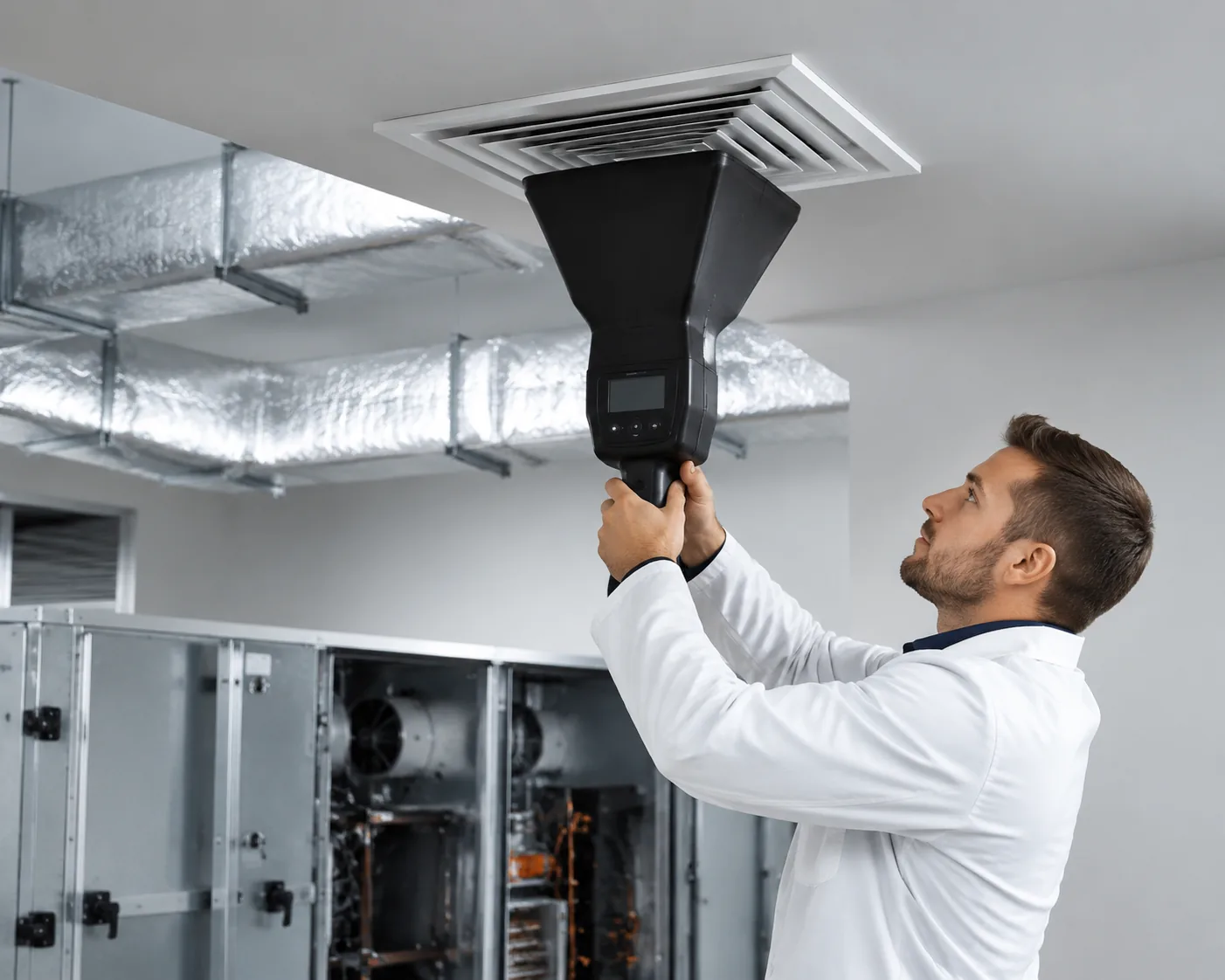
The most important framing fact, and one entirely absent from the search results, is that HVAC system testing is a lifecycle chain of four GB standards — each governing a different stage, the output of one feeding into the next:
| Stage | Standard | What it governs |
|---|---|---|
| Design | GB 50736-2012 — Design Code for Heating, Ventilation and Air Conditioning of Civil Buildings | Indoor design parameters, outdoor-air (fresh-air) rates, system selection, air-distribution design |
| Equipment | GB/T 14294 — Central-station Air-handling Units | AHU product performance: air-handling capacity, cooling/heating capacity, air-leakage rate, fan power |
| Construction acceptance | GB 50243-2016 — Code for Acceptance of Construction Quality of Ventilation and Air Conditioning Engineering | On-site acceptance test items: airflow, temperature/humidity, noise, leakage |
| Operational outcome | GB/T 18883-2022 — Indoor Air Quality Standard | The IAQ the running system actually delivers: CO₂, PM2.5, PM10, TVOC, formaldehyde, temperature, humidity |
The logic is sequential: the design standard (GB 50736) sets the fresh-air and design parameters the system must achieve; the equipment standard (GB/T 14294) sets the performance of the air-handling units selected; the acceptance standard (GB 50243) verifies on site that the as-built installation delivers what was designed; and the IAQ standard (GB/T 18883) verifies that the running system actually produces acceptable indoor air. A system can pass acceptance (GB 50243) yet fail the IAQ outcome (GB/T 18883) if, for example, filter selection or outdoor-air intake is wrong — which is why the chain runs to four, not three.
GB 50243-2016 — The Construction-Acceptance Standard
The construction-acceptance standard GB 50243-2016 (通风与空调工程施工质量验收规范, Code for Acceptance of Construction Quality of Ventilation and Air Conditioning Engineering) is the heart of HVAC system testing on site. It replaced GB 50243-2002 and is organized in 12 chapters covering ductwork, duct components, duct-system installation, fans and air-handling equipment, cooling/heating sources, anti-corrosion and thermal insulation, system commissioning, and completion acceptance. The acceptance test items are specified in the appendices:
| Appendix | Acceptance test item |
|---|---|
| E.3 | Air-handling water flow and water temperature |
| E.4 | Indoor environment temperature and humidity |
| E.5 | Indoor environment noise |
| E.6 | Air-handling equipment and unit operating noise |
Plus air-leakage testing of ductwork and the air-handling unit, and the system-commissioning verification that the installed system delivers the designed airflow, pressure, and temperature at each register. These on-site measurements — taken after construction is complete but before the building is handed over — are the practical core of HVAC system testing.
GB 50738 vs GB 50243 — Construction vs Acceptance
A distinction worth making because the two are often confused: GB 50738-2011 (Code for Construction of Ventilation and Air Conditioning Engineering) governs how the system is built (the construction process and its quality controls), while GB 50243-2016 governs whether the as-built system is accepted (the acceptance test and pass/fail). The two are companion standards used together — the contractor works to GB 50738 during construction, and the acceptance authority tests to GB 50243 at handover.
GB/T 14294 — The Air-Handling-Unit Product Standard
The air-handling unit (AHU) — the central-station unit that conditions and circulates the air — has its own product standard, GB/T 14294 (组合式空调机组, Central-station Air-handling Units). It defines the AHU's product performance:
- Air-handling capacity — the rated airflow the unit delivers (m³/h).
- Cooling and heating capacity — the rated cooling and heating the unit provides (kW).
- Air-leakage rate — the fraction of air that leaks out of the unit casing, a key efficiency and contamination-control parameter. GB 50243-2016 cites GB/T 14294 as the acceptance criterion for the AHU's leakage after on-site assembly.
- Fan power and external static pressure — the electrical power the fan draws and the static pressure it develops against the ductwork.
The AHU's product test (at the manufacturer) and its on-site acceptance test (at GB 50243) are the equipment and installation bookends of the equipment stage.
GB 50736-2012 — The Design Basis
GB 50736-2012 (民用建筑供暖通风与空气调节设计规范, Design Code for Heating, Ventilation and Air Conditioning of Civil Buildings) is the mandatory design standard that sets the parameters the HVAC system must achieve. It specifies, by building type (residential, office, hospital, school), the indoor design temperature and humidity, the minimum outdoor-air (fresh-air) rate per occupant or per floor area, and the air-distribution design. The acceptance and IAQ tests ultimately verify that the as-built, operating system meets these design parameters — GB 50736 is the "what the system is supposed to do" that GB 50243 and GB/T 18883 verify it actually does.
GB/T 18883-2022 — The Indoor-Air-Quality Outcome
The fourth link in the chain — and the one that verifies the system's operational outcome — is GB/T 18883-2022 (室内空气质量标准, Indoor Air Quality Standard), implemented to replace the 20-year-old GB/T 18883-2002. The 2022 edition updated the parameter list and limits substantially: PM2.5 was added (≤ 50 μg/m³), the formaldehyde limit was reviewed, and the CO₂, TVOC, and bacterium limits were updated. The IAQ parameters:
| Parameter | Limit (GB/T 18883-2022, representative) |
|---|---|
| Temperature | 22–28 °C (summer) / 16–24 °C (winter) |
| Relative humidity | 40–80 % (summer) / 30–60 % (winter) |
| CO₂ | ≤ 1000 mg/m³ (≤ 0.1 %) |
| PM2.5 | ≤ 50 μg/m³ (newly added in 2022) |
| PM10 | ≤ 150 μg/m³ |
| Formaldehyde (HCHO) | ≤ 0.10 mg/m³ |
| TVOC | ≤ 0.60 mg/m³ |
| Air velocity | ≤ 0.3 m/s |
GB/T 18883 is the ultimate test: a system that passes GB 50243 acceptance can still produce poor IAQ if the filter selection, outdoor-air rate, or source control is wrong — and only the GB/T 18883 measurement catches that. This is why the chain runs to four standards, not three.
Cleanroom vs General HVAC
The cleanroom is a specialized application of HVAC technology with its own standard family (ISO 14644 series for cleanliness classification, covered separately under cleanroom testing). A cleanroom test focuses on the particle-count cleanliness class, the airflow pattern, and the recovery time — the specialized contamination-control performance. General HVAC system testing (this article) is broader — it covers the air-handling, ventilation, and air-conditioning performance of ordinary buildings (offices, hospitals, factories, residential), governed by the GB 50243 / 14294 / 18883 / 50736 chain, not by the cleanroom standards.
Why the Search Results Are Off the Compliance Intent
The search results for "air conditioning and ventilation system testing" are dominated by content that does not frame the GB compliance chain:
- Australian national HVAC test facility (balanced-ambient calorimeter rooms, cooling/heating capacity, efficiency) — equipment-level performance testing under Australian standards, zero GB.
- US healthcare ventilation testing frequency (ASHRAE Standard 170, CDC guidelines, annual/quarterly testing) — US healthcare HVAC, zero GB.
- UK air-conditioning regulatory compliance (12 kW inspection mandate, Health and Safety at Work Act, COSHH) — UK regulatory, zero GB.
None tells a Chinese building owner, a construction contractor, an acceptance authority, or an IAQ investigator which four GB standards apply, how the design→equipment→acceptance→IAQ chain runs, or what the GB 50243 acceptance test items are. That compliance question is what this article addresses.
Our Testing Capabilities
Beijing ZKGX Research conducts air-conditioning and ventilation system testing across the four-standard chain:
- Construction acceptance (GB 50243-2016): on-site acceptance testing — air-handling water flow and temperature (E.3), indoor temperature and humidity (E.4), indoor noise (E.5), equipment and unit operating noise (E.6), ductwork and AHU air-leakage, and the system-commissioning verification of airflow, pressure, and temperature at each register.
- Equipment (GB/T 14294): air-handling-unit product verification — air-handling capacity, cooling/heating capacity, air-leakage rate, fan power and external static pressure.
- Design verification (GB 50736-2012): verification that the as-built system meets the design-standard outdoor-air rates and design parameters for the building type.
- Indoor air quality (GB/T 18883-2022): the full IAQ parameter panel — temperature, humidity, CO₂, PM2.5, PM10, formaldehyde, TVOC, air velocity — with the 2022 edition's updated limits.
- Sample types: commercial and residential buildings, hospitals, schools, industrial facilities, and the air-handling units and ductwork installed in them.
- Deliverable: a test report identifying the system, the standards applied at each chain stage, the measured values with method citations, and pass/fail against each standard's requirement.
If you have an HVAC system or air-handling unit requiring acceptance, performance, or IAQ verification, contact our testing team to scope the applicable chain stage(s) and the applicable GB standards.
Frequently Asked Questions
What standard governns air-conditioning and ventilation system testing?
It is a four-standard chain: GB 50736-2012 (design basis), GB/T 14294 (air-handling-unit product), GB 50243-2016 (construction acceptance), and GB/T 18883-2022 (indoor air quality). Each governs a different lifecycle stage — design, equipment, acceptance, operational outcome — and a complete report draws on all four.
What is the difference between GB 50243 and GB 50738?
GB 50738-2011 (Code for Construction of Ventilation and Air Conditioning Engineering) governs the construction process — how the system is built. GB 50243-2016 (Code for Acceptance of Construction Quality) governs the acceptance — whether the as-built system passes. The contractor works to GB 50738 during construction; the acceptance authority tests to GB 50243 at handover.
What replaced GB/T 18883-2002?
GB/T 18883-2002 (Indoor Air Quality Standard) was replaced by GB/T 18883-2022. The 2022 edition added PM2.5 (≤ 50 μg/m³), reviewed the formaldehyde limit, and updated the CO₂, TVOC, and bacterium limits. A current IAQ report cites GB/T 18883-2022.
What are the GB 50243-2016 acceptance test items?
The acceptance test items (per the appendices) include air-handling water flow and water temperature (E.3), indoor environment temperature and humidity (E.4), indoor environment noise (E.5), and air-handling equipment and unit operating noise (E.6), plus ductwork and AHU air-leakage testing and the system-commissioning verification of airflow and pressure.
Is HVAC system testing the same as cleanroom testing?
No. Cleanroom testing (ISO 14644 series) focuses on the particle-count cleanliness class, airflow pattern, and recovery time — specialized contamination-control performance. General HVAC system testing (GB 50243/14294/18883/50736) covers the air-handling, ventilation, and air-conditioning performance of ordinary buildings. A cleanroom uses HVAC technology but is governed by its own specialized standards.