Alfalfa testing is the laboratory verification of an alfalfa product — whether it is the seed for planting, the dried hay or ground meal used as animal feed, or a feed-safety assessment — against the Chinese national and industry standards that govern it. Alfalfa is tested under a three-product-class framework because the same crop exists in three distinct commercial forms, each governed by a different standard: the seed under the GB/T 2930 series (grass seed testing), the dried hay/meal product under NY/T 1459 (alfalfa meal quality grading), and the feed-safety layer under the mandatory GB 13078-2017 (feed hygiene standard). Identifying the form — and therefore the standard — is the first step of any alfalfa test.
The Three-Product-Class Framework
The most important framing fact, and one entirely absent from the search results, is that "alfalfa testing" splits into three forms, each under its own standard:
| Form | Standard | What it governs |
|---|---|---|
| Alfalfa seed (the planting material) | GB/T 2930 series — Rules for Seed Testing of Grasses | Seed germination, purity, moisture, other-seed contamination, thousand-seed weight |
| Alfalfa hay / meal product (the feed) | NY/T 1459 — Alfalfa Meal — Quality Grading | Crude protein, crude fiber, crude ash, moisture — graded by quality |
| Feed-safety layer (mandatory for the feed form) | GB 13078-2017 — Feed Hygiene Standard | Aflatoxin B1, Salmonella (not detected), heavy metals (Pb/Cd/As/Hg) |
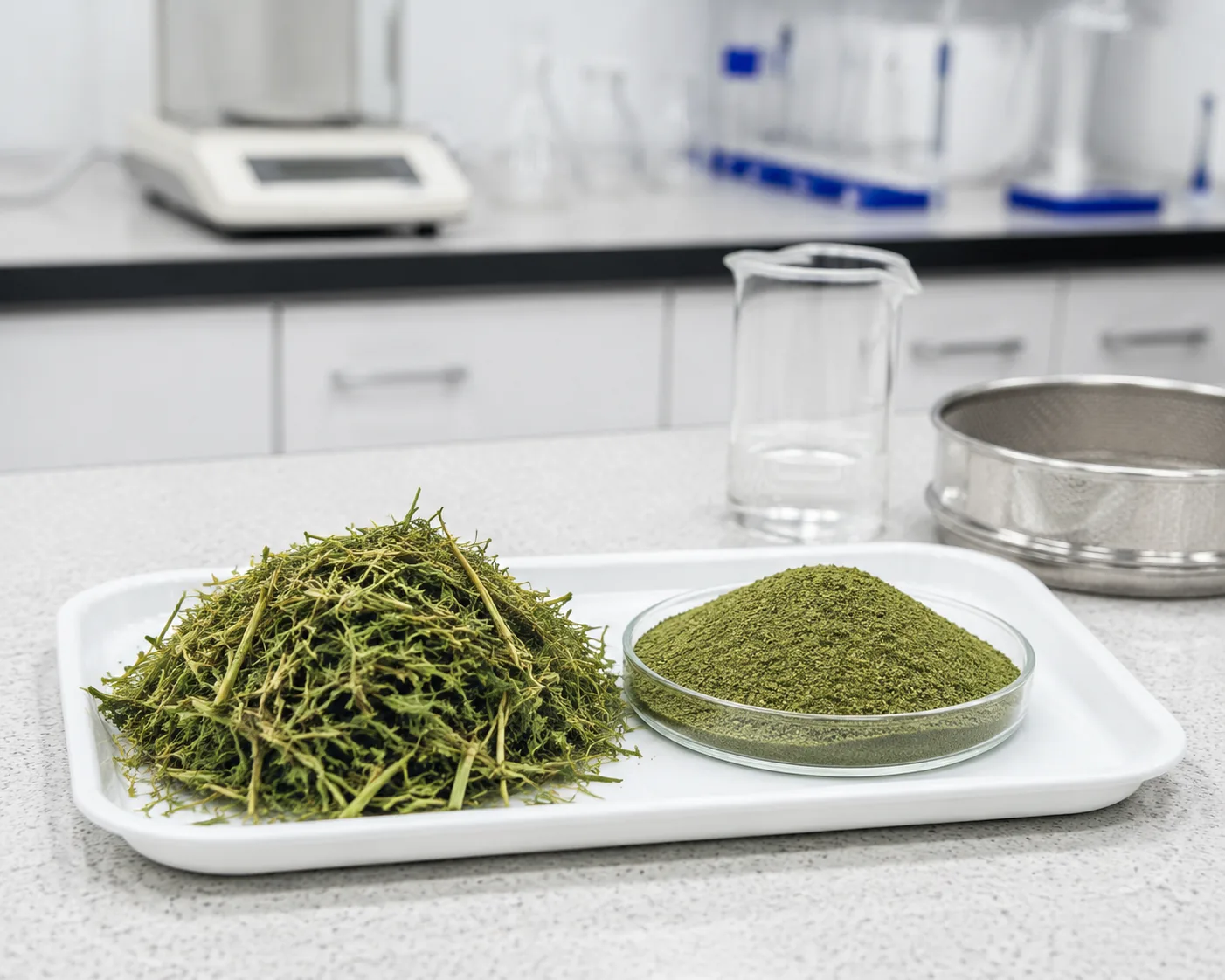
A report that tests only one form and ignores the others is incomplete. A seed-lot report cites GB/T 2930; a hay-or-meal feed product report cites NY/T 1459 for quality grading and GB 13078 for the mandatory feed-hygiene safety layer.
Alfalfa Seed Testing (GB/T 2930 Series)
Alfalfa (Medicago sativa) is a forage legume, and its seed is tested under the GB/T 2930 series (草种子检验规程, Rules for Seed Testing of Grasses), the grass-and-forage-seed equivalent of the agricultural-seed GB/T 3543 series. The current edition, GB/T 2930.4-2017 (发芽试验, Germination Test), replaced GB/T 2930.4-2001 and is effective 2018-05-01; the series was broadened from "牧草种子" (pasture seed) to "草种子" (grass seed) covering forage, turfgrass, feed crops, ecological grasses, and ornamental grasses.
The seed test covers:
- Germination (GB/T 2930.4-2017) — the percentage of seeds that produce normal seedlings under standardized conditions, the headline seed-quality parameter.
- Purity (GB/T 2930.2) — the percentage of pure alfalfa seed versus other-seed and inert-matter contamination.
- Moisture (GB/T 2930.8) — controlled for storage stability.
- Other seeds by number — weed and other-crop seed contamination.
- Thousand-seed weight — for sowing-rate calculation.
A seed-lot report cites GB/T 2930 and reports the germination percentage, purity, and moisture against the applicable seed-quality grade.
Alfalfa Hay/Meal Product Testing (NY/T 1459)
Once alfalfa is harvested, dried, and either baled as hay or ground into meal, the product is graded by its nutritional quality under NY/T 1459 (饲料原料 苜蓿草粉, Alfalfa Meal — Quality Grading; formally 苜蓿干草粉质量分级, Quality Grading of Alfalfa Hay Meal). The standard applies to alfalfa (紫花苜蓿) dried naturally or artificially and ground to a meal used as a feed ingredient. The grading parameters:
| Parameter | What it measures | Why it matters |
|---|---|---|
| Crude protein | The protein content (digestible nitrogen × 6.25) | The headline nutritional-quality indicator — alfalfa's value is its protein |
| Crude fiber | The indigestible structural fiber | Lower fiber = higher digestibility and feed value |
| Crude ash | The mineral residue | An indicator of mineral content and, when excessive, of soil/sand contamination |
| Moisture | Water content | Controlled for storage stability — high moisture causes mold |
The product is graded by these parameters — a higher crude-protein and lower crude-fiber result earns a higher quality grade, which determines the meal's market value. Alfalfa meal typically analyses at 12–26 % crude protein (depending on cut, maturity, and processing) and carries 20+ amino acids, xanthophyll, and vitamins that make it a premium forage ingredient.
Feed-Safety Layer (GB 13078-2017)
On top of the NY/T 1459 quality grading, alfalfa as a feed ingredient must meet the mandatory feed-hygiene standard GB 13078-2017 (饲料卫生标准, Feed Hygiene Standard), which replaced GB 13078-2001 and is the mandatory safety standard for all feed ingredients and compound feeds (excluding pet food). It governs five classes of harmful substances:
| Hazard class | Examples | Typical limit (by feed category) |
|---|---|---|
| Inorganic contaminants | Lead, cadmium, arsenic, mercury, chromium | Pb, Cd, As, Hg — category-specific mg/kg limits |
| Mycotoxins | Aflatoxin B1, ochratoxin A, zearalenone, DON | Aflatoxin B1 typically ≤ 10–20 μg/kg by category |
| Natural plant toxins | Glucosinolates, free gossypol, nitrites | Category-specific |
| Organochlorine pollutants | Persistent organic pollutants | Category-specific |
| Microbial pathogens | Salmonella | Not detected (不得检出) |
For alfalfa specifically, the items of greatest practical concern are:
- Aflatoxin B1 (≤ 10–20 μg/kg by feed category) — alfalfa can carry Aspergillus-mold-derived aflatoxins if harvested or stored wet; the limit is category-specific and the method is GB/T 30956 or GB/T 8381.
- Salmonella (not detected) — the feed-hygiene zero-tolerance pathogen; method GB/T 13091.
- Heavy metals (Pb, Cd, As, Hg) — soil-derived contamination carried into the forage.
A complete alfalfa-feed report cites NY/T 1459 for the quality grade and GB 13078-2017 for the mandatory hygiene compliance.
Why the Search Results Are Off the Compliance Intent
The search results for "alfalfa testing" are dominated by content that answers a different question:
- Utah State University Extension — alfalfa nutrient management for farmers: soil testing, fertilizer recommendation strategies (sufficiency, maintenance, buildup, combination), tissue testing for micronutrient deficiency, phosphorus/potassium/sulfur removal per ton of hay. This is agronomic advisory — it answers "how to fertilize the field to grow alfalfa," not "how to test the alfalfa product for compliance."
A soil-test recommendation of "apply 12 lbs P₂O₅ per ton of hay removed" is field-agronomy guidance to the farmer; it is not a laboratory compliance test on the harvested alfalfa product. None of the agronomy content cites GB/T 2930, NY/T 1459, or GB 13078, and none tells a seed company, a hay exporter, or a feed-quality lab which standard governs which form of alfalfa. That compliance question is what this article addresses.
Our Testing Capabilities
Beijing ZKGX Research conducts alfalfa testing across the three-product-class framework:
- Seed (GB/T 2930 series): germination (GB/T 2930.4-2017), purity (GB/T 2930.2), moisture (GB/T 2930.8), other-seed contamination, and thousand-seed weight, for planting-seed quality grading.
- Hay/meal product (NY/T 1459): crude protein, crude fiber, crude ash, and moisture for alfalfa-meal quality grading, with the grade determined per the standard's quality-classification scheme.
- Feed-safety (GB 13078-2017): aflatoxin B1 (GB/T 30956 / GB/T 8381), Salmonella (not detected, GB/T 13091), heavy metals (Pb, Cd, As, Hg), and the other GB 13078 hazard classes applicable to the feed category.
- Sample types: alfalfa planting seed, alfalfa hay bales, alfalfa meal (ground feed ingredient), and alfalfa-containing compound feeds.
- Deliverable: a test report identifying the product form, the standard applied (GB/T 2930 for seed, NY/T 1459 for the product grade, GB 13078-2017 for feed hygiene), each measured value with its method citation, and pass/fail against each standard's requirement.
If you have an alfalfa seed, hay, or meal product requiring testing, contact our testing team to scope the product form, the applicable standard set, and whether seed-grade, feed-quality-grade, or feed-hygiene verification is the applicable regime.
Frequently Asked Questions
What standard governns alfalfa testing?
It depends on the form. Alfalfa seed is tested under GB/T 2930 series (grass seed testing). Alfalfa hay/meal as a feed ingredient is graded under NY/T 1459 (alfalfa meal quality grading) and must also meet the mandatory feed-hygiene standard GB 13078-2017. The three standards apply to different product forms.
Is alfalfa testing the same as soil testing for alfalfa?
No. Soil testing (the Utah State Extension agronomy content that dominates the search results) tells the farmer how to fertilize the field. Alfalfa laboratory testing verifies the harvested seed, hay, or meal product against GB/T 2930, NY/T 1459, and GB 13078. They answer different questions — agronomy versus product compliance.
What is the alfalfa meal quality grade based on?
Under NY/T 1459, alfalfa meal is graded by crude protein, crude fiber, crude ash, and moisture. Higher crude protein and lower crude fiber earn a higher grade, which determines the meal's market value. Alfalfa meal typically analyses 12–26 % crude protein depending on cut, maturity, and processing.
What are the GB 13078-2017 feed-hygiene requirements for alfalfa?
GB 13078-2017 (the mandatory feed-hygiene standard) requires, for feed ingredients including alfalfa: aflatoxin B1 ≤ 10–20 μg/kg (by feed category, method GB/T 30956), Salmonella not detected (method GB/T 13091), and heavy metals (Pb, Cd, As, Hg) within category-specific limits. The standard replaced GB 13078-2001 and excludes pet food.
What replaced GB/T 2930.4-2001?
GB/T 2930.4-2001 (Pasture Seed Testing — Germination Test) was replaced by GB/T 2930.4-2017 (Rules for Seed Testing of Grasses — Germination Test), effective 2018-05-01. The 2017 edition broadened the scope from "牧草种子" (pasture seed) to "草种子" (grass seed), covering forage, turfgrass, feed crops, ecological grasses, and ornamental grasses.