Baby carriage testing is essential for protecting infants from injuries related to tip-overs, falls, entrapment, and structural failures. When parents buckle their baby into a stroller, they trust that those wheels will stay where they put them. Stability is the safety feature you only notice when it fails.
According to the National Institutes of Health, approximately 64,373 stroller-related injuries occur every year, most from falls, tip-overs, and entrapment. Academic Pediatrics reports an average of 17,000 emergency room visits per year for stroller and carrier injuries in young children, including concussions and other brain injuries. Behind those numbers are tiny bodies that rely on adults to choose, test, and use strollers wisely.
Rigorous stability standards exist to keep those wheels under control. Testing ensures:
- Structural integrity under various load conditions
- Stability resistance to prevent tip-overs on slopes
- Effective braking systems that prevent rollaways
- Safe restraint systems that keep children secure
- Freedom from entrapment hazards in openings and hinges
Without comprehensive testing, manufacturers risk product recalls, liability issues, and most importantly, infant injuries that could have been prevented.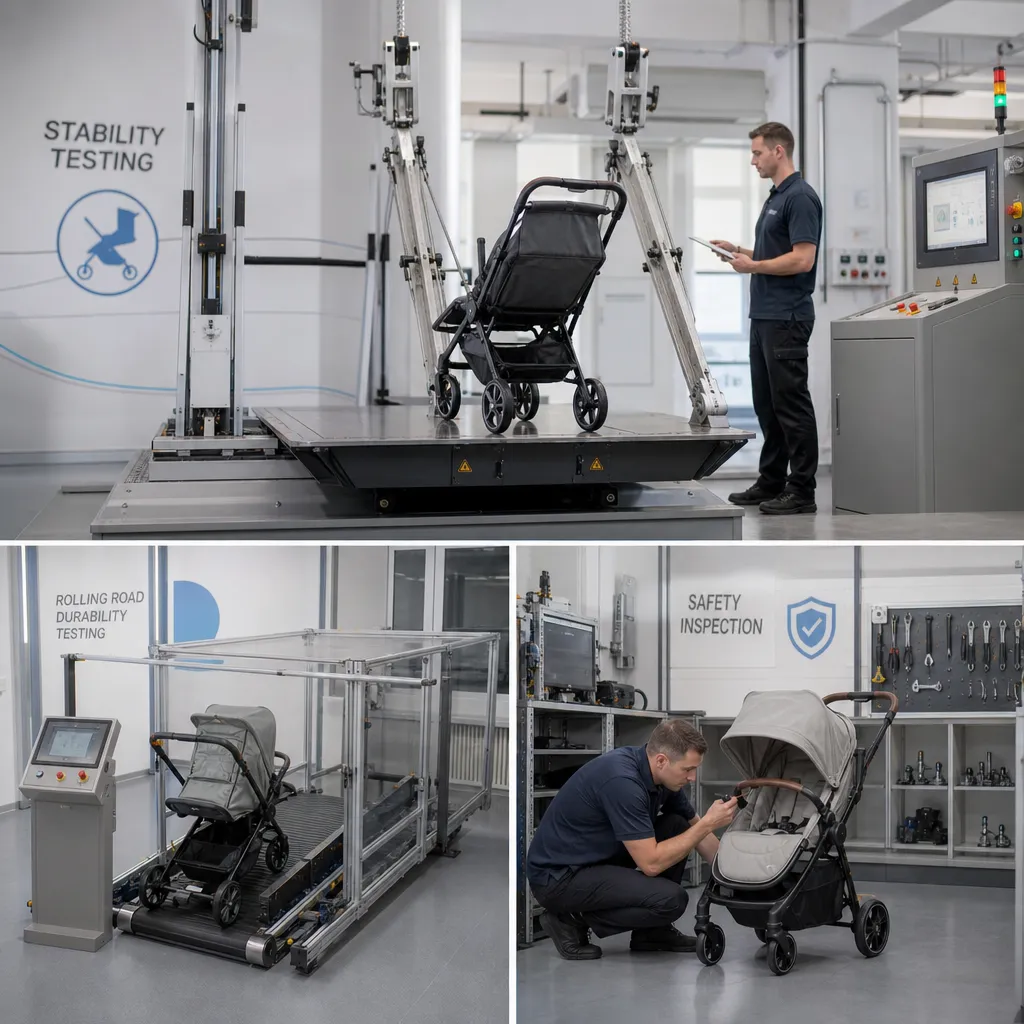
What Safety Standards Govern Baby Carriages?
Baby carriage safety is governed by multiple international standards that establish minimum requirements for design, performance, and testing. These standards represent decades of work by regulators and standards bodies worldwide.
United States Standards
16 CFR Part 1227 with ASTM F833:
- Federal stroller standard incorporating ASTM F833
- Covers parking brakes, static load and stability
- Addresses restraint systems and occupant retention
- Includes head and foot openings requirements
- Covers car seat-stroller combinations
- Includes impact tests and wheel detachment requirements
ASTM F833:
- Defines design and performance requirements
- Prohibits hazardous sharp edges and small parts
- Requires effective parking brakes
- Mandates stability on test planes
- Ensures structural integrity under static loads
- Regulates safe openings and springs
European Standards
EN 1888:
- Sets stroller tipping resistance requirements
- Addresses structural integrity
- Regulates locking system requirements
- Includes rolling-road durability tests
- Covers mechanical, entanglement, and asphyxia hazards
- Addresses chemical and choking hazards
International Standards
ISO 31110:
- Provides performance requirements for pushchairs and prams
- Includes stability and structural testing
- Ensures global safety and reliability
AS/NZS 2088 (Australia/New Zealand):
- Sets minimum safety and construction requirements
- Includes performance and labeling requirements
- Addresses parking aids and tether straps
- Covers reclining seats and stability criteria
CCPSA (Canada):
- Health Canada requirements similar to U.S. CPSC laws
- Emphasizes non-toxic durable materials
- Requires thoroughly tested restraint systems
- Mandates detailed warnings and stability testing
JPMA Certification
JPMA certification indicates a stroller has been tested to mandatory federal standards plus additional Juvenile Products Manufacturers Association criteria, providing extra assurance on braking, stability, and durability.
What Are the General Safety Requirements for Carriages?
General safety requirements address fundamental hazards that apply across all carriage and stroller designs. These requirements protect infants from common injury mechanisms.
Hazardous Sharp Edges and Points
Products must be free from:
- Sharp edges that could cut skin
- Sharp points that could puncture
- Burrs or metal slivers
- Rough surfaces that could cause abrasion
Small Parts
Testing must verify:
- No small parts that could detach and create choking hazards
- Protection against swallowing and ingestion risks
- Special attention to decorative elements and accessories
Scissoring, Shearing, and Pinching
Testing identifies potential for:
- Scissoring actions between moving parts
- Shearing hazards from folding mechanisms
- Pinching points that could trap fingers
- Crush hazards at hinge locations
Entrapment Hazards
Products must prevent:
- Head entrapment in openings
- Limb entrapment in gaps
- Finger entrapment in hinges and folding mechanisms
- Foot entrapment between components
Wood and Metal Components
Requirements include:
- Smooth, splinter-free surfaces
- Proper finishing of all edges
- Corrosion resistance for metal parts
- Non-toxic coatings and materials
Coil Springs and Moving Parts
Exposed coil springs must:
- Be covered or protected
- Not present pinching hazards
- Function safely under repeated use
- Remain securely attached
How Is Stability Testing Performed on Baby Carriages?
Stability testing verifies that carriages remain upright and under control during both stationary and moving conditions. Tests simulate realistic conditions that could cause tip-overs.
Static Stability Testing
Static stability measures a stroller's resistance to tipping when stationary:
Test Procedure:
- Place stroller on standardized test plane
- Apply specified forces at various positions
- Verify stroller does not tip over
- Test multiple orientations
What It Simulates:
- Child leaning to one side
- Parent placing items in basket
- Stroller parked on mild slopes
- Uneven weight distribution
Dynamic Stability Testing
Dynamic stability covers behavior during motion:
Test Conditions:
- Rolling over uneven ground
- Transitioning from sidewalk to street
- Navigating ramps and slopes
- Turning corners
Key Factors:
- Wheelbase design
- Suspension performance
- Center of gravity position
- Weight distribution
Inclined Plane Testing
The stroller is placed on a standardized slope:
Requirements:
- Must remain on plane without tipping
- Test with specified loads in seat
- May include storage area loads
- Verifies wheelbase adequacy
Center of Gravity Considerations
Testing ensures:
- Low center of gravity position
- Well-centered balance point
- Proper seat height relative to wheelbase
- Account for occupant and cargo weight
What Performance Tests Apply to Strollers and Prams?
Performance tests evaluate stroller safety under realistic use conditions. Each test targets specific potential failure modes.
Static Load Testing
Load Requirements:
- Carriages: Support at least 50 lb (approximately 23 kg)
- Strollers: Support approximately 100 lb (45 kg) or 2.5 times manufacturer's maximum rated weight per seat, whichever is greater
- Steps and footrests must hold significant load
Test Purpose:
- Verify frame does not deform or fail
- Ensure structural integrity with larger children
- Account for extra gear weight
- Confirm safety under maximum rated conditions
Handle Strength Testing
Per EN 1888:
- Tests dynamic resistance of reversible and adjustable handles
- Handles must not detach during testing
- Attachment points must not release or break
- Handles tested in multiple positions
Test Method:
- Place stroller on test platform
- Apply force through rope attached to handlebars
- Weight lifted to 150mm height
- Weight falls, pulling stroller
- Test repeated in different directions
Impact Testing
Impact tests evaluate:
- Resistance to collision damage
- Frame integrity under sudden force
- Wheel and swivel security
- Attachment strength of components
Wheel and Swivel Testing
Testing ensures:
- Wheels do not detach during normal use
- Swivels function properly
- Wheel attachment is secure
- No unexpected wheel failure
How Are Braking Systems Tested?
Braking system testing ensures strollers remain stationary when parked and resist rolling away on slopes. Effective brakes are essential for stroller safety.
Parking Brake Requirements
Brakes must:
- Lock both rear wheels with single motion
- Click securely into place
- Remain engaged under testing
- Be easy for adults to operate
- Be difficult for children to release
Brake Performance Testing
Per ASTM F833:
- Braked wheels tested repeatedly
- Must not rotate more than limited amount during force cycles
- Must still function after testing
- Simulates stroller on slope being jostled
Brake Durability Testing
Testing includes:
- Repeated engagement and disengagement
- 200 activation cycles minimum (EN 1888)
- Performance verification after cycling
- Resistance to wear and contamination
Dual-Wheel vs Single-Wheel Brakes
Safety sources recommend:
- Dual rear-wheel brakes over single-wheel systems
- Double-locking brakes for extra security
- Separate parking brake clearly engaged each stop
- Visual or audible confirmation of engagement
What Durability Testing Is Required?
Durability testing verifies that strollers maintain safety and functionality throughout their expected service life. Tests simulate extended use conditions.
Rolling Road Testing
Test Parameters (EN 1888/AS/NZS 2088):
- 64 hours at 5 km/h minimum
- Additional 10 hours at 10 km/h for jogging strollers
- Obstacles placed on rolling surface
- 72,000 obstacle traverses minimum
What It Evaluates:
- Frame durability
- Wheel integrity
- Suspension performance
- Fastener security
- Overall structural integrity
Kerb Mounting Test
Test Procedure:
- Continuous simulation of mounting kerbs
- Repeated impact cycles
- Shows whether components break or fail
- Tests real-world durability
Vibration Testing
Testing includes:
- More than 14,000 vibration cycles under international transport standard
- Evaluation of structural failures
- Assessment of functional failures
- Long-term reliability verification
Folding Mechanism Testing
Folding mechanisms must:
- Operate safely throughout testing
- Locks remain secure
- No pinching or crushing hazards develop
- Latching mechanisms remain functional
How Are Restraint Systems Evaluated?
Restraint system testing ensures children remain securely positioned in the stroller during use. Proper restraints are critical for preventing falls and injuries.
Harness Requirements
Five-Point Harness:
- Secures shoulders, hips, and between legs
- Gold standard per safety organizations
- Distributes forces across stronger body regions
- Keeps movement within safer range
- Prevents standing, leaning, and sliding
Harness Adjustability Testing
Testing verifies:
- Straps are adjustable for proper fit
- Adequate length for growing children
- No strangulation risks from excess strap
- Secure buckle function
- Easy for adults but difficult for children to open
Occupant Retention Testing
Tests ensure:
- No gaps children can slip through
- Buckles hold under stress
- Small leg openings prevent infant escape
- Harness remains secure during tip-over scenarios
Buckle Testing
Buckles must:
- Remain latched during testing
- Resist accidental release
- Function after repeated use
- Be accessible to adults
- Require dexterity children don't possess
What Labeling and Certification Requirements Apply?
Permanent labeling and certification requirements enable product identification and consumer notification of safety information. These requirements support recall effectiveness.
Required Label Information
Labels must include:
- Name of domestic manufacturer or importer
- Contact information with address and phone number
- Model name and/or number
- Date of manufacture (month and year minimum)
- Product identification number
Warning Labels
Products must include warnings about:
- Weight and age limits
- Proper use instructions
- Harness use requirements
- Brake engagement reminders
- Terrain limitations
Tracking Labels
Products must have:
- Permanent tracking labels
- Production lot identification
- Recall coordination capability
- Traceability to manufacturing date
Product Registration
Requirements include:
- Product registration forms provided
- Pre-paid postage option
- Online registration alternative
- Manufacturer contact for recall notification
Certification Marks
Look for:
- ASTM F833 compliance statement
- EN 1888 compliance (Europe)
- JPMA certification seal
- ISO 31110 reference
- National standard compliance statements
Choosing a Safe Baby Carriage
Choosing a safe baby carriage requires understanding safety features and verifying compliance with standards. Parents can evaluate safety through specific design features.
Stability Features to Seek
Wheelbase Design:
- Broad wheelbase resists tipping
- Wider base better than narrow frames
- Especially important for higher seats
- Critical for multiple-child strollers
Frame Material:
- Solid metal frames (aluminum alloys preferred)
- Frame should not flex when pushed or twisted
- Strong welded joints preferred
- Quality construction visible
Braking System Quality
Look for:
- Dual rear-wheel brakes
- Single-action engagement
- Clear engagement confirmation
- Separate parking brake
- Brake release not accessible to child
Restraint System Quality
Choose:
- Five-point harness system
- Adjustable straps for growth
- Easy adult operation
- Difficult child operation
- No-rethread adjustments preferred
Wheel Design
Consider:
- Larger wheels handle rough surfaces better
- Swiveling front wheels for maneuverability
- Lockable front wheels for rough terrain
- No wobbling or looseness
- Quality wheel attachment
Storage Placement
Remember:
- Use under-seat basket for heavy items
- Never hang heavy bags from handle
- Handle weight shifts center of gravity
- Common preventable cause of tip-overs
Special Considerations by Type
Jogging Strollers:
- Large air-filled tires
- Strong suspension
- Lockable or fixed front wheel
- Hand brake and wrist strap
- Not for infants under 6 months
Stroller Wagons:
- Low center of gravity
- Wide wheelbase
- Strong materials
- Reliable brakes
- Five-point harness systems
Travel Strollers:
- Hinges and locks robust
- Clear lock indicators
- Solid feel when open
- Certified compliance
- Not compromised by lightweight design
Conclusion
Comprehensive baby carriage testing ensures products meet rigorous safety standards and protect infants during everyday use. From stability testing on inclined planes to brake performance verification, from durability testing on rolling roads to restraint system evaluation, each test contributes to safer products.
Manufacturers must ensure products are tested by accredited laboratories to relevant standards such as ASTM F833, EN 1888, and ISO 31110. Parents should verify compliance when purchasing, use harnesses and brakes consistently, and register products for recall notification.
Understanding testing standards helps parents make informed choices and use strollers safely. When you choose a tested and certified stroller, load it thoughtfully, use the harness and brakes without exception, and maintain it properly, you provide your child with safe transportation for their earliest journeys.