Cellulase testing encompasses a range of analytical methods used to measure the activity of cellulase enzymes that break down cellulose into glucose and other sugars. These enzymes play crucial roles in industries ranging from biofuel production to textile manufacturing, making accurate activity measurement essential for quality control, research, and process optimization.
This comprehensive guide covers all major cellulase testing methodologies, from traditional DNS-based assays to modern high-throughput techniques. You'll learn how to measure endoglucanase activity, total cellulase activity, and optimize testing conditions for accurate, reproducible results.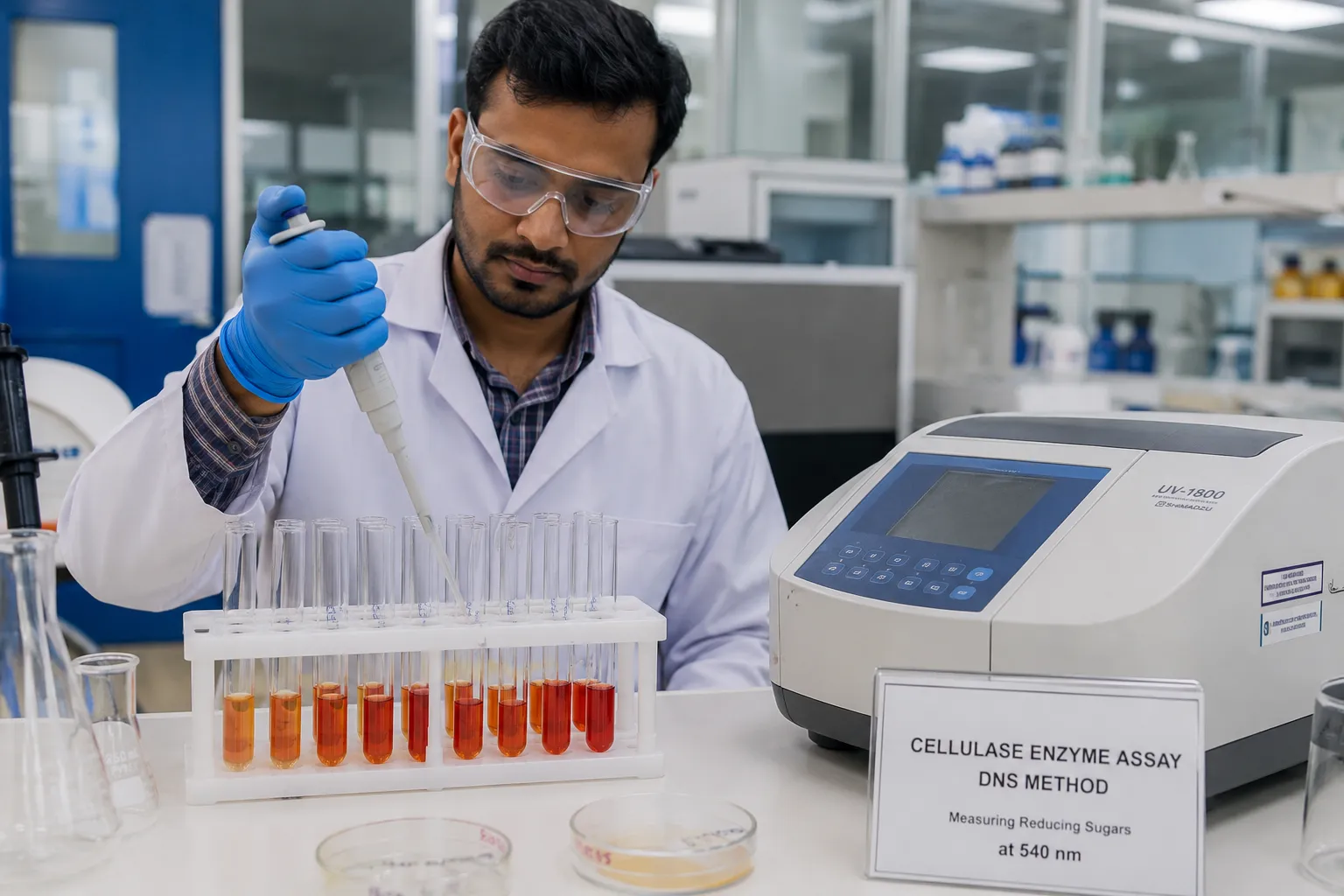
What you'll learn in this guide:
- DNS assay principles and procedures
- CMC (carboxymethylcellulose) activity testing
- Filter paper activity (FPU) measurement
- Enzyme activity units and calculations
- Sample preparation and handling
- Optimization parameters for testing
- High-throughput screening methods
- Industrial quality control applications
Importance of Cellulase Testing
Cellulase enzyme activity measurement serves critical functions across multiple industries and research applications.
Key benefits of cellulase testing:
Industrial quality control: Testing ensures enzyme preparations meet specified activity standards for commercial applications in biofuel, textile, and food industries.
Research and development: Accurate activity measurement enables enzyme discovery, strain improvement, and process optimization for enhanced cellulase production.
Bioprocess monitoring: Regular testing during fermentation processes enables real-time adjustment of culture conditions for maximum enzyme yield.
Product specification: Commercial enzyme preparations require standardized activity measurements for labeling, pricing, and application recommendations.
Environmental applications: Testing validates enzyme performance for biomass conversion, waste treatment, and bioremediation applications.
Cost optimization: Understanding enzyme activity helps optimize dosage rates and reduce production costs in industrial processes.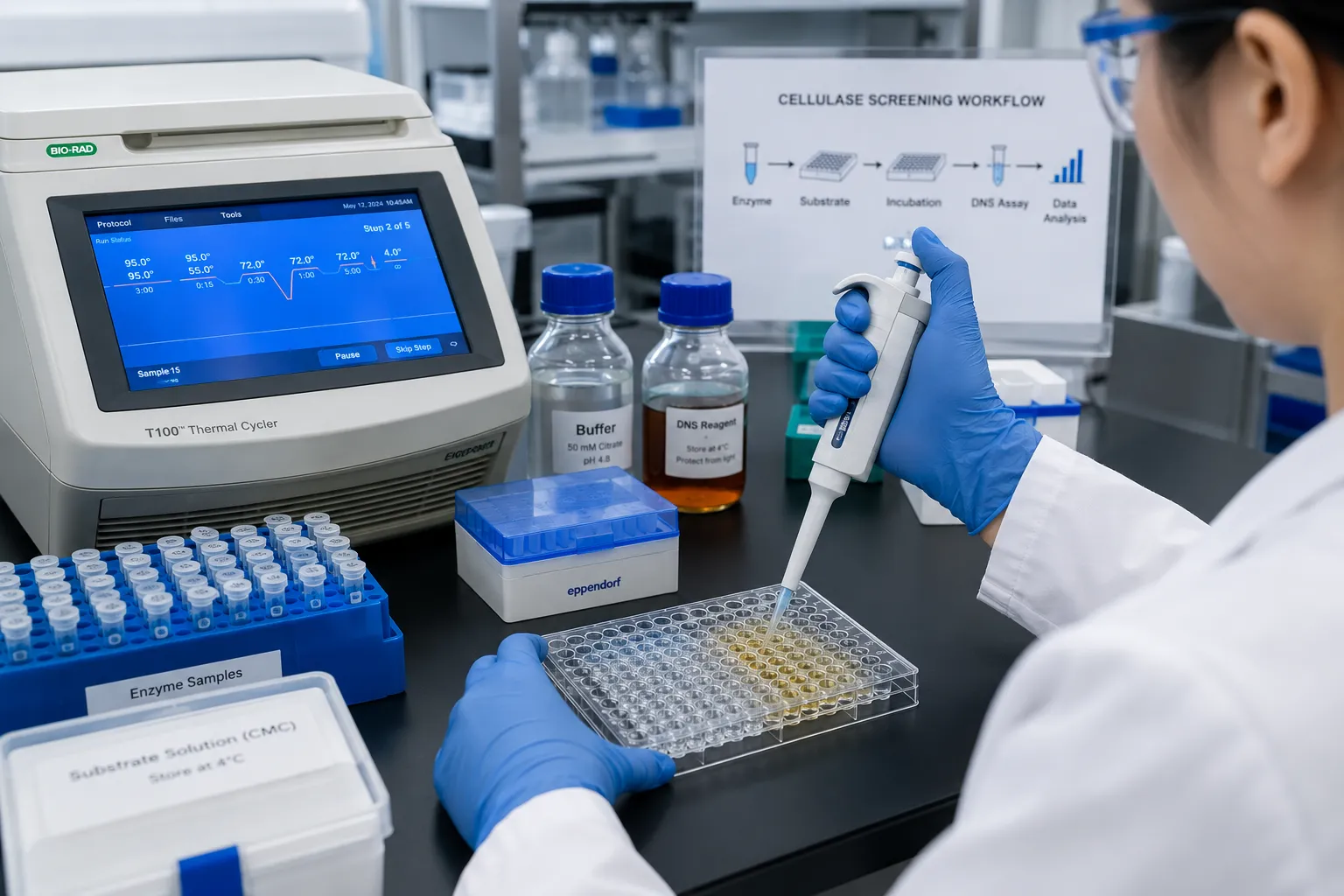
Cellulase Enzyme System Overview
Enzyme Components
Cellulase is not a single enzyme but a complex system of multiple enzymes working synergistically.
Endoglucanases (CMCase):
- Attack internal β-1,4-glycosidic bonds in cellulose chains
- Create new chain ends for exoglucanase action
- Measured using carboxymethylcellulose (CMC) as substrate
- Active on amorphous cellulose regions
Exoglucanases (Cellobiohydrolases):
- Processively cleave cellobiose units from chain ends
- Work on both reducing and non-reducing ends
- Essential for crystalline cellulose degradation
- Synergistic with endoglucanases
β-Glucosidases:
- Hydrolyze cellobiose to glucose
- Prevent cellobiose accumulation that inhibits cellulases
- Critical for complete cellulose conversion
- Often the rate-limiting component
Substrate Types
Different substrates are used to measure specific cellulase activities.
Carboxymethylcellulose (CMC):
- Soluble derivative of cellulose
- Used for endoglucanase activity measurement
- Amorphous structure allows easy enzyme access
- Standard substrate for CMCase assays
Filter Paper:
- Natural crystalline cellulose substrate
- Measures total cellulase activity (FPU)
- Represents combined action of all cellulase components
- Standardized by IUPAC method
Microcrystalline Cellulose (Avicel):
- Highly crystalline cellulose preparation
- Used for exoglucanase activity measurement
- More resistant to enzymatic degradation
- Requires complete cellulase system
DNS Assay Method
Principle
The 3,5-dinitrosalicylic acid (DNS) method is the most widely used technique for measuring reducing sugars released by cellulase activity.
Chemical Basis:
- Reducing sugars reduce DNS under alkaline conditions
- DNS is reduced to 3-amino-5-nitrosalicylic acid
- Produces orange-red to brown color
- Color intensity proportional to reducing sugar concentration
- Maximum absorbance at 540-575 nm
Reaction Conditions:
- Alkaline pH required for DNS reduction
- Heat accelerates color development
- Reaction must be standardized carefully
- Interference possible from other reducing compounds
DNS Reagent Preparation
Standard Composition (per 100 ml):
- 1.0 g 3,5-dinitrosalicylic acid (1.0%)
- 30 g potassium sodium tartrate (Rochelle salt) (30%)
- 20 ml 2N sodium hydroxide (0.4N final)
- Make up to 100 ml with distilled water
Alternative Formulation:
- 1.4% 3,5-dinitrosalicylic acid
- 0.28% phenol
- 0.07% sodium sulfite
- 28% sodium potassium tartrate
- 1.4% sodium hydroxide
Preparation Guidelines:
- Dissolve tartrate in warm water first
- Add DNS with stirring until dissolved
- Add NaOH solution slowly with cooling
- Store in amber bottle in dark
- Allow to age one week before use
- Stable for several months when stored properly
Standard CMC Activity Assay
Materials Required:
- 0.5 ml enzyme solution (appropriately diluted)
- 0.5 ml 2% CMC solution in 0.05M citrate buffer, pH 4.8
- 3.0 ml DNS reagent
- 20 ml distilled water
Assay Procedure:
- Pre-warm substrate and enzyme to 50°C separately
- Mix enzyme and substrate in test tube
- Incubate at 50°C for exactly 30 minutes
- Add 3.0 ml DNS reagent to stop reaction
- Heat in boiling water bath for 5 minutes
- Cool immediately in ice water bath
- Add 20 ml distilled water and mix well
- Measure absorbance at 540 nm against blank
Blank Preparation:
- DNS added before enzyme (inactivates enzyme)
- 0.5 ml buffer instead of enzyme
- Same incubation and heating conditions
- Used to zero spectrophotometer
Filter Paper Activity Assay (FPU)
Standard IUPAC Method:
Materials:
- 0.5 ml enzyme solution (appropriately diluted)
- 1.0 ml 0.05M citrate buffer, pH 4.8
- 1.0 × 6.0 cm filter paper strip (Whatman No.1, 50 mg)
- 3.0 ml DNS reagent
- 20 ml distilled water
Procedure:
- Add buffer and enzyme to test tube
- Add filter paper strip, ensuring complete immersion
- Incubate at 50°C for 60 minutes
- Add DNS reagent and mix well
- Boil for exactly 5 minutes
- Cool in ice bath
- Add 20 ml water, mix thoroughly
- Allow pulp to settle
- Measure absorbance at 540 nm
Critical Points:
- Enzyme must be diluted to release 2.0 mg glucose or less
- At least two dilutions required for accurate FPU
- Filter paper must be completely wetted initially
- Consistent tube dimensions important for reproducibility
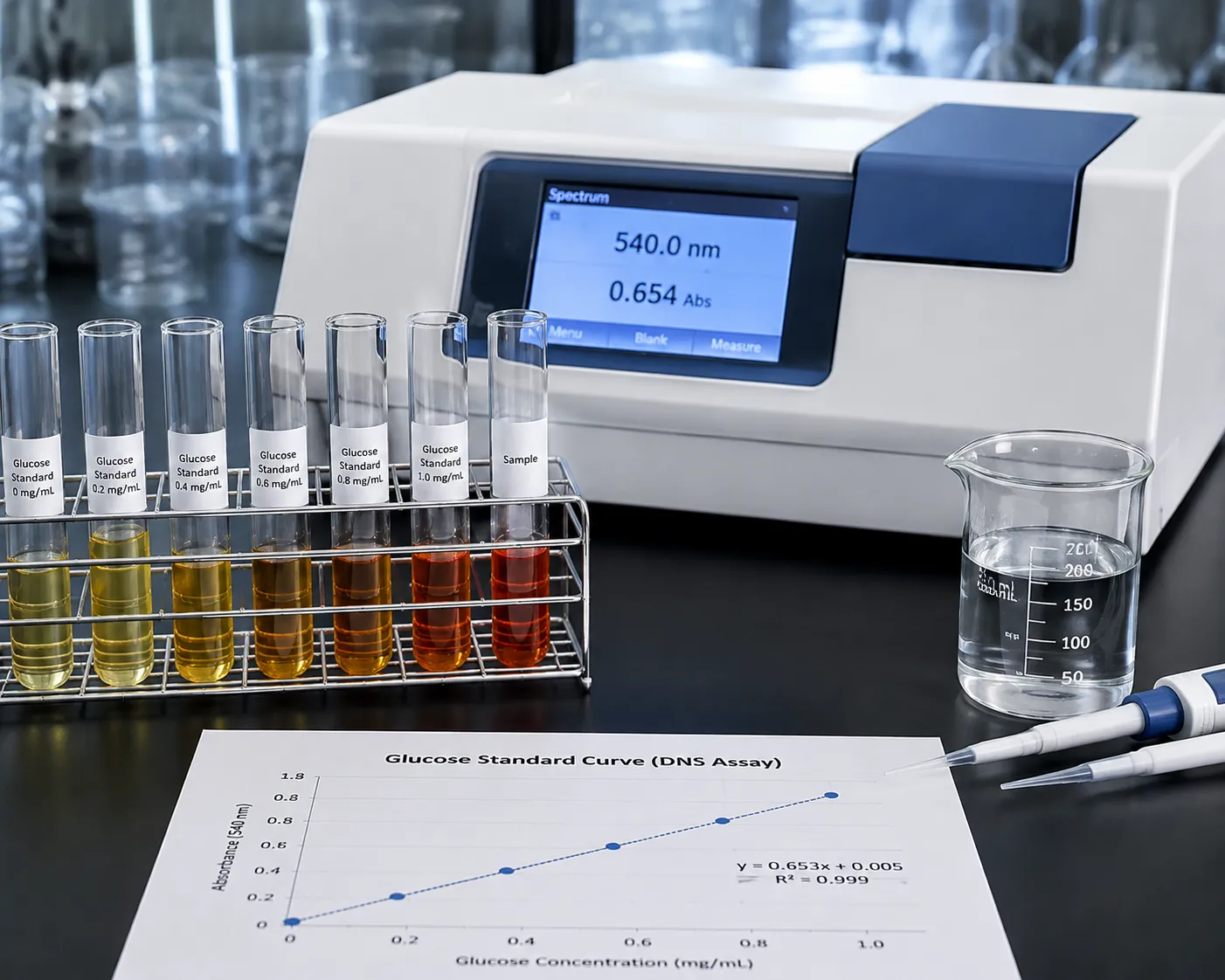
Glucose Standard Curve
Preparation:
- Prepare 1 mg/ml anhydrous glucose solution
- Dry glucose at 105°C for 3-4 hours before weighing
- Add glucose standards to test tubes:
| Tube | Glucose Solution (ml) | Water (ml) | Glucose (mg) |
|---|---|---|---|
| 0 | 0.0 | 1.0 | 0.0 |
| 1 | 0.2 | 0.8 | 0.2 |
| 2 | 0.4 | 0.6 | 0.4 |
| 3 | 0.6 | 0.4 | 0.6 |
| 4 | 0.8 | 0.2 | 0.8 |
| 5 | 1.0 | 0.0 | 1.0 |
- Add 3.0 ml DNS to each tube
- Boil 5 minutes, cool
- Add 20 ml water, mix
- Measure absorbance at 540 nm
- Plot glucose (mg) vs absorbance
Enzyme Activity Units
International Unit (IU)
Definition: One unit of cellulase activity releases 1 micromole of reducing sugar (as glucose equivalent) per minute under defined conditions.
Formula for CMCase:
CMCase (U/ml) = Y mg × (5.55 µmol/mg) × (1/30 min) × (1/X ml)
Where:
- Y = glucose (mg) from standard curve
- 5.55 = µmol glucose per mg
- 30 = incubation time (minutes)
- X = enzyme volume (ml)
Formula for FPU:
FPU/ml = Y mg × (5.55 µmol/mg) × (1/60 min) × (1/X ml)
Where:
- 60 = incubation time (minutes) for filter paper assay
- Same calculation principle as CMCase
FPU Activity Calculation
The Filter Paper Unit (FPU) is the internationally recognized unit for total cellulase activity.
Step-by-Step Calculation:
- Determine glucose released from standard curve
- Identify enzyme dilution that releases exactly 2.0 mg glucose
- Calculate activity using FPU formula
- Account for dilution factor
Example Calculation:
- Enzyme dilution 1:100 releases 2.0 mg glucose in 60 min
- FPU/ml = 2.0 × 5.55 × (1/60) × (1/0.5) × 100
- FPU/ml = 37.0 units
Important Considerations:
- Activity must be measured in linear range
- Multiple dilutions recommended for accuracy
- Report activity at specified dilution
- Compare activities only under identical conditions
Specific Activity
Definition: Enzyme activity per unit of protein.
Formula:
Specific Activity (U/mg) = Total Activity (U/ml) / Protein Concentration (mg/ml)
Protein Determination:
- Bradford assay
- Lowry method (Folin-Ciocalteau)
- BCA assay
- UV absorbance at 280 nm
Significance:
- Indicates enzyme purity
- Useful for purification monitoring
- Allows comparison between preparations
- Important for enzyme pricing
High-Throughput 96-Well Plate Method
Advantages
Modern laboratories increasingly use microplate-based assays for efficiency.
Benefits:
- Reduced reagent consumption (10-20× less)
- Higher sample throughput
- Automated processing possible
- Compatible with PCR instruments for temperature control
- Direct measurement in microplate reader
- Suitable for screening large strain collections
96-Well Plate Protocol
Materials:
- 96-well microplate
- 50 µl enzyme solution
- 50 µl 2% CMC (for CMCase) or buffer + filter paper disk (for FPU)
- 100 µl DNS reagent
Procedure:
- Add 50 µl enzyme to wells (triplicate recommended)
- Add 50 µl substrate solution or buffer + filter paper
- Seal plate and incubate at 50°C (PCR instrument convenient)
- 30 min for CMC assay
- 60 min for filter paper assay
- Add 100 µl DNS reagent to each well
- Heat at 99.9°C for 5 minutes (PCR instrument)
- Cool to room temperature
- Read absorbance at 540 nm in microplate reader
- Calculate activity using standard curve prepared in same plate
Critical Modifications:
- Filter paper: use 6 × 10 mm² disks
- Ensure complete immersion of filter paper
- No need to transfer solution after color development
- Total reaction volume 200 µl (vs 24.5 ml in standard method)
Standard Curve in 96-Well Format
Procedure:
- Add glucose standards (0-100 µl of 1 mg/ml solution) to wells
- Add water to bring to 100 µl total volume
- Add 100 µl DNS reagent
- Heat 5 minutes at 99.9°C
- Cool and read at 540 nm
- Plot absorbance vs glucose (µg)
Optimization Parameters
Temperature Effects
Cellulase activity is strongly influenced by temperature.
Optimal Temperature Range:
- Most fungal cellulases: 45-55°C
- Bacterial cellulases: 35-45°C
- Thermophilic enzymes: 60-80°C
Temperature Testing:
- Perform assay at different temperatures (30-80°C)
- Plot activity vs temperature
- Identify optimum and thermostability range
- Consider process temperature requirements
Thermal Stability:
- Pre-incubate enzyme at different temperatures
- Measure residual activity
- Determine half-life at elevated temperatures
- Important for industrial applications
pH Optimization
pH affects enzyme structure and activity.
Optimal pH Range:
- Fungal cellulases: pH 4.0-5.5
- Bacterial cellulases: pH 6.0-8.0
- Alkaline cellulases: pH 8.0-10.0
Buffer Systems:
- Citrate buffer: pH 3.0-6.0
- Acetate buffer: pH 4.0-5.5
- Phosphate buffer: pH 6.0-8.0
- Glycine-NaOH: pH 8.0-10.0
Testing Procedure:
- Prepare buffers at different pH values
- Perform standard assay at each pH
- Maintain constant ionic strength
- Plot activity vs pH curve
Substrate Concentration
Kinetic Parameters:
- Vary substrate concentration
- Measure initial reaction rates
- Plot Lineweaver-Burk or Michaelis-Menten curve
- Determine Km and Vmax
CMC Concentrations:
- Typically 0.5-2.0% (w/v)
- Ensure substrate excess
- Consider viscosity at higher concentrations
Filter Paper Amount:
- Standard: 50 mg (1 × 6 cm strip)
- Can vary for different applications
- Must ensure complete enzyme saturation
Incubation Time
Linear Range Determination:
- Perform assay at various time points (5-120 min)
- Plot glucose released vs time
- Identify linear portion of curve
- Use time within linear range
Standard Times:
- CMC assay: 30 minutes
- Filter paper assay: 60 minutes
- May need adjustment for very high or low activity
Sample Preparation
Enzyme Extraction
From Fermentation Broth:
- Harvest culture by centrifugation (10,000 × g, 10 min)
- Filter supernatant through Whatman No. 1
- Use filtrate as crude enzyme preparation
- Store at 4°C or -20°C for longer term
From Solid Substrate:
- Extract with appropriate buffer (1:5-1:10 ratio)
- Shake or stir for 1-2 hours
- Centrifuge or filter to remove solids
- Use supernatant for assay
Enzyme Dilution
Dilution Guidelines:
- Use same buffer as assay (citrate, pH 4.8)
- Prepare fresh dilutions before assay
- Aim for glucose release in linear range (0.5-2.0 mg)
- At least two different dilutions for accurate determination
Calculation Example:
- If undiluted enzyme releases >2.0 mg glucose
- Dilute 1:10, 1:100, 1:1000
- Select dilution giving 1.0-2.0 mg glucose
- Multiply activity by dilution factor
Protein Content Determination
Lowry Method (Folin-Ciocalteau):
Reagents:
- Alkaline sodium carbonate (2% Na₂CO₃ in 0.1N NaOH)
- Copper sulfate-tartrate (0.5% CuSO₄ in 1% Na,K-tartrate)
- Folin-Ciocalteau reagent (diluted 1:1 with water)
Procedure:
- Add 5 ml alkaline solution to 1 ml enzyme
- Wait 10 minutes at room temperature
- Add 0.5 ml diluted Folin reagent
- Mix immediately
- Wait 30 minutes
- Read absorbance at 750 nm
- Calculate from BSA standard curve
BSA Standard Curve:
- 0-1.0 mg/ml BSA solutions
- Treat identically to samples
- Plot absorbance vs concentration
Quality Control and Validation
Assay Validation Parameters
Precision:
- Intra-assay variation: <5% CV
- Inter-assay variation: <10% CV
- Run samples in triplicate
- Use appropriate controls
Accuracy:
- Spike recovery: 90-110%
- Compare with certified reference materials
- Verify with alternative assay method
Linearity:
- Glucose release linear with time
- Activity linear with enzyme concentration
- R² >0.98 for standard curves
Limit of Detection:
- Typically 0.01-0.05 U/ml
- Determine experimentally
- Report with confidence intervals
Reference Enzymes
Using Standard Enzymes:
- Commercial cellulase preparations available
- Run as control in every assay
- Verify activity matches certificate
- Useful for method validation
Common Reference Enzymes:
- Trichoderma reesei cellulase
- Aspergillus niger cellulase
- Novozymes preparations
- Sigma-Aldrich standards
Troubleshooting Common Issues
Low Activity Readings:
- Check enzyme dilution
- Verify substrate freshness
- Confirm incubation temperature
- Ensure proper DNS preparation
- Check spectrophotometer calibration
High Background:
- Increase washing steps
- Use appropriate blanks
- Check for contamination
- Verify DNS quality
Non-linear Results:
- Reduce enzyme concentration
- Shorten incubation time
- Ensure substrate excess
- Check for product inhibition
Industrial Applications
Biofuel Production
Cellulase testing is critical for lignocellulosic ethanol production.
Key Parameters:
- Total cellulase activity (FPU)
- β-glucosidase activity
- Enzyme cocktail optimization
- Synergy between components
Testing Requirements:
- Activity on pretreated biomass
- Thermostability at process conditions
- Inhibition by sugars and inhibitors
- Dosage optimization
Textile Industry
Cellulases used for biopolishing and denim finishing.
Specific Tests:
- Activity at pH 4.5-5.5
- Temperature stability at 50-60°C
- Weight loss determination
- Color retention testing
Quality Parameters:
- No damage to fiber strength
- Uniform surface modification
- Reproducible results
- Cost-effectiveness
Animal Feed Industry
Cellulases improve feed digestibility.
Testing Focus:
- Activity at pH 5.0-6.5 (rumen conditions)
- Stability to pelleting temperatures
- In-feed enzyme recovery
- Combination with other enzymes
Performance Tests:
- In vitro digestibility assays
- Reducing sugar release from feed
- Synergy with other enzymes
- Storage stability
Food and Beverage
Applications in fruit juice extraction and brewing.
Specific Requirements:
- Food-grade enzyme specifications
- Activity on fruit cell walls
- Temperature and pH compatibility
- No off-flavors or colors
Quality Tests:
- Juice yield improvement
- Clarity measurements
- Viscosity reduction
- Shelf-life studies
Frequently Asked Questions
What is the difference between CMCase and FPU?
CMCase measures endoglucanase activity using soluble carboxymethylcellulose, while FPU measures total cellulase activity using crystalline filter paper. FPU represents the combined action of all cellulase components working synergistically.
Why is DNS the preferred method for cellulase assay?
DNS is relatively simple, inexpensive, and measures all reducing sugars released. It has good sensitivity and reproducibility. However, it cannot distinguish between glucose, cellobiose, and other reducing sugars.
How should enzyme samples be stored?
Store at 4°C for short term (days) or -20°C for longer storage. Avoid repeated freeze-thaw cycles. Add stabilizers like glycerol if needed. Follow manufacturer's recommendations for commercial preparations.
What causes variation between laboratories?
Variation can arise from different DNS reagent preparation, substrate sources, buffer composition, incubation conditions, and spectrophotometer calibration. Using standardized protocols and reference enzymes minimizes variation.
How do I choose the right substrate?
CMC for endoglucanase activity, filter paper for total cellulase activity, and microcrystalline cellulose for exoglucanase activity. Match substrate to your application and enzyme composition.
Can cellulase activity be measured continuously?
Yes, using viscometric methods (CMC viscosity reduction), coupled enzyme assays, or chromogenic substrates. However, DNS remains the standard for most applications due to simplicity and reliability.
Conclusion
Cellulase testing provides essential data for understanding enzyme performance, optimizing production, and ensuring quality in industrial applications. The DNS-based assay methods, while developed decades ago, remain the gold standard for routine activity measurement due to their reliability, simplicity, and cost-effectiveness.
Modern adaptations using 96-well plate formats enable high-throughput screening while reducing reagent consumption. Careful attention to assay conditions, enzyme dilution, and standardization ensures reproducible, accurate results that support research, development, and quality control objectives.
Key takeaways:
- DNS assay measures reducing sugars released by cellulase activity
- CMCase and FPU assays measure different aspects of cellulase function
- Enzyme activity units must be clearly defined and calculated correctly
- Temperature, pH, and incubation time critically affect results
- High-throughput methods enable efficient screening
- Quality control and validation ensure reliable results
- Industrial applications require application-specific testing protocols
- Reference enzymes and standardized protocols minimize laboratory variation
The continuing importance of cellulases in biofuel production, textile processing, and other applications ensures that accurate, reliable testing methods remain essential tools for both research and industry.
Note: This article provides general guidance on cellulase testing methods. Always consult current literature, standardized protocols (IUPAC, ASTM), and specific industry requirements for detailed procedures and acceptance criteria.