Table of Contents
- What is a clean bench and what does clean bench testing verify?
- Which standards govern clean bench testing?
- How is airflow velocity tested and what is the acceptance range?
- How is HEPA filter integrity (PAO/DOP leak) testing done?
- What is airflow smoke pattern (visualization) testing?
- How are airborne particles classified inside the work zone?
- Why are microbial (settling and airborne) counts part of clean bench testing?
- What are the noise, illumination, and vibration limits?
- How often should a clean bench be retested?
- Clean bench vs biological safety cabinet: why the distinction matters for testing
- FAQ
- Our clean bench testing capabilities
What is a clean bench and what does clean bench testing verify?
A clean bench (laminar flow clean bench, LAF bench) is an enclosed workbench that blows HEPA- or ULPA-filtered unidirectional air over the working area to keep the product — not the operator — free of particulate contamination. It is the microenvironment version of a cleanroom, used in pharmaceutical compounding, microbiology, cell culture, medical-device assembly, semiconductor processing, and IV admixture preparation. Its performance depends on a blower, a main HEPA/ULPA filter, lighting, and a sash-controlled opening; the structure, performance ratings, and test methods are defined in the Chinese industry standard JG/T 292-2010, Clean bench, and in the Japanese JIS B 9922.
Clean bench testing verifies that the unit still meets its rated cleanliness, airflow, filter-integrity, illumination, noise, and vibration parameters after installation, repair, HEPA replacement, or relocation. The bench provides essentially no operator protection — HEPA-filtered air passes over the product first, then over the user's hands and into the room — so the integrity of the filter and the laminarity of the flow are the only thing standing between a sterile product and contamination. A bench that "looks fine" but has a pinhole leak in the HEPA medium or a sash opening that destroys laminarity will silently fail ISO Class 5 every working day until the next certification.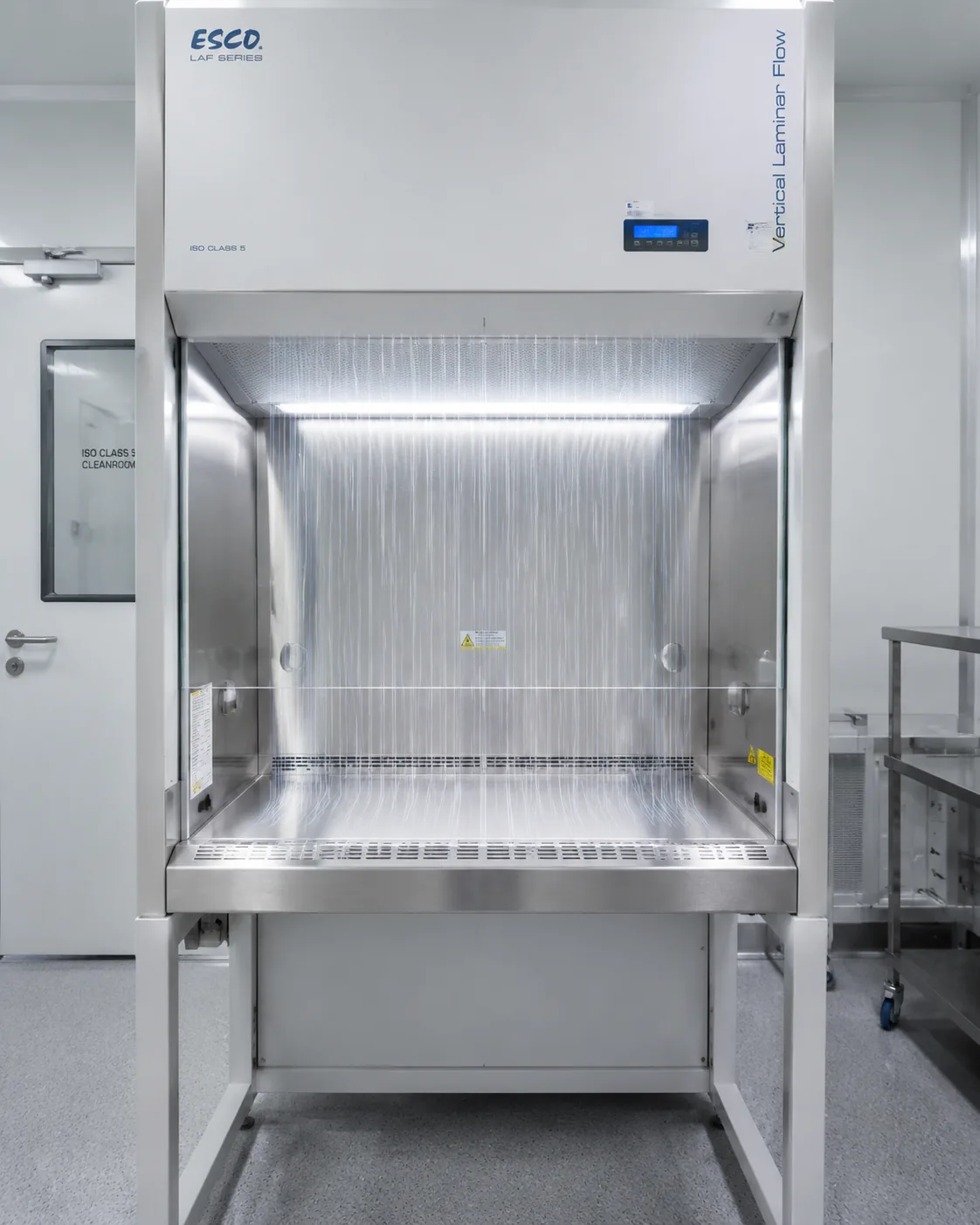
Which standards govern clean bench testing?
Three families of standards apply, and a complete conformity project for a Chinese laboratory or manufacturer typically draws from all three.
| Standard family | What it governs | Key clause |
|---|---|---|
| JG/T 292-2010 Clean bench (China, industry) | Product classification, structure, performance ratings, test methods, inspection rules for clean benches sold and used in China | Defines rated air velocity, noise, illumination, vibration, cleanliness |
| GB/T 25915 series (≡ ISO 14644, China) | Cleanroom and associated controlled environments — classification and test methods | Part 1 (classification by particle concentration), Part 3 (test methods) |
| GB 50591-2010 Code for construction and acceptance of cleanroom | Installation acceptance, as-built performance verification in China | Mandatory for newly installed benches in cleanroom projects |
| GB/T 16293 / GB/T 16294 (≡ ISO 14698 lineage) | Airborne microbial count / settling microbial count test methods | Apply to clean benches used in pharma and medical-device contexts |
| JIS B 9922 (Japan) | Clean bench performance and test methods | Rated wind velocity 0.3–0.6 m/s, ±20% tolerance |
| IEST-RP-CC-002.3 / NSF/ANSI 49 Annex E (US) | Laminar airflow device certification; light/vibration/electrical | Referenced for BSC-adjacent benches and USP <797> sterile compounding |
The single most consequential fact for a Chinese laboratory is that JG/T 292-2010 is the clean-bench-specific standard — it is not a cleanroom standard borrowed for the bench. Every performance threshold quoted in the sections below traces back to a clause of JG/T 292-2010 or to a GB/T 25915 test method that JG/T 292-2010 calls up.
How is airflow velocity tested and what is the acceptance range?
Airflow velocity is the dominant determinant of a clean bench's performance, because ventilation frequency — the rate at which particles and microorganisms are swept out of the work zone — is a direct function of air velocity. JG/T 292-2010 (mirrored by JIS B 9922) specifies three acceptance conditions for the downflow:
- Rated average air velocity in the work zone: 0.3–0.6 m/s.
- The mean velocity across the working plane must be within ±20% of the rated value.
- The velocity at each measurement point must be within ±20% of the mean.
The test itself uses a calibrated thermal or vane anemometer. Per the JIS B 9922 measurement convention adopted in JG/T 292-2010, the anemometer probe is positioned on a plane parallel to the filter face and 100 mm downstream of the air-blowing surface, and the mean is the arithmetic average of the point readings taken on a uniform grid across that plane (typically a 5 × n grid that covers the full filter cross-section). A run-in of at least 5 minutes with the blower at steady state is required before any reading is recorded.
A published 2024 Japanese study (Kuroda et al., Journal of the Japanese Association for Infection Prevention and Control, Vol. 39 No. 4) that measured wind velocity on 55 intersection points across three commercial clean bench models at a fixed 20 cm sash opening reported that the IQR of velocity was within the 0.3–0.6 m/s JIS band only on planes 20–50 cm above the work surface and 15–30 cm in depth from the sash. Below 20 cm of height the IQR exceeded the standard band at the 75th percentile — meaning the laminar flow does not actually reach the work surface. This is why a clean bench test report records velocity on a plane near the filter face, not near the work surface: the near-filter plane is the only plane where the 0.3–0.6 m/s criterion is physically meaningful, and a bench that fails it there has lost the laminarity on which every downstream parameter depends.
How is HEPA filter integrity (PAO/DOP leak) testing done?
HEPA filter integrity testing (also called scan leak testing, PAO test, or DOP test) is the test that catches the defects the eye cannot see — pinholes in the medium, a damaged gasket, a frame leak at the sealant. The procedure:
- Introduce a polyalphaolefin (PAO) or equivalent challenge aerosol upstream of the HEPA filter and stabilize the upstream concentration at ≥ 10 µg/L (10 mg/m³). The historical reagent was DOP (dioctyl phthalate); PAO is the current substitute because DOP is classified as a suspected carcinogen.
- Using an aerosol photometer with a scanning probe, scan the entire face of the filter, the filter frame, the gasket, and the sealant joints at a probe speed of ≤ 2.5 cm/s and a scan spacing of ≤ 1.5 cm.
- Acceptance criterion: no single point shall show a penetration greater than 0.01% of the upstream challenge concentration. A reading above 0.01% at any scanned point is recorded as a leak and the bench fails certification.
This 0.01% criterion is consistent across JG/T 292-2010 (downstream concentration exceeding 0.01% of upstream is judged a leak), IEST-RP-CC-034.4 (HEPA and ULPA filter leak test), and NSF/ANSI 49 Annex E. A failed scan forces the technician to reseat or replace the filter and then re-run the test — a clean bench with a leaking HEPA cannot be certified, regardless of how clean the particle count looks, because a small leak today becomes a large breach after the next thermal cycle.
What is airflow smoke pattern (visualization) testing?
Airflow visualization (smoke test, airflow smoke pattern test) is the qualitative counterpart to the velocity test: it shows whether the air is actually moving as a laminar sheet, rather than merely how fast it is moving. A neutrally buoyant visible medium — generated from a fogger, glycol aerosol, or (in older protocols) a tobacco or titanium tetrachloride smoke stick — is introduced at the filter face, the work plane, the sash opening, and around a simulated obstruction on the work surface. The technician observes and records whether:
- The smoke descends (vertical bench) or moves forward (horizontal bench) as a single coherent sheet with no swirl, reverse flow, or entrainment.
- The smoke is swept out of the work zone through the sash opening without re-entering.
- A simulated hand/arm obstruction does not generate a wake that draws room air into the work zone.
In the Kuroda et al. (2024) visualization experiment, mist released at the top of the bench descended vertically down to roughly 30 cm above the work surface and then arced toward the sash opening; at sash apertures of 0–20 cm the air was expelled outside the bench rather than reaching the work surface. This shape — vertical descent plus an arc to the sash — is what a passing smoke pattern must look like for a vertical laminar clean bench. A bench that shows turbulent eddies, reverse flow toward the filter, or room-air entrainment at the sash fails the visualization test and must be re-adjusted (typically sash height, blower speed, or obstruction layout) before certification.
How are airborne particles classified inside the work zone?
Non-viable particle counting classifies the cleanliness of the air inside the work zone against GB/T 25915-1 (≡ ISO 14644-1). A discrete-particle counter with a sample probe is operated at uniform flow across a defined grid of sampling points in the work zone, with the bench running at steady state. The result is reported as the number of particles per cubic metre at each relevant threshold particle size (0.1 µm through 5.0 µm).
For a clean bench that is expected to operate at ISO Class 5 (the historical Class 100, equivalent to EU GMP Grade A), the maximum allowable particle concentration is:
| Particle size | ISO Class 5 limit (particles/m³) |
|---|---|
| ≥ 0.1 µm | 100,000 |
| ≥ 0.3 µm | 10,200 |
| ≥ 0.5 µm | 3,520 |
| ≥ 1.0 µm | 832 |
| ≥ 5.0 µm | 29 |
The most cited of these — 3,520 particles/m³ at ≥ 0.5 µm — is the ISO Class 5 boundary condition that JG/T 292-2010 effectively demands of a rated clean bench's work zone. A particle count above this limit means the bench has lost its Class 5 rating; in a pharmaceutical compounding or aseptic-processing context, that is an out-of-specification event that shuts the bench down until the cause (a HEPA leak, a failed gasket, a fan-speed drift, a contaminated pre-filter) is corrected.
Why are microbial (settling and airborne) counts part of clean bench testing?
Non-viable particles are not the whole story. Particles are abiotic; microorganisms ride on particles. EU GMP Annex 1 (2022 revision) and the Chinese pharmacopoeia's <9205> guideline both require microbial monitoring of Grade A / ISO Class 5 zones, and a clean bench used for sterile compounding or aseptic processing is one such zone. The two microbial tests that bear on clean bench testing are:
- Settling microbial count (GB/T 16294): ∅90 mm settle plates exposed in the work zone, typically for ≥ 4 hours (or the full duration of a batch operation). For ISO Class 5 / Grade A the limit is ≤ 1 CFU per 4-hour exposure.
- Airborne microbial count (GB/T 16293): a microbial air sampler draws a known volume of work-zone air through a culture medium. For ISO Class 5 / Grade A the limit is ≤ 1 CFU/m³.
These limits are not arbitrary. Published hospital pharmacy research on IV admixture preparation inside clean benches (Kuroda, Hotoda et al., Yakugaku Zasshi 1999; Kuroda et al. 2023) found a positive correlation between airborne particle counts generated during preparation and the number of microorganisms recovered from the preparation — that is, particle control and microbial control are not independent problems. A clean bench that passes its particle count at ISO Class 5 but fails its airborne microbial count has a contamination source inside or upstream of the work zone (often a soiled pre-filter, a contaminated work surface, or a damaged HEPA edge) that the abiotic particle test alone cannot detect. This is the reason a defensible clean bench test report includes microbial results whenever the bench is used in a sterile or aseptic context, not only the particle count.
What are the noise, illumination, and vibration limits?
JG/T 292-2010 sets explicit pass/fail thresholds for the three operator-comfort and process-stability parameters that every clean bench service page lists but very few quantify:
| Parameter | JG/T 292-2010 acceptance criterion | Test method |
|---|---|---|
| Noise | ≤ 65 dB(A) at the operator position, blower running at rated speed | Sound-level meter, A-weighting, measured at 1 m in front of the bench at operator ear height |
| Illumination | ≥ 300 lx on the working surface (mean of a grid of points across the work zone) | Calibrated lux meter on the work plane |
| Vibration | Amplitude in each of the three axes (X, Y, Z) at the centre of the work surface ≤ 5 µm | Vibration pickup / accelerometer on the work surface, blower running |
The vibration limit matters beyond operator comfort. A clean bench used for analytical-balance weighing, microscopy, or micro-dispensing can transmit blower-induced vibration to the instrument and corrupt the measurement; the 5 µm cap is the threshold above which this becomes detectable in routine precision work. The 300 lx floor is the minimum at which an operator can read small markings, meniscus levels, or fine print on labels without eye fatigue that introduces handling errors. The 65 dB(A) cap corresponds to the threshold above which prolonged exposure degrades concentration in routine aseptic work.
How often should a clean bench be retested?
The default recertification interval in most laboratories and pharmacopoeias is every 12 months, performed by a competent third party or trained in-house certifier. Several events trigger an off-schedule retest regardless of the calendar:
- After HEPA filter replacement — the scan leak test must be re-run because a new filter can be damaged in shipping, installed with a folded gasket, or sealed with imperfect sealant.
- After the bench is relocated — moving a bench can crack the filter medium, dislodge the gasket, or shift the blower alignment.
- After any repair to the blower, motor, plenum, or control system — a fan-speed drift of even 10% can drop the work-zone velocity out of the ±20% band.
- After a failed in-use monitoring result — a settling plate or active air sample that comes back above the Grade A limit forces an immediate bench certification before the next batch.
- After a power event, fire, or contamination incident that could have stressed the filter medium.
In a USP <797> sterile compounding pharmacy or an EU GMP Annex 1 aseptic processing facility, the certification interval is also tied to the facility's risk assessment and may be shortened to every 6 months for the most critical benches. A bench that is used but not retested within its interval is treated as out of qualification; any product made in it since the last valid certification is suspect.
Clean bench vs biological safety cabinet: why the distinction matters for testing
The single most consequential conceptual error in clean bench testing is confusing a clean bench with a biological safety cabinet (BSC). Both are laminar-flow devices; both have a HEPA filter; both look superficially similar. They are tested to different standards and protect different things.
- A clean bench (JG/T 292-2010, IEST-RP-CC-002.3) blows filtered air over the product and into the room, and over the operator. It protects the product; it provides no operator protection and no room protection. It is appropriate only for non-hazardous materials — aseptic compounding of non-cytotoxic IVs, pour-plate preparation, electronics assembly, cell culture of BSL-1 organisms.
- A biological safety cabinet (NSF/ANSI 49; JG 170 in China) maintains a negative-pressure inflow at the sash that captures aerosols before they reach the operator, in addition to downflow HEPA filtration of the work zone and exhaust HEPA filtration before release. It protects product, operator, and environment. It is required for any work with infectious, toxic, radioactive, or volatile materials.
The testing differs accordingly. A BSC certification includes an inflow velocity test (the negative-pressure protective barrier) that has no counterpart in a clean bench certification, because a clean bench has no inflow barrier to test. A clean bench certification, conversely, can skip the person-product-environment protection tests that a BSC requires. Sending a BSC in for "clean bench testing" — or vice versa — produces a certificate that does not match the device and does not satisfy the regulator for either use case. The first question in any clean bench test report is therefore: what device is this, and which standard applies.
FAQ
How often should a clean bench be leak-tested?
HEPA filter integrity (PAO scan) testing should be performed at least annually and additionally after any HEPA replacement, relocation, blower repair, or failed in-use microbial monitoring. High-risk sterile compounding benches may require 6-month intervals per the facility's risk assessment.
What is the difference between a clean bench and a laminar flow hood?
"Laminar flow hood" is the umbrella term that includes both clean benches (product protection only) and biological safety cabinets (product, operator, and environment protection). A clean bench is one specific type of laminar flow hood. The terms are not interchangeable when specifying which standard to test to.
What is the acceptance criterion for a HEPA filter leak test?
No single point on the filter face, frame, gasket, or sealant shall show a penetration greater than 0.01% of the upstream challenge concentration, with the upstream PAO/DOP concentration held at ≥ 10 µg/L. A reading above 0.01% is recorded as a leak and the bench fails certification.
Can a clean bench be used for sterile compounding of hazardous drugs?
No. Clean benches provide no operator protection and must not be used for hazardous, infectious, cytotoxic, or volatile materials. Hazardous-drug compounding requires a Class II or Class III biological safety cabinet certified to NSF/ANSI 49 (or a containment isolator), not a clean bench certified to JG/T 292-2010.
What is the ISO Class 5 particle limit?
ISO Class 5 (≡ Class 100, ≡ EU GMP Grade A) limits the work-zone air to ≤ 3,520 particles/m³ at ≥ 0.5 µm (and proportionally lower limits at smaller sizes, down to 100,000/m³ at 0.1 µm). This is the cleanliness boundary that JG/T 292-2010-rated clean benches are designed to maintain in the work zone.
Our clean bench testing capabilities
Beijing ZKGX Research (ISO/IEC 17025 accredited testing laboratory) provides third-party clean bench testing and certification against JG/T 292-2010, GB/T 25915.1/.3 (≡ ISO 14644-1/-3), and GB 50591-2010, with the supporting microbial methods of GB/T 16293 (airborne count) and GB/T 16294 (settling count) for benches used in sterile or aseptic contexts.
We perform the complete primary and optional test suite:
- Downflow air velocity profile — anemometer grid on the 100 mm downstream plane, verified against the 0.3–0.6 m/s rated range with ±20% uniformity.
- HEPA filter integrity (PAO scan leak) testing — upstream challenge ≥ 10 µg/L, 0.01% penetration acceptance threshold, full scan of media, frame, gasket, and sealant.
- Airflow smoke pattern (visualization) testing — qualitative verification of unidirectional flow and sash-aperture behaviour.
- Airborne particle classification — discrete-particle counter, reported against ISO Class 5 / Grade A limits (3,520 particles/m³ at ≥ 0.5 µm).
- Microbial monitoring — settling plates (∅90 mm, ≥ 4 h exposure, ≤ 1 CFU/4 h) and active air sampling (≤ 1 CFU/m³) for benches used in pharma, medical-device, or aseptic compounding contexts.
- Noise, illumination, and vibration testing — sound-level meter, lux meter, and accelerometer, verified against the JG/T 292-2010 thresholds of 65 dB(A), 300 lx, and 5 µm respectively.
Suitable sample types include: newly installed or relocated laminar flow clean benches (horizontal and vertical), benches after HEPA replacement or blower repair, benches in pharmaceutical compounding and IV admixture units, medical-device assembly benches, microbiology laboratory benches, and electronics / semiconductor process benches. We also test biological safety cabinets to NSF/ANSI 49 and JG 170 — a separate certification track — for facilities that operate both device classes.
Each test is delivered with a full data report (test conditions, instrument calibration certificates, point-by-point measurements, pass/fail judgement against each clause, and a compliance certificate for the unit). Contact Beijing ZKGX Research to discuss the standards applicable to your bench and to schedule certification.