Corduroy testing is the laboratory verification that a corduroy fabric — a cut-pile woven cotton or cotton-blend fabric characterised by its longitudinal raised "wale" ridges (灯芯绒) — meets its product standard and the mandatory textile-safety baseline. The test is governed by a two-layer structure: the corduroy-specific product standards (GB/T 14311-2017 for printed/dyed cotton corduroy, FZ/T 13061-2024 for grey cotton corduroy, FZ/T 81019-2014 for corduroy garments) layered on the mandatory textile-safety baseline GB 18401-2010 and the garment physical-performance requirement GB/T 21295-2024. The defining trait of corduroy testing is the wale-specific performance requirement: the cut-pile structure makes corduroy uniquely vulnerable to pile loss, wale distortion, and seam slippage (纰裂) — failures that flat woven fabrics do not face — and these are tested alongside the standard textile parameters.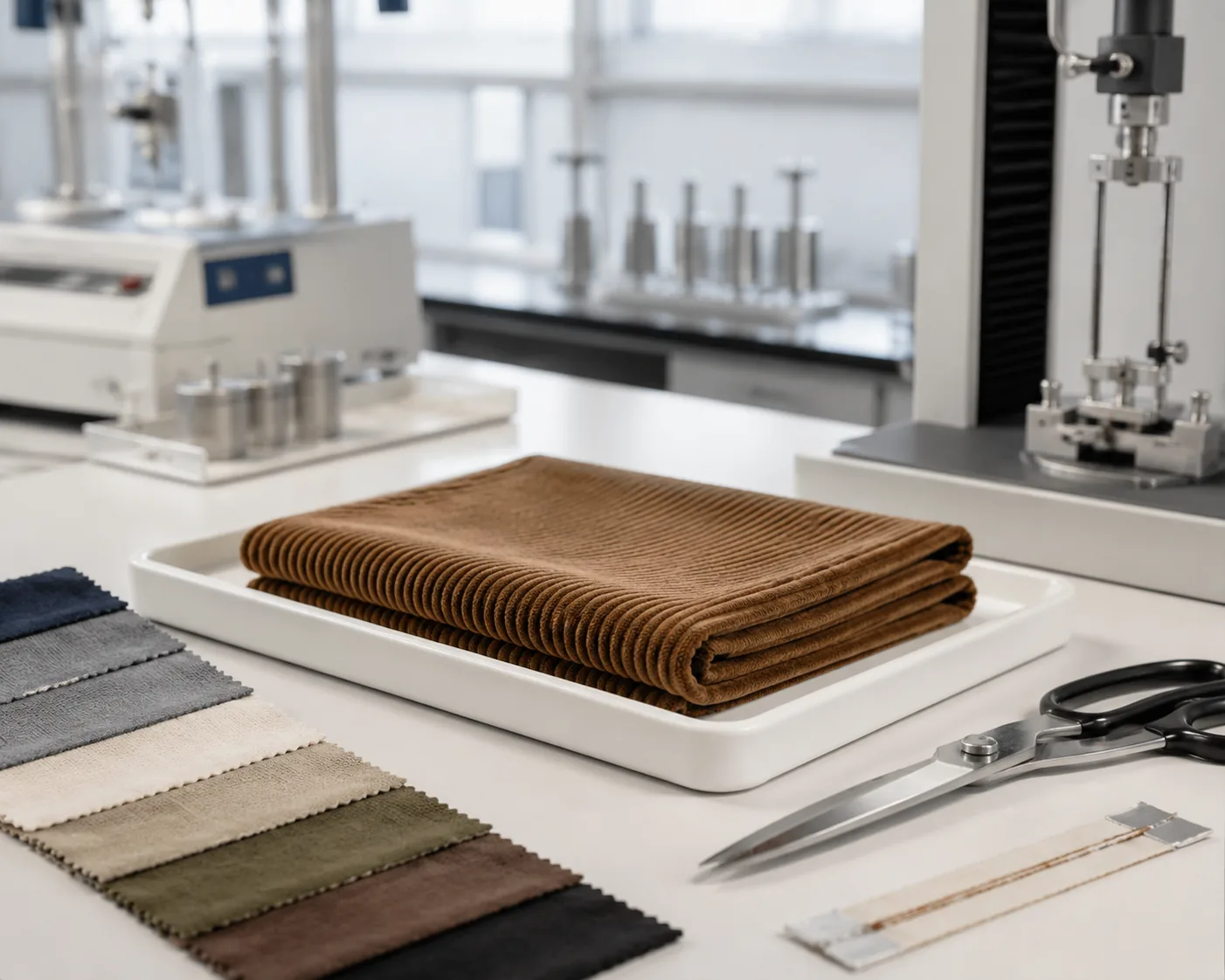
The Two-Layer Structure
A corduroy compliance report is built from two layers, applied together:
| Layer | Standard | What it governs |
|---|---|---|
| Product (corduroy-specific) | GB/T 14311-2017 (printed/dyed cotton corduroy fabric) / FZ/T 13061-2024 (grey cotton corduroy) / FZ/T 81019-2014 (corduroy garments) | Wale density, fabric construction, breaking force, tear force, pile retention, colourfastness, dimensional stability |
| Mandatory safety (all textiles) | GB 18401-2010 (class A/B/C by skin contact) | Formaldehyde, pH, colourfastness, odour, banned aromatic amines |
| Garment physical (if apparel) | GB/T 21295-2024 (technical requirements for garment physical performance) | Seam slippage, breaking force, colourfastness — as garment |
A report citing only GB 18401 (the safety floor) without the corduroy product standard (GB/T 14311 or FZ/T 81019) is incomplete — it verifies safety but not whether the fabric actually performs as corduroy should.
The Corduroy-Specific Parameters
The product standards carry requirements that flat woven fabrics do not have, driven by corduroy's unique cut-pile structure:
- Wale density (条密度) — the number of wales (ridges) per unit width, a defining construction parameter. Corduroy is classified by wale count (e.g., "jumbo" ≤8 wales/cm, "mid-wale" 8–16, "pinwale" ≥16), and the product standard requires the declared wale density to be met.
- Pile retention / pile loss (绒毛保留/掉绒) — the cut pile must stay anchored; pile loss during wear or washing degrades appearance and indicates poor weaving or finishing. This is tested by abrasion or washing and visual assessment.
- Breaking force and tear force (断裂强力和撕破强力) — the fabric's mechanical strength, tested per GB/T 3923.1 (strip method) and GB/T 3917.2 (trouser tear). Corduroy's pile structure can affect the base fabric's mechanical performance, and the product standard sets minimum values.
- Seam slippage / 纰裂 (GB/T 13772) — the resistance of the fabric's yarns to sliding apart at a seam under load. Corduroy's cut-pile face is particularly prone to seam slippage because the cutting process loosens the yarn interlacement at the surface, and a corduroy garment that opens at the seam under wear is a failed product.
- Dimensional stability (水洗尺寸变化率) — shrinkage after washing, tested per GB/T 8628/8629/8630. Corduroy's pile structure and cotton composition make it susceptible to shrinkage and wale distortion.
The Garment Standard: FZ/T 81019-2014
For corduroy used in apparel, FZ/T 81019-2014 (灯芯绒服装, Corduroy Garments) is the product standard. It applies to garments made from woven corduroy as the main fabric (excluding infant garments ≤36 months). It sets the requirements for the finished garment's appearance, construction, and physical performance — drawing on the method standards for breaking force, seam slippage, colourfastness, and dimensional stability.
The 2024 update to GB/T 21295 (服装理化性能的技术要求, Technical Requirements for Garment Physical and Chemical Performance) and GB/T 21294-2024 (服装理化性能的检验方法, Test Methods for Garment Physical and Chemical Performance) refined the garment-level requirements for wet-rubbing colourfastness, light colourfastness, seam slippage, and seam force — all of which apply to corduroy garments. The 2024 revision tightened several parameters, and a current corduroy-garment report cites GB/T 21295-2024 alongside FZ/T 81019-2014.
The Colourfastness Challenge
Corduroy presents a unique colourfastness challenge because of its raised pile surface. The cut pile fibres are more loosely held than in flat fabric, so:
- Wet rubbing colourfastness (耐湿摩擦色牢度) is typically half a grade lower than for flat fabric — the product standard acknowledges this and allows the lower grade for raised/brushed surfaces. Deep-coloured corduroy is particularly challenging.
- Light colourfastness, washing colourfastness, and perspiration colourfastness are all tested per their GB/T methods (GB/T 8427, GB/T 3921, GB/T 3922).
A colourfastness report on corduroy must account for the pile-surface allowance — a grade 3 wet-rubbing result that would fail on flat fabric may pass on corduroy if the product standard allows the half-grade reduction.
FZ/T 13061-2024 — the New Grey Corduroy Standard
A timeliness point: FZ/T 13061-2024 (灯芯绒棉本色布, Grey Cotton Corduroy) is the new industry standard for grey (unfinished) cotton corduroy fabric, the raw material that is subsequently dyed or printed. A new national standard plan 20252925-T-608 for grey cotton corduroy is also in development. A current grey-corduroy report cites FZ/T 13061-2024.
Our Testing Capabilities
Beijing ZKGX Research conducts corduroy testing across the two-layer structure:
- Product (GB/T 14311-2017 / FZ/T 13061-2024 / FZ/T 81019-2014): wale density, breaking force (GB/T 3923.1), tear force (GB/T 3917.2), seam slippage/纰裂 (GB/T 13772), pile retention, dimensional stability (GB/T 8628/8629/8630), and the full colourfastness set (rubbing GB/T 3920, washing GB/T 3921, perspiration GB/T 3922, light GB/T 8427).
- Mandatory safety (GB 18401-2010): formaldehyde (GB/T 2912.1), pH (GB/T 7573), colourfastness, odour, and the 24 banned aromatic amines (GB/T 17592 + GB/T 23344).
- Garment physical (GB/T 21295-2024 + GB/T 21294-2024): seam slippage, seam force, and the garment-level colourfastness and dimensional-stability requirements for finished corduroy apparel.
- Sample types: cotton and cotton-blend corduroy fabrics (all wale counts), printed and dyed corduroy, and corduroy garments (trousers, jackets, shirts, skirts).
- Deliverable: a test report identifying the product, the applicable product standard, each measured value with its method citation, and pass/fail against both the product standard and the GB 18401 safety baseline.
If you have a corduroy fabric or garment requiring compliance verification, contact our testing team to scope the applicable product standard, the GB 18401 class, and whether fabric-level or garment-level testing applies.
Frequently Asked Questions
What standard governns corduroy testing?
It is a two-layer structure. The corduroy-specific product standards are GB/T 14311-2017 (printed/dyed cotton corduroy), FZ/T 13061-2024 (grey cotton corduroy), and FZ/T 81019-2014 (corduroy garments). The mandatory safety baseline is GB 18401-2010 (class A/B/C). For finished garments, GB/T 21295-2024 (garment physical performance) applies alongside FZ/T 81019-2014.
Is corduroy testing the same as general Fabric testing?
No. Corduroy has product-specific requirements driven by its cut-pile structure: wale density (the defining construction parameter), pile retention (the pile must stay anchored), and enhanced seam-slippage testing (the cut pile makes the surface prone to yarn sliding). These are tested alongside the standard fabric parameters. See fabric testing for the general framework.
Why does corduroy have lower wet-rubbing colourfastness allowance?
Because the raised cut-pile surface holds loosely bound dye particles that transfer more readily to a rubbing cloth than the smooth surface of flat fabric. The product standard acknowledges this by allowing wet-rubbing colourfastness to be half a grade lower for raised/brushed surfaces like corduroy. Deep-coloured corduroy is particularly challenging.
What is FZ/T 81019-2014?
FZ/T 81019-2014 (灯芯绒服装, Corduroy Garments) is the product standard for garments made from woven corduroy as the main fabric (excluding infant garments ≤36 months). It sets requirements for appearance, construction, breaking force, seam slippage, colourfastness, and dimensional stability.
What changed in GB/T 21295-2024?
GB/T 21295-2024 (Technical Requirements for Garment Physical and Chemical Performance) tightened the requirements for wet-rubbing colourfastness, light colourfastness, seam slippage, and seam force for finished garments. The companion test-method standard GB/T 21294-2024 was updated concurrently. A current corduroy-garment report cites GB/T 21295-2024 alongside FZ/T 81019-2014.