Dietary fiber testing is the laboratory determination of the dietary-fiber content of a food by the enzymatic-gravimetric method — digesting away the starch and protein with enzymes, precipitating the remaining fiber with ethanol, weighing the dried residue, and correcting it for the residual ash and protein it still contains. In China the test is governed by the mandatory food-safety method standard GB 5009.88-2023 (National food safety Standard — Determination of Dietary Fiber in Foods), which replaced GB 5009.88-2014 and is a modified adoption of the international AOAC 991.43 method. The 2023 edition expanded the standard's scope to cover fiber-fortified foods — a category the 2014 edition did not address. The result reports total dietary fiber (TDF), soluble dietary fiber (SDF), and insoluble dietary fiber (IDF).
What Dietary Fiber Is and Why the Test Is Indirect
Dietary fiber is not a single molecule but a heterogeneous mixture of plant carbohydrates (and lignin) that resist digestion in the human small intestine and reach the large intestine. Because "fiber" is defined functionally (resists digestion) rather than structurally (one chemical), there is no direct chemical assay for it — you cannot titrate or spectrophotometer "fiber" the way you can protein or vitamin C. The test therefore measures fiber indirectly, by elimination: digest away everything that is not fiber (starch with α-amylase and amyloglucosidase, protein with protease), and what remains gravimetrically is the dietary fiber — corrected for the ash and protein the residue still holds.
This indirect, enzymatic-gravimetric logic is the foundation of every dietary-fiber method in the world — AOAC 985.29, 991.42, 991.43, 992.16, 993.19, and the GB 5009.88 series that modified-adopts the AOAC framework. The kit-based procedures the search results describe (Sigma-Aldrich TDF-100A and the like) are reagent kits that implement this same principle; they are not a different method.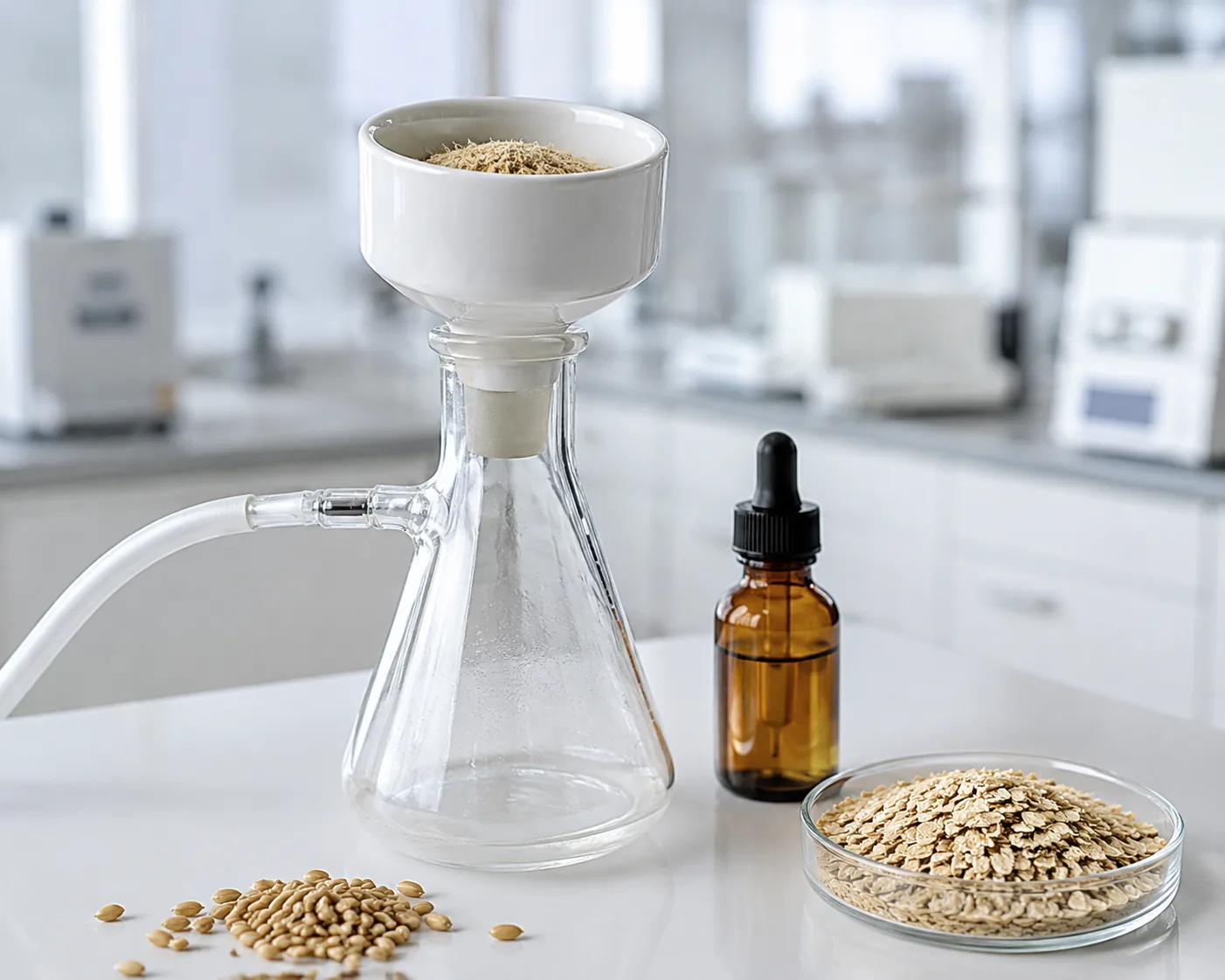
TDF, SDF, and IDF: Three Fractions, One Method
A dietary-fiber result is reported as one or more of three fractions, and GB 5009.88 reports all three:
| Fraction | Definition | Health role |
|---|---|---|
| Total dietary fiber (TDF) | All fiber — soluble + insoluble, including high-MW soluble fiber | The headline compliance number |
| Soluble dietary fiber (SDF) | Dissolves in water, forms a viscous gel; precipitated by 78 % ethanol | Cholesterol lowering, glycemic control |
| Insoluble dietary fiber (IDF) | Does not dissolve; filtered off before ethanol precipitation | Bowel regularity, fecal bulk |
The SDF and IDF fractions are separated physically: the enzyme-digested sample is filtered first (the filter catches the IDF), then the filtrate is treated with ethanol to precipitate the SDF, which is filtered separately. The TDF can be measured directly by precipitating the whole digested sample with ethanol without prior filtration, or calculated as IDF + SDF. Different food products and different regulatory regimes emphasize different fractions — a cholesterol-lowering health claim hinges on the SDF value, a regularity claim on IDF, and a general "high in fiber" claim on TDF.
The Method Standard: GB 5009.88-2023
The governing method standard is GB 5009.88-2023 (食品安全国家标准 食品中膳食纤维的测定), implemented to replace GB 5009.88-2014. Two things about the 2023 revision are worth stating plainly.
First, the scope was expanded. The 2014 edition applied to "plant-based foods and their products." The 2023 edition extends to "foods that have had dietary-fiber components added" (添加了膳食纤维组分的食品) — that is, functional-fiber-fortified products: special-medical-purpose foods, fortified milk powders, infant formulas, and meal replacements where isolated fibers (inulin, polydextrose, resistant dextrin, etc.) are added as ingredients. This is a fast-growing category that the 2014 edition did not cleanly cover, and the 2023 scope change closes that gap.
Second, GB 5009.88 is a modified adoption of AOAC 991.43 (Total, Soluble, and Insoluble Dietary Fiber in Foods — Enzymatic-Gravimetric Method, Phosphate Buffer). The international AOAC methods the search results cite (985.29, 991.42, 991.43, 993.19) and the GB method are the same fundamental procedure with national-procedure variations. A current Chinese-market report cites GB 5009.88-2023; an international report cites AOAC 991.43; the result is directly comparable.
The Enzymatic-Gravimetric Procedure
The procedure, shared by GB 5009.88-2023 and the AOAC framework, runs in five stages:
- Sample preparation — the food sample is homogenized and dried (freeze-drying recommended). If the fat content is above ~10 %, the sample is defatted with petroleum ether first, because residual fat would otherwise inflate the gravimetric residue and give a falsely high fiber result.
- Enzymatic digestion — the sample is digested sequentially with three enzymes that break down everything that is not fiber:
- α-amylase — gelatinizes and hydrolyzes the starch;
- protease — hydrolyzes the protein;
- amyloglucosidase — completes the conversion of starch fragments to glucose.
After this digestion, starch and protein have been removed as soluble sugars and amino acids; what remains structurally is the dietary fiber.
- Filtration / precipitation — for IDF, the digest is filtered immediately and the filter residue is the insoluble fiber. For SDF, the filtrate is treated with 78 % ethanol, which precipitates the soluble fiber. For TDF, the whole digest is precipitated with ethanol directly.
- Weighing — the filtered residue is dried and weighed.
- Ash and protein correction — see below.
The Ash + Protein Correction Principle
The defining calculation of the dietary-fiber test, and the part most explanations gloss over, is that the weighed residue is not pure fiber. The residue still contains:
- Ash — mineral material that came through the digestion and co-precipitated;
- Protein — residual protein not fully digested by the protease.
The correct fiber value is therefore:
Dietary fiber = residue weight − ash − protein
…measured on the residue. The residue from each determination is split: one portion is ashed (burned to mineral) to measure the ash fraction; another is analyzed for protein (by Kjeldahl nitrogen, GB 5009.5) to measure the residual-protein fraction. Only after these two corrections does the result become the true dietary-fiber content. A report that lists only the gravimetric residue, without the ash and protein corrections, is not a valid dietary-fiber result.
Quality Control: Quadruplicate Runs and Blanks
The enzymatic-gravimetric method carries procedural contamination and digestion-efficiency variation, so the standard imposes strict QC:
- Quadruplicate runs — samples and blanks are run at least in quadruplicate (four parallel determinations) so the variability is visible and a single contamination event does not corrupt the result.
- Blank subtraction — enzyme-reagent blanks (no sample) are run through the entire procedure to subtract the fiber-equivalent mass the enzymes and buffers themselves contribute. The enzymes are proteins, and a fraction of them co-precipitate with the fiber residue; the blank corrects for this.
- Control samples — a control sample of known fiber content is run alongside to confirm the digestion went to completion and the recovery is within tolerance.
These QC requirements — quadruplicate, blank, and control — are why a dietary-fiber test takes longer and costs more than a direct-chemical assay.
How China Compares Internationally
| Aspect | China (GB 5009.88-2023) | International (AOAC) |
|---|---|---|
| Method | Enzymatic-gravimetric (modified-adopted from AOAC 991.43) | AOAC 985.29 / 991.42 / 991.43 / 993.19 |
| Fractions | TDF, SDF, IDF | TDF, SDF, IDF |
| Scope (2023) | Plant foods + fiber-fortified foods | AOAC methods by product type |
| Procedure | α-amylase → protease → amyloglucosidase; ethanol precipitation; ash + protein correction | Same |
The Chinese method and the AOAC method are the same procedure; a report cites one or the other depending on the market. The 2023 GB scope expansion to fortified foods is the one area where GB is now more explicit than the older AOAC methods, which were written before fiber fortification became common.
Why the Search Results Are Off the Compliance Intent
The search results for "dietary fiber testing" are dominated by content that describes the method but does not frame the Chinese compliance framework:
- Sigma-Aldrich TDF assay kit documentation (TDF-100A, TDF-C10 control kit) — a reagent-kit manual describing the enzymatic-gravimetric procedure in full, with the ash/protein correction and the quadruplicate QC. Competent, but it is a kit manual that cites no GB standard.
- Hong Kong Food Regulation + AOAC method lists — the regulatory landscape in AOAC terms (985.29, 991.42, 991.43, 993.19), with zero reference to GB 5009.88.
- Academic methodology papers — the structure and chemistry of dietary fiber.
None tells a Chinese food producer, a fortified-food manufacturer, or an importer which GB standard applies, what the TDF/SDF/IDF distinction is, or how the 2023 scope expansion affects their fortified product. That compliance question is what this article addresses.
Our Testing Capabilities
Beijing ZKGX Research conducts dietary fiber testing to GB 5009.88-2023:
- Method: enzymatic-gravimetric (α-amylase → protease → amyloglucosidase; ethanol precipitation; ash + protein correction), per GB 5009.88-2023 (modified-adopted from AOAC 991.43). International reports to AOAC 985.29 / 991.43 on request.
- Fractions: total dietary fiber (TDF), soluble dietary fiber (SDF), and insoluble dietary fiber (IDF), reported individually.
- Scope (2023): plant-based foods and their products, plus fiber-fortified foods — special-medical-purpose foods, fortified milk powders and infant formulas, meal replacements, and products with added isolated fibers (inulin, polydextrose, resistant dextrin).
- Sample matrices: cereals, beans, vegetables, fruits, baked goods, dairy, and fortified nutritional products.
- Quality control: quadruplicate determinations, enzyme-reagent blank subtraction, and control-sample recovery, per the method standard.
- Deliverable: a test report stating the standard (GB 5009.88-2023 or AOAC), the fraction(s) measured (TDF/SDF/IDF) in g/100 g, the sample matrix, and pass/fail against the product's nutritional claim or label.
If you have a food or fortified product requiring dietary-fiber determination, contact our testing team to scope the fraction(s) needed, the applicable standard, and whether the fiber-fortified-food scope (2023) applies.
Frequently Asked Questions
What standard governns dietary fiber testing?
In China, GB 5009.88-2023 (National Food Safety Standard — Determination of Dietary Fiber in Foods), implemented to replace GB 5009.88-2014. It is a modified adoption of AOAC 991.43. Internationally the AOAC methods (985.29, 991.42, 991.43, 993.19) apply. Both are the same enzymatic-gravimetric procedure; a report cites one or the other depending on the market.
What is the difference between TDF, SDF, and IDF?
TDF (total dietary fiber) is all fiber combined — the headline compliance number. SDF (soluble dietary fiber) dissolves in water and is precipitated by ethanol; it carries cholesterol-lowering and glycemic-control claims. IDF (insoluble dietary fiber) does not dissolve and is filtered off before ethanol precipitation; it carries regularity/bulk claims. GB 5009.88 reports all three.
What changed in GB 5009.88-2023?
The 2023 edition expanded the scope from "plant-based foods and their products" to also cover "foods that have had dietary-fiber components added" — fiber-fortified products such as special-medical-purpose foods, fortified milk powders, infant formulas, and meal replacements with added isolated fibers (inulin, polydextrose, resistant dextrin). The enzymatic-gravimetric procedure was also refined.
Why is the residue corrected for ash and protein?
Because the dried gravimetric residue is not pure fiber — it still contains mineral ash and residual protein that survived digestion. The correct fiber value is residue − ash − protein, measured on the residue (ashed for the ash fraction, Kjeldahl-protein-analyzed for the protein fraction). A report that lists only the gravimetric residue, without these corrections, is not a valid fiber result.
Why is dietary fiber not measured directly?
Because dietary fiber is defined functionally (the plant carbohydrates and lignin that resist small-intestine digestion), not as a single molecule. There is no chemical assay for "fiber" the way there is for vitamin C or calcium. The test therefore measures fiber indirectly — by enzymatically digesting away everything that is not fiber (starch, protein), precipitating what remains with ethanol, weighing it, and correcting for residual ash and protein.