Edible mushroom testing is the laboratory verification that an edible-fungi product — fresh, dried, brined, or ready-to-eat — meets the food-safety requirements of the product standard GB 7096-2014 (National food safety Standard for Edible Fungi and Their Products), together with the contaminant, pesticide, and microbial limit standards it references. The test scope covers four families of measurement: sensory and physicochemical quality, heavy-metal contaminants, pesticide residues, and microbiological safety, each governed by its own referenced standard.
Why "Edible Mushroom Testing" Is a Food-Safety Test, Not a Foraging Question
A recurring confusion on the search results is worth clearing up first. Much of what appears under "mushroom testing" is foraging advice — how to distinguish a field mushroom from a yellow-stainer by cap, gill color, spore print, or a nibble-and-spit field test. That is species identification in the field, and it answers "is this wild mushroom safe to pick?"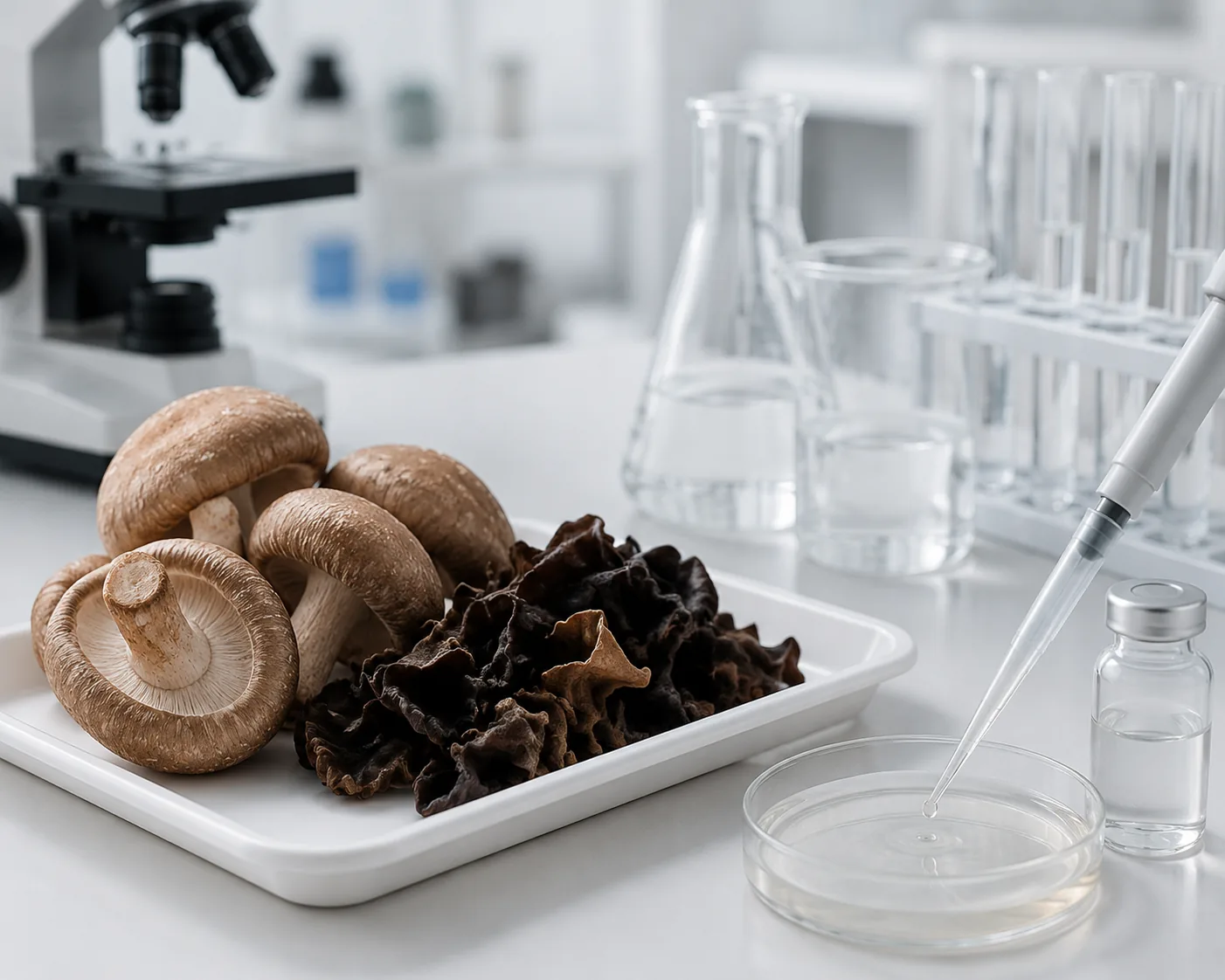
Edible mushroom testing in the laboratory sense answers a different question entirely: "does this batch of cultivated or processed edible fungi — already a commercial food product — comply with the food-safety standards that govern its sale?" That compliance question is the subject of this article, and it is governed not by foraging fieldcraft but by GB 7096-2014 and the family of limit standards it invokes. The two are unrelated activities, and conflating them is the first thing to avoid.
The Governing Standard: GB 7096-2014
GB 7096-2014 is the product standard for edible fungi and their products. It applies to fresh edible fungi, dried edible fungi, brined/pickled edible fungi, and ready-to-eat edible-fungi products (shiitake, wood-ear, straw mushroom, boletus, enoki, tremella, and the like). It replaced the earlier GB 7096-2003 (edible fungi hygiene standard) and GB 11675-2003 (tremella hygiene standard), consolidating them into one standard.
What GB 7096-2014 itself specifies, and what it delegates to other standards:
| Item category | Where the limits live |
|---|---|
| Sensory requirements (appearance, color, odor, taste, no foreign matter / off-odor / mildew) | GB 7096-2014 directly |
| Physicochemical indicators (moisture, ash) | GB 7096-2014 directly |
| Heavy-metal and other contaminants | GB 2762 (referenced) |
| Pesticide maximum residue limits | GB 2763 (referenced) |
| Ready-to-eat product pathogens | GB 29921 (referenced) |
| Food additive use | GB 2760 (referenced) |
So a complete edible-mushroom test report is never built from GB 7096 alone — it is assembled from GB 7096 (sensory + physicochemical + the framework) plus the limit values pulled from GB 2762, GB 2763, and GB 29921. Understanding this reference structure is the key to reading the report correctly.
Heavy-Metal Contaminants (GB 2762-2022)
Because fungi concentrate elements from their substrate, heavy metals are the contaminants most commonly associated with edible fungi, and they are the item most frequently failed. GB 2762-2022 (National Food Safety Standard for Contaminants in Foods) regulates four elements for edible fungi and their products:
- Lead (Pb)
- Cadmium (Cd)
- Total arsenic (total As) — with inorganic arsenic specified for some categories
- Total mercury (total Hg)
A critical rule that catches the most common compliance error: GB 2762 distinguishes between fresh and dried edible fungi, and for dried products the limit is judged after dehydration-rate conversion — i.e., the contaminant limit for the dried product is derived from the fresh-product limit adjusted by the concentration that occurs on drying. A dried shiitake cannot be tested against the fresh-fungus limit directly, and doing so is a frequent cause of false failures and false passes alike. The 2022 revision of GB 2762 specifically collected heavy-metal data on both cultivated and wild edible fungi and set limits on the basis of each fungus's bioconcentration behavior, so the limits are now fungus-category aware.
Pesticide Residues (GB 2763)
Cultivated edible fungi are grown on substrates where pesticide use during cultivation and storage is regulated, and residues are controlled by GB 2763 (Maximum Residue Limits for Pesticides in Foods). The standard lists compound-specific maximum residue limits (MRLs); the applicable set depends on whether the fungus is a cultivation-substrate type and on how it was processed. Pesticide-residue testing is a multi-residue screen, not a single measurement, and the test report lists each detected compound against its individual MRL.
Microbiological Safety
Microbiological testing splits along the fresh/processed line:
- Fresh and dried edible fungi are not sterile foods and are judged on hygiene indicators such as aerobic plate count and coliforms, reflecting handling and process sanitation rather than a kill-step expectation.
- Ready-to-eat edible-fungi products carry a pathogen requirement: their pathogen limits must meet the ready-to-eat fruit-and-vegetable product category of GB 29921 (Pathogen Limits in Pre-packaged Foods), which sets "not detected" criteria for pathogens such as Salmonella and Staphylococcus aureus. This is the stricter regime because the product is eaten without further cooking.
GB 7096-2014 added the ready-to-eat pathogen requirement (via GB 29921) that the 2003 standard lacked, which is one of the substantive changes in the current edition.
Physicochemical and Sensory Testing
The items GB 7096-2014 specifies directly are the sensory and physicochemical indicators:
- Sensory — appearance, color, odor, taste, and the absence of visible foreign matter, mildew, or off-odor. A subjective but standardized evaluation done against the standard's description.
- Moisture (water content) — a key indicator for dried products, because excess moisture drives both quality loss (texture) and microbial risk during storage. Determined by GB 5009.3.
- Ash — an indicator of mineral content and, when abnormal, of contamination (e.g., soil, sand, or adulteration). Also specified in the standard.
These are the items the manufacturer runs as routine factory release tests; the contaminant, pesticide, and pathogen items are typically run as periodic type tests or on a risk-based schedule.
Testing Methods and Reference Standards
Each parameter is measured by a defined method standard, so the report is traceable:
| Test item | Method standard |
|---|---|
| Moisture | GB 5009.3 |
| Ash | GB 5009.4 |
| Lead, cadmium, arsenic, mercury | GB 5009 series (e.g., GB 5009.12 lead, GB 5009.15 cadmium) |
| Pesticide multi-residue | GB 23200 series / GB 2763 methods |
| Aerobic plate count | GB 4789.2 |
| Coliforms | GB 4789.3 |
| Pathogens (ready-to-eat) | GB 4789.4 (Salmonella), GB 4789.10 (S. aureus), etc. |
A compliant report cites the method standard next to each measured value, because the limit and the method are paired — a result is only meaningful when both are stated.
Our Testing Capabilities
Beijing ZKGX Research conducts edible mushroom and edible-fungi product testing against the GB 7096 framework:
- Standards basis: GB 7096-2014 (product standard), with contaminants per GB 2762-2022, pesticides per GB 2763, ready-to-eat pathogens per GB 29921, and additives per GB 2760.
- Sample types: fresh edible fungi, dried edible fungi (shiitake, wood-ear, boletus, tremella), brined/pickled products, and ready-to-eat edible-fungi products.
- Test items: sensory; physicochemical (moisture, ash); heavy metals (Pb, Cd, total As, total Hg) with fresh/dried dehydration-rate conversion; pesticide multi-residue screen; aerobic plate count and coliforms; ready-to-eat pathogen panel.
- Methods: the GB 5009 series for physicochemical and elements, GB 4789 series for microbiology, and GB 23200 / GB 2763 methods for pesticide residues — each result reported with its method citation.
- Deliverable: a test report stating, for each item, the measured value, the limit from the applicable standard, the method used, and pass/fail, with dried products converted to the correct basis.
If you have an edible-fungi product requiring food-safety verification, contact our testing team to scope the sample type, the applicable limits, and whether the product falls under the fresh, dried, or ready-to-eat regime.
Frequently Asked Questions
What standard governs edible mushroom testing?
The product standard is GB 7096-2014 (National Food Safety Standard for Edible Fungi and Their Products). It specifies sensory and physicochemical requirements directly and references GB 2762 for contaminants, GB 2763 for pesticide residues, GB 29921 for ready-to-eat pathogens, and GB 2760 for additives. A complete report draws on all of these.
Is testing for edible mushrooms the same as identifying wild mushrooms?
No. Wild-mushroom identification (by cap, gill, spore print, or field taste test) answers whether a foraged fungus is a safe species. Edible mushroom laboratory testing answers whether a commercial edible-fungi product complies with food-safety limits for contaminants, pesticides, and microbes. They are unrelated activities.
Which heavy metals are limited in edible fungi?
Per GB 2762-2022, four elements are regulated in edible fungi and their products: lead, cadmium, total arsenic (inorganic arsenic for some categories), and total mercury. The limits differ between fresh and dried products, with dried products judged after dehydration-rate conversion.
Why are dried mushrooms tested differently from fresh ones?
Drying concentrates the contaminants present in the fresh fungus. GB 2762 therefore judges dried edible fungi by converting the fresh-product limit according to the dehydration rate, rather than applying the fresh limit directly. Testing a dried product against the fresh limit is a common error that produces false results.
Do ready-to-eat mushroom products need pathogen testing?
Yes. Ready-to-eat edible-fungi products must meet the pathogen limits of the ready-to-eat fruit-and-vegetable category in GB 29921, with "not detected" requirements for pathogens such as Salmonella and Staphylococcus aureus. Fresh and dried fungi are judged on hygiene indicators (aerobic count, coliforms) instead.