Table of Contents
- What is glucocorticoid testing?
- The standard stack: USP, EP, JP, Chinese Pharmacopoeia, ICH
- The major glucocorticoid APIs and their pharmacopeial monographs
- Assay: HPLC-UV and the 97.0–103.0 % specification
- Related substances: the degradation-product and process-impurity profile
- Residual solvents, elemental impurities, and the ICH Q3C/Q3D framework
- Content uniformity, dissolution, and the finished-product tests
- Identification: IR, HPLC retention time, and the Porter-Silver reaction
- Stability testing and the forced-degradation profile
- FAQ
- Our glucocorticoid testing capabilities
What is glucocorticoid testing?
Glucocorticoid testing is the measurement and validation of the identity, assay, purity, and finished-product performance of glucocorticoid active pharmaceutical ingredients (APIs) and their finished drug products (tablets, injections, creams, inhalers) — the synthetic corticosteroid hormones used as anti-inflammatory, immunosuppressive, anti-allergic, and anti-proliferative drugs. The major glucocorticoid APIs — dexamethasone (CAS 50-02-2), prednisone (CAS 53-03-2), prednisolone (CAS 50-24-8), methylprednisolone (CAS 83-43-2), betamethasone (CAS 378-44-9), triamcinolone acetonide (CAS 76-25-5), hydrocortisone (CAS 50-23-7), budesonide (CAS 51333-22-3), fluticasone propionate (CAS 80474-14-2), clobetasol propionate (CAS 25122-46-7) — are each governed by a specific pharmacopeial monograph (USP, EP, JP, Chinese Pharmacopoeia) with defined assay, related-substance, residual-solvent, identification, and finished-product specifications.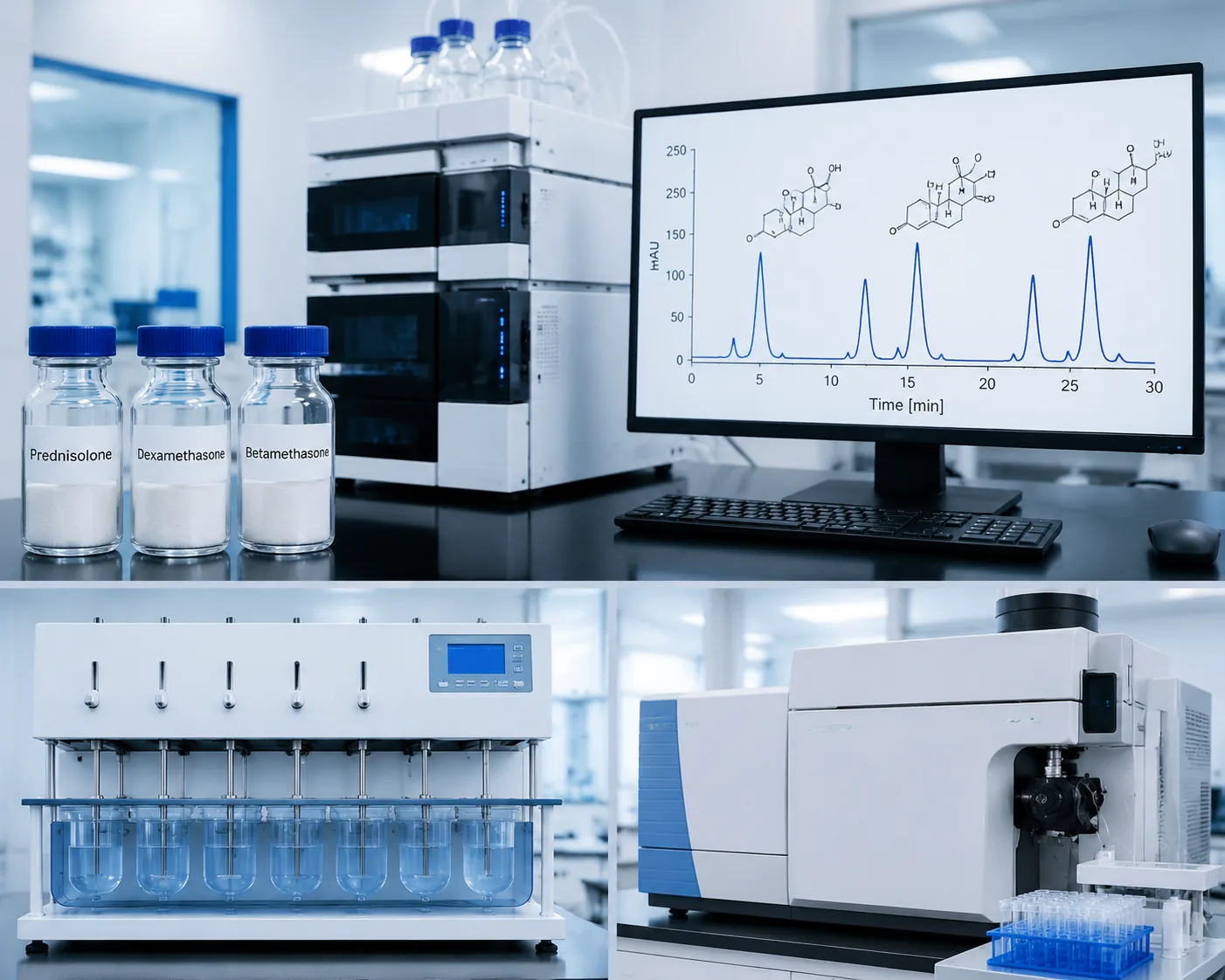
Glucocorticoids are the most widely prescribed class of anti-inflammatory drugs — at least 1 % of the general population uses glucocorticoids long-term (per the ESE/ES 2024 Joint Clinical Guideline), for asthma, rheumatoid arthritis, eczema, inflammatory bowel disease, autoimmune diseases, and organ-transplant immunosuppression. They are administered by tablets (prednisone, dexamethasone), injections (methylprednisolone sodium succinate, dexamethasone sodium phosphate), topical creams (clobetasol, betamethasone), inhalers (budesonide, fluticasone), eye drops (prednisolone acetate), and nasal sprays (fluticasone, budesonide). The glucocorticoid API quality — the assay, the impurity profile, the residual solvents, the degradation products — directly determines the drug's efficacy and safety; a sub-potent API fails to control the inflammation; an over-potent API causes the glucocorticoid-induced adrenal insufficiency; an impure API introduces the toxicity of the unidentified impurities.
The standards governing glucocorticoid testing span the USP monographs (the US pharmacopeial reference for each API — Dexamethasone, Prednisone, Prednisolone, Methylprednisolone, Betamethasone, Triamcinolone Acetonide, Hydrocortisone, Budesonide, Fluticasone Propionate, Clobetasol Propionate), the EP monographs (the European pharmacopeial references, harmonised with USP under the PDG for most glucocorticoids), the JP monographs (the Japanese pharmacopeial references), the Chinese Pharmacopoeia (ChP) monographs (the NMPA-mandated references for the Chinese market), and the ICH guidelines (Q2(R2) method validation, Q3A/B/C/D impurities, Q1A(R2) stability, S6 biotechnological). A glucocorticoid API placed on the US market must satisfy the USP monograph; on the EU market, the EP; on the Chinese market, the ChP; on the Japanese market, the JP.
The standard stack: USP, EP, JP, Chinese Pharmacopoeia, ICH
A complete glucocorticoid testing project draws on a stack of pharmacopeial monographs (one per API) and the cross-cutting ICH quality guidelines.
| Family | Standard | Scope |
|---|---|---|
| USP monographs | Dexamethasone, Prednisone, Prednisolone, Methylprednisolone, Betamethasone, Triamcinolone Acetonide, Hydrocortisone, Budesonide, Fluticasone Propionate, Clobetasol Propionate (and their respective tablet / injection / cream monographs) | The US pharmacopeial reference for each glucocorticoid API and its finished products |
| EP monographs | 01/2008:0388 Dexamethasone; 01/2008:0358 Prednisolone; 01/2008:0733 Methylprednisolone; 01/2008:0324 Betamethasone; 01/2008:1629 Triamcinolone Acetonide; 01/2008:0545 Budesonide | The European pharmacopeial references, harmonised with USP under the PDG |
| JP monographs | Dexamethasone, Prednisolone, Betamethasone, Triamcinolone Acetonide, Hydrocortisone, Budesonide | The Japanese pharmacopeial references |
| Chinese Pharmacopoeia (ChP) | 地塞米松、泼尼松、泼尼松龙、甲泼尼龙、倍他米松、曲安奈德、氢化可的松、布地奈德、氟替卡松丙酸酯、丙酸氯倍他索 (and their tablet/injection/cream monographs) | The NMPA-mandated references for the Chinese market |
| ICH Q2(R2) | Validation of Analytical Procedures | The method-validation framework for the assay, related-substance, and residual-solvent methods |
| ICH Q3A(R2) / Q3B(R2) | Impurities in New Drug Substances / Products | The impurity-qualification framework (the identification, qualification, and reporting thresholds) |
| ICH Q3C(R9) | Residual Solvents | The residual-solvent framework (the Class 1/2/3 solvents and their PDEs) |
| ICH Q3D(R2) | Elemental Impurities | The elemental-impurity framework (Pd, As, Cd, Hg, Pb; the Class 1/2A/2B/3 elements) |
| ICH Q1A(R2) | Stability Testing of New Drug Substances and Products | The stability-test framework (long-term, accelerated, intermediate) |
| USP <621> | Chromatography | The general chapter governing the HPLC method adjustments |
| USP <905> | Uniformity of Dosage Units | The content-uniformity test for tablets and capsules |
| USP <711> | Dissolution | The dissolution test for tablets |
The single most consequential fact for a Chinese manufacturer is that the Chinese Pharmacopoeia monograph is the NMPA-mandated reference for each glucocorticoid API and finished product. The ChP monographs are broadly harmonised with the USP and EP monographs (under the PDG), but with some Chinese-specific procedural differences (the identification-test numbering, the residual-solvent method, the heavy-metal limit). A glucocorticoid product placed on the Chinese market must satisfy the ChP monograph at every batch.
The major glucocorticoid APIs and their pharmacopeial monographs
The glucocorticoid API family spans ~20 commercially important compounds, each with a specific pharmacopeial monograph, a specific HPLC method, and a specific impurity profile.
| API | CAS | ChP monograph | USP monograph | EP monograph | Typical assay spec | Typical RS limit |
|---|---|---|---|---|---|---|
| Hydrocortisone (cortisol) | 50-23-7 | 氢化可的松 | Hydrocortisone | 01/2008:0335 | 97.0–102.0 % | ≤ 1.0 % total |
| Prednisolone | 50-24-8 | 泼尼松龙 | Prednisolone | 01/2008:0358 | 96.0–104.0 % | ≤ 1.0 % total |
| Prednisone | 53-03-2 | 泼尼松 | Prednisone | 01/2008:0354 | 97.0–102.0 % | ≤ 1.0 % total |
| Methylprednisolone | 83-43-2 | 甲泼尼龙 | Methylprednisolone | 01/2008:0733 | 96.0–104.0 % | ≤ 1.0 % total |
| Dexamethasone | 50-02-2 | 地塞米松 | Dexamethasone | 01/2008:0388 | 96.0–104.0 % | ≤ 1.0 % total |
| Betamethasone | 378-44-9 | 倍他米松 | Betamethasone | 01/2008:0324 | 97.0–103.0 % | ≤ 1.0 % total |
| Triamcinolone | 124-94-7 | 曲安西龙 | Triamcinolone | 01/2008:0566 | 96.0–104.0 % | ≤ 1.0 % total |
| Triamcinolone Acetonide | 76-25-5 | 曲安奈德 | Triamcinolone Acetonide | 01/2008:1629 | 96.0–104.0 % | ≤ 1.0 % total |
| Budesonide | 51333-22-3 | 布地奈德 | Budesonide | 01/2008:0545 | 96.0–104.0 % | ≤ 0.5 % total |
| Fluticasone Propionate | 80474-14-2 | 丙酸氟替卡松 | Fluticasone Propionate | 01/2014:2289 | 97.0–103.0 % | ≤ 0.5 % total |
| Clobetasol Propionate | 25122-46-7 | 丙酸氯倍他索 | Clobetasol Propionate | 01/2008:1093 | 97.0–103.0 % | ≤ 0.5 % total |
| Methylprednisolone Sodium Succinate (the soluble injection form) | 2375-03-3 | 甲泼尼龙琥珀酸钠 | Methylprednisolone Sodium Succinate | 01/2008:2043 | 96.0–104.0 % | ≤ 1.0 % total |
| Dexamethasone Sodium Phosphate (the soluble injection form) | 2392-39-4 | 地塞米松磷酸钠 | Dexamethasone Sodium Phosphate | 01/2008:0548 | 96.0–104.0 % | ≤ 1.0 % total |
The glucocorticoid APIs share the cyclopentanoperhydrophenanthrene (steroid) backbone but differ in the substituents at the C-6, C-9, C-16, and C-17 positions — the substituents that determine the potency (dexamethasone is ~30× more potent than hydrocortisone), the duration of action (short, intermediate, long-acting), the mineralocorticoid activity (fludrocortisone is the most mineralocorticoid-active; dexamethasone has essentially no mineralocorticoid activity), and the route of administration (the sodium succinate and sodium phosphate esters are water-soluble for injection; the acetonide ester is lipophilic for depot injection and topical use; the propionate ester is lipophilic for topical inhalation and cream use).
Assay: HPLC-UV and the 97.0–103.0 % specification
The assay of a glucocorticoid API is the quantitative measurement of the active content, reported as a mass fraction on the dried (or anhydrous) basis. The pharmacopeial monographs specify:
- Assay: typically 96.0–104.0 % or 97.0–103.0 % (depending on the API and the monograph), calculated on the dried (or anhydrous) basis, determined by HPLC-UV.
The HPLC-UV method (the reference method for all glucocorticoid monographs):
| Element | Typical |
|---|---|
| Column | C18 reversed-phase (e.g. 4.6 mm × 25 cm, 5 µm packing L1) |
| Mobile phase | A gradient or isocratic mixture of acetonitrile / methanol / water (the exact composition per the specific monograph — e.g. for dexamethasone: acetonitrile-water 40:60; for prednisolone: a gradient) |
| Detection | UV at 240-254 nm (the glucocorticoid λ_max, from the α,β-unsaturated ketone at C-3 / C-4 / C-5) |
| Flow rate | 1.0-1.5 mL/min |
| Column temperature | 25-40 °C |
| System suitability | Tailing factor ≤ 2.0; RSD ≤ 2.0 %; the resolution between the API peak and the nearest related-substance peak ≥ 1.5 |
| Calibration | External standard (the USP Reference Standard of the specific API) |
The assay is calculated as:
% Assay = (A_sample / A_standard) × (W_standard / W_sample) × (Purity of standard) × (Dilution correction) × 100
The HPLC-UV method simultaneously quantifies the related substances (the impurities and the degradation products) — the same chromatogram that gives the assay peak also gives the impurity peaks, which are quantified against a diluted standard of the API.
Related substances: the degradation-product and process-impurity profile
The related substances (the process impurities from the synthesis and the degradation products from the storage) are the most safety-critical impurity class for the glucocorticoid APIs. The pharmacopeial monographs specify:
| Parameter | Typical specification |
|---|---|
| Individual related substance | ≤ 0.5 % (for the 0.1 % reporting threshold per ICH Q3A; the 0.5 % is the typical qualification threshold) |
| Total related substances | ≤ 1.0 % (for most APIs); ≤ 0.5 % for the high-potency APIs (budesonide, fluticasone propionate, clobetasol propionate) |
| Specified related substances | Per the monograph — the known impurities are individually named and limited (e.g. for dexamethasone: dexamethasone related compound A (the 17-keto impurity); for prednisolone: prednisolone related compound A (the 11-deoxy impurity)) |
Common degradation pathways of glucocorticoids:
| Degradation | Product | Mechanism | Condition |
|---|---|---|---|
| Hydrolysis | The free acid (e.g. dexamethasone from dexamethasone sodium phosphate) | Ester hydrolysis | Aqueous solution, acidic or alkaline |
| Oxidation | The 21-aldehyde, the 21-carboxylic acid, the 21-hydroperoxide | Oxidation of the C-21 hydroxymethyl group | Oxygen, light, trace metals |
| Photodegradation | The B-ring photo-addition product | UV-mediated B-ring cycloaddition | Light (UV) |
| Isomerisation | The Δ⁹(¹¹)-dehydro impurity (the dehydration of the C-9/C-11 diol) | Acid-catalysed dehydration | Acidic conditions |
The oxidation of the C-21 hydroxymethyl group is the dominant degradation pathway for most glucocorticoids — the C-21 position is the most reactive (the primary allylic alcohol is easily oxidised to the aldehyde, then to the carboxylic acid, and can form the hydroperoxide under radical conditions). The C-21 oxidation products are the most commonly observed related substances in the stability study and are the focus of the stability-indicating HPLC method.
Residual solvents, elemental impurities, and the ICH Q3C/Q3D framework
| Impurity class | Framework | Typical limits for glucocorticoids |
|---|---|---|
| Residual solvents | ICH Q3C(R9) / USP <467> | Acetone (Class 3, 5000 ppm); dichloromethane (Class 2, 600 ppm); methanol (Class 2, 3000 ppm); acetonitrile (Class 2, 410 ppm); toluene (Class 2, 890 ppm) — the solvents from the API synthesis and purification |
| Elemental impurities | ICH Q3D(R2) / USP <232>/<233> | Pb, As, Cd, Hg (Class 1, ≤ 0.5-10 µg/day PDE); Co, V, Ni (Class 2A); Pd (Class 2B, from the palladium catalyst used in some glucocorticoid syntheses) |
| Heavy metals (the older pharmacopeial method) | USP <231> / ChP (being phased out, replaced by ICH Q3D / USP <232>/<233>) | ≤ 10-20 ppm |
The glucocorticoid synthesis may involve palladium-catalysed reactions (the C-C bond formation at the steroid backbone), and the Pd residue must be controlled per ICH Q3D (Pd is a Class 2B element with a PDE of 100 µg/day, requiring control in the API if the catalyst is used). The dichloromethane (DCM) is commonly used in the crystallisation of the glucocorticoid APIs and must be controlled per ICH Q3C (Class 2, PDE 6 mg/day, limit 600 ppm for a 10 g daily dose).
Content uniformity, dissolution, and the finished-product tests
For the finished drug products (tablets, capsules, injections, creams, inhalers), the additional pharmacopeial tests apply:
| Test | Standard | What it verifies |
|---|---|---|
| Content uniformity | USP <905> / ChP 通则 0941 | The active content of each individual tablet / capsule is within 85-115 % of the label claim (with a defined acceptance-value calculation) |
| Dissolution | USP <711> / ChP 通则 0931 | The active is released from the tablet in the dissolution medium within the specified time (e.g. ≥ 80 % in 30 min for immediate-release tablets; the specified profile for extended-release) |
| Disintegration | USP <701> / ChP 通则 0921 | The tablet disintegrates within the specified time (e.g. ≤ 30 min for uncoated tablets) |
| Deliverable volume / assay (for injections) | Per the monograph | The injection contains the declared amount of the API in the declared volume |
| Particle size (for inhalers) | USP <601> | The aerosol particle size is within the respirable range (1-5 µm MMAD) for the lung delivery |
| Microbial limits | USP <61>/<62> | The non-sterile products meet the bioburden limits; the sterile products are sterile per USP <71> |
| Sterility (for injections and ophthalmic preparations) | USP <71> | Sterile (SAL 10⁻⁶) |
| Bacterial endotoxin (for injections) | USP <85> | ≤ the monograph limit (typically 0.1-5 EU/mg, depending on the route of administration and the dose) |
Identification: IR, HPLC retention time, and the Porter-Silver reaction
The identification of a glucocorticoid API is confirmed by the pharmacopeial identification tests:
| Test | Method | Positive result |
|---|---|---|
| Identification A — IR | FT-IR with ATR | The infrared spectrum matches the reference spectrum |
| Identification B — HPLC retention time | The assay method | The retention time of the major peak corresponds to the USP Reference Standard |
| Identification C — UV spectrum | The HPLC-DAD UV spectrum (per the monograph) | The UV spectrum matches the reference |
| Identification D — colour reaction (historical, for some monographs) | The Porter-Silver reaction (tetrazolium blue TS gives a red-orange colour with the α,β-unsaturated ketone of the A-ring) | Red-orange colour |
| Identification E — optical rotation (for some APIs) | Polarimeter | The specific rotation matches the monograph |
Stability testing and the forced-degradation profile
The stability testing per ICH Q1A(R2):
| Condition | Temperature / humidity | Duration |
|---|---|---|
| Long-term | 25 ± 2 °C / 60 ± 5 % RH | 12-36 months |
| Intermediate | 30 ± 2 °C / 65 ± 5 % RH | 6-12 months |
| Accelerated | 40 ± 2 °C / 75 ± 5 % RH | 6 months |
The forced-degradation study (the stability-indicating-method development) applies the standard stress conditions:
| Condition | Stress | Expected degradation |
|---|---|---|
| Acid hydrolysis | 0.1-1 N HCl, 60-80 °C | The ester hydrolysis (for the ester prodrugs) |
| Base hydrolysis | 0.1-1 N NaOH, 60-80 °C | The ester hydrolysis + the retro-aldol cleavage |
| Oxidation | 3-30 % H₂O₂, room temperature to 60 °C | The C-21 oxidation (the 21-aldehyde, the 21-acid, the 21-hydroperoxide) |
| Photolysis | UV 254 nm and visible light | The B-ring photo-addition |
| Thermal | 60-80 °C, dry heat | Minor; the oxidation and the dehydration |
The stability-indicating HPLC method must separate the API from all the degradation products — the method is validated by demonstrating that each stress condition produces a distinct set of degradation-product peaks, and that none of these peaks co-elute with the API peak (the peak purity is confirmed by the PDA diode-array detection).
FAQ
What is the typical assay specification for a glucocorticoid API?
The pharmacopeial monographs specify typically 96.0–104.0 % or 97.0–103.0 %, calculated on the dried (or anhydrous) basis, determined by HPLC-UV (C18 reverse-phase, 240-254 nm detection). The specification varies slightly by API and monograph; the 96-104 % range accommodates the analytical uncertainty and the residual-moisture correction.
What are the most common related substances in glucocorticoid APIs?
The most common related substances are the C-21 oxidation products (the 21-aldehyde, the 21-carboxylic acid, the 21-hydroperoxide) from the oxidation of the reactive C-21 hydroxymethyl group; the ester hydrolysis products (the free acid from the ester prodrugs); the isomerisation / dehydration products (the Δ⁹(¹¹)-dehydro impurity); and the process impurities (the unreacted starting materials and the by-products from the synthesis).
Why is the C-21 oxidation the dominant degradation pathway?
The C-21 hydroxymethyl group is the most reactive site on the glucocorticoid backbone — it is a primary allylic alcohol (the hydroxymethyl at C-21 is adjacent to the C-20 ketone), easily oxidised to the aldehyde, then to the carboxylic acid, and can form the hydroperoxide under radical conditions. This reactivity is also the basis of the colour-reaction identification (the Porter-Silver tetrazolium blue test).
What is the ICH Q3D control for palladium in glucocorticoids?
Palladium is a Class 2B elemental impurity under ICH Q3D, with a PDE of 100 µg/day. The Pd is the catalyst residue from the palladium-catalysed C-C bond formation used in some glucocorticoid syntheses. The Pd must be controlled in the API per USP <232>/<233> by ICP-MS, typically to ≤ 10 ppm (the limit depends on the daily dose).
What finished-product tests apply to glucocorticoid tablets?
The finished-product tests include the content uniformity (USP <905>, 85-115 % of label claim), the dissolution (USP <711>, ≥ 80 % released in the specified time), the disintegration (USP <701>, ≤ 30 min), the assay (HPLC-UV per the finished-product monograph), the related substances, the microbial limits (USP <61>/<62>), and the identification (IR, HPLC RT).
Our glucocorticoid testing capabilities
Beijing ZKGX Research (ISO/IEC 17025 accredited, CMA- and CNAS-accredited testing laboratory) provides complete glucocorticoid API and finished-product testing across the USP, EP, JP, Chinese Pharmacopoeia, and ICH standard stack:
- USP monographs — Dexamethasone, Prednisone, Prednisolone, Methylprednisolone, Betamethasone, Triamcinolone Acetonide, Hydrocortisone, Budesonide, Fluticasone Propionate, Clobetasol Propionate, and their respective tablet / injection / cream monographs.
- EP monographs — harmonised with USP under the PDG.
- Chinese Pharmacopoeia — the NMPA-mandated monographs for the Chinese market.
- Assay — HPLC-UV (C18, 240-254 nm) per the specific monograph; external standard (USP RS); 96-104 % or 97-103 % on the dried basis.
- Related substances — HPLC-UV; individual ≤ 0.5 %; total ≤ 1.0 %; the specified related substances per the monograph; the stability-indicating method validated per ICH Q2(R2).
- Residual solvents — headspace GC-FID per USP <467> / ICH Q3C(R9); acetone, methanol, acetonitrile, dichloromethane, toluene.
- Elemental impurities — ICP-MS per USP <232>/<233> / ICH Q3D(R2); Pb, As, Cd, Hg, Co, V, Ni, Pd.
- Content uniformity — USP <905> / ChP 通则 0941; 85-115 % of label claim.
- Dissolution — USP <711> / ChP 通则 0931; the specified dissolution profile.
- Identification — IR (FT-IR ATR); HPLC retention time; UV spectrum; the Porter-Silver tetrazolium blue colour reaction (for the monographs that require it).
- Loss on drying / water content — gravimetric (LOD) or Karl Fischer per the monograph.
- Specific rotation — polarimeter per the monograph.
- Stability testing — long-term (25 °C / 60 % RH), accelerated (40 °C / 75 % RH), and forced degradation (acid, base, oxidation, photolysis, thermal); per ICH Q1A(R2) and Q1B.
- Method validation — per ICH Q2(R2); specificity, linearity, accuracy, precision, LOD, LOQ, robustness.
- Bacterial endotoxin (for injections) — LAL per USP <85>.
- Sterility (for injections) — USP <71>.
- Microbial limits (for non-sterile products) — USP <61>/<62>.
Suitable sample matrices include: glucocorticoid APIs (dexamethasone, prednisone, prednisolone, methylprednisolone, betamethasone, triamcinolone acetonide, hydrocortisone, budesonide, fluticasone propionate, clobetasol propionate); the water-soluble ester prodrugs (dexamethasone sodium phosphate, methylprednisolone sodium succinate); finished drug products (tablets, capsules, injections, creams, ointments, inhalers, nasal sprays, eye drops). Each project is delivered with a full data report (test protocol, instrument calibration, raw HPLC / GC / ICP-MS data, statistical analysis, identification-test evidence, classification conclusion per the applicable monograph) in English and/or Chinese, with CMA/CNAS stamping. Contact Beijing ZKGX Research to scope the glucocorticoid test applicable to your product and target market.