Hand warmer testing is the laboratory verification that a hand-warmer product — whether a storage-type electric hot-water bag that is plugged in to heat, or a rechargeable lithium-battery hand warmer — meets the Chinese national safety standards that govern its sale. The two product classes are governed by different standards: the storage-type by GB 4706.1 + GB 4706.99, and the lithium-battery type by GB 31241-2022 (+ GB 4943.1), each with its own set of type-test items aimed at the distinct hazards of mains-powered heating and lithium-battery energy storage respectively.
Why "Hand Warmer Testing" Is a Safety-Compliance Test, Not a Buying Guide
A recurring confusion on the search results is worth clearing up first. Much of what appears under "hand warmer testing" is consumer-review content — publications that bought a set of hand warmers and measured warmth, runtime, and size to rank them for buyers. That is product evaluation for purchase, answered by hands-on field testing.
Hand warmer testing in the laboratory sense answers a different question: "does this hand-warmer product comply with the mandatory national safety standards that govern whether it may be sold at all?" That compliance question is the subject of this article, and it is governed by GB 4706 / GB 31241 safety standards, not by how warm the product feels. The two are unrelated activities, and conflating them is the first thing to avoid.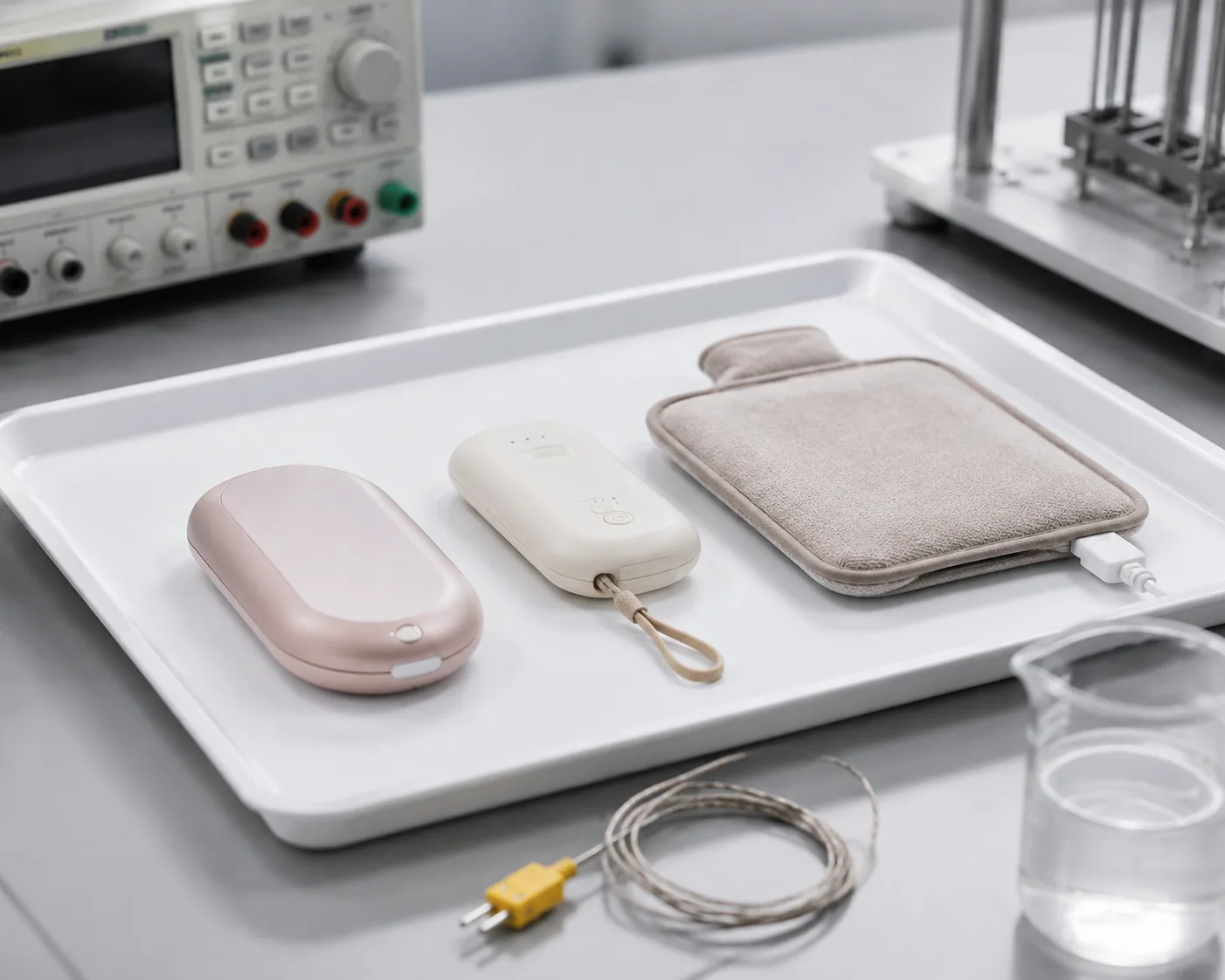
The Two Product Classes Govern Different Standards
This is the single most important fact, and it is absent from the search results. "Hand warmer" is not one product category under one standard. It is two distinct product classes, each with a different working principle and therefore a different hazard set and a different governing standard:
| Product class | How it works | Governing standards |
|---|---|---|
| Storage-type electric hand warmer (储热式电热暖手器 — the plug-in hot-water bag / electric warming bag) | 220 V mains power heats a storage medium (water, gel) that retains heat | GB 4706.1-2005 (general safety) + GB 4706.99-2009 (special requirements for storage-type electric hand warmers) + GB 4343.1 (EMC) |
| Rechargeable lithium-battery hand warmer (充电式暖手宝/暖手筒 — the USB-rechargeable pocket heater) | Built-in lithium-ion battery powers a resistive heater | GB 31241-2022 (lithium battery safety) + GB 4943.1-2022 (audio/video/IT equipment safety) |
A frequent error worth correcting: many sources cite GB 4706.8 for hand warmers. GB 4706.8 is the standard for electric blankets, heating pads, and flexible heating garments — a different product category. The correct special-requirements standard for storage-type hand warmers is GB 4706.99. Quoting GB 4706.8 for a hand warmer is a category error that produces a meaningless test report. Getting the product class — and therefore the standard — right is the first step of any hand-warmer test.
Storage-Type Hand Warmer Testing (GB 4706.1 + GB 4706.99)
The storage-type hand warmer is a mains-powered appliance, and its hazard set is that of a heating appliance energized at 220 V while the user holds it. GB 4706.1-2005 supplies the general safety requirements and GB 4706.99-2009 supplies the special requirements for this specific product. The key type-test items:
- Marking and instructions — rated voltage, power, the manufacturer's warnings, and a clear statement that the product is a storage-type hand warmer.
- Protection against access to live parts — the enclosure must prevent user contact with anything energized at mains potential.
- Input power and current — measured against the marked rating.
- Heating (temperature rise) — the surface and internal temperatures must stay within limits during normal heating, to prevent both burns and thermal damage.
- Leakage current and electric strength at working temperature — insulation integrity while energized and hot.
- Abnormal operation — the product must not create a hazard under single-fault conditions (a blocked thermostat, an overfilled bag, etc.).
- Clause 24.101 component test — the special-requirements clause that addresses the heating-element construction.
- Overheat protection — a functioning thermal cut-out that disconnects power when the set temperature is reached, preventing runaway heating.
- Explosion-proof construction — over-pressure relief so that a sealed bag cannot rupture from internal steam pressure. This is the item most directly tied to the widely reported "explosion" incidents.
- Supply connection and external cord, earthing, clearances and creepage — the mains-side items inherited from GB 4706.1.
A critical prohibition within this standard set: electrode-type heating is forbidden. In electrode heating, electrodes immersed directly in the liquid heat it by passing current through the solution. The electrodes corrode, the corrosion lowers the liquid's resistance, power rises, and the uncontrolled temperature rise — combined with the absence of an explosion-proof design — is the root cause of the explosion and burn incidents that have led regulators to ban this construction. A compliant storage-type hand warmer must use an isolated heating element (U-tube, sheathed element, or insulated heating wire), never bare electrodes.
Rechargeable Lithium Hand Warmer Testing (GB 31241-2022)
The rechargeable hand warmer is a portable battery-powered device, and its hazard set is that of a lithium-ion battery storing energy in a pocket device. GB 31241-2022 (Safety Technical Code for Lithium Ion Cells and Batteries Used in Portable Electronic Equipment) is the mandatory battery-safety standard, effective 2024-01-01 (replacing GB 31241-2014), with the device itself covered by GB 4943.1-2022. The type-test items split between cell-level and battery-pack-level safety:
- Environmental — altitude (low-pressure) simulation, temperature cycling.
- Mechanical — vibration, mechanical shock (drop).
- Electrical fault — external short circuit (at room and high temperature), overcharge, forced discharge.
- Abuse — heavy-object impact (crush), nail penetration.
- Fire projection — for products with non-user-replaceable batteries, a test that verifies the battery does not eject burning material under fault.
- Battery-pack protection circuit — verifies the pack's over-charge, over-discharge, and over-current protection functions correctly.
Lithium-battery hand warmers also fall under 3C mandatory certification — since 2023-08-01, the broader lithium-battery / power-bank category has been brought into the CCC compulsory certification catalogue, with GB 31241 and GB 4943.1 as the technical basis. A rechargeable hand warmer sold in China therefore requires CCC certification in addition to passing the type tests.
How to Choose the Right Test for Your Product
The practical first step is unambiguous product classification, because everything downstream — standards, items, pass criteria — follows from it:
- If the product plugs into the wall to heat a stored medium → storage-type → GB 4706.1 + GB 4706.99 (+ GB 4343.1). The test focus is mains safety, overheat protection, explosion-proof design, and the prohibition of electrode heating.
- If the product charges by USB and heats from a built-in lithium battery → rechargeable type → GB 31241-2022 (+ GB 4943.1, + CCC). The test focus is battery abuse tolerance, protection-circuit function, and fire-projection safety.
A product that combines both functions — for example a warming bag that can also run from a battery — is tested against both standard sets. And a product that uses a phase-change material with a chemical trigger rather than either mains or battery belongs to a different category (the disposable / catalytic warmer) with its own regulatory treatment, not covered here.
Our Testing Capabilities
Beijing ZKGX Research conducts hand-warmer safety testing across both product classes:
- Storage-type electric hand warmers — to GB 4706.1-2005 + GB 4706.99-2009 (+ GB 4343.1): marking, protection against live parts, input power, heating/temperature rise, leakage current and electric strength, abnormal operation, overheat protection, explosion-proof construction, the clause 24.101 element test, and electrode-heating prohibition verification.
- Rechargeable lithium hand warmers — to GB 31241-2022 (+ GB 4943.1-2022): environmental (altitude, temperature cycling), mechanical (vibration, shock), electrical-fault (short circuit, overcharge, forced discharge), abuse (crush, penetration), fire projection, and battery-pack protection-circuit verification; with CCC-certification support.
- Sample types — storage-type warming bags and hot-water hand warmers; USB-rechargeable pocket warmers and hand-warmer tubes; dual-mode products tested against both standard sets.
- Deliverable — a test report stating, for each item, the applied standard, the test condition, the measured result, and pass/fail, with the product class explicitly identified so the standard set is unambiguous.
If you have a hand-warmer product requiring safety verification, contact our testing team to scope the product class, the applicable standards, and whether CCC certification is required.
Frequently Asked Questions
What standard governs hand warmer testing?
It depends on the product class. Storage-type electric hand warmers (plug-in hot-water bags) are governed by GB 4706.1-2005 + GB 4706.99-2009. Rechargeable lithium-battery hand warmers (USB pocket warmers) are governed by GB 31241-2022 + GB 4943.1-2022 and require CCC certification. The two classes have different hazards and different standards.
Is GB 4706.8 the standard for hand warmers?
No. GB 4706.8 is the standard for electric blankets, heating pads, and flexible heating garments. The correct special-requirements standard for storage-type hand warmers is GB 4706.99. Quoting GB 4706.8 for a hand warmer is a common category error.
Why are electrode-type hand warmers banned?
Electrode heating passes mains current directly through the storage liquid via immersed electrodes. The electrodes corrode, lowering the liquid's resistance and causing uncontrolled power and temperature rise; combined with the absence of explosion-proof construction, this has caused explosions and burns. The construction is therefore prohibited, and compliant storage-type hand warmers must use an isolated heating element.
Do rechargeable hand warmers need CCC certification?
Yes. Since 2023-08-01 the lithium-battery / power-bank category (which rechargeable hand warmers fall under) is in the CCC compulsory certification catalogue, with GB 31241 and GB 4943.1 as the technical basis. CCC certification is required in addition to passing the GB 31241 type tests.
Is hand warmer testing the same as the warmth/runtime tests in buying guides?
No. Buying-guide warmth and runtime tests evaluate a product for consumer purchase. Hand warmer laboratory testing verifies compliance with the mandatory national safety standards (GB 4706.99 / GB 31241) that govern whether the product may be sold. They answer different questions.