Table of Contents
- What is hearing aid testing?
- The standard stack: ANSI S3.22, IEC 60118, GB/T 25102, FDA, EU MDR
- The IEC 60118 family: thirteen parts and what each covers
- The fundamental electroacoustic parameters: OSPL90, HFA, FOG, RTG, frequency response
- ANSI S3.22 vs IEC 60118-7: the four method differences
- The 2 cm³ coupler and the IEC 60318 measurement fixture
- T-coil (induction pickup) testing per IEC 60118-1
- Bone-conduction output testing per IEC 60118-9
- EMC testing per IEC 60118-13
- Speech-like signal testing per IEC 60118-15 (ISTS)
- Regulatory pathways: FDA 510(k), FDA 2022 OTC rule, EU MDR, NMPA
- FAQ
- Our hearing aid testing capabilities
What is hearing aid testing?
Hearing aid testing is the measurement and validation of the electroacoustic performance of a hearing aid — an air-conduction, bone-conduction, or implantable device that amplifies and processes sound for a hearing-impaired user — against the international, US, EU, and Chinese standards that govern its performance specification, production quality assurance, and regulatory market access. The output of a hearing aid test is a set of electroacoustic parameters — the maximum saturation output (OSPL90), the high-frequency average (HFA), the full-on gain (FOG), the reference test gain (RTG), and the frequency response curve — measured in a 2 cm³ coupler (the standard acoustic load that simulates the human ear canal) under defined input signals, with the results compared to the manufacturer's nominal specification tolerances.
A modern digital hearing aid is the convergence of a microphone, a digital signal processor (DSP), a receiver (miniature loudspeaker), a battery, a user-control interface, and — in many models — a telecoil (T-coil), a wireless radio (Bluetooth or proprietary), and an induction-loop receiver. Each of these subsystems is governed by a specific part of the IEC 60118 family (the international standard, 13 parts covering the full scope from basic measurement to EMC to speech-processing characterisation), with the ANSI S3.22 standard (the US specification of hearing aid characteristics) running in parallel and producing a closely-related but not identical set of measurements. The production-supply-delivery quality-assurance test is defined by IEC 60118-7:2005 / EN 60118-7:2005 (and its 2024 revision under active development), with the US equivalent ANSI S3.22-2014; the Chinese national standard is GB/T 25102.7-2017 (≡ IEC 60118-7). A hearing aid placed on the US market requires FDA 510(k) clearance (prescription) or FDA OTC compliance under the 2022 final rule (over-the-counter); on the EU market, CE marking under EU MDR 2017/745 as a Class Ia device; on the Chinese market, NMPA registration as a Class II medical device under GB/T 14199 and GB/T 25102 series. A hearing aid placed on any major market without the complete IEC 60118 / ANSI S3.22 / GB/T 25102 type-test dossier is non-compliant.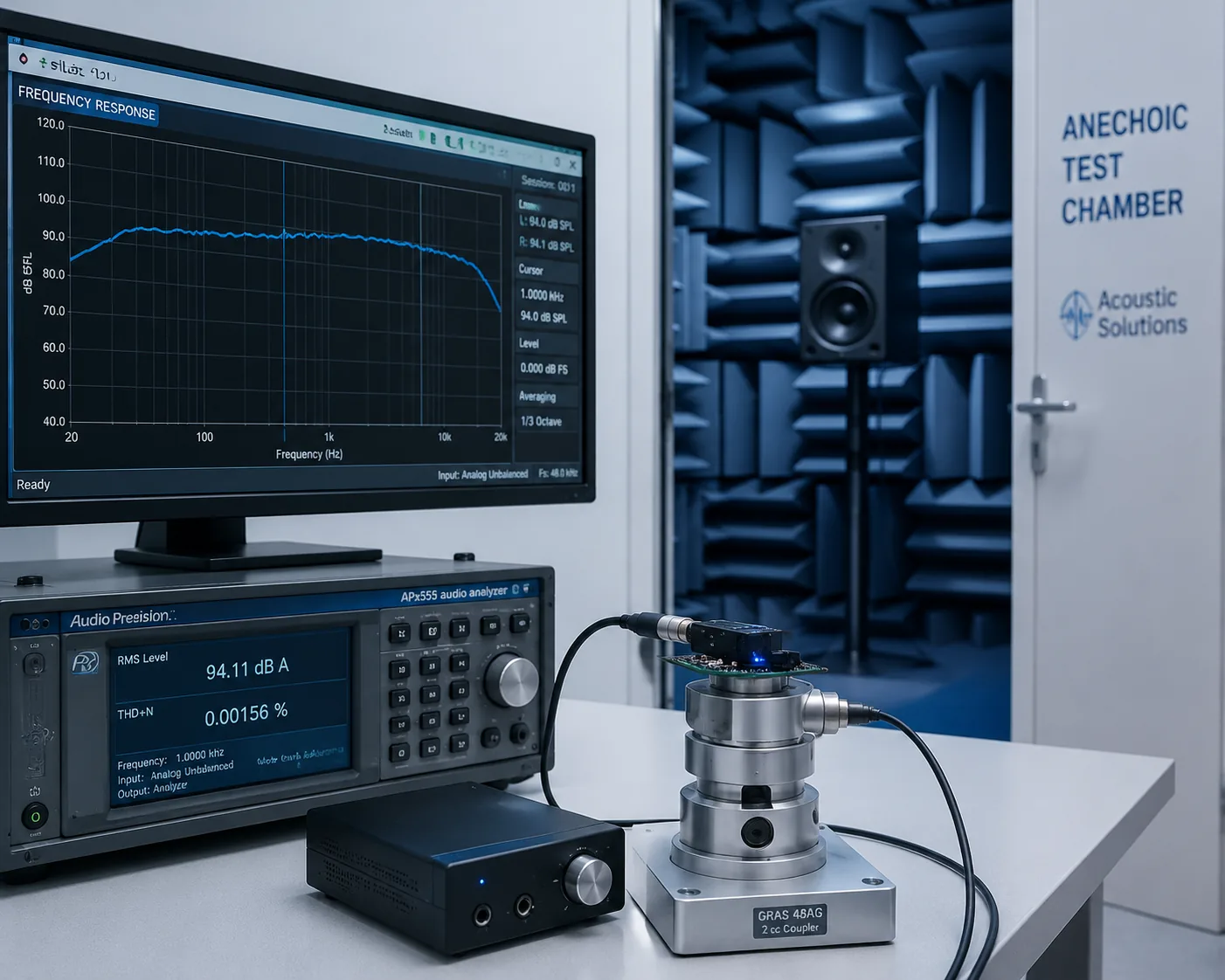
The standard stack: ANSI S3.22, IEC 60118, GB/T 25102, FDA, EU MDR
A complete hearing aid testing project draws on a stack of international, US, EU, and Chinese standards, the choice of which depends on the product type (air-conduction vs bone-conduction vs implantable), the regulatory pathway (prescription vs OTC, US vs EU vs China), and the test objective (type test, production QA, real-ear fitting).
| Family | Standard | Scope |
|---|---|---|
| IEC 60118 family (international) | 13 parts: 60118-0, -1, -2, -4, -5, -6, -7, -8, -9, -12, -13, -14, -15 | The full IEC hearing-aid standard family; see dedicated section |
| ANSI S3.22-2014 | Specification of Hearing Aid Characteristics | The US national hearing-aid specification; close to but not identical to IEC 60118-7 |
| ANSI S3.46-2013 | Methods of Measurement of Real-Ear Performance Characteristics of Hearing Aids | Real-ear (in-situ) measurement on the patient |
| ANSI S3.42-2012 / Part 2 | Testing Hearing Aids with a Speech-like Signal | National adoption of IEC 60118-15 |
| ANSI S3.47-2014 | Specification of Performance Measurement of Hearing Assistance Devices/Systems | Personal sound amplification products (PSAPs), distinct from hearing aids |
| GB/T 25102 series (China) | GB/T 25102.100-2010 (= IEC 60118-0), GB/T 25102.1-2010 (= IEC 60118-1), GB/T 25102.7-2017 (= IEC 60118-7), GB/T 25102.13-2010 (= IEC 60118-13), GB/T 25102.15-2010 (= IEC 60118-15) | The Chinese equivalent of the IEC 60118 family |
| GB/T 14199-2010 | Electroacoustics — General specifications for hearing aids | The Chinese general specification for hearing aids |
| YY 9706.266 / IEC 60601-1-22 | Medical electrical equipment — particular requirements for hearing aids (where applicable) | Electrical safety for hearing aids regulated as medical devices |
| FDA 510(k) | Class II hearing aid (product code LCD / LXF) | US premarket notification for prescription hearing aids |
| FDA 2022 OTC final rule | 21 CFR 800.30; 21 CFR 874.3320 | US OTC hearing aid regulation (October 2022); replaces 510(k) for OTC hearing aids |
| EU MDR 2017/745 | Class Ia medical device | EU hearing-aid classification with self-declaration of conformity |
| NMPA | Class II medical device, classification code 07-06-01 | Chinese hearing-aid registration pathway |
The single most consequential fact for a Chinese manufacturer is that GB/T 25102 is the Chinese equivalent of IEC 60118 (a part-by-part adoption), and GB/T 14199 is the Chinese general specification for hearing aids. A hearing aid placed on the Chinese market requires NMPA registration as a Class II medical device, with the technical file supporting the GB/T 25102.7 production-QA test, GB/T 14199 general-specification conformity, GB/T 25102.13 EMC, and a clinical evaluation appropriate to the device class.
The IEC 60118 family: thirteen parts and what each covers
The IEC 60118 family is the international backbone of hearing aid testing. Each part addresses a specific aspect of the device.
| Part | Title (abbreviated) | Scope |
|---|---|---|
| IEC 60118-0 | Measurement of the performance characteristics | Basic measurement of air-conduction hearing aids; the original 1983 version, updated 1994, harmonised as EN 60118-0 |
| IEC 60118-1 | Hearing aids with induction pick-up coil input | T-coil performance — sensitivity to a 1 mA/m magnetic field at 1 kHz |
| IEC 60118-2 | Hearing aids with automatic gain control circuits | AGC attack and release time, gain reduction |
| IEC 60118-4 | Induction loop systems for hearing aids | Magnetic field strength in room-loop installations (field strength 100 mA/m ± 3 dB per IEC 60118-4) |
| IEC 60118-5 | Nipples for insert earphones | Mechanical dimension standard for the earphone tip |
| IEC 60118-6 | Characteristics of electrical input circuits | For hearing aids with electrical (not acoustic) input |
| IEC 60118-7 | Measurement of performance for production, supply and delivery quality assurance | The production-QA test — OSPL90, HFA, FOG, RTG, frequency response in 2 cm³ coupler |
| IEC 60118-8 | Methods of measurement under simulated in-situ working conditions | Manikin (KEMAR) measurement, simulating real-ear conditions |
| IEC 60118-9 | Hearing aids with bone vibrator output | Bone-conduction hearing aids, measured on a mechanical coupler (IEC 60318-6) |
| IEC 60118-12 | Dimensions of electrical connector systems | Mechanical dimensions of hearing-aid connectors |
| IEC 60118-13 | Electromagnetic compatibility (EMC) | Immunity to wireless phones, mobile phones, and other RF; emissions |
| IEC 60118-14 | Specification of a digital interface | Digital interface for programming / data exchange |
| IEC 60118-15 | Methods for characterising signal processing with a speech-like signal | ISTS (International Speech Test Signal) — the standardised speech stimulus for non-linear hearing aids |
The most-used parts are IEC 60118-7 (production QA, the entry test for every hearing-aid batch), IEC 60118-0 (basic measurement, the type-test for the design), and IEC 60118-13 (EMC, mandatory under every regulatory pathway). The remaining parts are invoked for the specific subsystem they address (T-coil, AGC, bone vibrator, simulated in-situ, digital interface, speech processing) and form the full type-test battery of a hearing aid.
The fundamental electroacoustic parameters: OSPL90, HFA, FOG, RTG, frequency response
Every hearing aid is characterised by a small set of fundamental electroacoustic parameters, measured in the 2 cm³ coupler under defined input signals. These are the parameters that appear on the device data sheet and against which every production batch is verified.
| Parameter | Definition | Typical value range |
|---|---|---|
| OSPL90 | Output Sound Pressure Level for a 90 dB SPL input — the maximum saturation output of the hearing aid, measured in the 2 cm³ coupler at each frequency | 110 to 135 dB SPL (depending on device power class; a power BTE may reach 135 dB, a delicate CIC may be 110 dB) |
| HFA | High-Frequency Average — the average OSPL90 at 1000, 1600, and 2500 Hz; the single most-quoted "maximum output" specification | 105 to 130 dB SPL |
| FOG | Full-On Gain — the gain of the hearing aid with the user gain control at maximum, at 50 dB SPL input | 30 to 80 dB (power BTE on the high end) |
| RTG | Reference Test Gain — the gain setting at which OSPL90 is measured, set so the output at 60 dB input is 12 dB below OSPL90 at the HFA average; used as the standard test condition | — |
| Frequency response | The output-vs-frequency curve at RTG and 60 dB SPL input; the shape that defines the hearing aid's tonal character | Tolerance ± 4 dB on the manufacturer's nominal curve |
| Equivalent input noise | The noise floor of the hearing aid, measured at RTG, output minus gain | < 32 dB SPL (typical) |
| Battery current | DC current draw from the zinc-air or rechargeable battery at RTG | 0.5 to 2.0 mA (zinc-air) |
| AGC attack / release | Time constants of the automatic gain control (if fitted) | Attack 5-10 ms, release 50-300 ms |
The OSPL90 / HFA / FOG measurements are the absolute core of a hearing-aid type test. A device whose measured HFA falls outside the manufacturer's tolerance (typically ± 3 dB for OSPL90, ± 4 dB for frequency response, ± 5 dB for FOG) fails the type test and the production lot must be reworked. The frequency-response curve is the single most diagnostic measurement: a peak or dip in the response at a specific frequency points to a receiver resonance, a microphone fault, or a DSP algorithm error.
ANSI S3.22 vs IEC 60118-7: the four method differences
The two standards most often invoked in hearing aid testing — ANSI S3.22-2014 (US) and IEC 60118-7:2005 (international) — produce closely-related but not identical results. A hearing aid exported to both the US and EU markets must be tested against both, and a laboratory serving manufacturers serving both markets must hold capability in both.
| Parameter | ANSI S3.22-2014 | IEC 60118-7:2005 |
|---|---|---|
| Test signal | Swept pure tone (200-5000 Hz) | Stepped pure tone (third-octave or 1/12-octave) |
| Battery voltage simulation | Required — the test uses a battery simulator that maintains the battery voltage constant during the test, removing the influence of battery voltage drop on output | Optional — a fresh zinc-air battery is typically used; battery voltage drop is not separately controlled |
| Input signal level | 50, 65, 80, 90 dB SPL (with 90 dB SPL for OSPL90) | 50, 60, 65, 70, 80, 90 dB SPL (with 90 dB SPL for OSPL90); additional levels for compression characterisation |
| Reference test gain (RTG) setting | RTG = the gain at which the HFA output at 60 dB input is 12 dB below HFA OSPL90; the user gain control is fixed at RTG for the frequency response and noise tests | Same definition, but with the additional requirement of specifying the RTS (Reference Test Setting) for digital hearing aids with non-linear processing |
| Tolerance on the manufacturer's nominal | OSPL90 ± 3 dB; frequency response ± 4 dB; total harmonic distortion per frequency | Same tolerances, but with the additional requirement of reporting measurement uncertainty |
| Harmonic distortion measurement | At 70, 75, 80 dB SPL input; reported per frequency | At 70, 75, 80 dB SPL input; reported per frequency |
The two most consequential differences are (1) the battery voltage simulation required by ANSI S3.22, which removes a source of variability that affects the IEC 60118-7 result, and (2) the stepped vs swept signal, which gives ANSI S3.22 a slightly higher frequency resolution but a slightly longer test time. In practice the two standards give the same OSPL90 within ~1 dB for a well-designed device; for a marginal device the difference can be the pass/fail boundary.
The 2 cm³ coupler and the IEC 60318 measurement fixture
The acoustic load on which every hearing aid is measured is the 2 cm³ coupler (the "HA-1" or "HA-2" coupler), a metal cavity of 2 cm³ volume terminated by a measurement microphone (typically a ½-inch Brüel & Kjær 4134 or equivalent). The 2 cm³ coupler is defined by IEC 60318-5 (formerly IEC 126), with the related occluded-ear simulator defined by IEC 60318-4 (formerly IEC 711) providing a more realistic impedance for measurements intended to reflect real-ear performance.
| Fixture | Standard | Volume / impedance | Use |
|---|---|---|---|
| 2 cm³ coupler (HA-1) | IEC 60318-5 | 2 cm³, with the connection made via the hearing aid's sound tube to the HA-1 nipple | IEC 60118-7 production QA, ANSI S3.22 type test; the standard production-line test fixture |
| 2 cm³ coupler (HA-2) | IEC 60318-5 | 2 cm³, with the connection made via a sealed headphone-coupler adapter for in-the-ear hearing aids | BTE / ITE production QA |
| Occluded-ear simulator | IEC 60318-4 | Realistic ear-canal impedance, 100 mm³ to 3 cm³ | IEC 60118-0 type test, IEC 60118-8 simulated in-situ |
| Manikin (KEMAR) | IEC 60959 | Full head-and-torso with ear simulator | IEC 60118-8 directional microphone, wind noise, telephone coupling |
The measurement chain is calibrated at the start of every test session: the test microphone is calibrated with a pistonphone (124 dB SPL at 250 Hz) or a sound-level calibrator (94 dB or 114 dB SPL at 1 kHz); the sound source is equalised to produce a flat free-field at the test microphone; and the test chamber is verified for ambient noise (< 50 dB SPL) and reverberation. A hearing aid test system from Brüel & Kjær (the听诺 Affinity, the Unity, or the older 960) or Interacoustics (the Equinox, the Affinity) integrates the sound source, coupler, microphone, and analysis software in one unit; a modern measurement takes 30 seconds to 2 minutes per hearing aid for the full OSPL90 / FOG / RTG / frequency response / battery current / distortion battery.
T-coil (induction pickup) testing per IEC 60118-1
A telecoil (T-coil) is a small induction pickup coil inside a hearing aid that receives the magnetic field from a telephone earpiece or a room-loop induction-loop system, allowing the user to hear the telephone or the public-address system directly through the hearing aid without acoustic feedback. The T-coil is governed by IEC 60118-1 (Chinese adoption GB/T 25102.1-2010), which specifies:
- T-coil sensitivity: the output sound pressure level in the 2 cm³ coupler in response to a magnetic field strength of 1 mA/m (≈ -60 dB A/m) at 1 kHz, with the hearing aid gain set to the RTG; typical sensitivity is 70 to 110 dB SPL at 1 mA/m
- T-coil frequency response: the gain-vs-frequency curve from 100 to 5000 Hz in the magnetic-field mode
- Signal-to-noise ratio in T-coil mode: the difference between the T-coil output and the acoustic-input output at the same field strength
The measurement fixture is a Helmholtz coil pair that produces a uniform magnetic field of known strength (calibrated by a search coil); the hearing aid is placed at the centre of the coil pair, switched to T-coil mode, and the coupler output is measured. The room-loop installation is governed by IEC 60118-4, which specifies the field strength 100 mA/m ± 3 dB at the listening position, the frequency response, and the background noise.
Bone-conduction output testing per IEC 60118-9
A bone-conduction hearing aid drives a mechanical vibrator (typically on the mastoid bone behind the ear) instead of an acoustic receiver; it is used for conductive hearing loss and for single-sided deafness. The bone-conduction hearing aid is governed by IEC 60118-9, which specifies:
- Force output (OFL): the maximum force delivered by the vibrator into a mechanical coupler (IEC 60318-6, the Type 4930 B&K artificial mastoid) at 90 dB input; typical OFL 120 to 145 dB FL (force level)
- Bone-conduction full-on gain (FOG-BC)
- Frequency response: 100 to 4000 Hz (bone conduction is limited at high frequencies by skull mechanics)
- Distortion: harmonic distortion at each frequency
The mechanical coupler (artificial mastoid) is a piezoresistive force sensor with an impedance that simulates the human mastoid; the vibrator is held against the coupler at a defined static force (typically 2-5 N), and the output is measured as force level (dB re 1 µN). The IEC 60118-9 measurement is technically distinct from the IEC 60118-7 air-conduction measurement and requires the artificial-mastoid fixture.
EMC testing per IEC 60118-13
A hearing aid is both a victim of (susceptible to mobile-phone RF, fluorescent-light EMI, microwave-oven EMI) and a source of (radiated emissions from its DSP clock) electromagnetic interference. The EMC of hearing aids is governed by IEC 60118-13 (Chinese adoption GB/T 25102.13-2010), which specifies:
- Immunity to nearby mobile phones at 800-960 MHz and 1.4-2.5 GHz (GSM, UMTS, LTE), at field strengths up to 10 V/m; the criterion is that the hearing aid output must not generate an unacceptable acoustic disturbance (typically, the captured audio must be below a defined threshold)
- Immunity to DECT cordless phones, Wi-Fi, Bluetooth
- Emissions — the hearing aid must not radiate above the CISPR 11 / EN 55011 Class B limits
The IEC 60118-13 test is run with the hearing aid mounted on a manikin or on a coupler inside a GTEM cell or an anechoic chamber, with a base-station simulator generating the mobile-phone signal. A modern digital hearing aid with Bluetooth or a 2.4 GHz proprietary radio must additionally comply with the relevant radio standards (FCC Part 15 in the US, EN 300 328 in the EU for 2.4 GHz Bluetooth).
Speech-like signal testing per IEC 60118-15 (ISTS)
The traditional IEC 60118-7 test uses pure-tone stimuli, but a modern non-linear hearing aid processes speech in a way that no pure-tone test can characterise — the gain, compression, noise reduction, and feedback-cancellation algorithms all behave differently with a complex speech stimulus. To address this gap, IEC 60118-15 defines the International Speech Test Signal (ISTS), a standardised speech-like signal generated by concatenating nonsense syllables from multiple languages into a non-meaningful but speech-like waveform, and specifies the measurement of:
- Input-output gain at six input levels (55, 65, 70, 75, 80, 85 dB SPL), reflecting the non-linear compression behaviour
- Frequency response for each input level
- Speech intelligibility index (SII) — calculated per ANSI S3.5
ISTS testing is increasingly required by regulators and by clinical best practice for verifying the real-world performance of non-linear hearing aids. A hearing aid whose pure-tone OSPL90 and frequency response are within specification but whose ISTS performance shows poor compression or excessive noise reduction may fail the real-world speech-intelligibility benchmark.
Regulatory pathways: FDA 510(k), FDA 2022 OTC rule, EU MDR, NMPA
The regulatory pathway for a hearing aid depends on the claim, the user population, and the market.
| Market | Pathway | Requirements |
|---|---|---|
| US — prescription air-conduction | FDA 510(k), Class II, product code LCD (BTE), LXE (ITE) | ANSI S3.22-2014 type test; IEC 60118-13 EMC; biocompatibility per ISO 10993 (for shell materials); clinical performance data |
| US — OTC (since 2022) | FDA OTC Hearing Aid Controls final rule (October 2022) — 21 CFR 800.30; 21 CFR 874.3320; 21 CFR 801.420 (labeling) | ANSI S3.22 type test; output limiters (max OSPL90 ≤ 111 dB SPL for non-self-fitting, 117 dB for self-fitting, with gain limited to the lesser of OSPL90 − 5 dB or 25 dB above the patient's threshold); user-adjustable volume; no prescription required; specific OTC labeling |
| EU | EU MDR 2017/745 Class Ia | EN 60118-7 type test; EN 60118-13 EMC; Declaration of Conformity (self-declaration for Class Ia); ISO 13485 QMS; technical documentation |
| China | NMPA Class II, classification code 07-06-01 | GB/T 25102.7-2017 type test; GB/T 14199-2010 general specification; GB/T 25102.13-2010 EMC; GB/T 16886 biocompatibility; clinical evaluation; product technical requirements (PTR) per NMPA guidance |
The FDA OTC Hearing Aid Controls final rule (17 October 2022, effective October 2022, applicable from October 2024) is the most consequential regulatory change in the hearing-aid market in decades. It created a new regulatory category — the OTC hearing aid — for adults with perceived mild-to-moderate hearing loss, sold without a prescription, without a hearing test, and without a licensed dispenser's fitting. The OTC rule imposes an output limit (max OSPL90 ≤ 111 dB SPL for non-self-fitting OTC devices; 117 dB SPL for self-fitting OTC devices with gain limited to the lesser of OSPL90 − 5 dB or 25 dB above the patient's measured threshold), requires user-adjustable volume, requires specific labeling (including the statement "This hearing aid is for adults with perceived mild to moderate hearing loss"), and exempts OTC hearing aids from the 510(k) requirement (replaced by the OTC labeling + ANSI S3.22 type-test + registration/listing). A hearing aid that exceeds the OTC output limit must be regulated as a prescription device under 510(k). The OTC rule reshapes the hearing-aid testing landscape: a testing laboratory serving the US market now needs two parallel capability tracks — the ANSI S3.22 prescription track and the ANSI S3.22 OTC track with its output-limit verification.
The NMPA pathway for a Chinese hearing aid is more conservative than either US pathway: a Class II registration requires the full GB/T 25102.7 type test, GB/T 14199 conformity, GB/T 25102.13 EMC, GB/T 16886 biocompatibility for the shell materials, a clinical evaluation (typically a multi-centre clinical trial), and a product technical requirements document. The NMPA Hearing Aid Registration Technical Review Guideline provides the technical review framework.
FAQ
What is the difference between ANSI S3.22 and IEC 60118-7?
ANSI S3.22 (US) and IEC 60118-7 (international) produce closely related measurements of OSPL90, HFA, FOG, RTG, and frequency response in a 2 cm³ coupler, but differ in (1) the test signal (swept vs stepped pure tone), (2) the battery voltage simulation (required by ANSI, optional by IEC), (3) the input levels, and (4) the reporting of measurement uncertainty. The two are not interchangeable without a documented crosswalk.
What is OSPL90 and what is a typical value?
OSPL90 is the Output Sound Pressure Level produced by the hearing aid in a 2 cm³ coupler in response to a 90 dB SPL input — the saturation output. Typical OSPL90 is 110 to 135 dB SPL, with the High-Frequency Average (HFA, averaged at 1000/1600/2500 Hz) of 105 to 130 dB SPL. A power BTE may reach 135 dB; a discreet CIC may be 110 dB.
What is the FDA 2022 OTC Hearing Aid rule?
The FDA OTC Hearing Aid Controls final rule (October 2022, 21 CFR 800.30 and 874.3320) created a new category of OTC hearing aids for adults with perceived mild-to-moderate hearing loss, sold without prescription. It imposes an output limit (max OSPL90 ≤ 111 dB SPL non-self-fitting, 117 dB self-fitting with gain limited), requires user-adjustable volume and specific labeling, and replaces the 510(k) requirement with registration/listing + ANSI S3.22 type test + OTC labeling conformity.
What is the T-coil sensitivity test?
The T-coil (induction pickup) sensitivity is measured per IEC 60118-1 by applying a magnetic field of 1 mA/m at 1 kHz from a Helmholtz coil pair and measuring the coupler output. Typical T-coil sensitivity is 70 to 110 dB SPL at 1 mA/m. The related IEC 60118-4 standard specifies the magnetic field strength (100 mA/m ± 3 dB) of a room-loop installation.
Does NMPA accept an FDA 510(k) submission for a hearing aid?
Partially. NMPA requires the GB/T 25102.7-2017 type test, GB/T 14199-2010 general specification conformity, GB/T 25102.13-2010 EMC, GB/T 16886 biocompatibility, and a Chinese-clinical-evidence package. The FDA 510(k) submission supports but does not replace the NMPA submission. The Chinese clinical evaluation is typically a prospective multi-centre trial in Chinese hearing-impaired subjects.
Our hearing aid testing capabilities
Beijing ZKGX Research (ISO/IEC 17025 accredited, CMA- and CNAS-accredited testing laboratory) provides complete hearing aid testing across the international, US, EU, and Chinese standard stack:
- IEC 60118-7 / EN 60118-7 / GB/T 25102.7-2017 production-QA test — OSPL90, HFA, FOG, RTG, frequency response, equivalent input noise, battery current, harmonic distortion in the 2 cm³ coupler (HA-1, HA-2); 2 cm³ coupler per IEC 60318-5.
- ANSI S3.22-2014 specification of hearing aid characteristics — full ANSI S3.22 type test, with battery voltage simulation, swept-tone signal, and the complete ANSI tolerance reporting.
- IEC 60118-0 / GB/T 25102.100-2010 basic type test — performance characteristics in the occluded-ear simulator (IEC 60318-4) for the design-stage type test.
- IEC 60118-1 / GB/T 25102.1-2010 T-coil sensitivity and frequency response — measurement at 1 mA/m and 10 mA/m in a Helmholtz-coil fixture.
- IEC 60118-9 bone-conduction output — force output and frequency response on the IEC 60318-6 artificial mastoid.
- IEC 60118-13 / GB/T 25102.13-2010 EMC — immunity to mobile-phone RF (800-960 MHz, 1.4-2.5 GHz), DECT, Wi-Fi, Bluetooth; radiated emissions per CISPR 11 / EN 55011 Class B; in a GTEM cell or anechoic chamber.
- IEC 60118-15 / GB/T 25102.15-2010 ISTS speech-like signal — input-output gain at 55-85 dB SPL, frequency response per input level, SII calculation.
- FDA 510(k) prescription and FDA 2022 OTC conformity — ANSI S3.22 type test, OTC output-limit verification (max OSPL90 ≤ 111 dB SPL non-self-fitting, 117 dB self-fitting), OTC labeling review.
- NMPA Class II registration support — GB/T 25102.7 + GB/T 14199 + GB/T 25102.13 + GB/T 16886 biocompatibility + Chinese clinical evaluation + product technical requirements (PTR).
Suitable product types include: behind-the-ear (BTE), in-the-ear (ITE), in-the-canal (ITC), completely-in-the-canal (CIC), invisible-in-the-canal (IIC), receiver-in-canal (RIC), receiver-in-the-ear (RITE), bone-conduction (BC), implantable, and OTC self-fitting hearing aids; personal sound amplification products (PSAPs, per ANSI S3.47) where applicable. Each project is delivered with a full data report (test protocol, instrument calibration, raw coupler output curves, statistical analysis, classification conclusion against each standard's tolerance) in English and/or Chinese, with CMA/CNAS stamping, ready for direct submission to FDA, EU MDR notified bodies, or NMPA. Contact Beijing ZKGX Research to scope the hearing-aid test battery applicable to your product and target market.