Table of Contents
- What is hollow capsule testing?
- The standard stack: Chinese Pharmacopoeia, USP, EP, YBX-2000-2007
- Disintegration time: the ≤ 10 min specification
- Loss on drying: the 12.5–17.5 % moisture window
- Chromium (Cr): the ≤ 2 ppm limit and the 2012 crisis
- Heavy metals, arsenic, and sulphite
- Microbial limits and ethyl paraben
- Dimensions, wall thickness, and the 0–5 size system
- Gelatin vs HPMC capsules: the two material families
- FAQ
- Our hollow capsule testing capabilities
What is hollow capsule testing?
Hollow capsule testing is the measurement and validation of the disintegration time, moisture content, chromium content, heavy-metal purity, microbial limits, dimensions, and material identity of a hollow hard capsule — the two-piece (cap + body) pharmaceutical dosage-form container, made from gelatin or HPMC (hydroxypropyl methylcellulose), that holds the drug powder, pellets, or liquid for oral administration. The output of a hollow capsule test is a dossier covering the disintegration time (≤ 10 min for gelatin; ≤ 20-30 min for HPMC and enteric, in water or simulated gastric fluid at 37 °C), the loss on drying (12.5-17.5 % for gelatin; 3-9 % for HPMC, by gravimetry), the chromium (≤ 2 ppm by GFAAS — the single most safety-critical parameter, driven by the 2012 Chinese "toxic capsule" crisis), the heavy metals (≤ 30 ppm), arsenic (≤ 1 ppm), sulphite (≤ 0.01 % as SO₂), the microbial limits (total aerobic count, yeasts/moulds, specified pathogens per USP <61>/<62>), the dimensions (length, outer diameter, wall thickness, weight, per the 0-5 size system), and the material identity (gelatin vs HPMC vs enteric-coated, by IR or by the cross-linking/dissolution behaviour).
The hollow hard capsule is the second most common oral solid dosage form (after the tablet) and the primary form for formulations that are difficult to compress into a tablet (low-dose potent drugs, multi-pellet controlled-release systems, liquid/semi-solid fills, inhalation powders). The capsule shell is made from gelatin (the traditional animal-derived material, typically bovine or porcine bone/hide gelatin, with a 13-16 % moisture content that maintains the shell's flexibility) or from HPMC (the plant-derived alternative, with lower moisture and no animal-origin concerns). The shell's quality directly determines the drug's bioavailability — a capsule that fails to disintegrate within the pharmacopeial limit delays or prevents the drug release; a capsule with high chromium (from the industrial-waste gelatin) poses a direct patient-safety hazard.
The standards governing hollow capsule testing span the Chinese Pharmacopoeia Gelatin Hollow Capsule (明胶空心胶囊) and HPMC Hollow Capsule monographs (ChP 2020/2025 edition, in the药用辅料 section of Part IV), the national standard YBX-2000-2007 Gelatin Hollow Capsule (the older national standard that established the chromium limit and the disintegration method), the USP Gelatin and Disintegration <701> monographs, the EP Empty Hard Capsules monograph, and the DMF (Drug Master File) framework for the FDA registration of capsule shells. A hollow capsule placed on the Chinese pharmaceutical market must satisfy the Chinese Pharmacopoeia monograph; on the US market, the USP and a DMF filed with the FDA; on the EU market, the EP monograph.
The standard stack: Chinese Pharmacopoeia, USP, EP, YBX-2000-2007
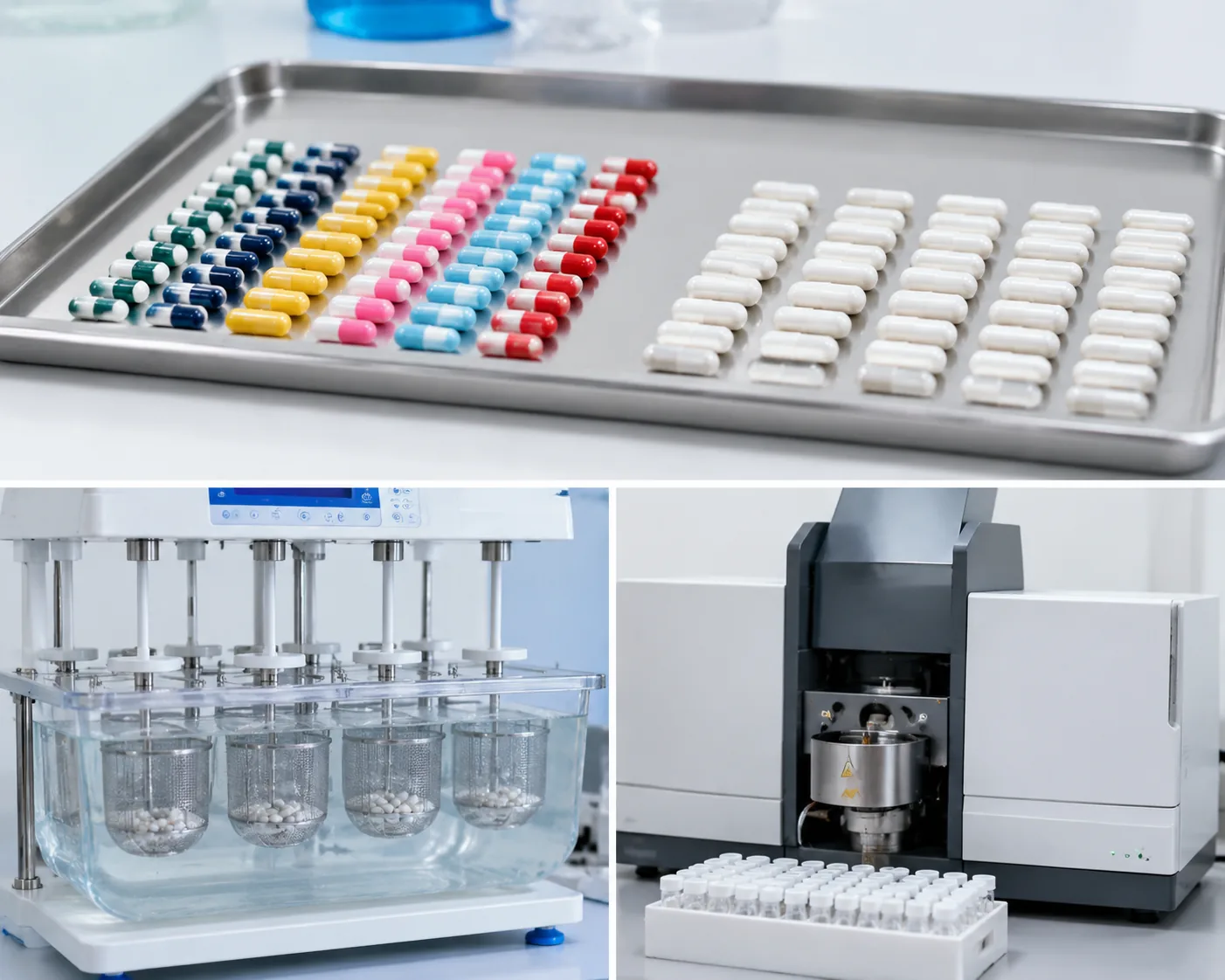
A complete hollow capsule testing project draws on a stack of Chinese pharmacopeial, international pharmacopeial, and national standards.
| Family | Standard | Scope |
|---|---|---|
| Chinese Pharmacopoeia 2020/2025 | 明胶空心胶囊 (Gelatin Hollow Capsule) monograph, Part IV | The NMPA-mandated Chinese standard for gelatin capsules; disintegration ≤ 10 min, LOD 12.5-17.5 %, Cr ≤ 2 ppm, heavy metals ≤ 30 ppm, As ≤ 1 ppm, SO₂ ≤ 0.01 %, microbial limits, paraben (if added) |
| Chinese Pharmacopoeia 2020/2025 | 羟丙甲纤维素空心胶囊 (HPMC Hollow Capsule) monograph | The Chinese standard for HPMC (plant-based) capsules; disintegration ≤ 20 min, LOD 3-9 %, same heavy-metal and microbial limits |
| Chinese Pharmacopoeia | 胶囊用明胶 (Gelatin for Capsules) monograph | The raw-material standard — the gelatin used to make the capsule shell must satisfy this monograph (Cr ≤ 2 ppm, heavy metals ≤ 30 ppm, As ≤ 1 ppm, microbial) |
| YBX-2000-2007 | 明胶空心胶囊 (national standard) | The older national standard that introduced the chromium limit and the revised disintegration method; largely superseded by the ChP monograph but still referenced for the product-registration legacy |
| USP <701> | Disintegration | The USP general chapter for the disintegration test of capsules |
| USP <711> | Dissolution | The USP dissolution test (for the drug-filled capsule) |
| USP Gelatin | Gelatin monograph (USP-NF) | The US pharmacopeial gelatin standard (for the raw material) |
| EP Empty Hard Capsules | Empty Hard Capsules monograph (European Pharmacopoeia) | The European pharmacopeial capsule-shell standard |
| JP Empty Capsule | Empty Capsule monograph (Japanese Pharmacopoeia) | The Japanese pharmacopeial reference |
| USP <61> / <62> | Microbial Examination | The USP microbial-limits framework |
| ICH Q3D | Elemental Impurities | The international elemental-impurity framework (Cr, Pb, As as Class 1 or 2A) |
| ISO 15378 | Primary packaging materials for medicinal products — GMP | The GMP for the capsule-shell manufacturing |
| FDA DMF | Drug Master File for Capsule Shells | The US FDA registration pathway for the capsule shell as a pharmaceutical excipient |
The single most consequential fact for a Chinese manufacturer is that the Chinese Pharmacopoeia Gelatin Hollow Capsule monograph is the NMPA-mandated standard for gelatin capsules on the Chinese market. The chromium limit (≤ 2 ppm, GFAAS) and the disintegration time (≤ 10 min in water at 37 °C) are the two most safety-critical parameters, both driven by the 2012 "toxic capsule" crisis in China.
Disintegration time: the ≤ 10 min specification
The disintegration time is the single most performance-critical specification of a hollow capsule — it determines whether the capsule shell will open and release the drug within the pharmacopeial time limit in the patient's gastrointestinal tract.
| Capsule type | Disintegration specification | Medium | Temperature | Method |
|---|---|---|---|---|
| Gelatin hollow capsule (ChP / USP / EP) | ≤ 10 min | Purified water | 37 ± 1 °C | The basket-rack assembly (USP <701> / ChP 通则 0921); one capsule per tube; the endpoint is when no residue remains on the screen (or the residue is a soft mass with no firm core) |
| HPMC hollow capsule (ChP) | ≤ 20 min | Purified water | 37 ± 1 °C | Same basket-rack method |
| Enteric-coated capsule (ChP) | No disintegration in 0.1 N HCl (60 min); disintegration in pH 6.8 phosphate buffer (≤ 30 min) | Simulated gastric fluid + simulated intestinal fluid | 37 ± 1 °C | The two-stage enteric test |
| Gelatin capsule with cross-linking (USP) | If cross-linking is suspected, use pancreatin enzyme in the medium (USP <711> with enzyme) | Water + pancreatin | 37 ± 1 °C | The enzyme aids the dissolution of the cross-linked gelatin |
The cross-linking is the most common disintegration-failure mode for gelatin capsules — the gelatin forms an insoluble pellicle (the aldehyde-cross-linked gelatin) that prevents the capsule from disintegrating. Cross-linking is caused by the aldehyde impurities in the excipients (the starch degradation products, the PEG decomposition, the dextrose caramelisation), by the storage at high temperature and humidity, and by the radiation sterilisation. When cross-linking is confirmed (the capsule fails the standard disintegration but passes with the enzyme), the dissolution test is run with pancreatin in the medium — the USP and the ChP both permit this.
Loss on drying: the 12.5–17.5 % moisture window
The loss on drying (LOD) measures the moisture content of the capsule shell — a tightly-controlled parameter that balances the shell's flexibility (needs moisture) against the brittleness (too dry → cracks) and the microbial growth (too moist → microbial proliferation).
| Capsule type | LOD specification | Method |
|---|---|---|
| Gelatin hollow capsule (ChP / YBX) | 12.5-17.5 % (some pharmacopeias use 12.5-16.0 %) | Gravimetric — dry at 105 °C to constant weight; or the Karl Fischer method |
| HPMC hollow capsule (ChP) | 3.0-9.0 % | Same gravimetric or KF method |
The gelatin capsule's moisture (13-16 % as shipped from the manufacturer, per the Zhaofeng product specification) is maintained by the gelatin's hygroscopic property — the capsule absorbs or desorbs moisture to equilibrate with the ambient humidity. The ideal storage condition for gelatin capsules is 35-65 % RH at 15-25 °C (per the Zhaofeng / Capsugel specification); below 35 % RH the capsules become brittle and crack; above 65 % RH they become soft and deform. The HPMC capsule's lower moisture (3-9 %) makes it the preferred shell for moisture-sensitive drugs (hygroscopic powders, liquid fills) where the gelatin's 13-16 % moisture would degrade the drug.
Chromium (Cr): the ≤ 2 ppm limit and the 2012 crisis
The chromium content of the gelatin capsule shell is the single most safety-critical specification — driven by the 2012 Chinese "toxic capsule" crisis in which 9 pharmaceutical companies were found to have used industrial-waste gelatin (containing high chromium from the chromium-tanning process in the leather industry) to make capsule shells. The Chinese Pharmacopoeia set the limit at ≤ 2 ppm (2 mg/kg) chromium, measured by graphite-furnace atomic absorption spectrophotometry (GFAAS).
Why chromium? — The industrial-waste gelatin is produced from the leather trimmings that have been treated with chromium (III) sulfate in the chrome-tanning process. The chromium remains in the gelatin as an impurity; a capsule shell made from the industrial-waste gelatin can contain 50-500 ppm chromium — 25-250× the pharmacopeial limit. Chromium (VI) (hexavalent chromium) is an IARC Group 1 carcinogen; chromium (III) (the form in the tanned leather) is less toxic but is the precursor to chromium (VI) under oxidative conditions.
Method — The capsule shell is ashed (or microwave-digested in nitric acid), and the chromium is measured by GFAAS (graphite-furnace AAS, at 357.9 nm, the chromium absorption line) or by ICP-MS (with the Cr-52 isotope). The GFAAS method is the Chinese Pharmacopoeia reference method; the ICP-MS is the modern alternative with lower detection limits (sub-ppb) and multi-element capability.
The regulatory aftermath — The 2012 crisis led to:
- The tightening of the Chinese Pharmacopoeia chromium limit from the pre-2012 "no limit" to ≤ 2 ppm
- The criminal prosecution of the industrial-waste gelatin suppliers
- The establishment of the YBX-2000-2007 national standard with the chromium limit
- The implementation of the raw-material traceability for all capsule-gelatin used in China (the gelatin must be from pharmaceutical-grade sources, traceable to the animal origin, and tested for chromium at every lot)
Heavy metals, arsenic, and sulphite
| Test | Specification (ChP / YBX) | Method |
|---|---|---|
| Heavy metals (as Pb) | ≤ 30 ppm (30 mg/kg) | The ChP heavy-metals limit test (thioacetamide colorimetric); or ICP-MS |
| Arsenic (As) | ≤ 1 ppm (1 mg/kg) | AAS (hydride generation) or ICP-MS; or the ChP arsenic limit test |
| Sulphite (SO₂) | ≤ 0.01 % (100 mg/kg) | The ChP sulphite limit test (iodometric titration) — the SO₂ is a residual from the gelatin bleaching process |
| Copper, zinc, and other elements | Per the raw-material gelatin monograph | ICP-MS multi-element |
The heavy-metals and arsenic limits apply to both the gelatin raw material and the finished capsule shell — the capsule shell inherits the impurities of the gelatin (the animal-bone / hide gelatin carries the environmental heavy metals and arsenic). The sulphite is a residual from the gelatin bleaching (the H₂O₂ or the SO₂ treatment used to whiten the gelatin) and can cause allergic reactions in sensitive patients.
Microbial limits and ethyl paraben
| Test | Specification (ChP / USP) | Method |
|---|---|---|
| Total aerobic microbial count | ≤ 1000 CFU/g | USP <61> / ChP 通则 1105 |
| Total yeasts and moulds | ≤ 100 CFU/g | USP <61> / ChP 通则 1105 |
| Escherichia coli | Absent in 1 g | USP <62> / ChP 通则 1106 |
| Salmonella spp. | Absent in 10 g | USP <62> / ChP 通则 1106 |
| Staphylococcus aureus | Absent in 1 g | USP <62> / ChP 通则 1106 |
| Pseudomonas aeruginosa | Absent in 1 g | USP <62> / ChP 通则 1106 |
| Ethyl paraben (if used as preservative) | Per the ChP monograph (typically 0.01-0.1 %) | HPLC-UV |
The microbial limits are the pharmacopeial specification for the bioburden of the capsule shell — the capsule is not terminally sterilised (the gelatin would melt), and the microbial control relies on the GMP manufacturing (the ISO Class 8 cleanroom, the controlled-humidity drying, the sealed packaging) and on the capsule shell's low moisture (the 13-16 % water activity is below the threshold for most microbial growth). The ethyl paraben (ethyl p-hydroxybenzoate, E 214) is the most common capsule-shell preservative — it prevents the mould growth during storage; if used, it must be declared on the DMF and tested per the ChP monograph.
Dimensions, wall thickness, and the 0–5 size system
The dimensions of the hollow capsule are defined by the 0-5 size system — a standardised dimensional system used worldwide (originally by Eli Lilly, now by all capsule manufacturers and all capsule-filling-machine manufacturers). The size determines the fill volume (the powder capacity) and the compatibility with the filling machine.
| Size | Locked length (mm) | Body length (mm) | Cap length (mm) | Outer diameter (mm) | Avg weight (mg) | Fill volume (mL) | Typical fill capacity (mg, density 0.7 g/mL) |
|---|---|---|---|---|---|---|---|
| 0 | 21.7 | 18.8 | 11.0 | 7.6 | 97 | 0.67 | 469 |
| 1 | 19.5 | 16.8 | 9.8 | 6.9 | 76 | 0.50 | 350 |
| 2 | 18.0 | 15.4 | 9.0 | 6.3 | 62 | 0.37 | 259 |
| 3 | 15.8 | 13.6 | 8.1 | 5.8 | 50 | 0.30 | 210 |
| 4 | 14.3 | 12.2 | 7.1 | 5.3 | 39 | 0.21 | 147 |
| 5 | 11.3 | 9.6 | 6.2 | 4.9 | 27 | 0.10 | 70 |
The dimensional tolerance per the ChP / YBX standard:
- Locked length: ± 2.0 mm (per the ChP specification)
- Body / cap length: ± 0.4 mm
- Outer diameter: ± 0.05 mm
- Wall thickness: 0.10-0.14 mm (the cap is typically 0.03 mm thinner than the body, to allow the cap to slide over the body)
- Average weight: ± 10 % of the declared value (per the YBX specification)
The dimensional measurement is performed by a digital calliper (for the length and the diameter), a wall-thickness gauge (for the wall thickness), and an analytical balance (for the average weight of 20 capsules). A capsule that does not meet the dimensional tolerance will jam the filling machine or will not close properly, producing a defect capsule.
Gelatin vs HPMC capsules: the two material families
The hollow capsule market is dominated by two material families: the traditional gelatin capsule (the animal-derived shell) and the plant-derived HPMC capsule (the hydroxypropyl methylcellulose shell). Each has its advantages and its test profile.
| Property | Gelatin capsule | HPMC capsule |
|---|---|---|
| Source | Animal-derived (bovine or porcine bone / hide gelatin) | Plant-derived (wood-pulp cellulose + propylene oxide + methyl chloride) |
| Moisture content | 13-16 % (high; maintains flexibility) | 3-9 % (low; suitable for moisture-sensitive drugs) |
| Disintegration | ≤ 10 min (rapid; the gelatin dissolves at body temperature) | ≤ 20 min (slightly slower; the HPMC hydrates and dissolves) |
| Cross-linking risk | High (the aldehyde-cross-linking is the main failure mode) | None (the HPMC does not cross-link — the main advantage) |
| Animal-origin / BSE / TSE | Must demonstrate the BSE/TSE-free animal origin | No animal origin — suitable for vegetarian, vegan, Kosher, Halal |
| Regulatory | Chinese Pharmacopoeia / USP / EP gelatin monograph | Chinese Pharmacopoeia / USP HPMC monograph |
| Typical cost | Lower (the gelatin is cheaper) | Higher (the HPMC is more expensive) |
The HPMC capsule is the preferred shell for:
- Moisture-sensitive drugs (the HPMC's 3-9 % moisture does not degrade the hygroscopic drug)
- Cross-linking-prone formulations (the HPMC does not cross-link with the aldehyde-containing excipients)
- Vegetarian / vegan / Kosher / Halal products (no animal origin)
- Liquid-fill capsules (the HPMC's lower moisture prevents the capsule-shell softening in contact with the liquid fill)
FAQ
What is the disintegration time specification for a gelatin hollow capsule?
The Chinese Pharmacopoeia, USP, and EP specify ≤ 10 min for the gelatin hollow capsule, tested in purified water at 37 ± 1 °C using the basket-rack assembly. For the HPMC capsule, the limit is ≤ 20 min. For the enteric-coated capsule, the test is two-stage (no disintegration in 0.1 N HCl for 60 min; disintegration in pH 6.8 phosphate buffer within 30 min).
Why is chromium limited to ≤ 2 ppm in capsule gelatin?
The chromium limit was introduced after the 2012 Chinese "toxic capsule" crisis in which industrial-waste gelatin (from chromium-tanned leather trimmings, containing 50-500 ppm Cr) was used to make capsule shells. The ≤ 2 ppm limit (by GFAAS or ICP-MS) ensures that only pharmaceutical-grade gelatin (not industrial-waste gelatin) is used in capsule manufacturing. Chromium (VI) is an IARC Group 1 carcinogen; chromium (III) from the tanned leather is the precursor.
What is cross-linking and how is it handled?
Cross-linking is the formation of an insoluble aldehyde-cross-linked gelatin pellicle on the capsule shell that prevents disintegration. It is caused by the aldehyde impurities in the excipients (starch, PEG, dextrose) or by the storage at high temperature/humidity. When cross-linking is confirmed (the capsule fails the standard disintegration but passes with enzyme), the dissolution test is run with pancreatin in the medium — the USP and the ChP both permit this. HPMC capsules do not cross-link.
What is the difference between gelatin and HPMC capsules?
Gelatin capsules are animal-derived (bovine or porcine bone/hide gelatin), with 13-16 % moisture and a ≤ 10 min disintegration; they are prone to cross-linking and are not suitable for vegetarian/vegan products. HPMC capsules are plant-derived (wood-pulp cellulose), with 3-9 % moisture and a ≤ 20 min disintegration; they do not cross-link and are suitable for vegetarian, vegan, Kosher, and Halal products. The HPMC is preferred for moisture-sensitive and cross-linking-prone formulations.
What sizes are hollow capsules available in?
The standard sizes are 0, 1, 2, 3, 4, 5 (from largest to smallest). Size 0 has a fill volume of 0.67 mL (typically 469 mg at 0.7 g/mL density); size 5 has a fill volume of 0.10 mL (70 mg). The size selection is based on the fill weight and the bulk density of the drug formulation. The dimensional tolerance per the ChP / YBX standard applies to the locked length, the body/cap length, the outer diameter, and the average weight.
Our hollow capsule testing capabilities
Beijing ZKGX Research (ISO/IEC 17025 accredited, CMA- and CNAS-accredited testing laboratory) provides complete hollow capsule testing across the Chinese Pharmacopoeia, USP, EP, and YBX standard stack:
- Chinese Pharmacopoeia Gelatin Hollow Capsule (明胶空心胶囊) monograph — full conformance: disintegration ≤ 10 min, LOD 12.5-17.5 %, Cr ≤ 2 ppm (GFAAS), heavy metals ≤ 30 ppm, As ≤ 1 ppm, SO₂ ≤ 0.01 %, microbial limits, paraben (if added).
- Chinese Pharmacopoeia HPMC Hollow Capsule (羟丙甲纤维素空心胶囊) monograph — disintegration ≤ 20 min, LOD 3-9 %, same heavy-metal and microbial limits.
- YBX-2000-2007 Gelatin Hollow Capsule national standard — the legacy standard with the chromium limit and the disintegration method.
- USP <701> disintegration and USP <711> dissolution (with the pancreatin enzyme option for the cross-linked gelatin capsule).
- EP Empty Hard Capsules monograph — for the EU market.
- Disintegration — basket-rack assembly at 37 ± 1 °C in purified water (gelatin ≤ 10 min; HPMC ≤ 20 min); the enteric two-stage test (0.1 N HCl 60 min → pH 6.8 phosphate buffer 30 min); the pancreatin-enzyme option for cross-linked gelatin.
- Loss on drying — gravimetric at 105 °C or Karl Fischer; 12.5-17.5 % gelatin, 3-9 % HPMC.
- Chromium — GFAAS (357.9 nm) or ICP-MS; ≤ 2 ppm (the 2012-crisis-driven limit).
- Heavy metals and arsenic — ICP-MS multi-element (Pb, As, Cd, Hg, Cr, Cu, Zn); heavy metals ≤ 30 ppm, As ≤ 1 ppm.
- Sulphite — iodometric titration; ≤ 0.01 % as SO₂.
- Microbial limits — USP <61>/<62> / ChP 通则 1105/1106; total aerobic ≤ 1000 CFU/g, yeasts/moulds ≤ 100 CFU/g, E. coli / Salmonella / S. aureus / P. aeruginosa absent.
- Dimensions — digital calliper for length and diameter; wall-thickness gauge; analytical balance for average weight of 20 capsules; the 0-5 size system tolerance.
- Material identification — gelatin vs HPMC by IR (the HPMC has a different IR fingerprint from the gelatin); the cross-linking test (the gelatin cross-links with aldehyde; the HPMC does not).
- DMF support — the FDA Drug Master File data package for the capsule-shell registration.
- ISO 15378 GMP audit support — for the capsule-shell manufacturing facility.
Suitable product categories include: gelatin hollow capsules (sizes 0-5, transparent, translucent, opaque); HPMC hollow capsules (vegetarian, vegan, Kosher, Halal); enteric-coated capsules; liquid-fill capsules; dry-powder inhalation capsules; printed / banded capsules. Each project is delivered with a full data report (test protocol, instrument calibration, raw disintegration / GFAAS / ICP-MS / microbial data, statistical analysis, classification conclusion per the applicable standard) in English and/or Chinese, with CMA/CNAS stamping. Contact Beijing ZKGX Research to scope the hollow capsule test applicable to your product and target market.