Table of Contents
- What is industrial robot testing?
- The standard families: ISO 10218, ISO/TS 15066, ISO 9283, GB 11291
- Functional safety and the four collaborative modes
- ISO/TS 15066 force and pressure thresholds by body region
- ISO 9283 performance testing: accuracy, repeatability, path
- Functional safety: ISO 13849 PL and IEC 62061 SIL
- Electromagnetic compatibility (EMC) testing
- Environmental and ingress protection (IP) testing
- Medical and surgical robotics: the IEC 60601 overlay
- Personal care and mobile service robots: ISO 13482 and ISO 18646
- Regulatory pathways: CE Machinery Directive, FDA, NMPA
- FAQ
- Our industrial robot testing capabilities
What is industrial robot testing?
Industrial robot testing is the measurement and validation of an industrial robot or robot system against the safety, performance, electromagnetic, environmental, and software standards that govern its placement on the market. The output is a set of test reports that prove the robot — in its final integrated form, with its end-effector, controller, teach pendant, and safeguards — satisfies ISO 10218-1 (the robot itself) and ISO 10218-2 (the integrated system), and where the robot is a cobot, the additional requirements of ISO/TS 15066 for power-and-force-limited collaborative operation. Performance is verified against ISO 9283; functional safety against ISO 13849 or IEC 62061; EMC against the IEC 61000 series; environmental sealing against IEC 60529; and where the robot is medical, electrical safety and essential performance against IEC 60601-1 plus the robot-specific particular IEC 80601-2-77.
Industrial robots have moved decisively out of caged factory cells into shared human-robot workspaces. The International Federation of Robotics reported more than 4 million industrial robot installations worldwide by the end of 2022, with collaborative robots (cobots) the fastest-growing segment. Each of these robots is a complex integrated system combining high-energy mechanical motion, sophisticated software control, sensory feedback, and high-power drive electronics — every one of which can fail in a way that injures a worker. Industrial robot testing exists to verify that the safety functions built into the robot (protective stop, speed and separation monitoring, power and force limiting) actually perform as designed under every reasonably foreseeable condition, including single-fault conditions, and that the robot's performance — accuracy, repeatability, path following — meets the values claimed on its data sheet. A robot placed on the EU market without CE marking under the Machinery Directive 2006/42/EC, or on the US market without the UL/ANSI conformity assessment, or on the Chinese market without GB 11291 type-test reports, is non-compliant and subject to recall.
The standard families: ISO 10218, ISO/TS 15066, ISO 9283, GB 11291
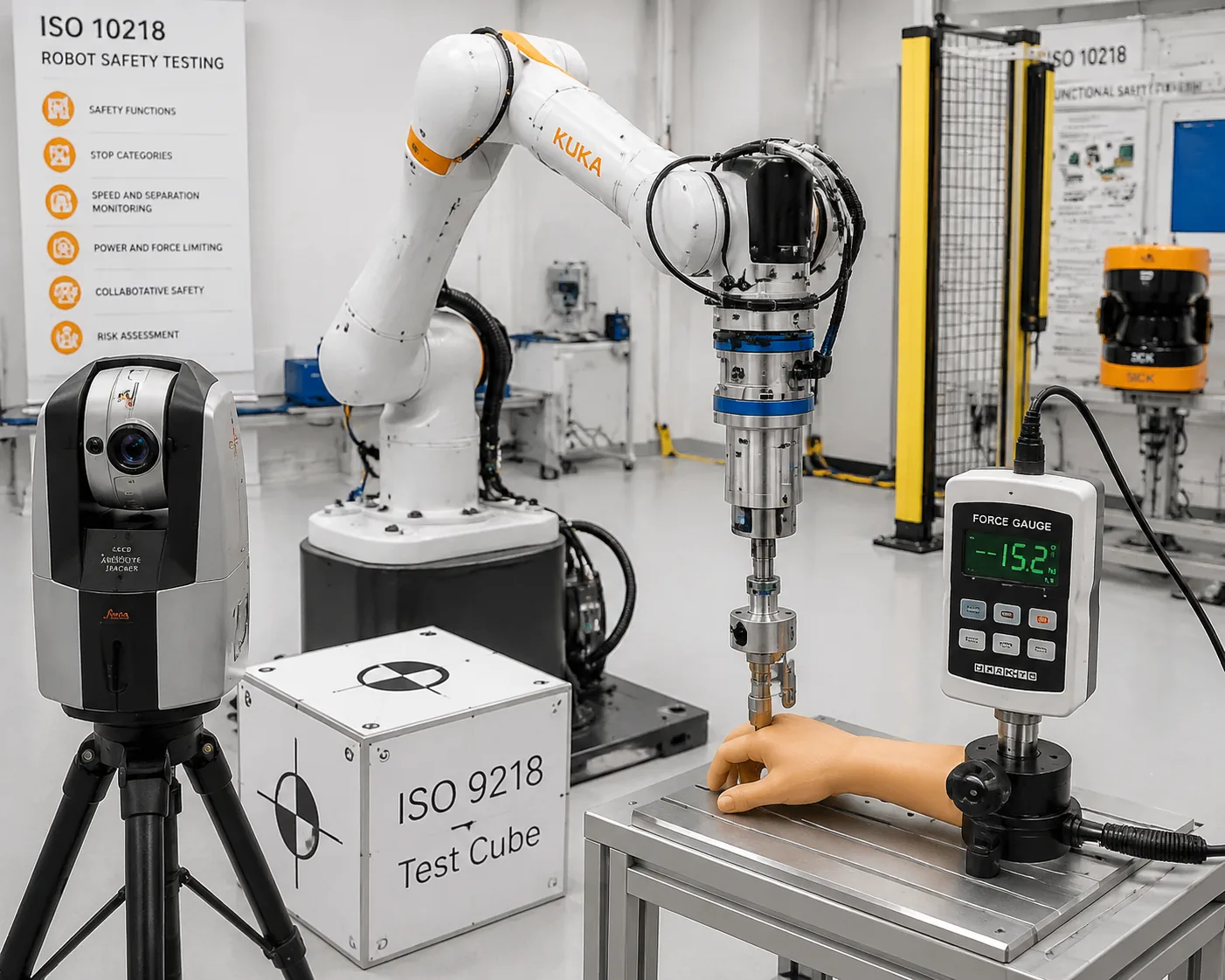
A complete industrial robot testing project draws on four interlocking standard families, with several product-specific overlays.
| Family | Core standards | Scope |
|---|---|---|
| ISO 10218 (international, robot safety) | 10218-1:2011 (robot) + 10218-2:2011 (system & integration); 10218-1:2025 (Edition 2, published) | Inherently safe design, safeguards, protective measures, information for use of industrial robots and integrated systems |
| ISO/TS 15066:2016 | Collaborative robot supplement to ISO 10218 | Biomechanical force/pressure thresholds for 29 body regions; quasi-static vs. transient contact; cobot-specific risk assessment |
| ISO 9283:1998 | Manipulating industrial robots — performance criteria and test methods | Position accuracy, repeatability, path accuracy, drift, warm-up |
| ISO 13849-1/-2:2015 | Safety of machinery — safety-related parts of control systems | Performance Level (PL) a-e for each safety function; validation |
| IEC 62061:2021 | Safety of machinery — functional safety of safety-related electrical/electronic/programmable electronic control systems | Safety Integrity Level (SIL) CL1-3 alternative to ISO 13849 |
| GB 11291 (China) | GB 11291.1-2011 (IDT ISO 10218-1:2006) + GB 11291.2-2013 (IDT ISO 10218-2:2011) | Mandatory for industrial robots on the Chinese market |
| GB/T 36008 | Collaborative robots (Chinese national standard) | Cobot-specific requirements in China |
| GB/T 5226.1 (IDT IEC 60204-1) | Industrial machine electrical equipment | Mandatory electrical safety for robot controllers in China |
| IEC 61000-6-2/-6-4 | EMC immunity / emission generic standards for industrial environments | Mandatory EMC for industrial robots |
| IEC 60529 | Ingress protection (IP) ratings | Dust/water sealing for the controller, manipulator, end-effector |
| ANSI/RIA R15.06-2012 | US national adoption of ISO 10218-1/-2:2011 | US market acceptance |
The single most consequential fact for a Chinese manufacturer is that GB 11291 is the Chinese mandatory equivalent of ISO 10218 — a robot placed on the Chinese market must satisfy GB 11291.1 (robot) and GB 11291.2 (integration), and a cobot must additionally satisfy GB/T 36008. The corresponding Chinese EMC standard is GB/T 17799.2 (industrial environment immunity) and the electrical equipment standard is GB/T 5226.1 (IDT IEC 60204-1). A test report against ISO 10218 is, in most respects, acceptable against GB 11291 if the laboratory holds the appropriate CMA and CNAS scope; the converse holds with the noted edition differences.
Functional safety and the four collaborative modes
The functional safety of an industrial robot is governed by ISO 10218 and, for collaborative operation, ISO/TS 15066. ISO 10218 defines four collaborative modes (sometimes called "collaborative technologies") that a cobot system may use to share workspace with a human:
| Mode | Operating principle | Typical use |
|---|---|---|
| Safety-rated Monitored Stop (SMS) | Robot motion stops when a human enters the safeguarded space; power remains on so operation can resume without a restart command | Manual loading of a workpiece while the robot holds position |
| Speed and Separation Monitoring (SSM) | Sensor (laser scanner, vision) tracks the human; robot dynamically reduces speed or stops before the human can reach the protective separation distance | Palletising, machine tending where the human enters occasionally |
| Power and Force Limiting (PFL) | Robot is designed so any contact with the human does not exceed the biomechanical thresholds of ISO/TS 15066; contact is permitted, but only below pain onset | Hand-guided assembly, sanding, polishing where contact is expected |
| Hand Guiding (HGC) | Worker directly guides the robot through a 3-position enabling device; the robot executes the programmed path under worker control | Heavy load positioning where the worker "drives" the robot to a location |
A cobot system typically combines modes — SSM with PFL is common, allowing high-speed operation when the worker is far away and slow PFL-compliant operation when the worker is close. The hand-over between modes must itself be a safety function, with the appropriate Performance Level. SMS, despite being listed as a "fourth" mode in the older RIA literature, is in practice used only in combination with the other three — it is the underlying stop function on which SSM, HGC, and PFL all rely.
Each mode triggers different test obligations. SSM requires validation of the protective separation distance calculation, the sensor response time, and the robot's worst-case stopping time and distance. PFL requires the biomechanical threshold measurements described in the next section. HGC requires validation of the enabling device, the hold-to-run logic, and the maximum speed in hand-guided mode (≤ 250 mm/s per ISO 10218). SMS requires validation of the standstill monitor and the response to any motion detected in the safeguarded space during the stop.
ISO/TS 15066 force and pressure thresholds by body region
The single most cited — and most often misquoted — piece of data in ISO/TS 15066 is the table of force and pressure thresholds that a PFL cobot must not exceed on contact with the human body. The standard divides the body into 29 regions and, for each region, specifies separate thresholds for quasi-static contact (a sustained clamping or crushing where the body part cannot recoil) and transient contact (a momentary impact where the body part is free to move away). The thresholds are based on the University of Mainz pain-onset study and are set to avoid pain, not merely to avoid injury. Selected representative values from ISO/TS 15066 Annex A:
| Body region | Quasi-static force (N) | Quasi-static pressure (N/cm²) | Transient force (N) | Transient pressure (N/cm²) |
|---|---|---|---|---|
| Skull / forehead | 130 | 110 | 175 | 150 |
| Face | 65 | 45 | 90 | 65 |
| Neck | 150 | 80 | 180 | 100 |
| Thorax (chest) | 140 | 120 | 210 | 160 |
| Abdomen | 110 | 80 | 160 | 110 |
| Pelvis | 160 | 120 | 210 | 150 |
| Upper arm | 150 | 100 | 210 | 140 |
| Lower arm | 150 | 90 | 220 | 140 |
| Hand (palm) | 140 | 200 | 220 | 260 |
| Hand (back) | 100 | 100 | 180 | 180 |
| Fingertip | 100 | 200 | 140 | 250 |
| Thigh | 160 | 130 | 220 | 170 |
| Lower leg | 130 | 100 | 170 | 130 |
The values are not absolute ceilings; they are the maximum permitted contact force and pressure for that body region and contact type, and a PFL system must remain below them under worst-case contact (largest moving mass, highest speed in PFL mode, sharpest contact geometry). The two-to-three-fold higher transient thresholds reflect the body's ability to absorb momentary impacts without pain; the quasi-static thresholds are the binding constraint for any PFL application that can clamp or trap a body part against a fixture. A laboratory tests these thresholds using a force-and-pressure sensing device (a spring-loaded pressure sensor with a calibrated contact area of 1 cm² or 2 cm²) applied at each body-region contact point, at each PFL operating speed, with the worst-case end-effector and payload.
ISO/TS 15066 also provides, in Annex A.4, an alternative energy-based limit: the maximum permissible kinetic energy of the moving robot mass on transient contact, derived from the same pain-onset data. This energy-based formulation is preferred when the contact geometry is sharp or unknown, because it directly bounds the energy transferred to the body regardless of contact area.
ISO 9283 performance testing: accuracy, repeatability, path
Beyond safety, a robot's commercial value is determined by its positioning performance, measured per ISO 9283:1998. The standard defines five primary performance characteristics and the standardised procedures for measuring them. All measurements are taken inside the ISO test cube — the largest cube that fits inside the robot's workspace — at five Standard Test Positions within the cube (P1 the centre, P2-P5 the corners of a single diagonal plane), with 30 repetitions per measurement to compute the statistics.
| Characteristic | Symbol | Definition |
|---|---|---|
| Position accuracy | AP | The deviation between the commanded position and the mean of the attained positions, in 3-D, expressed as AP = √[(x̄-x_c)² + (ȳ-y_c)² + (z̄-z_c)² |
| Position repeatability | RP | The radius of the sphere centred on the mean attained position that contains 4 standard deviations of the attained positions; RP = k̄ + 3·S_k, the ball-bar test |
| Path accuracy | AT | The maximum deviation between the commanded path and the actual mean path, measured continuously along the trajectory |
| Pose stabilisation time | — | The time from the commanded arrival to when the robot settles within a defined tolerance band |
| Drift of pose / warm-up | — | The change in attained position over time at a fixed commanded pose, measured over the warm-up period |
Of these, RP is by far the most reported in robot data sheets, because in pick-and-place, welding, and assembly, returning to the same point every time is more important than hitting an absolute coordinate. The ISO 9283 RP test, run with a laser tracker or coordinate measuring machine (CMM) sampling at ≥ 50 Hz, generates a 30-point cloud per pose; RP is the radius of the sphere centred on the cloud centroid that contains 4·S_k of the points (k = distance of each point from the centroid). Modern 6-axis industrial robots quote RP in the range ±0.02 to ±0.1 mm; cobots typically ±0.03 to ±0.1 mm; large-payload robots up to ±0.2 mm. A robot whose measured RP exceeds its data-sheet value fails the ISO 9283 test, and the failure must be investigated (mechanical backlash, joint encoder drift, controller tuning) before the robot ships.
Functional safety: ISO 13849 PL and IEC 62061 SIL
Every safety function on an industrial robot — the emergency stop, the protective stop, the safety-rated monitored stop, the safety door interlock, the speed and separation monitoring response, the PFL torque limit, the enabling device logic — is a safety-related control function that must achieve a specified level of reliability. Two standards provide the reliability framework; either may be used, although ISO 13849 (the Performance Level framework) is the more common choice for robots.
| Standard | Reliability measure | Levels | Risk-driven assignment |
|---|---|---|---|
| ISO 13849-1:2015 | Performance Level (PL) | PL a (lowest) to PL e (highest) | Risk assessment assigns PLr (required); the safety function must achieve PL ≥ PLr |
| IEC 62061:2021 | Safety Integrity Level (SIL CL) | SIL CL 1 to SIL CL 3 | Risk assessment assigns SIL; the safety function must achieve SIL ≥ SIL required |
Typical PLr assignments for industrial robot safety functions, per RIA TR R15.306 and ISO 10218-1:2011:
| Safety function | Typical PLr (ISO 13849) | Rationale |
|---|---|---|
| Emergency stop | PLr e (SIL 3) | Highest — single safety function relied on to stop a serious hazard in any mode |
| Protective stop (category 0 or 1) | PLr e (SIL 3) | Highest — primary stop relied on during integration, programming, and operation |
| Safety-rated monitored stop (SMS) | PLr d (SIL 2) | Stop function used in collaborative operation; requires reliable standstill detection |
| Speed and separation monitoring (SSM) | PLr d (SIL 2) | Safety-rated sensor + safety-rated speed monitoring |
| Power and force limiting (PFL) | PLr d (SIL 2) | Safety-rated torque / force feedback; must keep contact below ISO/TS 15066 thresholds |
| Hand guiding (HGC) enabling device | PLr d (SIL 2) | 3-position enabling device, hold-to-run, ≤ 250 mm/s |
| Safety door interlock | PLr d (SIL 2) | Prevents automatic operation with a guard open |
| Soft-axis limit / space limiting | PLr d (SIL 2) | Software-defined workspace envelope |
A safety function achieves its PL by combining: the architecture category (B, 1, 2, 3, or 4 — single channel, single channel with monitoring, dual channel with monitoring), the Mean Time To dangerous Failure (MTTF_d) of the components, the Diagnostic Coverage (DC) of the test mechanisms, and the Common Cause Failure (CCF) score. The PL calculation per ISO 13849-1 Annex K is reported in the functional safety file, and the safety function is validated by fault injection testing per ISO 13849-2. The functional safety file is the most-queried single document during a CE Machinery Directive review and an FDA submission.
Electromagnetic compatibility (EMC) testing
A robot is a significant source — and victim — of electromagnetic interference. The motor drives produce conducted and radiated emissions through the PWM switching of high-current IGBTs; the controllers, encoders, and safety busses must remain immune to the radiated fields, fast transients, and ESD events that pervade an industrial environment. EMC testing per the IEC 61000 series is mandatory under the EU EMC Directive 2014/30/EU and is enforced by NMPA in China via GB/T 17799.2 (immunity) and GB/T 17799.4 or product-family emission standards.
| Test | Standard | Pass criterion |
|---|---|---|
| Conducted emissions (AC power port) | CISPR 11 / GB 4824, Class A (industrial) or Class B (residential) | Below the Class limit line across 150 kHz – 30 MHz |
| Radiated emissions (enclosure port) | CISPR 11 / GB 4824, Class A or B | Below the Class limit line across 30 MHz – 1 GHz, measured at 10 m (Class A) or 3 m (Class B) in a semi-anechoic chamber |
| Immunity — electrostatic discharge (ESD) | IEC 61000-4-2 / GB/T 17626.2 | Performance criterion B at ± 4 kV contact / ± 8 kV air |
| Immunity — radiated RF field | IEC 61000-4-3 / GB/T 17626.3 | Performance criterion A at 10 V/m (industrial) |
| Immunity — electrical fast transient (EFT) | IEC 61000-4-4 / GB/T 17626.4 | Performance criterion B at ± 2 kV (power port) |
| Immunity — surge | IEC 61000-4-5 / GB/T 17626.5 | Performance criterion B at ± 1 kV line-to-line / ± 2 kV line-to-ground |
| Immunity — conducted disturbance | IEC 61000-4-6 / GB/T 17626.6 | Performance criterion A at 10 V (industrial) |
A "performance criterion A" pass means the robot continues to operate as intended during the disturbance; "B" means a temporary degradation or function loss that self-recovers; "C" means a permanent loss that requires operator intervention (and is generally a fail for a safety function). For a robot's safety functions the criterion is effectively A — the safety function must not mis-trigger or fail to trigger under any industrial-environment EMI scenario, because the consequence can be uncontrolled motion into a human worker.
Environmental and ingress protection (IP) testing
Robots deployed outside a clean factory cell — in food processing, outdoor logistics, agriculture, or marine applications — must withstand environmental stress. The relevant tests are the IP rating per IEC 60529 (Chinese adoption GB/T 4208) for dust and water ingress, plus climatic, shock, and vibration tests per the IEC 60068 series or, for military-derived applications, MIL-STD-810.
| Test | Standard | Typical requirement |
|---|---|---|
| Solid particle ingress (first IP digit) | IEC 60529 / GB/T 4208 | IP5X (dust-protected) for factory; IP6X (dust-tight) for food processing |
| Water ingress (second IP digit) | IEC 60529 / GB/T 4208 | IPX4 (splashing) for factory; IPX7 (1 m immersion, 30 min) or IPX9K (high-pressure jetting) for food and outdoor |
| Operating temperature range | IEC 60068-2-1/-2 | Typically +5 °C to +40 °C for indoor; –20 °C to +50 °C for outdoor |
| Damp heat steady state | IEC 60068-2-78 / GB/T 2423.3 | 40 °C / 93 % RH, 4 to 21 days — typically required by GB/T 5226.1 for controllers |
| Shock | IEC 60068-2-27 / GB/T 2423.5 | 15 g, 11 ms half-sine, in each axis |
| Vibration (sinusoidal) | IEC 60068-2-6 / GB/T 2423.10 | 1 g, 10-500 Hz sweep, in each axis (operating); 2 g (non-operating, transport) |
The IP rating is per-port (controller, manipulator joints, end-effector) and the lowest-rated port on the robot system determines the system rating. A robot whose end-effector is IP67 but whose wrist joint is IP54 carries an IP54 system rating — a common trap when a robot system is reconfigured with a new end-effector.
Medical and surgical robotics: the IEC 60601 overlay
A medical robot — a surgical robot, a rehabilitation exoskeleton, a robotic surgery assistant — is simultaneously an industrial robot and a medical electrical (ME) device. It must comply with the industrial robot safety stack (ISO 10218, ISO/TS 15066 where applicable) and the medical device stack, the latter being IEC 60601-1:2005 + A1:2012 + A2:2020 (general ME safety) plus the robot-specific particular IEC 80601-2-77:2019 (surgical robots) and the medical-device software standard IEC 62304:2006 + A1:2015.
| Standard | Title | Scope |
|---|---|---|
| IEC 60601-1:2005 + A1:2012 + A2:2020 | Medical electrical equipment — general requirements | Electrical safety, mechanical safety, thermal safety, essential performance |
| IEC 80601-2-77:2019 | Particular requirements for surgically invasive medical robots | Robot-specific surgical safety, motion accuracy, emergency removal |
| IEC 62304:2006 + A1:2015 | Medical device software — software life cycle processes | Software safety class A/B/C; required by FDA and NMPA |
| ISO 14971:2019 | Application of risk management to medical devices | Risk management file — mandatory |
| YY 9706.277-2023 (China) | IDT IEC 80601-2-77 | Chinese national standard for surgically invasive robots |
| YY/T 0664-2020 (China) | Medical device software lifecycle | Chinese adoption of IEC 62304 framework |
The NMPA registration pathway for a surgical robot requires the full medical-device type-test report set: GB 9706.1 (general ME safety) + YY 9706.277 (robot-specific) + YY 0505 / IEC 60601-1-2 EMC + software lifecycle documentation per YY/T 0664 + clinical evaluation. A medical robot NMPA dossier that omits any of these is incomplete. The FDA pathway similarly requires IEC 60601-1 plus IEC 80601-2-77 plus IEC 62304 software documentation, plus the FDA's own premarket submission (510(k) or De Novo or PMA) for the robot's intended use.
Personal care and mobile service robots: ISO 13482 and ISO 18646
Robots that are not industrial — personal care robots (mobile servant robots, person-carrier robots, physical assistant robots) and mobile service robots (AMRs, AGVs) — fall outside ISO 10218 and are governed by a different standard set. ISO 13482:2019 is the safety standard for personal care robots; ISO 18646-1/-2/-3 are the performance measurement standards for service robots (lower-body locomotion, upper-body manipulation, whole-body manipulation). Mobile robots are additionally subject to ISO 3691-4:2023 (driverless industrial trucks — AGVs and AMRs), which defines their safety requirements and verification methods in shared industrial spaces.
The Chinese adoption is GB/T 36593 (mobile service robots) and GB/T 38117 (personal care robot safety). An autonomous mobile robot deployed in a warehouse or hospital is subject to ISO 3691-4 / GB/T 38117 in addition to any industrial robot standard if it carries a manipulator arm — a complex dual-standard scenario that a testing laboratory experienced in both families must handle.
Regulatory pathways: CE Machinery Directive, FDA, NMPA
| Market | Framework | Key requirements |
|---|---|---|
| EU | Machinery Directive 2006/42/EC + EMC Directive 2014/30/EU | CE marking; Declaration of Incorporation (Annex II 1 B) for the robot itself and Declaration of Conformity for the integrated system; ISO 10218 + ISO/TS 15066 type-test reports; functional safety file (PL/SIL); TCF (Technical Construction File) |
| US | OSHA 29 CFR 1910 Subpart O; ANSI/RIA R15.06-2012; UL 1740 | UL/CSA electrical safety; ANSI/RIA conformity; OSHA compliance at the workplace |
| China (NMPA for medical; SAMR for non-medical) | GB 11291.1 + GB 11291.2 + GB/T 36008 + GB/T 5226.1 + GB/T 17799.2 | CMA + CNAS accredited type-test reports; CCC certification for some electrical components; medical robots additionally GB 9706.1 + YY 9706.277 + YY/T 0664 + NMPA registration |
A robot heading for all three markets therefore needs three parallel conformity assessments: the EU CE Machinery Directive file, the US UL/ANSI/OSHA file, and the Chinese GB 11291 + GB/T 36008 + GB/T 17799.2 + GB/T 5226.1 type-test reports. A testing laboratory that can produce a single consolidated test report set — with parallel ISO 10218 / GB 11291 / ANSI/RIA test data, functional safety file, EMC data, and environmental data — eliminates the duplication that drives most of the cost and timeline of multi-market robot certification.
FAQ
What standards apply to industrial robot testing?
The core safety stack is ISO 10218-1 (robot) and ISO 10218-2 (system integration), supplemented by ISO/TS 15066 for collaborative operation, ISO 9283 for performance, ISO 13849 or IEC 62061 for functional safety, IEC 61000 for EMC, and IEC 60529 for IP rating. In China the equivalents are GB 11291.1, GB 11291.2, GB/T 36008, GB/T 5226.1, and GB/T 17799.2.
What are the four collaborative modes of a cobot?
Safety-rated Monitored Stop (SMS), Speed and Separation Monitoring (SSM), Power and Force Limiting (PFL), and Hand Guiding (HGC). A cobot system typically combines modes — SSM with PFL is common — and each mode has its own test obligations under ISO 10218 and ISO/TS 15066.
What are the ISO/TS 15066 force thresholds?
For each of 29 body regions ISO/TS 15066 specifies separate quasi-static and transient thresholds for both force (N) and pressure (N/cm²), based on the University of Mainz pain-onset study. Representative values: skull 130 N quasi-static / 175 N transient; thorax 140 / 210; hand palm 140 / 220; fingertip 100 / 140. A PFL cobot must remain below the threshold for the worst-case body region, contact type, speed, and geometry.
What is the difference between ISO 13849 PL and IEC 62061 SIL?
Both measure the reliability of a safety-related control function; either framework may be used. ISO 13849 assigns Performance Level PL a-e based on category, MTTF_d, DC, and CCF. IEC 62061 assigns Safety Integrity Level SIL CL 1-3 based on hardware fault tolerance and the probability of dangerous failure per hour. For industrial robots the typical requirement is PLr d (SIL CL 2) for collaborative safety functions and PLr e (SIL 3) for emergency and protective stop.
Does a medical robot need both ISO 10218 and IEC 60601?
Generally yes. A surgical robot is both an industrial robot (motion, force, end-effector hazards) and a medical electrical device (patient-connected electrical safety, essential performance). The typical submission combines IEC 60601-1 + IEC 80601-2-77 + IEC 62304 + ISO 14971, with the robot-specific motion-safety requirements drawn from ISO 10218 / ISO/TS 15066 where the medical-device particulars do not cover them.
Our industrial robot testing capabilities
Beijing ZKGX Research (ISO/IEC 17025 accredited, CMA- and CNAS-accredited testing laboratory) provides complete industrial and collaborative robot testing against the international and Chinese standard stack:
- ISO 10218-1 / GB 11291.1 robot safety — inherently safe design verification, safeguard verification, protective-stop verification, single-fault testing.
- ISO 10218-2 / GB 11291.2 system integration safety — safeguarding, interlock, enable device, reduced-speed (≤ 250 mm/s) verification in teach mode.
- ISO/TS 15066 / GB/T 36008 cobot — PFL biomechanical threshold testing at all 29 body regions, quasi-static and transient, with force/pressure sensing equipment and worst-case end-effector and payload; SSM protective-separation distance validation; HGC enabling-device verification; SMS standstill monitoring.
- ISO 9283 performance — position accuracy (AP), position repeatability (RP), path accuracy (AT), pose stabilisation time, drift and warm-up, measured inside the ISO test cube with a laser tracker or CMM at 5 standard test positions and 30 repetitions.
- ISO 13849-1/-2 functional safety — PLr assignment per safety function, PL calculation (category, MTTF_d, DC, CCF), fault injection validation.
- IEC 62061 functional safety — SIL CL assignment and validation as an alternative to ISO 13849.
- EMC — conducted and radiated emissions per CISPR 11 / GB 4824, immunity per IEC 61000-4-2/-3/-4/-5/-6 / GB/T 17799.2, in a 3-m semi-anechoic chamber.
- Environmental — IP rating per IEC 60529 / GB/T 4208; damp heat per IEC 60068-2-78 / GB/T 2423.3; shock and vibration per IEC 60068-2-27/-2-6 / GB/T 2423.5/.10.
- Medical robots — IEC 60601-1 / GB 9706.1 electrical safety, IEC 80601-2-77 / YY 9706.277 surgical-robot particular, IEC 62304 / YY/T 0664 software lifecycle, ISO 14971 risk management, for NMPA and FDA submission.
- Mobile service robots — ISO 13482 / GB/T 38117 personal care robot safety, ISO 18646 service robot performance, ISO 3691-4 driverless industrial truck safety.
Suitable product categories include: 6-axis articulated robots; SCARA robots; Cartesian / gantry robots; parallel / Delta robots; collaborative robots (PFL, SSM, HGC, SMS modes); AGVs and AMRs; mobile manipulators; surgical robots; rehabilitation and assistive exoskeletons; service robots for commercial, healthcare, and domestic use. Each project is delivered with a full data report (test protocol, instrument calibration, raw measurement data, single-fault simulation, performance statistics, functional safety file, EMC and environmental data, classification conclusion) in English and/or Chinese, with CMA/CNAS stamping, ready for direct submission to EU notified bodies, FDA, OSHA, or NMPA. Contact Beijing ZKGX Research to scope the test battery applicable to your robot and target market.