Infant cradle testing is essential for ensuring the safety of babies during their most vulnerable early months. A baby cradle can be a game-changer for both parents and infants, providing a cozy little spot where babies can relax and parents can catch much-needed breaks. However, this only works if the cradle meets rigorous safety standards.
Infant cradles are classified as durable infant or toddler products under the Consumer Product Safety Improvement Act of 2008. This classification mandates comprehensive testing to protect infants from potential hazards. Small design flaws or manufacturing defects can result in serious injuries, making thorough testing critical before products reach consumers.
Testing ensures:
- Structural integrity under various load conditions
- Safe sleep environments free from suffocation hazards
- Stable operation during rocking or swinging functions
- Freedom from hazardous materials and sharp edges
- Compliance with federal safety regulations
Parents rely on testing to make informed purchasing decisions. Without proper testing, manufacturers risk product recalls, liability issues, and most importantly, infant injuries.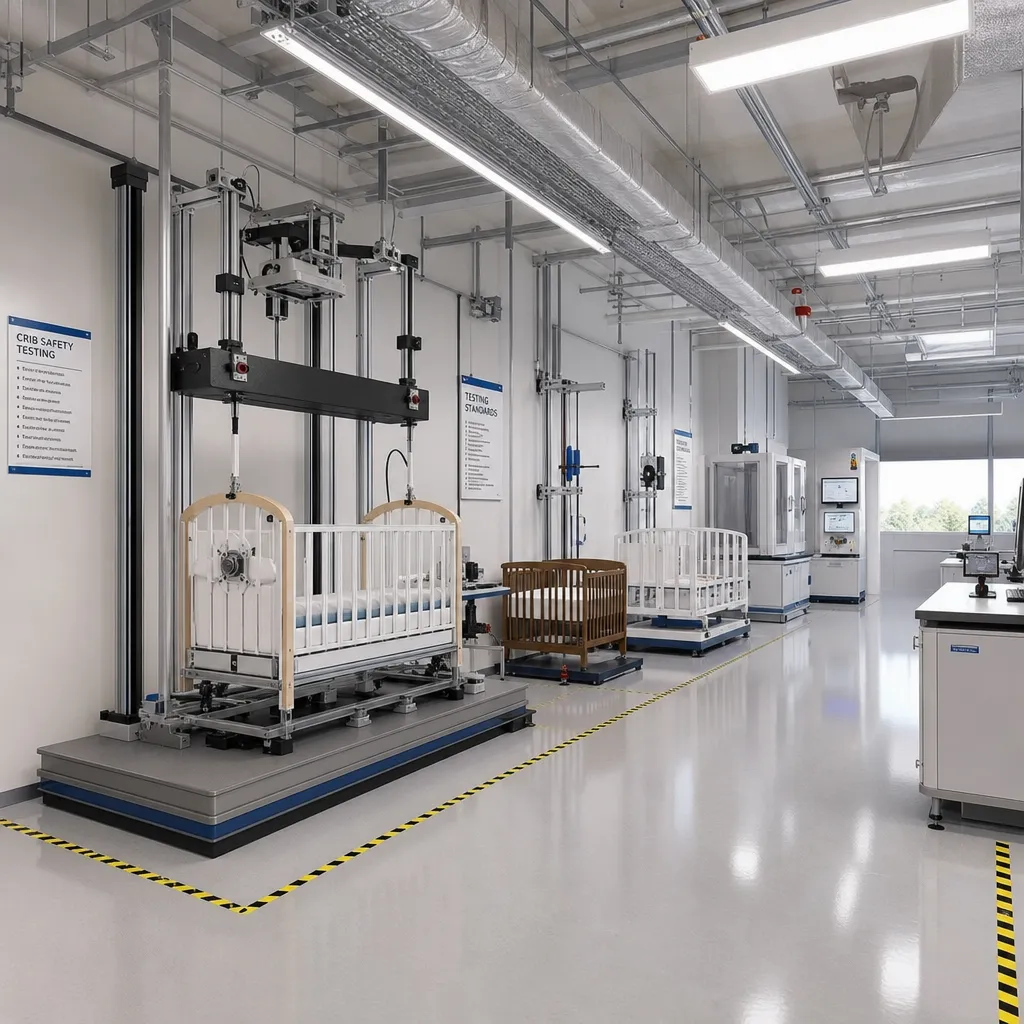
What Safety Standards Govern Infant Cradles?
Infant cradle safety in the United States is governed by 16 C.F.R. Part 1218, which incorporates ASTM F2194 by reference. Section 104(b)(1) of the Consumer Product Safety Improvement Act of 2008 requires the CPSC to promulgate safety rules for durable infant or toddler products.
Current Mandatory Standard
Effective February 21, 2026:
- ASTM F2194-25 is mandatory
- Published in 90 FR 57691
- Replaces previous versions with updated requirements
Previous Versions:
- April 23, 2014: ASTM F2194-13 with modification
- Published in 78 FR 63019
Scope of the Standard
A bassinet/cradle is defined as a small bed designed primarily to provide sleeping accommodations for infants, supported by:
- Freestanding legs
- Stationary base/stand/frame
- Wheeled base
- Rocking base
- Base which can swing relative to a stationary base
While in a rest position, a bassinet/cradle must have a head-to-toe sleep surface less than or equal to 10 degrees from horizontal.
Accessories and Convertible Products
ASTM F2194 also includes requirements for:
- Bassinets that are accessories to play yards
- Bassinets that are accessories to non-full-size cribs
- Convertible products with a bassinet/cradle mode
These accessories must meet both the bassinet and cradle standard in addition to the standard for the primary product.
What Are the General Requirements for Cradle Testing?
General requirements for infant cradle testing address fundamental safety hazards that apply across all product designs. These requirements protect infants from common injury mechanisms.
Lead in Paints
All painted surfaces must comply with lead content limits:
- Maximum 90 ppm lead in paint
- Additional guidance available on lead in paint business guidance page
- Testing must verify compliance through certified laboratories
Hazardous Sharp Edges or Points
Products must be free from:
- Sharp edges that could cut skin
- Sharp points that could puncture
- Burrs or metal slivers
- Reference: 16 C.F.R. §§ 1500.3(b)(4)(i)(D) and 1500.3(b)(15)(i)(A)
Small Parts
Testing must verify:
- No small parts that could detach
- Protection against choking hazards
- Special attention to toys and decorative elements
- Reference: Small parts business guidance page
Wood Parts
Wood components must meet requirements for:
- Smooth surface finish
- No splinters or cracks
- Proper fastening of joints
- Absence of toxic coatings
Scissoring, Shearing, and Pinching
Testing identifies potential for:
- Scissoring actions between moving parts
- Shearing hazards from folding mechanisms
- Pinching points that could trap fingers
- Crush hazards at hinge locations
Unintentional Folding
Products must prevent:
- Accidental collapse during use
- Unexpected folding mechanisms
- Lock failures that could drop the infant
Openings
Testing ensures:
- No entrapment hazards in openings
- Appropriate opening sizes prevent head entrapment
- Mesh openings meet size requirements
- Fabric-sided enclosed openings comply with standards
Fasteners
All fasteners must be:
- Properly sized for the application
- Securely attached
- Resistant to loosening during use
- Tested for pull-out strength
Corner Posts
Corner posts must:
- Not extend more than 1.5 mm above the upper surface
- Be free from projections that could catch clothing
- Not present strangulation hazards
Toys
Any toy accessories must:
- Meet applicable children's toy requirements
- Be tested for choking hazards
- Comply with ASTM F963 toy safety standard
What Performance Tests Apply to Infant Cradles?
Performance tests evaluate cradle safety under realistic use conditions to verify structural integrity and hazard protection. Each test targets specific potential failure modes.
Spacing of Rigid Sided Components
Testing ensures:
- Proper spacing between rigid components
- No entrapment hazards at joints and seams
- Consistent gaps throughout the product
Openings for Mesh/Fabric Sided Cradles
Mesh and fabric sided products must:
- Have appropriately sized openings
- Prevent finger or toe entrapment
- Maintain structural integrity under load
Static Load Testing
Products must withstand:
- Specified weight loads without failure
- Distribution of weight across sleep surface
- Load applied at multiple positions
- Duration specified by test protocol
Stability Testing
Cradles must resist:
- Tip-over when force is applied at edges
- Rolling or sliding on floor surfaces
- Movement when weight shifts
- Lateral instability during use
Mattress Testing
Mattress requirements include:
- Firmness to prevent suffocation
- Proper fit without gaps
- Thickness within specified limits
- Flat surface for safe sleeping
Side Height Testing
Side heights must:
- Prevent infant rollover
- Meet minimum height requirements
- Be tested at multiple positions
- Account for mattress compression
Sleeping Pad Testing
If a sleeping pad is used:
- Must meet minimum thickness requirements
- Must provide adequate support
- Must not create gaps with side walls
Protective Components
Guardrails and protective elements must:
- Prevent falls
- Withstand impact forces
- Remain securely attached
- Not present new hazards
Bassinets with Segmented Mattresses
Flatness testing ensures:
- No gaps between segments
- Continuous sleep surface
- No entrapment between segments
Rock/Swing Angle Testing
Rocking and swinging features must:
- Stay within specified angle limits
- Prevent excessive tilting
- Maintain stability during motion
- Lock securely when stationary
Bassinet Structural Elements
Structural testing evaluates:
- Sidewall integrity under load
- Occupant support capability
- Minimum height requirements
- Connection strength between components
Sleep Surface Angle Testing
Angles must be verified:
- Head-to-toe sleep surface: ≤10 degrees from horizontal
- Lateral sleep surface angle within limits
- Tested under loaded and unloaded conditions
Electrical and Battery Powered Features
Electrical components must:
- Meet applicable electrical safety standards
- Prevent shock hazards
- Have proper battery compartment security
- Function safely under normal use
Aftermarket Mattresses
Testing of aftermarket mattresses ensures:
- Compatibility with specific cradle models
- Proper fit without gaps
- Appropriate firmness level
- No compromise of safety features
How Are Stability Tests Conducted on Cradles?
Stability testing verifies that cradles remain upright and secure during normal use and reasonable misuse scenarios. Tests simulate conditions that could cause tip-overs.
Tip-Over Resistance
Testing procedures:
- Apply force at edge of sleep surface
- Measure angle at which tip occurs
- Verify product returns to stable position
- Test multiple directions and positions
Base Stability
Requirements include:
- Contact area with floor surface
- Resistance to sliding on smooth surfaces
- Performance on carpeted surfaces
- Stable operation on level ground
Movement Stability
Testing verifies:
- Cradle doesn't roll unexpectedly on wheeled models
- Rocking motion stays within bounds
- Swinging feature remains controlled
- Locking mechanisms function properly
Load Distribution
Stability tests account for:
- Weight distributed across sleep surface
- Off-center loading conditions
- Dynamic loads from infant movement
- Maximum rated weight capacity
What Mattress and Sleep Surface Testing Is Required?
Mattress and sleep surface testing ensures infants have safe, supportive, and hazard-free sleeping environments. These tests address suffocation and entrapment risks.
Mattress Firmness
Firmness testing:
- Measures resistance to compression
- Prevents soft surfaces that could conform to infant face
- Uses standardized test weights and methods
- Verifies airway protection
Mattress Fit
Fit requirements:
- Mattress must fill entire sleep surface
- No gaps greater than specified limits at edges
- Mattress stays in position during use
- Compatible with product dimensions
Mattress Thickness
Thickness standards:
- Minimum thickness for support
- Maximum thickness for safety
- Consistent thickness across surface
- No lumps or indentations
Flatness Testing
Sleep surfaces must:
- Remain flat when loaded
- Not create depressions that trap infants
- Maintain angle within specifications
- Support infant in safe sleeping position
Sleep Surface Dimensions
Testing verifies:
- Adequate length for growing infant
- Appropriate width for movement
- Depth suitable for containment
- Transition to crib timing guidance
How Are Rock and Swing Features Tested?
Rocking and swinging features require specialized testing to ensure safe motion without creating hazards. Tests evaluate both mechanical function and safety limits.
Rock/Swing Angle Limits
Testing measures:
- Maximum tilt angle from horizontal
- Range of motion during operation
- Stability at extreme positions
- Return to rest position
Locking Mechanisms
Locks must:
- Secure the cradle in stationary position
- Prevent unintended motion
- Be accessible and easy to operate
- Remain engaged under load
Motion Control
Features must:
- Provide smooth, even motion
- Not jerk or stop abruptly
- Stay within speed limits for motorized models
- Allow manual control when needed
Mechanical Integrity
Moving parts are tested for:
- Durability under repeated use
- Resistance to wear and fatigue
- Secure attachment to frame
- Absence of pinch points
Overuse Prevention
Testing considerations:
- Motor shut-off timers on powered models
- Warning labels about use duration
- Guidance on appropriate swinging speed
- Recognition of overstimulation signs
What Labeling Requirements Apply to Infant Cradles?
Permanent labeling requirements ensure products can be identified and consumers can receive safety information. Per 16 C.F.R. § 1130.4, specific information must be permanently affixed.
Required Label Information
Labels must include in English:
- Name of domestic manufacturer or importer
- Contact information with US address and phone number
- Toll-free number if available
- Model name and/or number
- Date of manufacture (month and year minimum)
- Product identification number may substitute for model identification
Tracking Labels
In addition to durable product labeling:
- Products must have tracking labels per children's product requirements
- Labels enable identification of production lot
- Assist in recall coordination if needed
Warning Labels
Products must include warnings about:
- Weight and age limits
- Proper use instructions
- Transition to crib timing
- Sleep surface angle limits
- Supervision requirements
Registration Forms
All durable infant products must include:
- Product registration form
- Pre-paid postage option
- Online registration alternative
- Manufacturer contact information
Registration enables manufacturers or retailers to contact consumers with recall or safety information.
How to Choose a Safe Infant Cradle
Choosing a safe infant cradle requires understanding testing standards and evaluating product compliance. Parents should look for specific safety features and certifications.
Verify Certification
Check for:
- Children's Product Certificate (CPC)
- Testing to ASTM F2194 standard
- Compliance with 16 CFR Part 1218
- Third-party laboratory testing
Check Weight and Age Limits
Verify that:
- Limits are clearly marked on product
- Limits match your infant's size
- You understand when to transition to crib
- Product accommodates your planned use period
Inspect Construction Features
Look for:
- Stable base with wide stance
- Firm, tight-fitting mattress
- Smooth surfaces without sharp edges
- Secure locking mechanisms on rocking features
- Proper mesh size if fabric sided
Avoid Common Mistakes
Don't:
- Use soft mattresses or thick bedding
- Ignore weight and age limits
- Place cradle near hazards
- Leave baby unsupervised
- Overuse swinging features
Proper Placement
Place cradle:
- On flat, level surface
- Away from windows and cords
- Clear of furniture edges
- In area with good ventilation
- Away from direct sunlight or heat sources
Common Testing Mistakes to Avoid
Manufacturers and testing laboratories must avoid common mistakes that could compromise product safety. Understanding these errors helps prevent failures.
Inadequate Testing Coverage
Avoid:
- Testing only best-case scenarios
- Skipping performance tests
- Neglecting stability testing
- Ignoring accessory testing requirements
Improper Sample Selection
Ensure:
- Production samples, not prototypes
- Multiple units tested
- Representative of actual production
- Correct product configuration
Incomplete Documentation
Maintain:
- Full test reports
- Photographs of test setups
- Pass/fail determinations
- Traceability to standards
Missing Regulatory Updates
Stay current with:
- Standard revisions
- Effective dates for new requirements
- CPSC guidance updates
- ASTM ballot results
Inadequate Quality Control
Implement:
- Production testing programs
- Incoming material inspection
- Process controls
- Final product verification
Conclusion
Comprehensive infant cradle testing ensures products meet federal safety requirements and protect vulnerable infants during sleep. From structural integrity tests to stability evaluations, from mattress requirements to labeling compliance, each aspect of testing contributes to safer products.
Manufacturers must ensure products are tested by CPSC-accepted third-party laboratories and certified with Children's Product Certificates. Parents should verify compliance when purchasing and follow all usage instructions to maintain safety.
The February 2026 effective date for ASTM F2194-25 provides updated requirements that manufacturers must meet. Understanding these standards helps ensure infant cradles provide safe sleeping environments during the critical early months of life.