Table of Contents
- What is laser equipment testing?
- The classification system: seven classes under IEC 60825-1
- Accessible Emission Limits (AELs): the numerical thresholds
- The measurement geometry: apertures, conditions, and the 100 mm rule
- Single-fault condition testing
- The test parameters your laboratory must measure
- Which standards apply: IEC, GB, EN, FDA, and the product-specific overlays
- Medical lasers: the IEC 60601-2-22 / GB 9706.222 / YY 0507 stack
- Consumer and toy lasers: EN 50689
- NOHD and MPE: extending the classification outdoors
- Marking, labelling, and user information
- FAQ
- Our laser equipment testing capabilities
What is laser equipment testing?
Laser equipment testing is the measurement and classification of a laser product's accessible radiation against the safety limits defined in IEC 60825-1 (international) and its Chinese adoption GB 7247.1-2012 / GB/T 7247.1-2024, with product-specific overlays for medical lasers (IEC 60601-2-22 / GB 9706.222-2022), consumer and toy lasers (EN 50689 / GB 19865), optical fibre communication systems (IEC 60825-2 / GB 7247.12), and free-space optical communication (IEC 60825-12 / GB 7247.13). The output of a laser equipment test is a classification — Class 1, 1M, 1C, 2, 2M, 3R, 3B, or 4 — that defines the legal hazard level of the product and dictates its labelling, user-information, and engineering-control requirements.
A laser is a source of intense, coherent, directional optical radiation. Its applications run from the trivial (barcode scanner, laser pointer, optical disc drive) to the surgical (ophthalmic LASIK, dermatologic resurfacing, dental soft-tissue ablation) to the industrial (cutting, welding, marking, additive manufacturing). The same directivity and intensity that makes a laser useful makes it hazardous — the energy density delivered to the retina by even a 5 mW visible laser is sufficient to cause irreversible photothermal retinal burns within the blink reflex window. Laser equipment testing exists to ensure that every product on the market has been measured, compared against the published accessible-emission limits, classified to the correct hazard class, and labelled accordingly — before it reaches a user. A laser product placed on the Chinese market without a valid classification to GB 7247.1 / GB/T 7247.1, or on the EU market without EN 60825-1 / EN 50689, or on the US market without a 21 CFR 1040.10 product report on file with FDA CDRH, is non-compliant and subject to recall.
The classification system: seven classes under IEC 60825-1
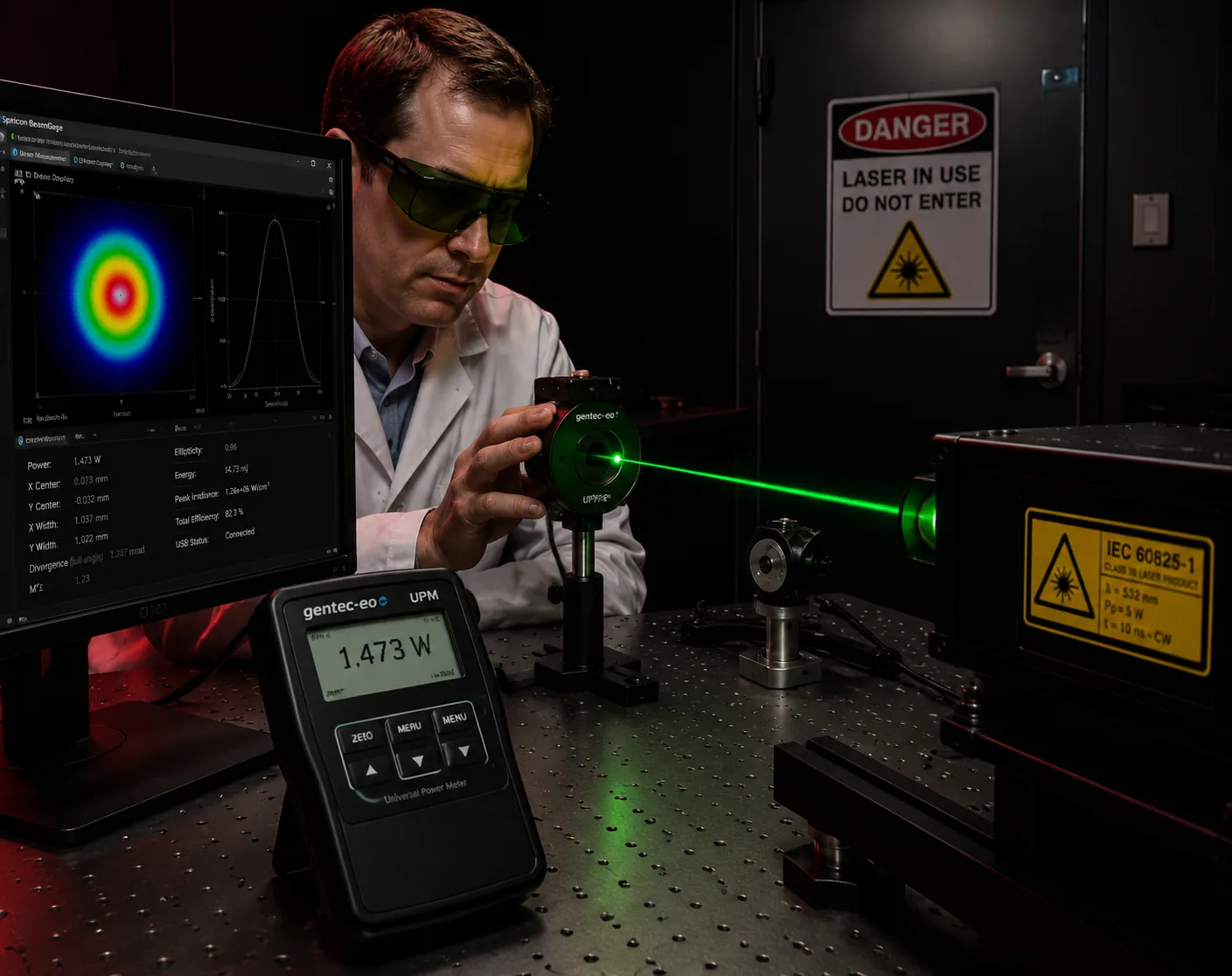
IEC 60825-1:2014 (Edition 3) defines seven classes, arranged in increasing order of accessible hazard. The Chinese standard GB 7247.1-2012 adopts Edition 2 (IEC 60825-1:2007) verbatim; the updated GB/T 7247.1-2024 modifies-adopts Edition 3. The classes are:
| Class | Hazard to the unaided eye | Hazard with optical aids | Typical products |
|---|---|---|---|
| 1 | Safe under reasonably foreseeable conditions of use | Safe | CD/DVD/Blu-ray drives, laser printers, barcode scanners, fully-enclosed industrial markers |
| 1M | Safe for the unaided eye | Hazardous if viewed with telescope/binoculars in the collecting beam path | Fibre optic transmitters, some alignment lasers with large-divergence / large-diameter beams |
| 1C | Safe under engineering controls built into the product (medical / therapy only, new in 2014) | Safe | Medical lasers with embedded contact-tip or scanned-output safety interlocks |
| 2 | Safe via the 0.25 s aversion response (visible only, 400–700 nm) | Hazardous if viewed with telescope/binoculars | Laser pointers, alignment lasers, levelling instruments ≤ 1 mW |
| 2M | Safe via aversion response, unaided | Hazardous if viewed with telescope/binoculars | Some alignment / levelling lasers with large-divergence beams |
| 3R | Potentially hazardous; "relaxed requirements" (5× Class 1 or Class 2 AEL) | Hazardous | Laser pointers up to 5 mW, some alignment lasers |
| 3B | Hazardous by direct-beam intrabeam viewing; diffuse reflections generally not hazardous | Hazardous | Industrial lasers up to 0.5 W, research lasers, laser light-show projectors |
| 4 | Hazardous by direct and diffuse-reflection viewing; skin and fire hazard | Hazardous | Industrial cutting / welding lasers, surgical lasers, research lasers > 0.5 W |
The classification is determined by measurement, not by design intent. A product designed as Class 1 must be measured to prove that its accessible emission does not exceed the Class 1 AEL under every reasonably foreseeable condition, including single-fault conditions of its drive electronics; a product that fails this measurement is reclassified upward to 3B or 4 even though its intended use was Class 1.
Accessible Emission Limits (AELs): the numerical thresholds
The classification is determined by comparing the measured accessible emission against the Accessible Emission Limit (AEL) for each class. For the most common case — a continuous-wave (CW) visible laser operating in the 400–700 nm wavelength band — the AELs are:
| Class | AEL (CW, visible 400–700 nm) | Derivation |
|---|---|---|
| Class 1 | 0.39 mW | MPE-derived; the lowest class |
| Class 1M | Same as Class 1 (viewing-condition-dependent) | Only hazardous with collecting optics |
| Class 2 | 1 mW | 0.25 s aversion response times MPE × 7 mm pupil |
| Class 2M | Same as Class 2 (viewing-condition-dependent) | Only hazardous with collecting optics |
| Class 3R | 5 mW | 5× the Class 2 AEL ("relaxed" class) |
| Class 3B | 0.5 W (500 mW) | Upper bound of the hazardous-direct-beam class |
| Class 4 | > 0.5 W | Above 3B; eye, skin, and fire hazard |
For invisible wavelengths (UV below 400 nm; near-IR above 700 nm) the aversion response is absent, the applicable exposure duration is longer (up to 30 000 s), and the AELs are computed from the Maximum Permissible Exposure (MPE) over the limiting aperture for the relevant wavelength band and exposure time. For pulsed lasers, the AEL is computed per pulse, per pulse train, and per average-over-the-emission-duration, and the most restrictive of the three applies. The full derivation is given in Tables 4–6 of IEC 60825-1 and the corresponding tables of GB/T 7247.1.
This numerical AEL table is the single most consequential piece of data in a laser classification project, and the single most common gap in published SERP content. A 4 mW visible laser is Class 3R; a 6 mW visible laser is Class 3B; a 1.5 mW visible laser with a small-diameter beam that is safe unaided but hazardous through binoculars is Class 2M. The classification follows directly from the measured emission value against the AEL row of this table — there is no judgement call.
The measurement geometry: apertures, conditions, and the 100 mm rule
Classification depends not only on what is measured but on where and how it is measured. IEC 60825-1:2014 defines three standard measurement conditions (Conditions 1, 2, 3) that simulate the eye at different distances and with different optical aids:
| Condition | Simulated exposure | Aperture stop | Measurement distance |
|---|---|---|---|
| Condition 1 | Eye with telescope / binoculars (collecting optics) | 50 mm diameter | 100 mm from the accessible emission point |
| Condition 2 | Eye with magnifier (eye loupe) | 7 mm diameter | Removed in 2014 (was 70 mm in Edition 2) |
| Condition 3 | Naked eye (unaided) | 7 mm diameter (the standard human pupil) | 100 mm from the accessible emission point |
Two Edition 3 changes are critical and frequently missed. First, Condition 2 (the 70 mm magnifier condition) was removed in 2014; the closest permitted measurement distance is now Condition 3 at 100 mm. Second, the 7 mm aperture is the IEC standard limiting aperture for the visible and near-IR, representing the fully-dilated human pupil; for far-IR (> 1400 nm) the limiting aperture is 3.5 mm (smaller pupil at night for the heat-induced pupil constriction) or 1 mm for very short UV wavelengths. A measurement made with the wrong aperture or at the wrong distance produces a classification that does not match the standard and is not defensible to a regulator.
For Class 1M and 2M products the geometry is the entire point of the classification: a 1M or 2M product emits radiation that is within the Class 1 or Class 2 AEL when measured at Condition 3 (naked eye), but exceeds the AEL when measured at Condition 1 (with collecting optics). The "M" classes exist to flag that the hazard depends on the use of optical aids.
Single-fault condition testing
IEC 60825-1:2014 clause 4.3 requires that the classification be carried out at the highest accessible emission power under reasonably foreseeable single-fault conditions of the drive electronics. This requirement catches a class of failures that a "normal operation" test entirely misses: a transistor on the laser-diode drive circuit fails short-circuit, the current limit is bypassed, and the diode — designed to operate at 5 mW — is suddenly driven at 100 mW, twenty times its intended output. Modern high-power laser diodes are routinely operated at a small fraction of their rated maximum output to improve lifetime, which means that under a single drive-electronics fault they can run indefinitely at many times their intended power without self-destructing.
The single-fault requirement is enforced in the test laboratory by simulating each single-fault on the drive circuit (short-circuited transistor, open-circuited current-sense resistor, failed software current limit) and re-measuring the accessible emission. If any single fault drives the emission above the AEL for the desired class, the product is classified at the higher class unless the electronics is redesigned. The standard's list of acceptable engineering controls that maintain classification under single fault includes:
- Induced catastrophic failure of the diode within approximately 1 s of the fault (a deliberate diode-killer circuit)
- Secondary optical monitoring with independent shutdown — a second photodiode that watches the laser output and cuts drive current if the output rises above a threshold
- Optical attenuators that limit maximum transmission regardless of diode output
- Current monitoring with independent shutdown — a current-sense circuit independent of the primary controller
- Modulation watchdogs that detect the loss of modulation and shut down
- Critical component cross-checking with independent shutdown
Of these, secondary optical monitoring with an independent shutdown path is the most robust, because it catches the partial-failure cases (contamination of the monitor photodiode, partial degradation of the primary current limit) that pure current monitoring misses. A laser equipment test report must document, per drive-circuit fault simulated, that the product's accessible emission remained within the AEL for the declared class — or that the product was reclassified upward.
The test parameters your laboratory must measure
A complete laser equipment test report covers the following measured parameters, each of which feeds into the AEL comparison:
- Wavelength (λ). Determined by a spectrometer or monochromator; reported to ±1 nm. Determines which AEL table applies (visible / UV / IR bands behave differently because of the wavelength-dependence of retinal vs. corneal absorption).
- Output power (CW) or pulse energy (pulsed). Measured with a calibrated thermopile or pyroelectric power/energy meter, matched to the wavelength and the beam diameter. For pulsed lasers, both peak power per pulse and average power are measured.
- Beam diameter and divergence. Measured with a beam profiler (CMOS/CCC camera for visible and near-IR; pyroelectric array for mid-IR) or by the scanning-knife-edge method. The divergence is the rate at which the beam spreads, in milliradians; it enters the NOHD calculation directly.
- Pulse duration and repetition rate. Measured with a fast photodiode (sub-nanosecond rise time) and an oscilloscope. Pulse duration enters the AEL calculation because the MPE for a single 20 ns pulse is different from the MPE for a 1 ms pulse at the same average power.
- Emission duration. For pulsed trains, the total time over which the laser is emitting; used to determine the applicable exposure duration for the MPE.
- Accessible emission under each measurement condition. Condition 1 (50 mm aperture at 100 mm) and Condition 3 (7 mm aperture at 100 mm) per the standard.
The report then compares the worst-case accessible emission value across all measurement conditions, all modes of operation (CW, pulsed, modulated, start-up, calibration, single-fault), and all wavelengths against the AEL table for each class, and assigns the highest class for which the product's accessible emission is below the AEL.
Which standards apply: IEC, GB, EN, FDA, and the product-specific overlays
A complete laser equipment testing project for a product intended for multiple markets draws on a stack of international, regional, and Chinese standards. The core classification standard (IEC 60825-1 / GB 7247.1 / EN 60825-1) is the entry point; the product-specific overlays add requirements based on intended use.
| Standard | Scope | Market |
|---|---|---|
| IEC 60825-1:2014 (Ed. 3) | Laser product classification and requirements, general | International (IEC member states) |
| GB 7247.1-2012 (≡ IEC 60825-1:2007 Ed. 2) | Same — currently the most-cited Chinese standard | China (mandatory) |
| GB/T 7247.1-2024 (MOD IEC 60825-1:2014 Ed. 3) | Updated to Edition 3 with Chinese deviations | China (recommended; replacing GB 7247.1) |
| EN 60825-1:2014 + A11:2021 | European adoption of Ed. 3, with EU-specific amendments | EU (CE marking) |
| AS/NZS IEC 60825.1:2014 | Australia / New Zealand adoption | AU/NZ |
| FDA 21 CFR 1040.10 / 1040.11 | US laser product performance standard | US (FDA CDRH Accession Number) |
| IEC 60825-2 / GB 7247.12 | Optical fibre communication system safety | Fibre optic applications |
| IEC 60825-12 / GB 7247.13 | Free-space optical communication safety | FSO links |
| IEC 62471 / GB/T 20145 | Photobiological safety of lamps and lamp systems (LEDs) | LED products |
| ANSI Z136 series | Safe use of lasers (workplace safety, not product classification) | US workplace |
A product placed on the Chinese market must comply with GB 7247.1-2012 (or GB/T 7247.1-2024); the same product on the EU market must comply with EN 60825-1:2014; on the US market, with 21 CFR 1040.10. The three standards are technically close but not identical, and a test report produced for one may not satisfy another without conversion. A test laboratory that can issue a single report set covering all three (the IECEE CB Scheme for IEC 60825-1, plus FDA CDRH report generation, plus EU CE documentation) eliminates the multi-market reporting overhead for the manufacturer.
Medical lasers: the IEC 60601-2-22 / GB 9706.222 / YY 0507 stack
A medical laser is simultaneously a laser product and a medical electrical (ME) device, and must comply with two parallel standard stacks. The laser classification stack (IEC 60825-1 / GB 7247.1) governs the optical-radiation hazard; the medical device stack (IEC 60601-1 + IEC 60601-2-22, or in China GB 9706.1 + GB 9706.222-2022 + YY 0507) governs the electrical safety, essential performance, and laser-specific functional safety requirements of the device used in clinical practice.
The Chinese medical laser stack is:
| Standard | Title | Status |
|---|---|---|
| GB 9706.1-2020 | Medical electrical equipment — Part 1: General requirements for basic safety and essential performance (≡ IEC 60601-1) | Mandatory |
| GB 9706.222-2022 | Medical electrical equipment — Part 2-22: Particular requirements for basic safety and essential performance of surgical, cosmetic, therapeutic and diagnostic laser equipment (MOD IEC 60601-2-22:2019) | Mandatory, effective 2024-05-01, replaces the older GB 9706.22 |
| GB 7247.1-2012 / GB/T 7247.1-2024 | Laser product safety — classification | Mandatory |
| YY 0507 | Medical laser equipment — industry standard for performance and test methods | Industry (recommended) |
| YY 0758-2009 | Laser fibres for surgical / therapeutic use — general requirements | Industry |
| YY/T 0756-2009 | Laser protective barriers / screens for medical use | Industry |
The NMPA registration pathway for a medical laser device requires a full GB 9706.222-2022 type test, a GB 9706.1-2020 electrical safety test, a GB 7247.1 / GB/T 7247.1 laser classification, an electromagnetic compatibility (EMC) test per YY 9706.102 / IEC 60601-1-2, plus the clinical evaluation appropriate to the device's risk class (Class II or III). The GB 9706.222-2022 test in particular adds, on top of the general ME device requirements, the laser-specific provisions: classification as Class 1C, 3B, or 4; the ready-state indicator; the emergency stop; the aiming-beam safety; the aperture marking; the output power verification at the distal end of any articulated arm or fibre. A medical-laser NMPA dossier that omits the GB 9706.222 report is incomplete.
Consumer and toy lasers: EN 50689
The 2021 EU standard EN 50689:2021 — Safety of consumer laser products tightened the requirements for laser products accessible to the general public, including toys, cosmetic devices, and consumer electronics. EN 50689 limits consumer laser products to a maximum accessible emission of Class 1 in most consumer-exposure scenarios, and imposes additional requirements on labelling, user information, and the assessment of reasonably foreseeable misuse. For children's toys the relevant standard is EN 62143 / EN IEC 62143 together with the Toy Safety Directive 2009/48/EC.
The Chinese counterparts are GB 19865-2005 (≡ IEC 62143, electric toys safety) and the general GB 7247.1 / GB/T 7247.1 classification. A consumer-grade laser pointer sold in the EU as a children's toy must be Class 1 under both EN 60825-1 (the classification standard) and EN 50689 (the consumer-product overlay); a 5 mW Class 3R pointer that is legal for adult use is illegal as a children's toy in both the EU and the US (the FDA's 2014 guidance caps children's products at Class 1).
NOHD and MPE: extending the classification outdoors
The classification is a hazard level assigned to the product; in use, the hazard zone around the product is defined by the Nominal Ocular Hazard Distance (NOHD) — the distance at which the beam irradiance drops to the Maximum Permissible Exposure (MPE). The NOHD is computed from the measured laser power, beam divergence, and the MPE for the relevant wavelength and exposure duration:
NOHD = √( 4P / (π · MPE · θ²) )
where P is the laser output power in watts, MPE is the maximum permissible exposure in W/cm² for the relevant wavelength and exposure duration, and θ is the beam divergence in radians. For a 5 mW visible laser pointer with 1 mrad divergence and the standard visible MPE of 2.54 × 10⁻³ W/cm² (for 0.25 s accidental exposure), the NOHD is approximately 50 m — meaning the beam remains above the eye-safety MPE out to 50 m from the pointer. For a 1 W industrial laser with 2 mrad divergence, the NOHD exceeds 7 km, which is why the use of such lasers outdoors requires an FAA / CAA airspace notification.
The NOHD calculation enters laser equipment testing in three contexts. First, outdoor lasers (surveying, levelling, alignment, laser light shows, free-space optical links, military target designators) require an NOHD-based Nominal Hazard Zone (NHZ) for the operating procedure. Second, the aided-viewer NOHD (computed with a 50 mm or larger collecting aperture instead of the 7 mm naked-eye pupil) extends the hazard zone — critical for laser-pointer incidents near airports, where pilots may view the beam through cockpit transparencies or, in some assessments, through binoculars. Third, the EN 12254 / GB 18151 laser protective barrier rating for an installation is selected to match the NOHD of the lasers in use, and the barrier's damage threshold test is conducted against the worst-case beam parameters of the protected installation. A laser equipment test laboratory that produces a complete product-test package for outdoor or industrial use will include the NOHD and the aided-viewer NOHD as derived values in the report.
Marking, labelling, and user information
Once the classification is determined the product must be marked and labelled per IEC 60825-1 clause 5 (and identically per GB 7247.1 / EN 60825-1 / FDA 21 CFR 1040.10). The required marks are:
- The class label (a yellow-background warning label showing the class symbol, the maximum output power, and the wavelength)
- The aperture marking at each opening through which accessible laser radiation is emitted
- The non-interlocked protective housing label for service access
- The user information in the operator's manual, including the class, the wavelength, the maximum output, the NOHD where relevant, the protective eyewear requirement (with the OD rating), and the safe operating procedure
For medical lasers, GB 9706.222-2022 adds the ready-state indicator, the emergency-stop label, and the specific marking for the aiming beam. For consumer lasers in the EU, EN 50689 adds a "do not view directly with optical instruments" pictogram. A laser equipment test report concludes with a label and user-information review that verifies each required marking is present, in the correct language, at the correct size, on the production unit.
FAQ
What are the IEC 60825-1 laser classes and their power limits?
The seven classes — 1, 1M, 1C, 2, 2M, 3R, 3B, 4 — are based on accessible emission, not nominal output. For a visible CW laser (400–700 nm), Class 1 AEL = 0.39 mW, Class 2 AEL = 1 mW, Class 3R AEL = 5 mW, Class 3B AEL = 0.5 W, and Class 4 is any emission above 0.5 W. Class 1M and 2M share the Class 1 and Class 2 AELs respectively but are hazardous with collecting optics; Class 1C is the medical-therapy class introduced in IEC 60825-1:2014.
What is the difference between IEC 60825-1 and GB 7247.1?
GB 7247.1-2012 is the verbatim Chinese adoption of IEC 60825-1:2007 (Edition 2). The updated GB/T 7247.1-2024 modifies-adopts IEC 60825-1:2014 (Edition 3), adding Class 1C, removing the Condition 2 70 mm measurement distance, and aligning with the 100 mm minimum measurement distance of Condition 3. A product classified to GB 7247.1 is classified to IEC 60825-1 for the corresponding edition; the converse holds with the noted edition differences.
What is the single-fault condition in laser testing?
IEC 60825-1 clause 4.3 requires the classification to be carried out at the highest accessible emission under any reasonably foreseeable single-fault condition of the drive electronics. A short-circuited transistor on the laser-diode drive circuit can drive the diode at many times its intended power; if any single fault pushes the accessible emission above the AEL for the desired class, the product is reclassified upward unless the electronics is redesigned (typically with a secondary optical monitor and independent shutdown).
What standard applies to a medical laser in China?
A medical laser must comply with the laser classification standard (GB 7247.1 / GB/T 7247.1) and the medical electrical equipment stack: GB 9706.1-2020 (general ME safety) + GB 9706.222-2022 (laser-specific ME requirements, ≡ IEC 60601-2-22:2019, effective 2024-05-01) + YY 0507 (medical laser industry standard) + EMC per YY 9706.102. NMPA registration requires a full type-test report covering all of the above.
What is NOHD and how is it computed?
The Nominal Ocular Hazard Distance is the distance at which the laser beam irradiance drops to the Maximum Permissible Exposure (MPE) for the relevant wavelength and exposure duration. NOHD = √(4P / (π · MPE · θ²)), with P in watts, MPE in W/cm², and divergence θ in radians. For a 5 mW / 1 mrad visible laser pointer the NOHD is approximately 50 m; for a 1 W / 2 mrad industrial laser it exceeds 7 km.
Our laser equipment testing capabilities
Beijing ZKGX Research (ISO/IEC 17025 accredited testing laboratory) provides laser equipment testing and classification against the full international and Chinese standard stack:
- IEC 60825-1:2014 and its Chinese adoption GB 7247.1-2012 / GB/T 7247.1-2024, for the seven-class classification (1, 1M, 1C, 2, 2M, 3R, 3B, 4) of any laser product.
- FDA 21 CFR 1040.10 / 1040.11 for the US Accession Number report.
- EN 60825-1:2014 + A11:2021 and EN 50689:2021 for the EU CE marking of laser and consumer-laser products.
- GB 9706.222-2022 (≡ IEC 60601-2-22:2019) and YY 0507 for medical lasers in the NMPA registration pathway, with the supporting GB 9706.1-2020 and YY 9706.102 EMC tests.
- IEC 60825-2 / GB 7247.12 for optical fibre communication systems and IEC 60825-12 / GB 7247.13 for free-space optical links.
- IEC 62471 / GB/T 20145 for LED and lamp photobiological safety.
We measure the full parameter set — wavelength, CW power and pulsed energy, beam diameter and divergence, pulse duration and repetition rate, emission duration, and accessible emission under Condition 1 (50 mm aperture) and Condition 3 (7 mm aperture, 100 mm distance) — and compare each against the AEL table per the applicable standard. Single-fault testing of the drive electronics is performed per IEC 60825-1 clause 4.3. NOHD and aided-viewer NOHD are computed from the measured power, divergence, and MPE, with the resulting Nominal Hazard Zone reported for outdoor-use products.
Suitable product categories include: consumer laser products (pointers, levelling instruments, toys, pet toys); office automation (laser printers, barcode scanners, optical-disc drives); IT and telecom (fibre optic transmitters, FSO links); industrial lasers (markers, cutters, welders, engravers); medical lasers (CO₂, semiconductor, diode-pumped solid-state, Ho:YAG, Er:YAG, excimer) for surgical, cosmetic, therapeutic, ophthalmic, and dental applications; and laboratory and research lasers. Each project is delivered with a full data report (instrument calibration, raw measurement data, single-fault simulation results, AEL comparison per class, classification conclusion, label/user-information review, and where applicable the NOHD/NHZ computation) ready for direct submission to NMPA, FDA CDRH, EU notified bodies, or other market-access authorities. Contact Beijing ZKGX Research to scope the test battery applicable to your product and target market.