Table of Contents
- What is maltitol testing?
- The standard stack: USP, FAO JECFA, EU 1333/2008, GB 1886
- Assay: HPLC-RI and the ≥ 98 % (crystalline) / ≥ 50 % (solution) specification
- Specific rotation, melting point, and the D-maltitol identity
- Reducing sugars, nickel, and the DEG/EG limit
- Water content, sulfated ash, chlorides, sulfates, and lead
- Microbial limits, pH, and identification tests
- Maltitol vs other polyols: the analytical family
- FAQ
- Our maltitol testing capabilities
What is maltitol testing?
Maltitol testing is the measurement and validation of the identity, assay, purity, and physical properties of maltitol (D-maltitol, α-D-glucopyranosyl-1,4-D-glucitol, CAS 585-88-6, C₁₂H₂₄O₁₁, MW 344.31, INS 965 / E 965) — the sugar alcohol (polyol) produced by the hydrogenation of maltose, used as a low-calorie sweetener, humectant, stabiliser, and bulking agent in sugar-free confectionery, chocolate, baked goods, ice cream, and pharmaceutical tablet formulations. The output of a maltitol test is a dossier covering the assay (≥ 98.0 % for crystalline maltitol; ≥ 50.0 % for maltitol solution, by HPLC-RI), the specific rotation (+105.5° to +108.5°, identifying the D-maltitol configuration), the melting range (148–151 °C), the reducing sugars (≤ 0.1 % as glucose for crystalline; ≤ 0.3 % for solution), the nickel (≤ 2 mg/kg crystalline; ≤ 1 ppm solution, the catalyst residue), the DEG/EG (≤ 0.10 % each, the diethylene glycol / ethylene glycol contamination), the water content (≤ 1.0 % crystalline; ≤ 31.5 % solution, by Karl Fischer), the sulfated ash (≤ 0.1 %), and the chlorides (≤ 50 mg/kg), sulfates (≤ 100 mg/kg), lead (≤ 1 mg/kg), and microbial limits.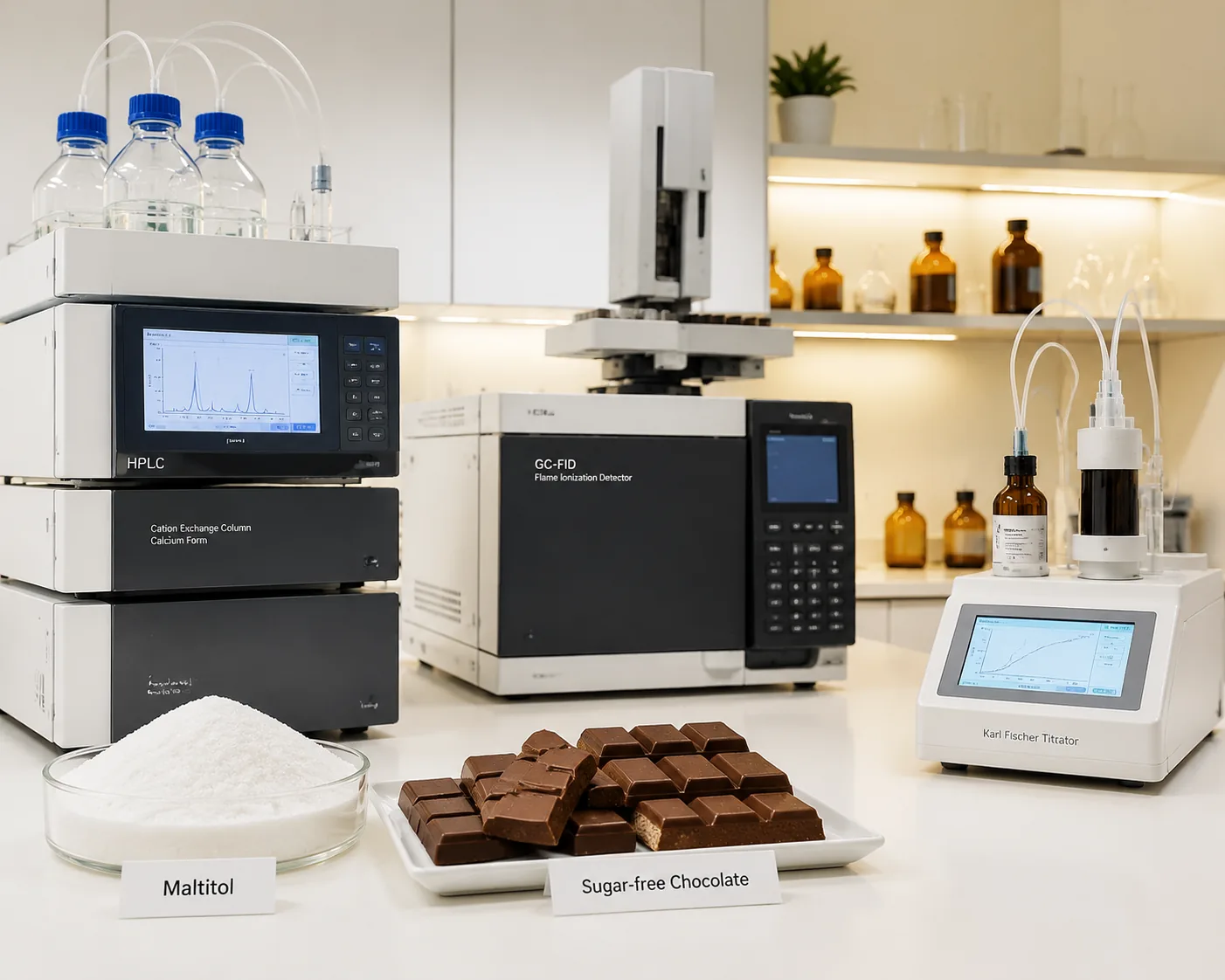
Maltitol is the sweetest of the common polyols (90 % of sucrose sweetness) with the lowest cooling effect, making it the preferred polyol for sugar-free chocolate and baked goods where a sucrose-like sweetness without the metallic or cooling aftertaste of xylitol or erythritol is desired. It is produced industrially by the catalytic hydrogenation of high-maltose corn syrup (the maltose is hydrogenated to maltitol over a Raney nickel catalyst), followed by purification by chromatographic separation and crystallisation. The nickel catalyst leaves a residual that is tightly regulated (≤ 2 mg/kg); the hydrogenation can also produce DEG and EG as side-products from the over-reduction of the sugar, which are tightly regulated at ≤ 0.10 % each because of the acute toxicity of DEG (the historical cause of fatal poisonings in pharmaceutical syrups and cough syrups).
The standards governing maltitol testing span the FAO JECFA INS 965 monograph (the international food-additive specification, ADI "not specified" since 1993, 41st JECFA), the USP Maltitol Solution monograph (the US pharmacopeial reference for the solution form, with the DEG/EG limit added in 2010), the EU Regulation (EC) No 1333/2008 (the food-additive regulation that authorises E 965 in specified food categories at specified maximum levels), the EFSA re-evaluation (the ongoing EU re-evaluation of E 965, with a 2023 public call for data including the in vitro micronucleus genotoxicity gap per OECD TG 487), and the GB 1886.x series (the Chinese food-additive standard). A maltitol placed on the Chinese food market must satisfy GB 1886.x; on the EU food market, E 965 per Regulation 1333/2008; on the US food market, the GRAS status and the USP monograph; on the US pharmaceutical market, the USP Maltitol Solution monograph.
The standard stack: USP, FAO JECFA, EU 1333/2008, GB 1886
A complete maltitol testing project draws on a stack of pharmacopeial, food-additive, and regulatory standards.
| Family | Standard | Scope |
|---|---|---|
| USP Maltitol Solution | Maltitol Solution monograph (USP-NF) | The US pharmacopeial reference for the solution form; assay ≥ 50.0 % D-maltitol (w/w, anhydrous), ≤ 8.0 % D-sorbitol, DEG ≤ 0.10 %, EG ≤ 0.10 %, nickel ≤ 1 ppm, reducing sugars ≤ 0.3 %, water ≤ 31.5 % |
| FAO JECFA INS 965 | Maltitol monograph (Compendium of Food Additive Specifications, 46th JECFA 1996) | The international food-additive specification; assay ≥ 98.0 %, specific rotation +105.5° to +108.5°, melting range 148–151 °C, water ≤ 1.0 %, sulfated ash ≤ 0.1 %, chlorides ≤ 50 mg/kg, sulfates ≤ 100 mg/kg, nickel ≤ 2 mg/kg, reducing sugars ≤ 0.1 %, lead ≤ 1 mg/kg |
| EU Regulation (EC) No 1333/2008 | Food additives authorised in food — E 965 (i) maltitol, E 965 (ii) maltitol syrup | The EU food-additive regulation; E 965 permitted in specified food categories at GMP or specified maximum levels |
| Commission Regulation (EU) No 231/2012 | Specifications for food additives — E 965 | The EU purity specification for E 965 maltitol and maltitol syrup |
| EFSA FAF Panel re-evaluation | Re-evaluation of maltitols (E 965) as a food additive (EFSA-Q-2017-00490, 2023 call for data) | The ongoing EU re-evaluation; the in vitro micronucleus test (OECD TG 487) gap identified |
| GB 1886.x | Food additive — Maltitol | The Chinese national food-additive standard |
| GB 2760-2024 | Use of Food Additives | The Chinese usage scope — maltitol permitted in specified food categories at GMP |
| ICH Q3D | Elemental Impurities | For the pharmaceutical-grade maltitol (Ni, Pb as Class 2A elements) |
| FDA Guidance (2023) | Glycerin and Other High-Risk Drug Components Contaminated with DEG or EG | The FDA guidance on DEG/EG contamination, directly relevant to the USP Maltitol Solution DEG/EG limit |
The single most consequential fact for a Chinese manufacturer is that GB 1886.x is the Chinese food-additive standard for maltitol and GB 2760-2024 regulates the usage scope (maltitol is permitted in most sugar-free food categories at GMP). For the pharmaceutical-grade maltitol solution, the USP monograph applies with its unique DEG/EG limit.
Assay: HPLC-RI and the ≥ 98 % (crystalline) / ≥ 50 % (solution) specification
The assay of maltitol is the quantitative measurement of the D-maltitol content. The specification differs between the crystalline form and the solution form.
| Form | Specification | Method |
|---|---|---|
| Crystalline maltitol (FAO JECFA INS 965) | ≥ 98.0 % D-maltitol on the anhydrous basis | HPLC-RI; Aminex HPX 87C (calcium-form resin) column, 30 cm × 9 mm; degassed water mobile phase; 85 °C; 0.5 mL/min |
| Maltitol solution (USP) | NLT 50.0 % D-maltitol (w/w) on the anhydrous basis; NMT 8.0 % D-sorbitol (w/w) | HPLC-RI; L34 packing (sulfonated styrene-divinylbenzene resin in calcium form), 7.8 mm × 10 cm; water mobile phase; 60 °C; 0.5 mL/min |
The HPLC-RI method uses a cation-exchange resin in the calcium form (the Aminex HPX 87C, the Phenomenex Rezex RCM, or the Waters Sugar-Pak) — the calcium form separates the sugar alcohols by the size and the complexation of the calcium ion with the hydroxyl groups. The RI detector is used because the sugar alcohols have no UV-absorbing chromophore. The relative retention times are: maltotriitol 0.38, maltitol 0.48, sorbitol 1.0 — the method separates the three principal polyols that co-occur in the maltitol syrup.
The USP system suitability requires a tailing factor ≤ 1.2 for maltitol and sorbitol and a RSD ≤ 2.0 % for replicate injections — ensuring the chromatographic resolution is sufficient for the accurate quantification.
Specific rotation, melting point, and the D-maltitol identity
| Parameter | FAO JECFA specification | Method |
|---|---|---|
| Specific rotation [α]²⁰_D | +105.5° to +108.5° (5 % w/v aqueous solution, 20 °C, sodium D-line) | Polarimeter |
| Melting range | 148–151 °C | Capillary melting-point apparatus |
| Solubility | Very soluble in water; slightly soluble in ethanol | — |
| Thin-layer chromatography | Passes the test (against a maltitol reference standard) | Silica-gel TLC; the Rf of the sample matches the standard |
The specific rotation identifies the D-maltitol configuration (the α-D-glucopyranosyl-1,4-D-glucitol); the melting range confirms the crystalline identity. The TLC is an additional identification that confirms the sample is maltitol and not another polyol (sorbitol, xylitol, mannitol, erythritol) that might be present as an impurity or an intentional substitution.
Reducing sugars, nickel, and the DEG/EG limit
The three most safety-critical impurity tests for maltitol are the reducing sugars, the nickel, and the DEG/EG.
| Test | Crystalline maltitol (FAO JECFA) | Maltitol solution (USP) | Method |
|---|---|---|---|
| Reducing sugars (as glucose) | ≤ 0.1 % (the cuprous oxide shall not exceed 20 mg) | ≤ 0.3 % (NLT 12.8 mL of 0.05 N sodium thiosulfate VS required in the iodometric back-titration) | The copper-reduction (Fehling's) method; the reducing sugars (maltose, glucose from incomplete hydrogenation) reduce the copper citrate, and the excess is titrated iodometrically |
| Nickel | ≤ 2 mg/kg (2 ppm) | ≤ 1 ppm (1 µg/g) | Atomic absorption spectrophotometry (AAS, air-acetylene flame, 232 nm, nickel hollow-cathode lamp); or ICP-MS; the nickel is the catalyst residue from the Raney nickel hydrogenation |
| DEG (diethylene glycol) | — (not specified in FAO JECFA) | ≤ 0.10 % | GC-FID; fused-silica capillary column (G46 phase, 0.32 mm × 15 m, 0.25 µm); helium carrier gas; temperature programme 70 °C (hold 2 min) → 50 °C/min → 300 °C (hold 5 min); split 10:1; 1,3-butanediol internal standard; the DEG and EG are extracted from the maltitol solution by acetone precipitation of the maltitol |
| EG (ethylene glycol) | — | ≤ 0.10 % | Same GC-FID method as DEG; EG elutes before DEG |
The DEG/EG limit is unique to the USP Maltitol Solution monograph (added in the 2010 Revision Bulletin) and was driven by the FDA's ongoing concern about DEG contamination of pharmaceutical excipients (the 2023 FDA guidance on glycerin and other high-risk drug components contaminated with DEG or EG). The DEG/EG is not limited in the FAO JECFA food-additive monograph — the food-grade maltitol does not carry the same historical DEG-poisoning risk as the pharmaceutical-grade solution. The DEG/EG test requires the acetone precipitation of the maltitol (the maltitol is insoluble in acetone; the DEG and EG remain in the acetone supernatant), followed by the GC-FID analysis of the supernatant with the 1,3-butanediol internal standard.
Water content, sulfated ash, chlorides, sulfates, and lead
| Test | Crystalline (FAO JECFA) | Solution (USP) | Method |
|---|---|---|---|
| Water | ≤ 1.0 % | ≤ 31.5 % | Karl Fischer (Method I, USP <921>) |
| Sulfated ash | ≤ 0.1 % | ≤ 0.1 % | Ignition with H₂SO₄ at 600 °C (2 g sample) |
| Chlorides | ≤ 50 mg/kg | — | Limit test with silver nitrate (10 g sample, 1.5 mL of 0.01 N HCl control) |
| Sulfates | ≤ 100 mg/kg | — | Limit test with barium chloride (10 g sample, 2.0 mL of 0.01 N H₂SO₄ control) |
| Lead | ≤ 1 mg/kg | — | Atomic absorption (appropriate to the specified level) |
The water content of the crystalline maltitol (≤ 1.0 %) is very low — the crystalline form is anhydrous and non-hygroscopic, suitable for direct compression tablet formulations. The maltitol solution (≤ 31.5 % water) is the aqueous form used in liquid formulations.
Microbial limits, pH, and identification tests
| Test | Specification | Method |
|---|---|---|
| Microbial enumeration (USP) | Total aerobic microbial count ≤ 1000 CFU/mL; total combined moulds and yeasts ≤ 100 CFU/mL | USP <61> |
| Specific microorganisms (USP) | No E. coli, Salmonella, S. aureus | USP <62> |
| pH (USP) | 5.0–7.5 (14 % w/w solution in CO₂-free water) | USP <791> |
| Identification A — catechol (USP) | Dissolve 1.4 g in 75 mL water; transfer 3 mL, add 3 mL catechol (1 in 10), add 6 mL sulfuric acid, heat in flame 30 s | Deep pink or wine-red colour appears |
| Identification B — HPLC retention time (USP) | The retention time of the major peak of the sample solution corresponds to the standard | HPLC-RI (the assay method) |
Maltitol vs other polyols: the analytical family
Maltitol is one of six common polyols (sugar alcohols) used as food additives — each with its own INS/E number, its own monograph, and its own analytical profile.
| Polyol | INS / E | CAS | MW | Sweetness (% sucrose) | Typical source |
|---|---|---|---|---|---|
| Sorbitol | 420 / E 420 | 50-70-4 | 182.17 | 60 | Hydrogenation of glucose (corn syrup) |
| Mannitol | 421 / E 421 | 69-65-8 | 182.17 | 50-60 | Hydrogenation of fructose / isomerisation of sorbitol |
| Xylitol | 967 / E 967 | 87-99-0 | 152.15 | 100 | Hydrogenation of xylose (birch hemicellulose) |
| Erythritol | 968 / E 968 | 149-32-6 | 122.12 | 60-70 | Fermentation of glucose by Moniliella |
| Maltitol | 965 / E 965 | 585-88-6 | 344.31 | 90 | Hydrogenation of maltose (high-maltose corn syrup) |
| Isomalt | 953 / E 953 | 64519-80-0 | 344.31 | 50-60 | Hydrogenation of isomaltulose (sucrose isomer) |
A polyol test report must identify which polyol is being tested — the HPLC-RI method separates all six polyols on the same calcium-form column, and a mis-identification (reporting sorbitol as maltitol, for example) would produce a false assay. The specific rotation and the melting range are the additional identification tools that distinguish maltitol from the other polyols.
FAQ
What is the assay specification for maltitol?
For the crystalline form (FAO JECFA INS 965), the assay is ≥ 98.0 % D-maltitol on the anhydrous basis, by HPLC-RI. For the solution form (USP Maltitol Solution), the assay is NLT 50.0 % D-maltitol (w/w) on the anhydrous basis, with NMT 8.0 % D-sorbitol — the solution is the aqueous form with the sorbitol co-product.
Why is nickel regulated in maltitol and what is the limit?
Nickel is the catalyst residue from the Raney nickel hydrogenation of maltose to maltitol. The FAO JECFA limit is ≤ 2 mg/kg (2 ppm) for crystalline maltitol; the USP limit is ≤ 1 ppm for the solution. The nickel is measured by atomic absorption spectrophotometry (AAS, 232 nm, air-acetylene flame) or ICP-MS.
What is the DEG/EG limit and why is it unique to the USP monograph?
The USP Maltitol Solution monograph limits DEG (diethylene glycol) ≤ 0.10 % and EG (ethylene glycol) ≤ 0.10 % — the by-products of the over-reduction of the sugar. The limit is unique to the USP (not in the FAO JECFA food-grade monograph) and was driven by the FDA's concern about DEG contamination of pharmaceutical excipients. The DEG/EG is measured by GC-FID after acetone precipitation of the maltitol, with 1,3-butanediol as the internal standard.
What is the EFSA re-evaluation of E 965?
The EFSA FAF Panel is re-evaluating E 965 (maltitol) under the EU sweetener re-evaluation programme. The 2023 public call for data identified a specific gap — the lack of a fully reliable in vitro micronucleus test per OECD TG 487. A negative in vitro micronucleus test would complete the genotoxicity assessment and maltitol would be considered not genotoxic; a positive would trigger an in vivo follow-up.
How is maltitol distinguished from sorbitol and other polyols?
The HPLC-RI assay separates maltitol (RRT 0.48), sorbitol (RRT 1.0), and maltotriitol (RRT 0.38) on the calcium-form cation-exchange column. The specific rotation (+105.5° to +108.5° for maltitol) and the melting range (148–151 °C) are the additional identification tools that distinguish maltitol from sorbitol (which has a different specific rotation and does not crystallise under the same conditions).
Our maltitol testing capabilities
Beijing ZKGX Research (ISO/IEC 17025 accredited, CMA- and CNAS-accredited testing laboratory) provides complete maltitol testing across the FAO JECFA, USP, EU, and GB standard stack:
- FAO JECFA INS 965 maltitol monograph — full conformance: assay ≥ 98.0 % (HPLC-RI), specific rotation +105.5° to +108.5°, melting range 148–151 °C, water ≤ 1.0 % (KF), sulfated ash ≤ 0.1 %, chlorides ≤ 50 mg/kg, sulfates ≤ 100 mg/kg, nickel ≤ 2 mg/kg (AAS), reducing sugars ≤ 0.1 %, lead ≤ 1 mg/kg (AAS/ICP-MS), TLC identification.
- USP Maltitol Solution monograph — full conformance: assay NLT 50.0 % D-maltitol (HPLC-RI, L34 column), NMT 8.0 % D-sorbitol, DEG ≤ 0.10 % (GC-FID), EG ≤ 0.10 % (GC-FID), nickel ≤ 1 ppm (AAS), reducing sugars ≤ 0.3 % (iodometric), water ≤ 31.5 % (KF), residue on ignition ≤ 0.1 %, pH 5.0–7.5, microbial limits (USP <61>/<62>), identification (catechol colour, HPLC retention time).
- EU Regulation 1333/2008 / 231/2012 E 965 — for the EU food market; the EFSA re-evaluation support.
- GB 1886.x Chinese food-additive maltitol — for the Chinese food market; GB 2760-2024 usage-scope verification.
- Assay — HPLC-RI (Aminex HPX 87C / Waters Sugar-Pak / Phenomenex Rezex RCM calcium-form column); crystalline ≥ 98 %; solution ≥ 50 % with sorbitol ≤ 8 %.
- Specific rotation — polarimeter at 20 °C, sodium D-line; +105.5° to +108.5°.
- Melting range — capillary melting-point apparatus; 148–151 °C.
- Reducing sugars — copper-reduction (Fehling's) / iodometric back-titration; ≤ 0.1 % crystalline, ≤ 0.3 % solution.
- Nickel — AAS (232 nm, air-acetylene flame, nickel hollow-cathode lamp) or ICP-MS; ≤ 2 mg/kg crystalline, ≤ 1 ppm solution.
- DEG/EG — GC-FID after acetone precipitation of maltitol; 1,3-butanediol internal standard; fused-silica capillary (G46); temperature programme; ≤ 0.10 % each.
- Water — Karl Fischer; ≤ 1.0 % crystalline, ≤ 31.5 % solution.
- Purity — sulfated ash, chlorides, sulfates, lead (AAS/ICP-MS).
- Microbial — USP <61>/<62>; total aerobic ≤ 1000 CFU/mL, yeasts/moulds ≤ 100 CFU/mL.
- Full polyol panel — sorbitol, mannitol, xylitol, erythritol, maltitol, isomalt on the same HPLC-RI method.
Suitable sample matrices include: crystalline maltitol (food-grade and pharmaceutical-grade); maltitol solution (pharmaceutical-grade, USP); sugar-free confectionery, chocolate, baked goods, ice cream; pharmaceutical tablet formulations; dietary supplements. Each project is delivered with a full data report (test protocol, instrument calibration, raw HPLC-RI / GC-FID / AAS / KF data, statistical analysis, identification-test evidence, classification conclusion per the applicable standard) in English and/or Chinese, with CMA/CNAS stamping. Contact Beijing ZKGX Research to scope the maltitol test applicable to your product and target market.