What Photoaging Testing Actually Measures
Photoaging testing evaluates one thing: how a material degrades when exposed to light. Not just any light — specifically the ultraviolet and visible wavelengths present in natural sunlight that initiate photochemical reactions at the molecular level.
The test does not simulate weather in the full sense. Rain, temperature cycling, humidity, and pollutants each contribute to material degradation through separate mechanisms. Photoaging isolates the photonic component — the breaking of chemical bonds by UV photons, the generation of free radicals, the yellowing of polymers, the chalking of coatings, the embrittlement of fibers. These are light-driven processes, and they are the dominant degradation mechanism for materials used outdoors.
When you run a photoaging test, you are answering a set of practical questions:
-
How long before the color shifts beyond acceptable tolerance?
-
How much tensile strength is lost after a year of sunlight exposure?
-
Does the material crack, chalk, or delaminate under UV load?
-
Which stabilizer package actually works in this formulation?
The answers determine whether a product survives its warranty period, whether a building material meets code, whether an automotive interior resists fading through the life of the vehicle.
The Physics Behind Photoaging
Sunlight reaching the Earth's surface contains two UV bands that drive material degradation. Understanding the difference between them matters for test design.
UV-A (320 nm to 400 nm) penetrates deeper into most polymer structures. It represents the majority of the UV energy arriving at ground level. UV-A photons are individually less energetic than UV-B photons, but they arrive in far greater numbers and reach deeper layers. For thick-section materials — polymer sheet, cable jacketing, composite laminates — UV-A exposure often dominates the long-term degradation profile.
UV-B (280 nm to 320 nm) is more energetic per photon and more destructive at the surface. It represents approximately 5% of solar UV radiation but accounts for a disproportionate share of surface-level damage — gloss loss, micro-cracking, pigment degradation. UV-B is the primary driver for thin films, surface coatings, and materials where appearance retention is critical.
UV-C (below 280 nm) is fully blocked by the ozone layer and does not reach the Earth's surface. It should not appear in a properly filtered solar simulation unless your material is destined for space applications or will be exposed to artificial UV-C sources like germicidal lamps.
The key insight for test design: UV-A and UV-B attack materials through different mechanisms and at different depths. A test that only uses one band may miss failure modes that occur under natural exposure. A test that over-weights short wavelengths may produce unrealistic failure modes that never appear in service.
Test Equipment: What the Machines Actually Do
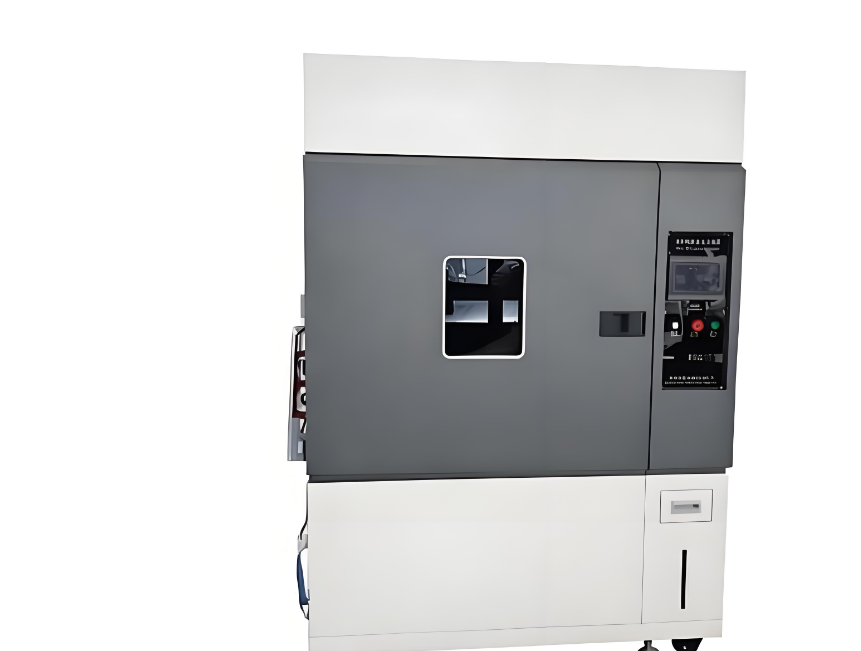
Three categories of equipment dominate photoaging testing. Each has a legitimate purpose, and each produces different results. Selecting the wrong one is a common and expensive mistake.
Xenon Arc Chambers
Xenon arc lamps produce the closest match to the full solar spectrum, from UV through visible to near-infrared. With proper optical filters, a xenon system can reproduce the spectral power distribution of natural sunlight with good fidelity. This makes xenon the default choice for colorfastness testing (textiles, automotive interiors, architectural coatings) and for applications where the material's response to visible light matters — photo-oxidation initiated by visible wavelengths does occur, particularly in white and lightly pigmented materials.
The trade-offs: xenon lamps generate significant heat, require water cooling or forced air, and the lamps degrade and shift spectrally over their service life. Lamp replacement is a major operating cost. Irradiance control at the sample plane requires regular calibration.
Fluorescent UV Chambers
Fluorescent UV lamps emit a narrow spectrum concentrated in specific UV bands. The most common configurations are UVA-340 (which simulates the short-wavelength end of natural sunlight) and UVB-313 (which is more aggressive and used for accelerated screening). These systems do not attempt to reproduce the full solar spectrum. Instead, they deliver concentrated UV energy in the wavelengths most responsible for polymer degradation.
The advantages: lower equipment cost, simpler operation, and in many cases faster results because all the lamp output is concentrated in the photochemically active UV bands. The limitation: because visible and infrared wavelengths are absent, any degradation mechanism triggered or accelerated by those wavelengths will be missed. Fluorescent UV testing is best suited to comparative screening — evaluating stabilizer packages, benchmarking formulations — rather than service life prediction.
LED-Based Systems
UV LED testing is a newer approach that uses solid-state light sources emitting at specific, selectable wavelengths. The UWAVE approach mentioned in the source material represents this category: a mix of visible, UV-A, and UV-B LEDs configured to approximate the solar spectrum while maintaining the wavelength-specific control that fluorescent lamps lack.
LED systems offer several advantages for research and quality control: no lamp degradation over test duration, instant on/off without warm-up, independent control of individual wavelength channels, and excellent irradiance homogeneity across the sample plane. The capital cost is currently higher than fluorescent systems, but operating costs are lower and spectral stability is superior.
Natural Exposure Testing
Natural outdoor exposure — Florida, Arizona, and other standardized test sites — remains the reference method for service life correlation. Specimens are mounted on racks at specified angles (typically 5°, 45°, or 90°) and exposed to real sunlight, real temperature cycles, and real moisture. The results are inherently realistic because the exposure is real.
The disadvantage is time. A 5-year outdoor exposure study takes 5 years. Accelerated laboratory methods are necessary for product development cycles measured in months. The standard practice is to run accelerated and natural exposure in parallel, building a correlation model that allows laboratory results to be translated into service life estimates.
Key Test Parameters You Must Specify
When you send a test request to a laboratory, the following parameters determine whether the results will be useful or misleading.
Light Source and Optical Filters
Specify the lamp type and filter configuration exactly. "Xenon with daylight filters" and "xenon with window glass filters" produce different spectra and different degradation profiles. Window glass filters cut off most UV below approximately 310 nm — appropriate for materials used indoors behind glass. Daylight filters transmit the full solar UV spectrum down to the ozone cutoff around 295 nm — appropriate for outdoor applications.
For fluorescent UV, specify the lamp type: UVA-340 for realistic outdoor simulation, UVB-313 for accelerated screening with the understanding that results may not correlate with natural exposure.
Irradiance Level
Irradiance is the light power per unit area at the sample plane, typically reported in W/m² at a reference wavelength (340 nm or 420 nm are common). Higher irradiance accelerates the test, but there is a limit: above a certain photon flux, the degradation mechanism may shift from photon-limited to diffusion-limited, and further increases in irradiance produce nonlinear acceleration. The material sees unrealistic conditions, and the results become unreliable for service life prediction.
Standard irradiance setpoints for xenon testing are typically 0.35 or 0.55 W/m² at 340 nm. For fluorescent UV, typical values range from 0.35 to 1.35 W/m² at 340 nm depending on the lamp type and test cycle. Do not arbitrarily increase irradiance to shorten the test without confirming that the acceleration remains linear for your specific material.
Temperature Control
Photochemical reactions are temperature-dependent. A 10°C increase in sample temperature can double the reaction rate for some degradation mechanisms. Test standards specify black panel temperature (BPT) or black standard temperature (BST) — the temperature measured by a thermometer in contact with the back of a black-painted panel exposed alongside the test specimens.
Typical BPT values for photoaging tests range from 40°C to 65°C. The choice should reflect the expected service temperature of the material. A roofing membrane that reaches 80°C in summer sun needs testing at higher temperatures than an automotive interior component behind UV-blocking glass.
Moisture and Humidity
While photoaging tests focus on light exposure, most standards include moisture in the form of condensation (dark cycle with high humidity) or water spray (light cycle with intermittent spray). Moisture synergizes with UV — water swells polymers, leaches stabilizers, hydrolyzes bonds weakened by photo-oxidation, and physically washes away degraded surface layers to expose fresh material.
A pure light-only test will under-report degradation for many materials. The inclusion of moisture cycles is what distinguishes a photoaging test from a simple UV exposure. If your material will see rain, dew, or condensation in service, the test cycle should include a dark condensation phase.
Cycle Programming
A test cycle defines the alternating sequence of light exposure and dark periods, with associated temperature and humidity conditions for each segment. Common cycles from established standards include:
-
Continuous light at constant temperature — simplest, most aggressive UV dose per calendar hour
-
Alternating light and dark with condensation during dark — better correlation with natural weathering
-
Light with intermittent water spray — simulation of rain events during daylight exposure
The cycle selection should reflect the material's service environment. A material in Phoenix, Arizona experiences hot, dry UV exposure with occasional rain. A material in Miami, Florida experiences warm, humid UV exposure with frequent condensation and rain.
What to Measure Before and After Exposure
The test is only as informative as the measurements you take. Standard evaluation parameters include:
Physical Properties
-
Tensile strength and elongation at break: primary indicators of polymer degradation. UV-induced chain scission reduces both, but elongation is typically more sensitive — it detects early-stage degradation before strength loss becomes significant.
-
Hardness: surface hardening (or softening) may indicate crosslinking (or chain scission) in the surface layer.
-
Impact resistance: many materials become brittle long before they lose significant tensile strength. Impact testing detects this embrittlement.
Appearance Properties
-
Color change (ΔE): measured by spectrophotometer against unexposed controls. A ΔE of 1 is barely perceptible; ΔE above 3 is generally visible; ΔE above 10 is severe.
-
Gloss retention: measured at standardized angles (20°, 60°, 85°). Gloss loss is often the first visible sign of surface degradation.
-
Chalking: qualitative or quantitative assessment of pigment release at the surface as the polymer binder degrades.
Chemical Properties
-
FTIR spectroscopy: identifies chemical changes — carbonyl index increase indicates oxidation, disappearance of specific peaks indicates bond breaking.
-
Thermal analysis (DSC, TGA): detects changes in crystallinity, glass transition temperature, or thermal stability that indicate molecular-level degradation.
-
Molecular weight: gel permeation chromatography quantifies chain scission or crosslinking, providing the most direct measurement of polymer degradation.
Correlation with Natural Exposure
Accelerated photoaging tests predict service life only to the extent that they reproduce the degradation mechanisms of natural exposure. This is not guaranteed.
A material that passes 1000 hours of xenon arc testing may fail after 6 months in Florida. Conversely, a material that fails quickly under fluorescent UVB-313 may perform adequately outdoors because the short-wavelength UV-B that destroyed it in the lab is present at much lower intensity in natural sunlight.
To build a correlation model:
-
Run the laboratory test at multiple exposure levels.
-
Run parallel natural exposure at a reference test site.
-
Measure the same properties at equivalent degradation milestones in both environments.
-
Calculate an acceleration factor: how many laboratory hours equal one year outdoors for this specific material, this specific property, this specific climate.
The acceleration factor is material-specific, property-specific, and climate-specific. There is no universal conversion between laboratory hours and outdoor years. Anyone who claims otherwise is oversimplifying.
Common Pitfalls
Selecting the wrong lamp. Using UVB-313 for materials that will be used indoors behind glass produces irrelevant failures. Using xenon without understanding the filter selection produces spectra that do not match the service environment.
Over-accelerating. Crank up the irradiance too high, and the degradation mechanism changes. Oxygen diffusion into the polymer becomes rate-limiting. The surface degrades rapidly while the bulk remains intact. Natural exposure would produce more uniform degradation through the thickness. The test result is not just accelerated — it is wrong.
Ignoring moisture synergy. A light-only test on a material that will see rain or condensation in service will systematically under-report degradation. Include moisture cycles.
Testing the wrong side. For films, coatings, and laminates, the exposed side matters. A coating tested with UV exposure on the back side — through the substrate — sees a different spectrum and produces different results than exposure from the coated side.
Inadequate sample characterization. Measuring only color change and ignoring mechanical property loss misses the most functionally important degradation modes. A material that retains color but has lost 80% of its elongation at break is not acceptable for most applications.
Relevant Standards
-
ASTM G154: Standard practice for operating fluorescent UV lamp apparatus
-
ASTM G155: Standard practice for operating xenon arc lamp apparatus
-
ASTM D2565: Xenon arc exposure of plastics intended for outdoor applications
-
ASTM D4329: Fluorescent UV exposure of plastics
-
ISO 4892: Series of standards covering xenon arc, fluorescent UV, and open-air carbon arc exposure
-
ASTM D4587: Fluorescent UV condensation exposure of paint and related coatings
-
SAE J2527: Automotive exterior testing using xenon arc
-
AATCC TM16: Colorfastness to light, widely used in textiles
Choosing the Right Test for Your Application
| Application | Recommended Equipment | Key Standard |
|---|---|---|
| Outdoor plastics, general | Xenon arc or UVA-340 | ASTM D2565, D4329 |
| Automotive exterior coatings | Xenon arc | SAE J2527 |
| Automotive interior materials | Xenon with window glass filters | SAE J2412 |
| Textiles and apparel | Xenon arc | AATCC TM16 |
| Roofing membranes | UVB-313 for screening, xenon for qualification | ASTM G154, G155 |
| PV module components | Xenon arc or LED UV | IEC 61215 |
| Stabilizer screening | Fluorescent UVB-313 | ASTM G154 |
| Colorfastness benchmarking | Xenon arc | AATCC TM16, ISO 105-B02 |
The bottom line: photoaging testing is not a single test with a single answer. It is a toolset. The value of the result depends entirely on how well you match the test conditions to the service environment and how carefully you measure what matters. Get those two things right, and the test will pay for itself many times over in prevented field failures.