What Does "Pressure Sensor Testing" Mean in a Laboratory Context?
A pressure sensor (or pressure transmitter/transducer) converts an applied pressure into an electrical signal — most often a 4–20 mA current loop, a 0–10 V voltage, or a millivolt output from a strain-gauge bridge. "Pressure sensor testing" in a calibration laboratory is the verification and characterisation of that pressure-to-signal relationship against a traceable standard, governed by metrological regulations such as JJG 882 (the Chinese verification regulation for pressure transmitters), JJG 860 (pressure sensors, static) and the international IEC 60770 family. This is distinct from the field-troubleshooting that dominates most online guides — where a technician checks a 4–20 mA loop with a multimeter to see whether a unit is dead or alive. A laboratory test answers a different question: does the sensor still meet its declared accuracy class, and is there documented evidence for it? That answer is what a calibration certificate, an ISO/IEC 17025 audit, or a product-type-approval dossier requires.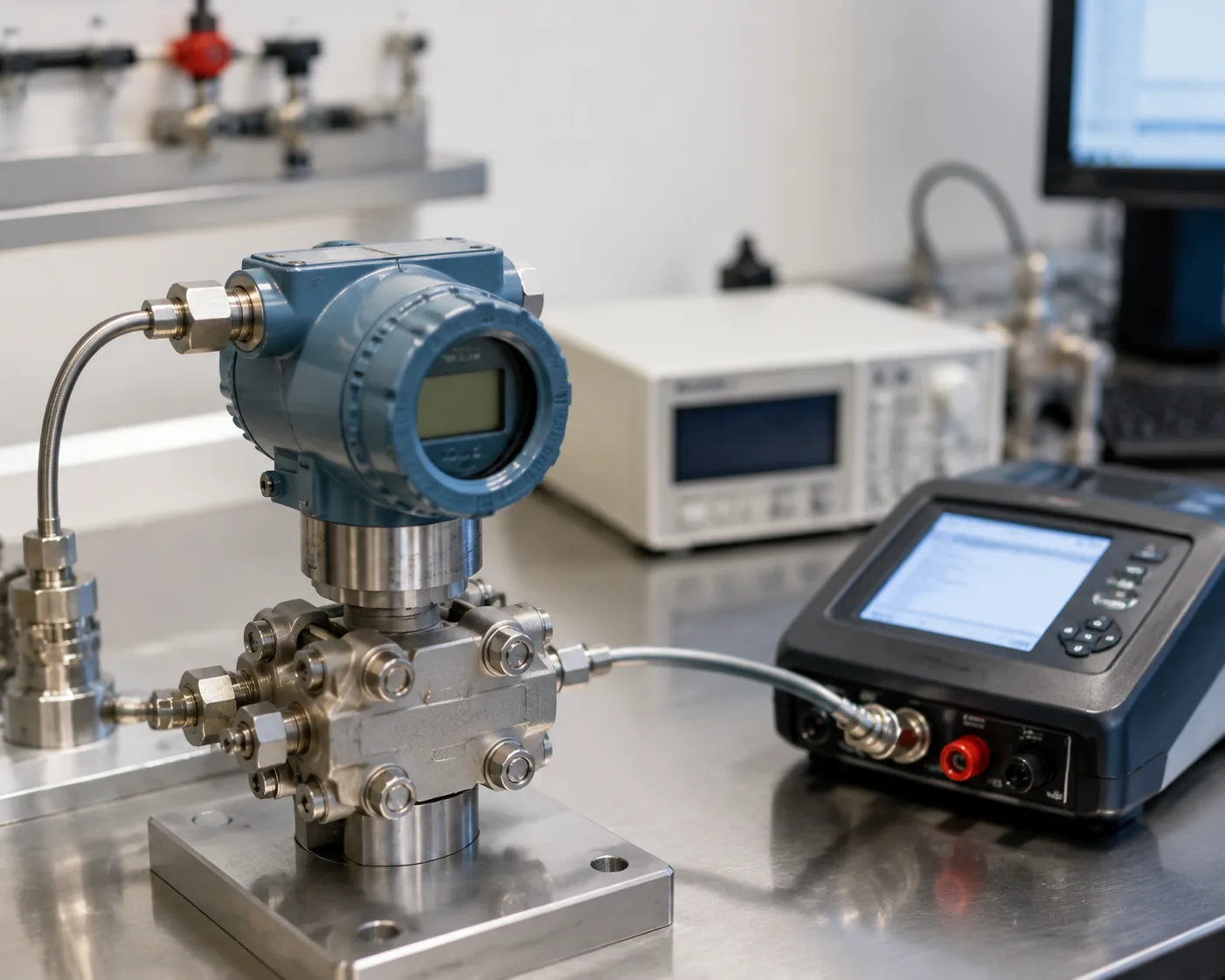
Why Accuracy Class Is the Framework for Everything Else
Every pressure transmitter is sold with a declared accuracy class that defines its maximum permissible error (MPE) as a percentage of full scale (FS). JJG 882-2019 fixes these classes, and the MPE is what every other test result is judged against:
| Accuracy class | Maximum permissible error (MPE) |
|---|---|
| 0.05 | ± 0.05 % FS |
| 0.1 | ± 0.1 % FS |
| 0.2 | ± 0.2 % FS |
| 0.5 | ± 0.5 % FS |
| 1.0 | ± 1.0 % FS |
A 0.2-class transmitter on a 0–16 MPa range therefore has an MPE of ± 0.2 % × 16 = ± 0.032 MPa; any single-point reading outside that band fails the test. The class also drives the test design: 0.1 class and above require at least 9 test points; 0.2 class and below require at least 5, with points distributed approximately evenly across the range and including the upper and lower limits (or within 10 % of them).
How Is a Pressure Sensor Actually Calibrated in the Lab?
The test is a multi-point, multi-cycle pressure sweep against a reference standard, not a single application of pressure. The procedure under JJG 882 (and analogous IEC 60770 practice) is:
- Conditioning and zero — stabilise the sensor at reference conditions (typically 20 °C), energise it for warm-up, and record the zero output at no load.
- Upward stroke (上行程) — apply pressure in equal steps from the lower limit to the upper limit, recording output at each of the ≥5/≥9 test points.
- Downward stroke (下行程) — decrease pressure back through the same points to the lower limit.
- Repeat for ≥ 3 cycles — so that repeatability and hysteresis can be separated statistically.
- Calculate — at each point derive the indication error (reading − true pressure from the standard), the hysteresis (up-stroke − down-stroke difference), and the repeatability (spread across cycles).
- Round and judge — round results so rounding error is < 1/10 of the MPE, then judge pass/fail on the rounded data.
The pass criterion is that every test point's indication error stays within the MPE for the declared class, and that hysteresis and repeatability remain within their own limits. A certificate that reports only a single "passed" verdict without the point-by-point data and the uncertainty is not a complete calibration record.
What Reference Standard Is Required, and Why It Matters
A calibration is only as good as the reference, and JJG 882 enforces the one-third rule: the absolute expanded uncertainty of the pressure standard must be no greater than 1/3 (and for 0.1 class and above, effectively 1/4 under the 2019 revision) of the device-under-test's MPE. To verify a 0.1-class transmitter (± 0.1 % FS), the laboratory therefore needs a standard — typically a precision pressure calibrator, deadweight tester or gas/oil-operated piston gauge — accurate to roughly ± 0.025 % FS or better. This is why a high-accuracy transmitter cannot be meaningfully "tested" with a hand pump and an industrial gauge: the reference is worse than the device. The standard's own calibration must in turn be traceable, through an unbroken chain, to a national metrology institute — which is the documentation an ISO/IEC 17025 audit examines.
What Are the Static Performance Parameters That Define a Sensor?
Beyond the single indication-error pass/fail, a full performance characterisation reports the parameters that govern real-world behaviour:
- Linearity — how well the output follows a straight line across the range; the maximum deviation from the best-fit line, expressed as % FS. Non-linearity arises from diaphragm mechanics, strain-gauge placement and signal-conditioning design.
- Hysteresis (回差) — the maximum difference between up-stroke and down-stroke readings at the same pressure; reflects mechanical and material "memory" in the diaphragm and bond lines.
- Repeatability — the spread of readings at the same point across repeated cycles under identical conditions; a pure measure of the sensor's own noise and mechanical stability.
- Sensitivity — output change per unit pressure change (e.g. mA/MPa); must match the datasheet span (e.g. 16 mA over the declared range).
- Zero and span drift — change in the zero output and the full-scale output over time; the basis for setting the recalibration interval.
A sensor can pass the indication-error test at delivery yet drift out of class within months if its stability is poor, which is why periodic recalibration — not a one-off acceptance test — is the requirement in regulated use.
How Are Temperature Effects and Long-Term Drift Tested?
Pressure and signal are not the only variables. Real sensors operate across temperature swings and over years, so characterisation extends to environmental and temporal stability:
- Temperature effect on zero and on span (温漂) — the sensor is placed in a temperature chamber and held at, say, −20 °C, +20 °C and +60 °C while pressure is held constant; the shift in zero output and the shift in span sensitivity are each quantified, typically in % FS / 10 °C. A sensor stable at room temperature can drift well outside class at the extremes.
- Long-term stability (时漂 / long-term drift) — the change in zero and span over a specified period (commonly 6 or 12 months) under reference conditions; declared on the datasheet and verified by interval calibration.
- Pressure-media and position effects — for some designs, orientation and the wetted medium shift the zero; these are checked at installation-imitating conditions.
These are the tests that separate a sensor that merely reads correctly today from one that will hold its class through the service interval. They are also the tests most often absent from field troubleshooting guides, which by definition only catch a sensor once it has already failed.
What Belongs on a Pressure Sensor Calibration Certificate?
A calibration certificate fit for accreditation and audit must contain specific elements — and the absence of any of them is a flag that the "calibration" was incomplete:
- Identification of the device-under-test (make, model, serial, range, output type, declared accuracy class).
- The reference standard used, with its own certificate number, accuracy class, and traceability statement to a national metrology institute.
- Environmental conditions during the test (temperature, humidity).
- Test point table — applied pressure, expected output, measured output, indication error at each point, for both up- and down-strokes across all cycles.
- Hysteresis and repeatability results.
- Measurement uncertainty of the calibration, not just the pass result.
- Conformity statement — whether the device meets its declared accuracy class, judged on rounded data.
- Recalibration interval recommendation.
For instrument-engineering context on environmental-condition testing that overlaps with these procedures, see our high-temperature test capability.
FAQ
What is the difference between pressure sensor testing and pressure transmitter calibration?
They overlap, but a sensor is the sensing element (often a raw millivolt-output strain-gauge bridge), tested under JJG 860 (static), while a transmitter integrates the sensor with signal conditioning and a normalised output (4–20 mA / 0–10 V), tested under JJG 882. Most industrial "pressure sensor testing" in practice means transmitter calibration to JJG 882.
How many test points are required?
Under JJG 882-2019: at least 9 points for 0.1 class and above; at least 5 points for 0.2 class and below, evenly distributed and including the range limits. Each is measured on both the up-stroke and the down-stroke, repeated for at least 3 cycles.
How accurate must the laboratory's reference standard be?
The standard's expanded uncertainty must be no greater than 1/3 of the device's MPE (the one-third rule); for 0.1 class and above the 2019 revision effectively tightens this to 1/4 (the "4× transfer" rule). So a 0.1-class transmitter needs a reference at roughly ± 0.025 % FS or better.
Can I use a multimeter reading to validate my 4–20 mA transmitter?
A multimeter check tells you whether the loop is alive and roughly whether the zero (4 mA) and span (20 mA) are in the right ballpark — useful for field troubleshooting. It does not constitute a calibration: it has no traceable reference, no test-point sweep, no hysteresis or repeatability data, and no uncertainty. A transmitter can pass a multimeter check and still be out of accuracy class.
How often should a pressure sensor be recalibrated?
There is no single number; the interval is set by stability, criticality and the applicable quality system. Common practice is annual recalibration for process-critical transmitters, extending to 2–3 years for stable, non-critical units with documented drift history, and shorter intervals (e.g. 6 months) for high-accuracy or harsh-service applications. The datasheet's declared long-term stability is the starting point for the decision.
Our Testing Capabilities
As an ISO/IEC 17025-accredited third-party laboratory, Beijing ZKGX Research provides pressure sensor and transmitter calibration aligned to JJG 882, JJG 860 and the IEC 60770 framework:
- Indication-error calibration to JJG 882-2019 across accuracy classes 0.05–1.0, with ≥5/≥9 test points, up- and down-strokes, and ≥3 cycles, over ranges up to 500 MPa (gauge, absolute and differential).
- Reference standards — precision pressure calibrators, deadweight testers and piston gauges with traceability to national metrology institutes and uncertainties meeting the 1/3 (1/4 for 0.1 class) rule.
- Static performance characterisation — linearity, hysteresis, repeatability, sensitivity, zero/span drift.
- Environmental and temporal stability — temperature effect on zero and span (in a temperature chamber), long-term drift assessment.
- Output types covered — 4–20 mA (2/3/4-wire), 0–10 V, 0–5 V, mV bridge, HART and digital bus outputs.
- Calibration certificates with full point-by-point data, measurement uncertainty, environmental conditions, traceability and a conformity statement against the declared accuracy class.
Sample types include industrial pressure transmitters, differential-pressure transmitters, absolute-pressure sensors, submersible level transmitters and precision pressure calibrators themselves. If you have a specific device, declared accuracy class, range, or compliance target, contact the laboratory to confirm the exact test set, standards and reporting format.