Table of Contents
- What is propyl gallate testing?
- The standard stack: FAO JECFA, USP, EU 1333/2008, GB 1886, EFSA
- Assay and identity: the HPLC-UV method and the ≥ 98.5 % specification
- Physicochemical properties: melting point, LogP, pKa, and the pyrogallol moiety
- Impurity profile: gallic acid, heavy metals, residual solvents, sulphated ash
- Regulatory limits: ADI 0.5 mg/kg, EU E310, GB 2760, 21 CFR
- Analytical methods: HPLC-UV, HPLC-MS/MS, and nanomaterial sensors
- Metabolism, toxicology, and the prodrug paradigm
- FAQ
- Our propyl gallate testing capabilities
What is propyl gallate testing?
Propyl gallate (PG, propyl 3,4,5-trihydroxybenzoate, CAS 121-79-9, C₁₀H₁₂O₅, MW 212.20, INS 310 / E 310) testing is the measurement and validation of the identity, assay, purity, and physicochemical properties of propyl gallate — the synthetic phenolic antioxidant produced by the esterification of gallic acid with propanol, used as a lipid-oxidation inhibitor in edible oils, meat products, baked goods, chewing gum, margarine, cosmetics (lipsticks, creams), and pharmaceutical formulations. The output of a PG test is a dossier covering the assay (≥ 98.5 % on the dried basis, by HPLC-UV), the identity (by IR, HPLC retention time, and the ferric chloride colour reaction), the melting point (146–150 °C), the impurity profile (gallic acid ≤ 0.5 %; heavy metals ≤ 10 ppm; sulphated ash ≤ 0.1 %; residual solvents per ICH Q3C), and the food-matrix quantification (by HPLC-UV or HPLC-MS/MS, against the regulatory maximum-use levels of the applicable standard).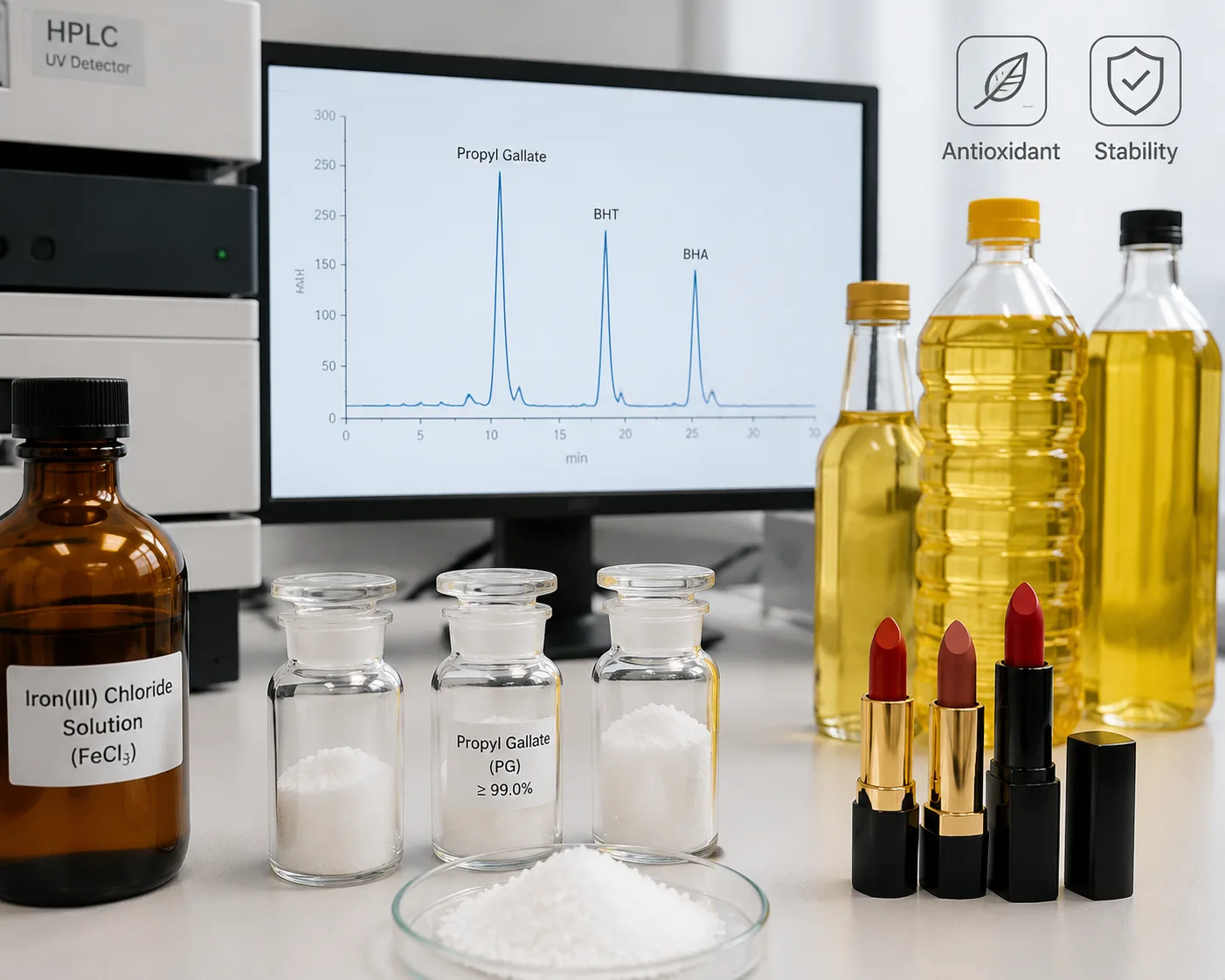
PG is a chain-breaking (primary) antioxidant — it donates a hydrogen atom from one of its three adjacent phenolic hydroxyl groups (the pyrogallol moiety) to a lipid peroxyl radical (LOO•), converting the radical to a lipid hydroperoxide (LOOH) and interrupting the free-radical chain reaction that leads to rancidity. The resulting PG phenoxy radical is resonance-stabilised and does not initiate new oxidation chains. PG is more potent than BHA or BHT in bulk oils and oil-in-water emulsions but has lower oil solubility (LogP ~1.8) — it is therefore commonly used in combination with BHA, BHT, and citric acid (a chelator) in the synergistic antioxidant blends (e.g. BHA + BHT + PG + citric acid) that are the commercial standard for fat and oil stabilisation.
The standards governing PG testing span the FAO JECFA INS 310 monograph (the international food-additive specification, ADI "not specified" at earlier JECFA, updated by EFSA to 0.5 mg/kg bw/day), the USP Propyl Gallate monograph (the US pharmacopeial reference, assay ≥ 98.5 % by titration), the EU Commission Regulation (EC) No 1333/2008 (the food-additive regulation authorising E 310 at specified maximum-use levels in specified food categories), the Commission Regulation (EU) No 231/2012 (the E 310 purity specification), the EFSA 2014 re-evaluation (the ANS Panel scientific opinion setting the current ADI of 0.5 mg/kg bw/day, based on a NOAEL of 135 mg/kg bw/day from a 90-day rat study), the Chinese GB 1886.x series (the food-additive standard), the GB 2760-2024 (the usage scope), and the FDA 21 CFR (the US food additive regulations: 21 CFR 172.615 chewing gum, 21 CFR 166.100 margarine, 21 CFR 319.700 margarine, 21 CFR 172.615 food additives). A PG placed on the Chinese food market must satisfy GB 1886.x and GB 2760; on the EU food market, E 310 per Regulation 1333/2008; on the US food market, the FDA 21 CFR regulations.
The standard stack: FAO JECFA, USP, EU 1333/2008, GB 1886, EFSA
A complete PG testing project draws on a stack of international, US, EU, Chinese, and pharmacopeial standards.
| Family | Standard | Scope |
|---|---|---|
| FAO JECFA INS 310 | Propyl Gallate monograph (Compendium of Food Additive Specifications) | International food-additive specification; assay ≥ 98.5 % (dried basis); name, description, functional uses, identification, purity |
| USP Propyl Gallate | Propyl Gallate monograph (USP-NF) | US pharmacopeial reference; assay ≥ 98.5 % (titration); identification (IR, ferric chloride); heavy metals ≤ 10 ppm; sulphated ash ≤ 0.1 %; loss on drying ≤ 0.5 %; melting range 146–150 °C; residual solvents per <467> |
| EU Regulation (EC) No 1333/2008 | Food additives — E 310 Propyl Gallate | EU food-additive regulation; E 310 permitted in specified food categories at specified maximum-use levels (e.g. fats and oils, chewing gum, margarine, dried meat) |
| Commission Regulation (EU) No 231/2012 | Specifications for food additives — E 310 | EU purity specification for E 310 |
| EFSA ANS Panel 2014 | Re-evaluation of propyl gallate (E 310) as a food additive (EFSA Journal 12:3642) | EU scientific opinion; ADI 0.5 mg/kg bw/day (updated from the previous 0.2–0.5); NOAEL 135 mg/kg bw/day from a 90-day rat study |
| EFSA FEEDAP 2020 / 2024 | Safety and efficacy of propyl gallate for all animal species (EFSA Journal 18:6069; 22:1-11) | EU feed-additive safety; safe doses for animal species (40 mg/kg for ruminants; 71 mg/kg for dogs and cats) |
| GB 1886.x | Food additive — Propyl Gallate | Chinese national food-additive standard |
| GB 2760-2024 | Use of Food Additives | Chinese usage scope — PG permitted in specified food categories at specified maximum levels |
| FDA 21 CFR 172.615 | Food additives — Chewing gum base | PG ≤ 0.1 % alone or in combination |
| FDA 21 CFR 166.100 | Margarine | PG ≤ 0.0075 % as optional preservative |
| FDA 21 CFR 319.700 | Margarine or oleomargarine | PG ≤ 0.02 % by weight, alone or in combination |
| FDA 21 CFR 175.300 | Resinous and polymeric food-contact surfaces | PG as antioxidant in metal can coatings |
| IARC Monograph | Propyl gallate — Group 3 (not classifiable as to carcinogenicity) | IARC classification |
| ICH Q3C | Residual Solvents | The international residual-solvent framework |
| Cosmetic Ingredient Review (CIR) | Safety Assessment of Propyl Gallate as Used in Cosmetics (2024 Re-Review) | Safe at ≤ 0.1 % in cosmetics (the 2007 amended conclusion); 2023 FDA VCRP data shows 86 uses at ≤ 0.012 % |
The single most consequential fact for a Chinese manufacturer is that GB 1886.x is the Chinese food-additive standard for PG and GB 2760-2024 regulates the usage scope. For the EU market, EFSA 2014 ADI = 0.5 mg/kg bw/day is the current dietary-exposure benchmark.
Assay and identity: the HPLC-UV method and the ≥ 98.5 % specification
The assay of PG is the quantitative measurement of the propyl gallate content. The USP monograph specifies:
- Assay: NLT 98.5 % and NMT 102.0 % of C₁₀H₁₂O₅, calculated on the dried basis
The USP reference method is the acid-base titration: dissolve the sample in diluted alcohol; titrate with 0.1 N sodium hydroxide VS to the phenolphthalein endpoint. Each mL of 0.1 N NaOH is equivalent to 21.22 mg of C₁₀H₁₂O₅.
The food-matrix quantification uses HPLC-UV (reverse-phase C18 column, UV detection at 273 nm, the PG λ_max; acetonitrile-water-acetic acid mobile phase; external standard) or HPLC-MS/MS (for the trace-level quantification in complex matrices). The HPLC-UV method simultaneously quantifies PG, BHA, and BHT — the three antioxidants that are commonly used in combination in the food industry.
Identity tests:
- IR spectroscopy — the infrared spectrum of the sample matches the reference spectrum
- HPLC retention time — the retention time of the major peak corresponds to the standard
- Ferric chloride colour reaction — a solution of PG gives a blue-black colour with a few drops of FeCl₃ TS (the pyrogallol moiety forms a coloured complex with Fe³⁺)
- Melting range — 146–150 °C
Physicochemical properties: melting point, LogP, pKa, and the pyrogallol moiety
| Property | Value |
|---|---|
| IUPAC name | Propyl 3,4,5-trihydroxybenzoate |
| CAS | 121-79-9 |
| Molecular formula | C₁₀H₁₂O₅ |
| MW | 212.20 g/mol |
| Appearance | White to creamy-white crystalline powder |
| Melting point | 146–150 °C |
| Boiling point | Decomposes |
| Solubility in water | 3.5 g/L at 25 °C |
| Solubility in ethanol, fats, oils | Soluble |
| pKa | ~8.1 (phenolic hydroxyl groups) |
| LogP (octanol-water) | ~1.8 (moderate lipophilicity) |
| E number | E 310 |
| INS | 310 |
The pyrogallol moiety (the 1,2,3-trihydroxybenzene on the gallic acid backbone) is the defining structural feature of PG — the three adjacent hydroxyl groups make PG an exceptionally efficient hydrogen donor (more potent than BHA or BHT), but they also give PG a lower oil solubility than BHA/BHT (the three hydroxyls increase the hydrophilicity). This is why PG is commonly used in combination with BHA and BHT — the blend provides both the bulk-oil solubility of BHA/BHT and the emulsion potency of PG.
Impurity profile: gallic acid, heavy metals, residual solvents, sulphated ash
| Impurity | USP / FAO JECFA specification | Method |
|---|---|---|
| Gallic acid (the hydrolysis product / the unreacted starting material) | ≤ 0.5 % | HPLC-UV (the free gallic acid is separated from the PG ester on the C18 column) |
| Heavy metals (as Pb) | ≤ 10 ppm (USP); per FAO JECFA (lead ≤ 2 mg/kg) | ICP-MS or AAS |
| Sulphated ash | ≤ 0.1 % | Ignition with H₂SO₄ at 600 °C |
| Loss on drying | ≤ 0.5 % (USP; 105 °C to constant weight) | Gravimetric |
| Residual solvents (propanol, ethanol from the esterification) | Per USP <467> / ICH Q3C | Headspace GC |
| Chlorides, sulphates | Per FAO JECFA | Limit test |
The gallic acid impurity is the most diagnostically significant — a high gallic acid content (> 0.5 %) indicates either an incomplete esterification (unreacted starting material) or a hydrolysed sample (PG degraded back to gallic acid during storage). Gallic acid is also the primary metabolite of PG in the body (PG is rapidly hydrolysed to gallic acid + propanol upon ingestion), so the gallic acid impurity and the metabolic fate are linked.
Regulatory limits: ADI 0.5 mg/kg, EU E310, GB 2760, 21 CFR
The regulatory framework for PG has been progressively tightened, driven by the EFSA 2014 re-evaluation.
| Jurisdiction | ADI / maximum-use level | Standard |
|---|---|---|
| EU (EFSA 2014) | ADI 0.5 mg/kg bw/day (updated from 0.2–0.5); NOAEL 135 mg/kg bw/day (90-day rat) | EFSA Journal 12:3642 |
| EU (Regulation 1333/2008) | E 310 permitted in fats and oils (200 mg/kg), chewing gum (1000 mg/kg), dried meat (200 mg/kg), margarine (200 mg/kg) — varies by food category | Regulation (EC) No 1333/2008 Annex II |
| US (FDA) | 21 CFR 172.615 chewing gum base ≤ 0.1 %; 21 CFR 166.100 margarine ≤ 0.0075 %; 21 CFR 319.700 margarine ≤ 0.02 %; 21 CFR 175.300 food-contact coatings | FDA 21 CFR |
| JECFA | ADI 0.2–0.5 mg/kg bw/day (set at the 18th JECFA 1974; updated by EFSA to 0.5) | FAO JECFA |
| China | GB 2760-2024 — PG permitted in specified food categories at specified maximum levels (typically 100-200 mg/kg in fats and oils, meat products) | GB 2760-2024 |
| Cosmetics (CIR) | Safe at ≤ 0.1 % (the 2007 amended conclusion); 2023 FDA VCRP shows ≤ 0.012 % actual use | CIR 2024 Re-Review |
| IARC | Group 3 (not classifiable as to carcinogenicity to humans) | IARC Monograph |
Analytical methods: HPLC-UV, HPLC-MS/MS, and nanomaterial sensors
Three generations of analytical methods are used for PG quantification, spanning the reference method, the trace-level method, and the emerging rapid-detection method.
| Method | Application | Detection limit |
|---|---|---|
| HPLC-UV (C18 reverse-phase, 273 nm) | The reference method for food and pharmaceutical matrices; simultaneously quantifies PG + BHA + BHT | ~ 0.5-1 mg/kg in food |
| HPLC-MS/MS (ESI negative mode, MRM of m/z 211 → 127 for PG) | The trace-level method for complex matrices (edible oils, meat, biological fluids) | ~ 0.01 mg/kg |
| Electrochemical sensors (Au-decorated α-Fe₂O₃ electrode; functionalised Tb-MOF electrode) | The emerging rapid-detection method for on-site food-safety screening | ~ 0.1 µmol/L (sub-ppb) |
| Ratiometric fluorescence (MnO₂ nanoflakes + quantum dots) | The emerging rapid-detection method with high selectivity | ~ 0.01 µmol/L |
The nanomaterial-based electrochemical and fluorescence sensors (the Au-Fe₂O₃ sensor of Jana 2023, the Tb-MOF sensor of Chen 2024, the MnO₂-QD sensor of Peng 2024) represent the frontier of PG detection — they offer sub-ppb sensitivity in a portable format, suitable for on-site food-safety monitoring. These sensors exploit the pyrogallol moiety's electrochemical activity (the hydroxyl groups are oxidised at the electrode surface) and its quenching effect on fluorescent nanomaterials.
Metabolism, toxicology, and the prodrug paradigm
The toxicological profile of PG is dominated by its metabolic fate: PG is rapidly hydrolysed in the small intestine to gallic acid (GA) and n-propanol upon ingestion. The body is therefore primarily exposed to GA (not intact PG), and PG functions as a prodrug for GA delivery.
Key toxicological endpoints:
| Endpoint | Finding | Significance |
|---|---|---|
| Acute oral toxicity (LD₅₀ rat) | > 1700 mg/kg bw (low acute toxicity) | Rapid hydrolysis limits systemic PG exposure |
| Genotoxicity (in vitro) | Positive in some in vitro assays (chromosomal aberrations, driven by ROS generation in the culture medium) | The in vitro effect is a pro-oxidant artefact of the culture medium — not observed in vivo |
| Genotoxicity (in vivo) | Generally negative | The body's antioxidant defences and the rapid metabolism prevent the ROS accumulation |
| Carcinogenicity | Not carcinogenic in long-term animal studies | IARC Group 3 (not classifiable) |
| Reproductive toxicity | High doses impair oocyte maturation (200 µM in vitro); 2-cell embryo development affected at 50 µM; no teratogenic effects at normal doses | The in vitro developmental toxicity is a recent finding requiring further evaluation |
| Allergenicity | Known contact allergen — causes allergic contact dermatitis (ACD) and cheilitis from cosmetics | The CIR limit of ≤ 0.1 % in cosmetics (2007) was driven by the sensitisation data |
| NOAEL | 135 mg/kg bw/day (90-day rat study, EFSA 2014) | The basis for the ADI of 0.5 mg/kg bw/day (with a 100-fold uncertainty factor) |
The prodrug paradigm — that PG is the gallic acid delivery vehicle — is the key to understanding the dual bioactivity of PG: the antioxidant (hydrogen-donating) activity is from the intact PG molecule; the pro-oxidant, anti-cancer, and antibiotic-adjuvant activities are from the GA metabolite's interaction with the cellular redox systems. This duality is the scientific frontier of PG research.
FAQ
What is propyl gallate and why is it used?
Propyl gallate (PG, E 310, INS 310) is a synthetic phenolic antioxidant — the propyl ester of gallic acid — used to inhibit lipid oxidation (rancidity) in edible oils, meat products, baked goods, chewing gum, margarine, and cosmetics. It works by donating a hydrogen atom from its pyrogallol (1,2,3-trihydroxybenzene) moiety to lipid peroxyl radicals, interrupting the free-radical chain reaction. It is commonly used in combination with BHA and BHT (which have better oil solubility) in synergistic antioxidant blends.
What is the ADI for propyl gallate?
The EFSA 2014 re-evaluation set the ADI at 0.5 mg/kg bw/day (updated from the previous 0.2–0.5 range), based on a NOAEL of 135 mg/kg bw/day from a 90-day rat study with a 100-fold uncertainty factor. The JECFA ADI is also 0.2–0.5 mg/kg bw/day.
Why is propyl gallate genotoxic in vitro but not in vivo?
PG generates reactive oxygen species (ROS) in the artificial environment of the cell-culture medium (where there are no antioxidant defences), which damage the DNA in vitro. In vivo, the body's antioxidant defence systems (glutathione, catalase, SOD) and the rapid hydrolysis of PG to gallic acid + propanol prevent the ROS accumulation — hence no genotoxicity in the whole animal.
What is the maximum use level of propyl gallate in food?
The maximum-use level varies by food category and jurisdiction. In the EU (Regulation 1333/2008), E 310 is permitted at ~200 mg/kg in fats and oils and dried meat, and at ~1000 mg/kg in chewing gum. In the US (21 CFR), PG is permitted at ≤ 0.1 % in chewing gum base, ≤ 0.02 % in margarine. In China (GB 2760-2024), PG is permitted in specified categories at specified levels (typically 100-200 mg/kg).
What analytical method is used for propyl gallate quantification?
The reference method for food and pharmaceutical matrices is HPLC-UV at 273 nm (C18 reverse-phase), which simultaneously quantifies PG, BHA, and BHT. For trace-level quantification in complex matrices, HPLC-MS/MS (MRM m/z 211 → 127) is used. Emerging methods include electrochemical and fluorescence nanomaterial sensors (Au-Fe₂O₃, Tb-MOF, MnO₂-QD) with sub-ppb detection limits for on-site screening.
Our propyl gallate testing capabilities
Beijing ZKGX Research (ISO/IEC 17025 accredited, CMA- and CNAS-accredited testing laboratory) provides complete propyl gallate testing across the FAO JECFA, USP, EU, GB, and EFSA standard stack:
- FAO JECFA INS 310 propyl gallate monograph — full conformance: assay ≥ 98.5 %, identity, purity, heavy metals.
- USP Propyl Gallate monograph — assay ≥ 98.5 % (titration); identification (IR, ferric chloride, HPLC RT); heavy metals ≤ 10 ppm; sulphated ash ≤ 0.1 %; LOD ≤ 0.5 %; melting range 146–150 °C; residual solvents per USP <467>.
- EU Regulation 1333/2008 / 231/2012 E 310 — maximum-use-level compliance for the EU food market.
- EFSA 2014 re-evaluation support — ADI 0.5 mg/kg bw/day dietary-exposure assessment.
- GB 1886.x Chinese food-additive PG — for the Chinese food market.
- GB 2760-2024 usage-scope verification — confirmation that the intended food-category usage is permitted at the specified level.
- FDA 21 CFR compliance — for the US food market (chewing gum, margarine, food-contact coatings).
- Assay — USP titration (0.1 N NaOH, phenolphthalein); HPLC-UV (C18, 273 nm) for food matrices.
- HPLC-UV simultaneous PG + BHA + BHT quantification — the standard food-matrix method; detection ~ 0.5-1 mg/kg.
- HPLC-MS/MS trace-level quantification — MRM m/z 211 → 127; for complex matrices (edible oils, meat, biological fluids); detection ~ 0.01 mg/kg.
- Gallic acid impurity — HPLC-UV; ≤ 0.5 %.
- Heavy metals — ICP-MS or AAS; ≤ 10 ppm (USP).
- Melting range — 146–150 °C capillary method.
- Identity — IR; ferric chloride blue-black colour; HPLC retention time.
- Residual solvents — headspace GC; propanol, ethanol; per USP <467> / ICH Q3C.
- Loss on drying, sulphated ash — gravimetric; ≤ 0.5 % LOD, ≤ 0.1 % ash.
Suitable sample matrices include: crystalline propyl gallate (food-grade and pharmaceutical-grade); edible oils and fats; meat products (sausages, dried meat); baked goods; chewing gum; margarine; cosmetics (lipsticks, creams); pharmaceutical formulations; food-contact coatings (metal can linings); active packaging films. Each project is delivered with a full data report (test protocol, instrument calibration, raw HPLC / titration / ICP-MS data, statistical analysis, identification-test evidence, classification conclusion per the applicable standard) in English and/or Chinese, with CMA/CNAS stamping. Contact Beijing ZKGX Research to scope the propyl gallate test applicable to your product and target market.