Table of Contents
- What Does Range Hood Testing Measure?
- How Is Airflow (CFM) Tested and Certified?
- What Noise Standards Apply (Sones and ASHRAE 62.2)?
- What Is Capture Efficiency and How Is It Tested (ASTM F2941)?
- How Does IEC 61591 Test European Cooking Fume Extractors?
- What Are the Chinese GB/T 17713 Requirements?
- Why Is Installed Performance Lower Than Rated Performance?
- How Do US, European, and Chinese Standards Compare?
- FAQ
- Our Range Hood Performance Testing Capabilities
What Does Range Hood Testing Measure?
Range hood testing quantifies how effectively a kitchen ventilation device removes cooking pollutants — and it does so across four measurable performance axes: airflow, noise, pollutant capture, and grease filtration. A range hood that moves air loudly but captures little is no better than one that is quiet but underpowered, so standardized testing exists to measure each axis under controlled, repeatable conditions and report numbers that can be compared between models and markets.
The four axes correspond to distinct user concerns: airflow (will it clear the kitchen fast enough?), noise (will the household actually use it?), capture efficiency (does it remove the pollutants, not just move air?), and grease separation (does it stop grease from coating the ductwork). Each axis is governed by a specific standard with defined test conditions, and the standards differ between the United States, Europe, and China — a point that complicates global product qualification but that a proper test program resolves by mapping one result set against the others.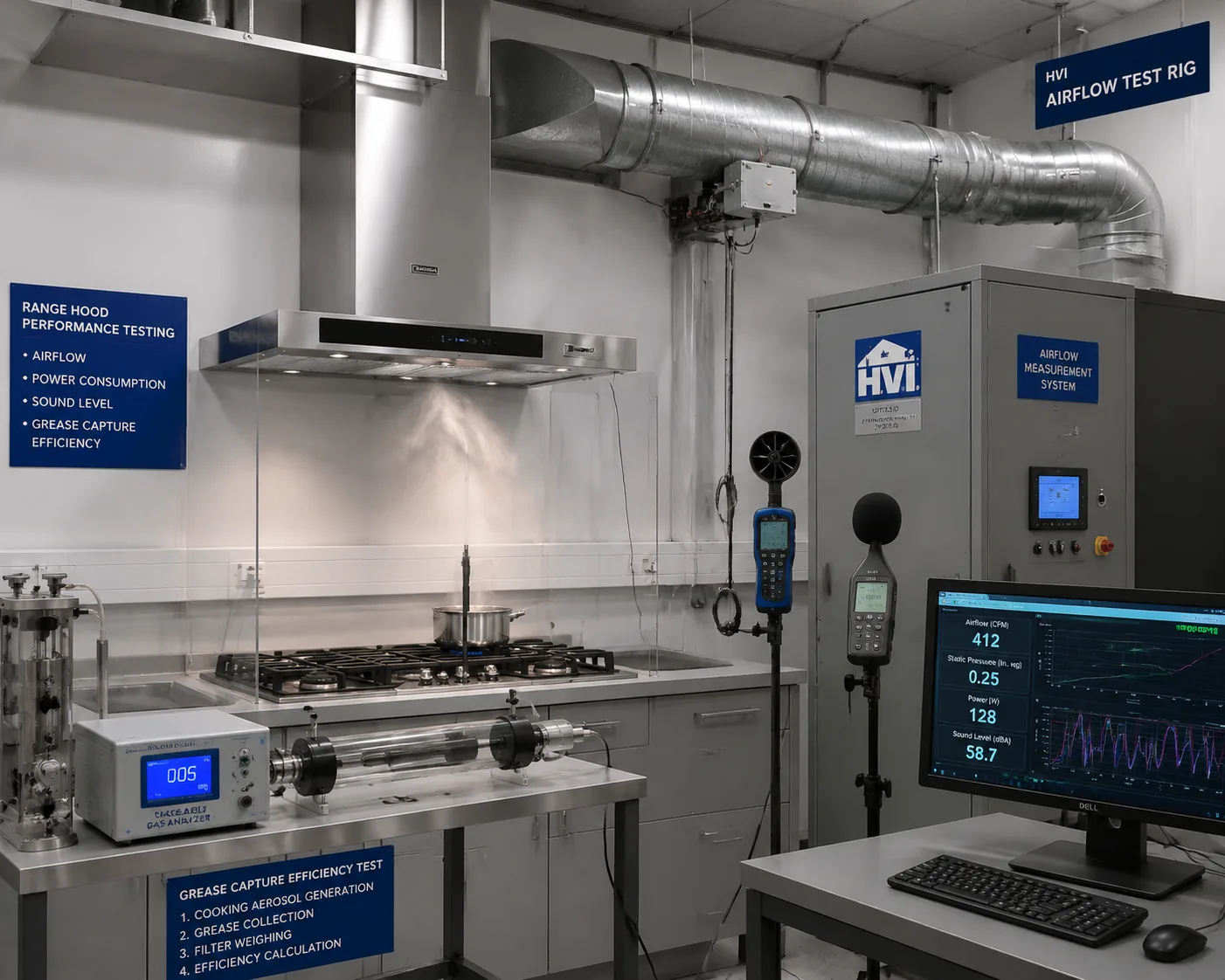
How Is Airflow (CFM) Tested and Certified?
In the United States, airflow is measured in cubic feet per minute (CFM) and certified by the Home Ventilating Institute (HVI) using standardized duct-testing procedures. HVI does not report a single number — it tests at multiple static-pressure levels and plots a performance curve showing how airflow falls as duct resistance rises. Two ratings matter:
| Rating | Static Pressure | What It Represents |
|---|---|---|
| HVI Certified Rating | 0.1 inches w.c. | Typical installed performance in a properly designed residential duct system — the number to trust |
| Maximum Power Rating | 0 inches w.c. | Maximum airflow with no duct attached — an ideal-condition ceiling, not installed performance |
The HVI certified rating at 0.1 inches is the figure that reflects real-world operation, because every residential duct system imposes some resistance. The maximum-power rating (0 static pressure) is always higher and is the number some manufacturers promote without explaining the condition. A common sizing guideline drawn from this testing: roughly 1 CFM per 100 BTU of cooking power — so a 45,000-BTU gas range calls for about 450 CFM — with high-emission cooking (wok, grilling) typically needing 300–400 CFM or more.
For whole-house ventilation use, ASHRAE Standard 62.2-2016 sets a residential kitchen minimum of 100 CFM for demand-operated exhaust.
What Noise Standards Apply (Sones and ASHRAE 62.2)?
Range hood noise in the US is measured in sones, a linear unit of perceived loudness that is more intuitive than the logarithmic decibel. Reference points help interpret the scale: 1 sone is roughly the sound of a refrigerator running, normal conversation is about 4 sones, and light traffic is about 8 sones.
ASHRAE Standard 62.2-2016 sets the binding noise limits for residential range hoods:
| Condition | Limit |
|---|---|
| Occupant-controlled range hood, at ≥100 CFM | ≤ 3 sones |
| Continuously operating whole-house exhaust | ≤ 1 sone |
| Multispeed demand-controlled fans | At least one speed must run < 3 sones |
The HVI certifies sone ratings alongside airflow, but manufacturer self-published sone values may not follow HVI test methods and can be inconsistent — which is why HVI-certified noise data is the reliable basis for comparison. The engineering trade-off is real: field studies by Lawrence Berkeley National Laboratory (LBNL) found that hoods with the highest capture efficiency were also noisier at higher fan speeds, so the test data must balance both axes rather than optimize one.
What Is Capture Efficiency and How Is It Tested (ASTM F2941)?
Capture efficiency (CE) is the single most meaningful performance metric — it measures the fraction of cooking pollutants the hood actually removes, as opposed to the air it merely moves. A hood can move 600 CFM but capture only 50% of the grease and combustion products; CE exposes that gap.
The standardized test method is ASTM F2941, which defines a reproducible procedure for measuring how much of a tracer pollutant (generated at the cooktop) is captured and exhausted versus what escapes into the kitchen. LBNL research underpins the performance benchmarks: deep hoods with large internal volume and full cooktop coverage achieve CE ≥ 80%, while flat "designer" hoods and over-the-range microwave exhaust systems score substantially lower. The practical guidance drawn from the data: select a hood at least 7 inches in vertical depth with recessed grease filters and the blower entry inside the hood body.
CE ratings certified to the ASTM method are the most relevant single figure for comparing pollutant-removal performance — more meaningful than CFM alone, because CFM says nothing about whether the captured air actually contains the pollutants.
How Does IEC 61591 Test European Cooking Fume Extractors?
The European and international counterpart to the US framework is IEC 61591 (current edition EN IEC 61591:2023), titled Cooking fume extractors — Methods for measuring performance. It is the primary performance standard for range hoods in Europe and is harmonized under CENELEC. Where the US system splits airflow, noise, and capture across separate standards, IEC 61591 consolidates the principal performance tests into one document:
| Test | What IEC 61591 Measures |
|---|---|
| Air delivery | Airflow at the air-outlet orifice under specified conditions |
| Grease filter efficiency | Fraction of grease particles captured by the filter |
| Odour reduction | Effectiveness in reducing cooking odours (the European equivalent of capture, measured by tracer gas) |
| Noise | Sound power / sound radiation under standardized operating conditions |
| Lighting | Illumination of the cooking surface |
| Overall efficiency | Integrated extraction-performance rating |
The odour-reduction and grease-filter-efficiency tests are the European equivalents of the US capture-efficiency concept — they quantify pollutant removal directly rather than inferring it from airflow. Because IEC 61591 is a single consolidated standard, a European test report covers the full performance picture in one document, which simplifies comparison between models but uses test conditions that differ from the US ASTM/HVI methods.
What Are the Chinese GB/T 17713 Requirements?
The Chinese national standard GB/T 17713-2022 (Range hoods and other cooking fume extractors, effective January 1, 2023) sets the performance floor for the Chinese market. The 2022 revision raised two key limits and restructured the odour test:
| Parameter | GB/T 17713-2022 Requirement | Change vs. Previous Edition |
|---|---|---|
| Airflow (风量) | ≥ 10 m³/min | Benchmark rated flow |
| Transient odour reduction rate (瞬时气味降低度) | ≥ 60% | Raised; the old "constant odour reduction rate" was deleted |
| Grease separation efficiency (油脂分离度) | ≥ 85% | Raised from the previous floor |
The 2022 revision also expanded scope to explicitly cover integrated stoves (集成灶), closing a previous regulatory gap. The transient odour-reduction test and grease-separation test are methodologically aligned with the IEC 61591 concepts but use Chinese test conditions and units (m³/min rather than CFM, percent thresholds). A product meeting GB/T 17713-2022 therefore satisfies the Chinese market floor, while IEC 61591 covers Europe and the ASTM/HVI/ASHRAE set covers the US.
Why Is Installed Performance Lower Than Rated Performance?
A recurring finding across all the standards is that the rated airflow on a specification sheet does not equal the airflow delivered in a real kitchen. The gap comes from duct-system resistance, which the HVI 0.1-inch static-pressure rating approximates but cannot fully predict for every installation. The factors that reduce installed performance:
- Duct length — longer runs increase friction and reduce flow
- Duct path — each elbow and turn adds resistance; straight runs perform best
- Duct size — diameter should match the hood outlet; undersizing chokes flow
- Duct type — rigid metal ducting is preferred; flexible ducting adds substantial resistance
- Static pressure — a poorly designed duct system raises static pressure and lowers delivered airflow
This is why the HVI distinguishes the certified rating (0.1″, realistic) from the maximum-power rating (0″, ideal). A hood rated 600 CFM at maximum power may deliver 350–400 CFM through a typical residential duct — and that installed figure is what actually determines whether the kitchen air is cleared. Testing to the standardized static-pressure condition is what makes the comparison honest.
How Do US, European, and Chinese Standards Compare?
Because the three markets use different standards, units, and test conditions, a product qualified for one market cannot be assumed to meet another's requirements. The comparison below maps the equivalent tests:
| Performance Axis | United States | Europe / International | China |
|---|---|---|---|
| Airflow | CFM, HVI certified at 0.1″ w.c. | m³/h, IEC 61591 | ≥10 m³/min, GB/T 17713 |
| Noise | Sones, ASHRAE 62.2 (≤3 @100 CFM) | dB(A) sound power, IEC 61591 | GB/T 17713 noise limit |
| Pollutant removal | Capture efficiency ≥80% (ASTM F2941, LBNL benchmark) | Odour reduction %, IEC 61591 | Transient odour reduction ≥60%, GB/T 17713 |
| Grease | ( grease filter tested per HVI) | Grease filter efficiency %, IEC 61591 | Grease separation ≥85%, GB/T 17713 |
| Lighting | ( CR evaluates separately) | IEC 61591 illumination test | GB/T 17713 |
A complete third-party test program for a globally marketed range hood runs all three frameworks. The airflow, odour-reduction, and grease-separation tests overlap conceptually but use different apparatus and units, so each must be executed to its own standard to generate a valid report for that market.
FAQ
What is the difference between HVI certified airflow and maximum power airflow?
HVI certified airflow is measured at 0.1 inches of static pressure, simulating a typical residential duct system — it reflects realistic installed performance. Maximum power airflow is measured at 0 static pressure (no duct attached) and is always higher; it represents an ideal-condition ceiling. Always compare models using the HVI certified figure.
What capture efficiency should a range hood achieve?
Based on LBNL research benchmarks, a range hood should achieve capture efficiency of 80% or higher. Deep hoods with large internal volume and full cooktop coverage reach this level; flat "designer" hoods and over-the-range microwave exhaust systems typically fall well below. ASTM F2941 defines the standardized test method.
Can a range hood be quiet and still capture pollutants effectively?
There is a real trade-off. LBNL field studies found that the hoods with the highest capture efficiency were also noisier at higher fan speeds. The practical resolution is a multispeed hood: run it on low (quiet, <3 sones) for light cooking and high (louder, higher CE) for high-emission cooking like stir-frying or grilling.
How does the Chinese GB/T 17713 odour-reduction test differ from the US capture-efficiency test?
Both measure pollutant removal, but differently. GB/T 17713-2022 measures a transient odour-reduction rate (≥60% required) using a tracer under Chinese test conditions. The US ASTM F2941 measures capture efficiency as a percentage of a tracer pollutant captured at the cooktop. They are conceptually equivalent but use different apparatus and units, so results are not directly interchangeable.
Does a higher CFM rating always mean better pollutant removal?
No. CFM measures air moved, not pollutants captured. A hood moving 600 CFM with poor geometry can capture less than a 350-CFM hood with deep volume and full coverage. Capture efficiency (ASTM F2941) is the metric that directly measures pollutant removal; CFM is necessary but not sufficient.
Do over-the-range microwave exhaust systems meet range hood standards?
Most do not. Per the ASHRAE 62.2-2016 data, no over-the-range microwave currently complies with the airflow or noise requirements, and few carry HVI-certified sound or airflow ratings. They are not recommended for households sensitive to noise, odors, or air pollution, or for frequent cooking.
Our Range Hood Performance Testing Capabilities
Beijing ZKGX Research Institute provides third-party performance testing for range hoods and cooking-fume extractors. Our testing follows the validated US (HVI/ASHRAE/ASTM), European (IEC 61591), and Chinese (GB/T 17713) methods, applied to each product's target markets.
Standards Our Testing Covers
| Test Endpoint | Method Reference |
|---|---|
| Airflow (HVI certified, max power) | HVI / ASHRAE 62.2 |
| Noise (sones) | ASHRAE 62.2 / HVI |
| Capture efficiency | ASTM F2941 |
| Cooking fume extractor full performance | IEC 61591:2023 |
| Airflow, odour reduction, grease separation, noise | GB/T 17713-2022 |
| Grease filter / grease separation efficiency | IEC 61591 / GB/T 17713 |
What We Can Test
- Wall-chimney and under-cabinet range hoods — airflow, noise, capture efficiency, grease separation
- Over-the-range microwave exhaust systems — ASHRAE 62.2 compliance and HVI-equivalent performance
- Recirculating (ductless) hoods — odour reduction and grease filtration in recirculation mode
- Integrated stoves (集成灶) and specialty hoods — GB/T 17713-2022 qualification
Sample Types We Accept
Finished range hood products across standard widths (30-inch / 60-cm typical), with ducting configured per the target standard's test rig. Capture-efficiency and odour-reduction tests use the standardized tracer-gas apparatus; airflow tests use the HVI/IEC multi-point static-pressure rig.
Get a Testing Quote
If you need performance certification for a range hood or cooking-fume extractor — for the US, European, or Chinese market — our team will confirm the applicable standard, sample requirements, and a quotation. Contact Beijing ZKGX Research Institute to start.