Salmonella testing is the laboratory detection of the foodborne pathogen Salmonella in food, environmental, and animal-feed samples, to the mandatory food-safety method standard GB 4789.4-2024 (National food safety Standard — Food Microbiological Examination: Salmonella). The test is governed by a zero-tolerance presence/absence logic: because Salmonella is a pathogen for which any detectable level in a ready-to-eat food is unacceptable, the result is reported as detected / not-detected in 25 g, not as a colony count. The method is a four-stage culture pipeline — pre-enrichment, selective enrichment, selective plating, and biochemical confirmation — designed to recover low-level, stressed Salmonella cells from complex food matrices.
Why Salmonella Testing Is Presence/Absence, Not a Count
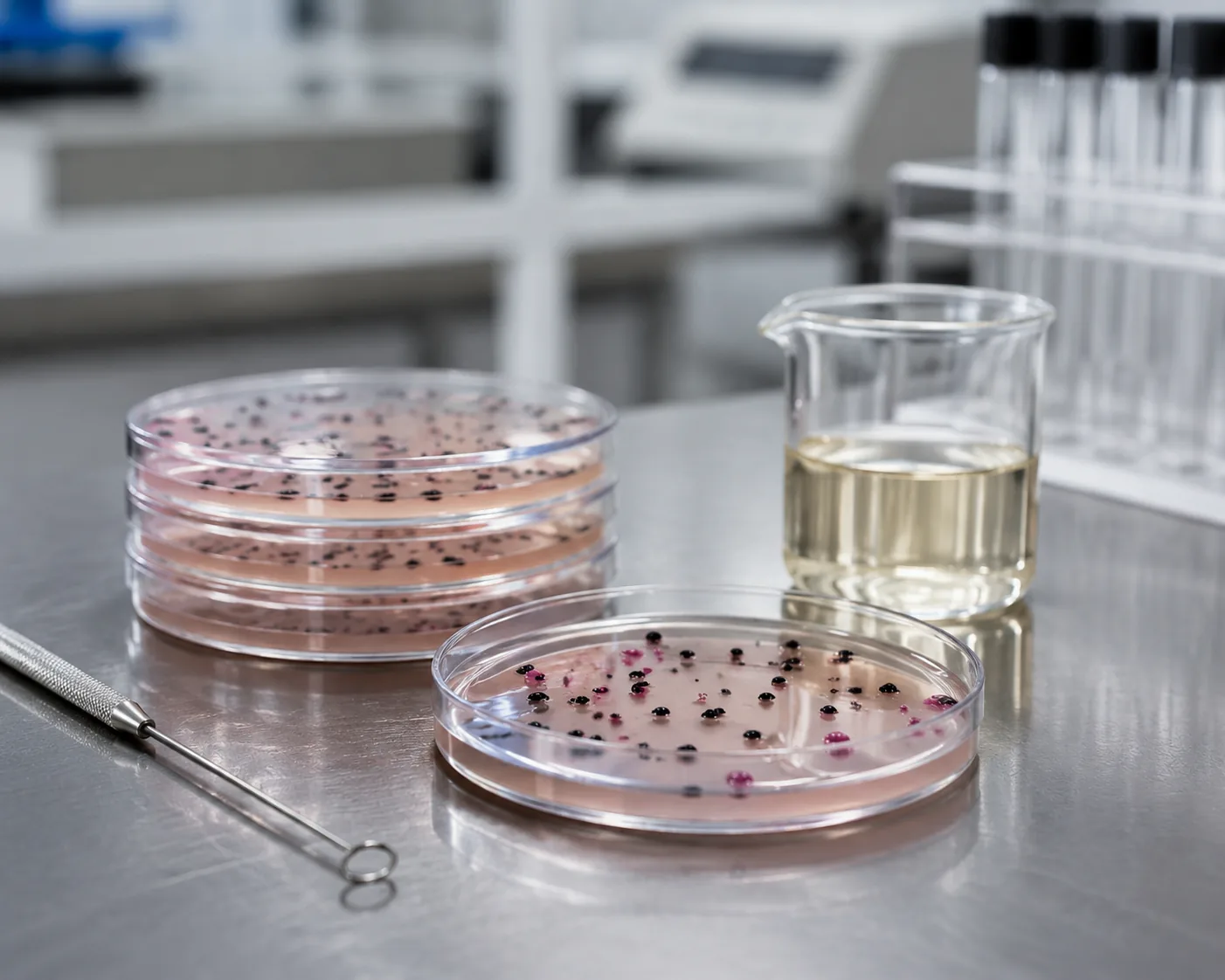
Salmonella belongs to the Enterobacteriaceae family; over 2,600 serovars are known, classified by their somatic (O) and flagellar (H) antigens. The non-typhoidal serovars Salmonella Typhimurium and Enteritidis are among the most common causes of bacterial gastroenteritis worldwide, transmitted mainly through food of animal origin (poultry, eggs, meat, milk) and increasingly through produce, spices, and dry products.
Because ingestion of even a small number of Salmonella cells can cause illness — and because contamination is typically low-level and unevenly distributed within a food lot — the regulatory approach is not to count cells but to ask whether the organism is detectable at all in a defined sample quantity. In China, the standard sample is 25 g, and the result is "Salmonella detected in 25 g" or "not detected in 25 g." A detected result fails the food, regardless of how many colonies grew; this is the zero-tolerance logic that distinguishes a pathogen test from an indicator-organism test like total bacterial count.
The Method Standard: GB 4789.4-2024
The governing method standard is GB 4789.4-2024 (食品安全国家标准 食品微生物学检验 沙门氏菌检验), implemented to replace GB 4789.4-2016. Three changes in the 2024 edition are worth stating:
- Pre-enrichment cultures may be refrigerated at 2–8 °C for up to 72 hours before proceeding to selective enrichment, without affecting the result. This is a practical scheduling change — a lab that finishes pre-enrichment late on Friday can hold the culture over the weekend rather than discarding it or running staff overnight.
- Selective-enrichment broths (RVS, TTB) must be mixed before inoculation — a procedural clarification that improves recovery consistency.
- The selective-plating media (XLD, BS) and the TTB selective-enrichment formulation were adjusted, aligning the medium specifications with current practice.
A current food-microbiology report cites GB 4789.4-2024; the 2016 edition is withdrawn.
The Four-Stage Culture Pipeline
GB 4789.4 is built as a four-stage pipeline, each stage narrowing the microbial population from "everything in the food" down to "confirmed Salmonella":
Stage 1 — Pre-enrichment (non-selective recovery). The 25 g sample is homogenized in buffered peptone water (BPW), a nutrient broth that resuscitates stressed and injured Salmonella cells (cells damaged by processing heat, drying, or acidity) without selective pressure. This stage is essential because food processing injures Salmonella without killing it, and injured cells will not grow on selective media unless first resuscitated.
Stage 2 — Selective enrichment. A portion of the pre-enrichment is transferred to two selective broths that favor Salmonella over the competing background flora:
- RVS (Rappaport-Vassiliadis Soya broth) — low-pH, magnesium-chloride-rich, selective for Salmonella;
- TTB (Tetrathionate broth) — selective via tetrathionate, suppressing competitors.
Using two different selective broths in parallel maximizes recovery across the serovar diversity, because some serovars are recovered better by one broth than the other. (The 2024 edition requires both broths to be mixed before inoculation.)
Stage 3 — Selective plating. The selective enrichments are streaked onto two selective-differential agars:
- XLD (Xylose-Lysine-Deoxycholate) agar — Salmonella colonies appear black-centered (H₂S production);
- BS (Bismuth Sulfite) agar — Salmonella colonies appear brownish-black with metallic sheen.
Suspect colonies — those with the characteristic Salmonella appearance — are picked for confirmation. The plating stage is where the visual identification happens, but appearance alone is not confirmation.
Stage 4 — Biochemical and serological confirmation. Suspect colonies are confirmed by:
- TSI (Triple Sugar Iron) agar — Salmonella gives a characteristic reaction (red slant, yellow butt, black from H₂S, gas);
- Lysine iron agar, urease, indole and other biochemical tests;
- Serological agglutination with O- and H-antigen grouping sera, identifying the serovar.
Only a colony that has the right appearance on the selective plate, the right biochemical profile, and the right serological reaction is reported as Salmonella confirmed. The report is "detected / not-detected in 25 g," with the serovar identified where the testing plan requires it.
The Serovar Classification: O and H Antigens
The 2,600+ Salmonella serovars are classified by the Kauffmann-White scheme, which uses the somatic (O) and flagellar (H) antigens to assign a serovar name (e.g., S. Enteritidis, S. Typhimurium, S. Newport). The serovar matters for outbreak investigation and source tracing — when a foodborne outbreak occurs, serotyping links the food isolate to the clinical isolate — and some product standards require serovar reporting for specific high-risk serovars. The GB 4789.4 confirmation stage includes the serological grouping; full serovar identification is performed when the testing plan or the regulator requires it.
Salmonella's Resilience and Why the Test Is Demanding
The test is technically demanding because Salmonella is resilient in ways that defeat simple detection:
- Drying resistance — once dried, Salmonella survives for long periods and acquires high heat resistance, making it a particular problem in dry and semi-dry products (milk powder, spices, infant formula).
- Acid tolerance — it survives in acidic foods, so a low-pH product cannot be assumed Salmonella-free.
- Fat protection — fatty foods protect Salmonella cells from heat treatment, so pasteurization of a high-fat product may not eliminate it.
- Freezing tolerance — freezing does not kill Salmonella.
These properties are why the four-stage pipeline (resuscitation → selective enrichment → plating → confirmation) is necessary: a single-step plating would miss stressed, injured, or low-level cells that the enrichment stages are designed to recover.
How China Compares Internationally
| Aspect | China (GB 4789.4-2024) | International |
|---|---|---|
| Method | 4-stage culture pipeline | ISO 6579-1:2017 (same pipeline), US FDA BAM Chapter 5 |
| Pre-enrichment | Buffered peptone water (BPW) | BPW (ISO), buffered peptone water (BAM) |
| Selective enrichment | RVS + TTB | MKTTn + RVS + MSRV (ISO); Rappaport-Vassiliadis (BAM) |
| Selective plating | XLD + BS | XLD + second selective agar (ISO); BS, XLD, HE (BAM) |
| Result | Detected / not-detected in 25 g | Same (ISO, BAM) |
| Serovar scheme | Kauffmann-White (O/H antigens) | Same |
The Chinese, ISO, and US methods are fundamentally the same four-stage pipeline with procedural variations. A report cites one depending on the market: GB 4789.4-2024 for China, ISO 6579-1 for the EU, FDA BAM Chapter 5 for the US.
Why the Search Results Are Off the Compliance Intent
The search results for "Salmonella testing" are dominated by content that describes the method but does not frame the Chinese compliance framework:
- US FDA Bacteriological Analytical Manual (BAM) Chapter 5 — the US-regulation method (Jan 2026 / May 2024 editions), with LAMP/qPCR screening and the 21 CFR shell-egg protocol. US-regulation, zero GB.
- Clinical CDC content — salmonellosis diagnosis, antibiotic treatment, multidrug-resistant Newport. Clinical-diagnostic intent.
- Reagent-vendor ISO method pages (Merck Granucult/ReadyTube) — ISO 6579-1:2017 with selective media, ISO 11133-compliant media. Reagent-selling, ISO-focused.
- Academic methodology — detection-method research.
None tells a Chinese food producer, an importer, or a quality lab which GB standard applies, what the 72-h refrigeration and TTB-mix changes mean, or how the zero-tolerance 25-g logic governs the report. That compliance question is what this article addresses.
Our Testing Capabilities
Beijing ZKGX Research conducts Salmonella testing to GB 4789.4-2024:
- Method: the full four-stage culture pipeline — BPW pre-enrichment → RVS + TTB selective enrichment → XLD + BS selective plating → TSI/biochemical confirmation and O/H serological grouping — per GB 4789.4-2024. International reports to ISO 6579-1:2017 or FDA BAM Chapter 5 on request.
- Result: detected / not-detected in 25 g (zero-tolerance presence/absence), with the serovar identified where the testing plan requires.
- Sample matrices: raw and ready-to-eat foods of animal origin (poultry, eggs, meat, milk), produce, spices, dry/semi-dry products (milk powder, infant formula), animal feed, and environmental swabs.
- Rapid-method support: real-time PCR and LAMP screening for faster presumptive results, with culture confirmation per the standard for compliance reporting.
- Deliverable: a test report stating the standard (GB 4789.4-2024), the sample quantity, the detected/not-detected result in 25 g, the confirmed serovar where applicable, and pass/fail against the product's microbiological limit standard (e.g., GB 29921 for ready-to-eat foods).
If you have a food, feed, or environmental sample requiring Salmonella verification, contact our testing team to scope the matrix, the standard, and whether serovar identification is required.
Frequently Asked Questions
What standard governns Salmonella testing in food?
In China, GB 4789.4-2024 (National Food Safety Standard — Food Microbiological Examination: Salmonella), implemented to replace GB 4789.4-2016. Internationally, ISO 6579-1:2017 and the US FDA BAM Chapter 5 apply. All are the same four-stage culture pipeline (pre-enrichment → selective enrichment → selective plating → biochemical confirmation); the report cites one depending on the market.
What changed in GB 4789.4-2024?
Three practical changes: pre-enrichment cultures may be refrigerated at 2–8 °C for up to 72 hours before selective enrichment (work-scheduling flexibility); the selective-enrichment broths RVS and TTB must be mixed before inoculation (recovery consistency); and the XLD/BS plating media and TTB formulation were adjusted. A current report cites GB 4789.4-2024.
Why is Salmonella reported as detected/not-detected, not as a count?
Because Salmonella is a pathogen for which any detectable level in a ready-to-eat food is unacceptable, and because contamination is typically low-level and uneven. The result is "detected in 25 g" or "not detected in 25 g" — a detected result fails the food regardless of colony count. This zero-tolerance presence/absence logic distinguishes a pathogen test from an indicator-organism count like total bacterial count.
What are the four stages of the GB 4789.4 pipeline?
(1) Pre-enrichment in buffered peptone water (BPW) to resuscitate stressed cells; (2) selective enrichment in RVS + TTB broths that favor Salmonella over competitors; (3) selective plating on XLD + BS agars where suspect colonies show the characteristic appearance; (4) biochemical confirmation on TSI agar and serological grouping by O/H antigens. Only a colony confirmed through all four stages is reported as Salmonella.
How many Salmonella serovars are there?
Over 2,600, classified by the Kauffmann-White scheme using the somatic (O) and flagellar (H) antigens. The non-typhoidal serovars Typhimurium and Enteritidis are among the most common causes of gastroenteritis. Serovar identification matters for outbreak investigation and source tracing, and is performed when the testing plan or regulator requires it.