Sand and dust testing is a critical validation process for products designed to operate in real-world environments. While products may perform flawlessly in controlled laboratory conditions with filtered air and regulated temperature, the real world presents a far more challenging environment. Ambient air contains microparticles that can infiltrate equipment, causing failures through multiple mechanisms.
Common Failure Modes from Sand and Dust Ingress:
-
Dust buildup near ventilation points causing overheating in fan-cooled power supplies
-
Solar panels covered with dirt and sand, significantly reducing energy efficiency
-
Abrasion and erosion of surfaces from blowing sand particles
-
Penetration of seals leading to contamination
-
Degraded electrical circuit performance from conductive dust
-
Obstruction and clogging of openings and filters
-
Physical interference with moving and mating parts
-
Reduced heat transfer efficiency
-
Optical interference affecting sensors and displays
-
Increased wear from embedded particles between surfaces
Testing for sand and dust ingress is especially critical for microelectronics, integrated circuits, automotive components, military equipment, and any devices expected to operate in harsh environments such as deserts, construction sites, agricultural settings, or industrial facilities.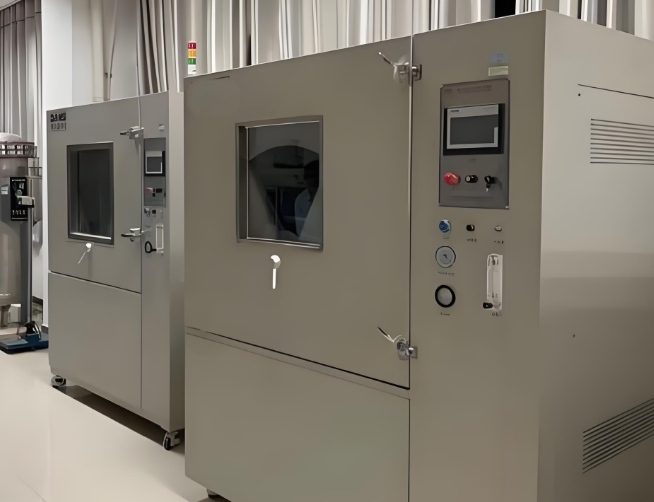
Understanding IP Code Ratings for Dust Protection
The IP Code (International Protection Marking), established by the International Electrotechnical Commission (IEC) standard 60529, provides a standardized classification system for enclosure protection against solid objects and liquids.
IP Code Structure
The IP code uses a two-digit format where:
-
First digit: Protection against solid objects (0-6)
-
Second digit: Protection against liquids (0-8)
Dust Protection Levels
|
IP Rating |
Solid Protection |
Description |
|---|---|---|
|
IP0X |
No protection |
No special protection against contact or ingress |
|
IP1X |
> 50 mm |
Protection against large body parts like hands |
|
IP2X |
> 12.5 mm |
Protection against fingers or similar objects |
|
IP3X |
> 2.5 mm |
Protection against tools, wires, and thick wires |
|
IP4X |
> 1.0 mm |
Protection against most wires, screws, and small objects |
|
IP5X |
Dust protected |
Limited dust ingress not interfering with operation |
|
IP6X |
Dust tight |
Complete protection against dust ingress |
Practical Examples
-
IP5X rated product: Dust ingress is not fully prevented but remains within tolerances that allow adequate product functionality
-
IP6X rated product: Fully protected from dust ingress—no dust can enter the enclosure
-
IP67 rated product: Dust tight and water tight—protected from both dust and water immersion up to 1 meter depth
Sand vs. Dust: Understanding the Difference
According to MIL-STD-810H Method 510.7, the distinction between sand and dust is based on particle size:
Dust (Procedure I)
-
Particle size: Less than 150 μm in diameter
-
Primary concerns: Obstruction of openings, penetration into cracks and crevices, interference with bearings and joints, filter effectiveness evaluation
-
Movement: Can remain suspended in air for extended periods
-
Effects: Binding of moving parts, electrical conductivity changes, corrosion when combined with moisture
Sand (Procedure II)
-
Particle size: 150 to 850 μm in diameter
-
Primary concerns: Abrasion and erosion of surfaces, degradation of performance through physical wear
-
Movement: Requires higher wind velocities to become airborne
-
Effects: Surface erosion, paint removal, optical surface degradation, seal wear
MIL-STD-810H Method 510.7: The Military Standard
MIL-STD-810H Method 510.7 is the comprehensive military standard for sand and dust testing. This standard provides detailed procedures for evaluating equipment's ability to resist the effects of sand and dust environments.
Standard Scope and Application
Purpose: Evaluate all mechanical, optical, electrical, electronic, electrochemical, and electromechanical devices likely to be exposed to dry blowing sand or dust-laden atmospheres.
Application Areas:
-
Platform-mounted equipment
-
Man-portable devices
-
Automotive and vehicle components
-
Aerospace systems
-
Industrial equipment
-
Consumer electronics for harsh environments
Limitations
The standard explicitly notes several limitations:
-
Not suitable for determining electrostatic charge buildup effects
-
Does not address outdoor sand or dust testing due to control problems
-
Does not address settling dust (for settling dust, refer to IEC 60068-2-68 Test Lb)
-
For weapon system components operating during weather encounters (flight through abrasive particles), tailored approaches are required
Test Procedure I: Blowing Dust
Test Objectives
Procedure I evaluates equipment's ability to resist concentrations of blowing dust (< 150 μm). The test assesses:
-
Dust penetration into enclosures
-
Effectiveness of seals and gaskets
-
Filter performance
-
Electrical system integrity
-
Moving part functionality
Critical Test Parameters
Temperature
Tests are conducted at two temperature conditions:
-
Standard ambient temperature: Room temperature conditions
-
High operating or storage temperature: Maximum expected service temperature
In the absence of specified temperatures, use the maximum ambient air temperature for the A1 climatic category.
Relative Humidity
Critical requirement: Maintain relative humidity at or below 30% throughout the test.
Why this matters: High humidity levels cause dust particles to cake together, fundamentally changing their behavior and potentially creating conditions that don't represent actual service environments. Caked dust behaves differently from dry dust in terms of penetration, abrasion, and electrical effects.
Air Velocity
Two air velocity conditions are specified:
-
Reduced velocity: 1.5 ± 1 m/s (300 ± 200 ft/min)
-
Used to maintain test temperature conditions
-
Minimizes airborne dust during temperature conditioning
-
Reduces pressure on dust-laden test item
-
-
Higher velocity: 8.9 ± 1.3 m/s (1750 ± 250 ft/min)
-
Typical of desert wind conditions
-
Used in the absence of specified values
-
More representative of natural conditions
-
Wind speed verification: Sampling rate minimum 4 samples per second, averaged over 10 seconds with controls held constant.
Dust Composition
The standard provides detailed guidance on dust composition, recognizing that natural dust varies significantly by region.
Natural dust constituents:
-
Quartz (primary component, typically < 80% by mass)
-
Feldspars
-
Calcite (carbonate)
-
Dolomite
-
Micas
-
Chlorite
-
Heavy oxides
-
Amorphous inorganic material
-
Organic matter
-
Mixed layer clays (kaolinite, illite, smectite)
-
Soluble salts (in arid regions): calcite, gypsum, halite
Why composition matters:
-
Mixed layer clays swell upon contact with lubricants, causing parts to stick or seize
-
Carbonates enhance scale formation on metal alloys and can cause electrical shorting
-
Soluble salts cause both corrosion and abrasion
-
Silica (quartz) is chemically non-reactive but highly abrasive
Recommended particle size distribution:
-
100% by weight less than 150 μm
-
Median diameter (50% by weight): 20 ± 5 μm
Standard test dust options (in order of preference):
-
Red china clay (most representative of worldwide dust):
-
CaCO₃, MgCO₃, MgO, TiO₂, etc.: 5%
-
Ferric oxide (Fe₂O₃): 10 ± 5%
-
Aluminum oxide (Al₂O₃): 20 ± 10%
-
Silicon dioxide (SiO₂): remaining (50-80%)
-
-
Silica flour (widely used, readily available):
-
97-99% silicon dioxide by weight
-
140 mesh (about 2% retained on 106 micron sieve)
-
Meets particle size distribution requirements
-
WARNING: Exposure can cause silicosis—follow Safety Data Sheet guidelines
-
-
Alternative materials (less desirable):
-
Talcum powder (hydrated magnesium silicate)
-
Fire extinguisher powder (sodium/potassium hydrogen carbonate)
-
Quartz
-
Undecomposed feldspar and olivine
-
Dust Concentration
Standard concentration: 10.6 ± 7 g/m³ (0.3 ± 0.2 g/ft³)
Rationale: This concentration exceeds that normally associated with moving vehicles, aircraft, and troop movement but has historically proven reliable for blowing dust tests using silica flour.
Best practice: When available, use dust concentration based on natural environment data or historical information specific to the service condition.
Test Duration
Standard duration:
-
At least 6 hours at standard ambient temperature
-
Additional 6 hours at high storage or operating temperature
-
Total minimum: 12 hours
Orientation considerations:
-
Rotate test item at equal intervals to expose all vulnerable surfaces
-
If facility can only cover half of each face, double the total testing time
-
Most vulnerable surfaces should face the blowing dust
Operation During Test
Requirements:
-
Include at least one 10-minute operation period during the last hour of testing
-
Most vulnerable surface(s) facing the blowing dust during operation
-
If equipment operates throughout dust events in the field, operate throughout test exposures
Critical considerations:
-
Dust accumulation reduces thermal dissipation capability
-
If dust accumulation is expected in service, perform operational test without removing dust
-
Consider performing high temperature operational test on dust-laden equipment using Methods 501 or 505
-
Manipulate test item as it would be used in the field to uncover binding or wear issues
Dust Accumulation Management
Typical accumulation: Dust accumulations of 13 mm (0.5 inch) on test items are not uncommon during chamber exposure.
Removal considerations:
-
Heavy dust layers may form a protective seal over gaskets, creating unrealistic conditions
-
Removal during reorientation may provide more realistic field representation
-
Removal procedures must reflect in-service use per field manual with available tools
-
Remove by brushing or wiping—avoid introducing additional dust
-
Do NOT use air blast or vacuum unless these methods are used in service
-
Photograph before and after removal
Test Procedure II: Blowing Sand
Test Objectives
Procedure II evaluates equipment's ability to be stored and operated in blowing sand conditions without degrading performance, effectiveness, reliability, and maintainability due to abrasion or clogging effects.
Critical Test Parameters
Temperature
Conduct tests at the high storage or operating temperature for the climatic category of interest, or as specified in the test plan.
Air Velocity
Higher velocities required: Sand particles are larger and heavier than dust, requiring greater wind force to become airborne.
Typical range: 18 to 29 m/s (approximately 40 to 65 mph)
Rationale: These velocities represent severe sandstorm conditions and ensure adequate sand particle movement.
Sand Composition
Particle size: 150 to 850 μm diameter
Composition considerations:
-
Silica sand is commonly used
-
Sharp-edged particles cause more abrasion than rounded particles
-
Consider using sand representative of the deployment region
-
Particle hardness affects abrasion severity
Sand Concentration
Typical concentration: 1.1 to 2.2 g/m³
Lower than dust concentration: Sand's larger particle size means fewer particles per unit volume at the same mass concentration.
Test Duration
Standard duration: Similar to dust testing
-
6 hours at standard ambient temperature
-
6 hours at elevated temperature
-
Rotate to expose all vulnerable surfaces
Abrasion Evaluation
Post-test abrasion assessment should include:
-
Surface roughness measurements
-
Coating integrity evaluation
-
Optical surface inspection
-
Seal and gasket examination
-
Moving part functionality check
Test Equipment and Facilities
Dust Chambers
Settling Dust Chambers
Purpose: Simulate natural dust accumulation from atmospheric settling.
Example: Nvirotest Solutions LRHS-512DUST
-
Interior volume: 0.512 m³
-
Dust concentration: 2.0-4.0 kg/m³
-
Air velocity: up to 2 m/s
-
Compatible particulates: dry talcum powder, silicate cement, smoke ash
-
Features: blower motor, vibration motor, flowmeter, pressure gauge, viewing window
Operation: Blower motor pumps particulates into chamber, scattering over product. Vibration motor prevents dust accumulation on chamber walls.
Dual Dust and Sand Chambers
Purpose: More rigorous testing for harsher environments.
Example: Nvirotest Solutions H-DTDS-216
-
Chamber volume: 216 L (7.6 ft³)
-
Interior: SUS#304 stainless steel with high temperature protection
-
Wind speeds: 1.0-29.0 m/s with speed adjustor
-
Temperature control: Electric heater with SSR and PID control
-
Concentration sensors: 3.0-17.6 g/m³ automatic adjustment
Facility Requirements
Chamber sizing:
-
Test item must not occupy more than 50% of chamber's cross-sectional area
-
Test item must not occupy more than 30% of chamber volume
-
Ensures adequate circulation of dust-laden air
Air distribution:
-
Dust must be uniformly distributed in air stream
-
Introduce dust-laden air to allow laminar flow
-
Prevent excessive turbulence as flow strikes test item
Instrumentation:
-
Calibrated smoke meter and standard light source for concentration verification
-
Keep light source and smoke meter free of dust accumulations
-
Use dry air purge system to protect instrumentation
Grounding:
-
Ground test item and facility to prevent electrostatic charge buildup
-
Verify resistance/continuity per applicable safety requirements
Applicable Standards Beyond MIL-STD-810H
International Standards
IEC 60529: IP Code rating system for enclosure protection
-
IP5X: Dust protected
-
IP6X: Dust tight
IEC 60068-2-68: Environmental testing – Test L: Dust and sand
-
Test La: Circulating dust
-
Test Lb: Settling dust
-
Test Lc: Blowing sand
ISO 20653: Road vehicles – Degrees of protection for electrical equipment
-
Extends IP code for automotive applications
-
Specific requirements for vehicle components
Regional Standards
DIN 40050: German standard for road vehicle components
-
IP rating system for automotive applications
-
Harmonized with ISO 20653
SAE J575: Society of Automotive Engineers standard
-
Testing methods for vehicle lighting and components
-
Dust and sand test procedures
Industry-Specific Standards
ISO/IEC 17025: Testing and calibration laboratory accreditation
-
Ensures test result validity and reproducibility
-
Required for regulatory compliance testing
Effects of Sand and Dust Environments
Mechanical Effects
-
Abrasion and erosion: Surface degradation from particle impact
-
Penetration of seals: Compromise of environmental protection
-
Physical interference: Binding of mating parts
-
Moving part fouling: Increased friction and wear
-
Weight gain: Accumulation affecting balance
-
Filter clogging: Reduced airflow and cooling
Electrical Effects
-
Circuit degradation: Conductive dust causing short circuits
-
Signal attenuation: Interference with electrical connections
-
Electrostatic effects: Charge buildup affecting sensitive electronics
-
Corrosion: Chemical reaction with dust constituents in presence of moisture
Thermal Effects
-
Reduced heat transfer: Dust insulation on heat sinks
-
Restricted ventilation: Blocked airflow paths
-
Overheating: Thermal management system compromise
-
Fire hazard: Extreme cases of overheating
Optical Effects
-
Surface degradation: Abrasion of lenses and displays
-
Light transmission reduction: Coated surfaces compromised
-
Sensor interference: Particle accumulation on optical sensors
Test Sequence Considerations
Position in Test Program
General guidance: Follow anticipated life cycle sequence of events.
Interaction with other tests:
-
Dust coating can influence Solar Radiation (Method 505.7) results
-
Dust can affect Humidity (Method 507.6) and Fungus (Method 508.8) tests
-
Dust combined with Salt Fog (Method 509.6) can accelerate corrosion
-
Consider performing sand/dust test after other environmental tests unless assessing dust effects on subsequent environments
Multiple Procedure Testing
If both blowing dust and blowing sand procedures apply to the same test item:
-
Recommended sequence: Conduct less damaging test first
-
Typical order: Blowing dust (Procedure I) → Blowing sand (Procedure II)
Pre-Test Preparation
Documentation Requirements
Pre-test information needed:
-
Test temperature(s)
-
Dust or sand composition
-
Concentration levels
-
Operating requirements
-
Test item orientation(s)
-
Exposure time per orientation
-
Dust/sand removal methods used in service
-
Air velocity specifications
-
Abrasion evaluation procedures
-
Operational test instructions
-
Additional parameters to measure (weight, balance, fluid contamination)
Test Item Configuration
Configure test item to reproduce anticipated service configuration:
-
Enclosed in shipping/storage container
-
Protected or unprotected
-
Deployed with realistic restraints
-
Openings covered as they would be in service
Pretest Checkout
Steps:
-
Complete visual examination with attention to sealed areas and small openings
-
Prepare test item in operating configuration
-
Install instrumentation as required
-
Position item near chamber center, oriented to expose most critical parts
-
Ensure proper grounding
-
Stabilize at standard ambient temperature
-
Conduct operational checkout and verify proper function
Post-Test Analysis
Blowing Dust Test Evaluation
Assessment criteria:
-
Dust penetration extent and location
-
Filter effectiveness
-
Seal integrity
-
Moving part functionality
-
Electrical performance
-
Optical clarity
-
Thermal management capability
Blowing Sand Test Evaluation
Assessment criteria:
-
Surface abrasion severity
-
Coating damage
-
Erosion depth
-
Seal and gasket wear
-
Optical surface degradation
-
Mechanical function retention
-
Structural integrity
Documentation
Required post-test data:
-
Initial and final test item orientation
-
Test variable values for each section
-
Visual inspection results
-
Test plan deviations
-
Dust/sand composition used
-
Detailed post-test photographs
-
Abrasion area documentation
-
Sand/dust intrusion documentation
-
Cleaning methods performed with before/after photographs
Common Testing Mistakes to Avoid
1. Ignoring Humidity Control
Exceeding 30% relative humidity causes dust caking, fundamentally altering test conditions and producing non-representative results.
2. Using Non-Representative Dust
Selecting dust composition without considering the deployment region's actual dust characteristics can miss critical failure modes related to reactive dust components.
3. Inadequate Duration
Shorter test durations may not reveal time-dependent effects like gradual seal penetration or cumulative filter loading.
4. Neglecting Operational Testing
Failing to operate equipment during test misses critical interactions between dust and moving parts, thermal effects, and operational stress.
5. Improper Facility Sizing
Oversized test items relative to chamber volume prevent uniform dust distribution and create unrealistic flow patterns.
6. Ignoring Electrostatic Effects
Dry conditions and moving air can generate significant static charges affecting sensitive electronics—proper grounding is essential.
7. Inappropriate Dust Removal
Using removal methods (compressed air, vacuum) that won't be available in service creates unrealistic expectations of field performance.
Best Practices for Sand and Dust Testing
Tailoring the Test
Essential principle: MIL-STD-810H emphasizes that tailoring is essential. Select methods, procedures, and parameter levels based on:
-
Requirements documents
-
Life Cycle Environmental Profile (LCEP)
-
Specific deployment region characteristics
-
Anticipated operational scenarios
Realistic Test Conditions
Base test conditions on:
-
Field data when available
-
Historical information from similar deployments
-
Climatic data for geographic areas of operation
-
Induced environments from vehicle or aircraft operation
Comprehensive Documentation
Maintain detailed records of:
-
Chamber conditions throughout test
-
Test item performance at each stage
-
Photographic evidence before, during, and after
-
Any deviations from test plan
-
Post-test cleaning procedures
Safety Considerations
Critical warnings:
-
Silica flour exposure can cause silicosis—follow Safety Data Sheet requirements
-
Use appropriate personal protective equipment
-
Ensure adequate ventilation in test facilities
-
Implement dust containment and cleanup procedures
-
Monitor for electrostatic discharge hazards
Conclusion
Sand and dust testing is essential for validating product reliability in real-world environments where airborne particulates pose significant threats to equipment functionality and longevity. From consumer electronics to military systems, automotive components to industrial equipment, understanding and testing for sand and dust effects ensures products will perform as intended throughout their service life.
The distinction between dust (< 150 μm) and sand (150-850 μm) drives fundamentally different test approaches—dust testing focuses on penetration and interference, while sand testing emphasizes abrasion and erosion. MIL-STD-810H Method 510.7 provides comprehensive procedures for both, with detailed guidance on test parameters, equipment requirements, and evaluation criteria.
Success in sand and dust testing requires careful attention to test conditions—particularly humidity control, dust composition, air velocity, and test duration. Proper test item configuration, realistic operational scenarios, and thorough post-test analysis complete the validation process.
As equipment increasingly operates in diverse global environments—from desert deployments to agricultural settings, construction sites to industrial facilities—sand and dust testing remains a critical component of environmental test programs, ensuring reliability, safety, and performance when it matters most.
Frequently Asked Questions
Q1: What is the difference between IP5X and IP6X ratings?
IP5X means the enclosure is "dust protected"—dust ingress is not fully prevented but does not interfere with satisfactory operation. IP6X means "dust tight"—no dust can enter the enclosure at all. IP6X provides complete protection against dust ingress.
Q2: Why is humidity control important in dust testing?
Relative humidity must be kept below 30% to prevent dust particles from caking together. Caked dust behaves differently from dry dust—it doesn't penetrate as effectively, doesn't distribute uniformly, and can create conditions that don't represent actual service environments.
Q3: What particle sizes define dust versus sand?
According to MIL-STD-810H, dust particles are less than 150 μm in diameter, while sand particles range from 150 to 850 μm. This size difference affects how particles become airborne, their penetration capability, and the type of damage they cause.
Q4: How long should a dust test last?
Standard duration is at least 6 hours at ambient temperature plus 6 hours at elevated temperature, for a minimum total of 12 hours. Duration may need to increase if the test item has multiple vulnerable faces or if facility limitations prevent simultaneous exposure of all surfaces.
Q5: Can I use any type of dust for testing?
No. Dust composition should represent the deployment environment. The standard recommends red china clay or silica flour with specific particle size distributions (100% < 150 μm, median 20 ± 5 μm). Using inappropriate dust can miss failure modes related to reactive components in natural dust.
Q6: Should equipment be operated during the test?
Yes, if the equipment operates in dusty environments during service. The standard requires at least one 10-minute operation period during the last hour of testing. If equipment operates throughout dust events in the field, it should operate throughout the test exposure.
Q7: What's the difference between settling dust and blowing dust tests?
Settling dust tests (IEC 60068-2-68 Test Lb) simulate natural dust accumulation from atmospheric settling with low air velocities. Blowing dust tests (MIL-STD-810H Procedure I) use higher air velocities to drive dust penetration into enclosures, seals, and filters.
Q8: Why do sand tests require higher air velocities than dust tests?
Sand particles are larger and heavier than dust particles, requiring greater wind force to become airborne and achieve the impact velocities necessary for meaningful abrasion testing. Typical sand test velocities are 18-29 m/s versus 8.9 m/s for dust tests.