Sewing machine testing is the laboratory verification that a household electric sewing machine meets the safety requirements of the household-appliance standard set GB 4706.1 + GB 4706.74 (adopted identically from IEC 60335-1 + IEC 60335-2-28), and the CCC certification that the Chinese market requires of it. It is an appliance-safety test, not the consumer "sewing test" that checks stitch quality — those are different activities answering different questions, and the distinction is the first thing this article draws.
"Sewing Machine Testing" Means Two Different Things
The search results for "sewing machine testing" are dominated by two unrelated meanings, both of which are different from laboratory compliance testing:
| Meaning | What it is | Governing reference |
|---|---|---|
| Sewing machine compliance testing (this article) | Laboratory verification of an electric sewing machine against household-appliance safety standards | GB 4706.1 + GB 4706.74, plus CCC |
| Consumer "sewing test" | Stitch-quality checks at different speeds, buttonhole test, balanced-stitch / pull-test for tension — to evaluate or repair a machine | Field evaluation / repair guides |
The consumer "sewing test" answers "does this machine sew well" — a functional and stitch-quality question. Sewing machine compliance testing answers "does this electric sewing machine meet the mandatory safety standards that govern whether it may be sold" — an electrical and mechanical-safety question. They share the word "test" but are otherwise unrelated, and conflating them is the first error to avoid. This article addresses only the compliance test.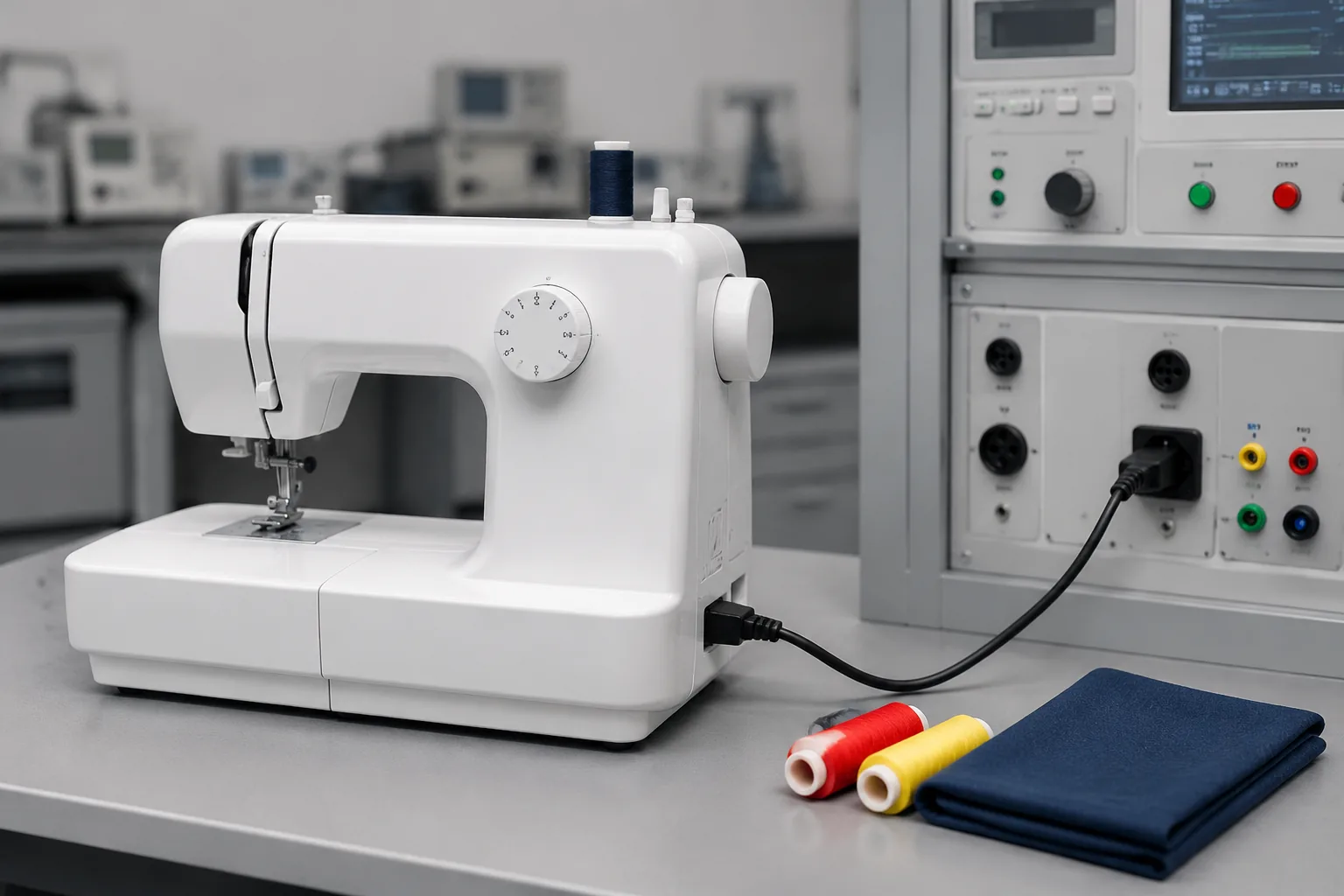
Which Standard Governs Sewing Machine Testing?
Sewing machines are household and similar electrical appliances, and they are tested under the household-appliance safety standard system. The standard set, with its current transition status:
| Document | Status | Role |
|---|---|---|
| GB 4706.1-2005 | Current until 2026-08-01 | Household appliances — general safety requirements (the 22-clause base) |
| GB/T 4706.1-2024 | Implements 2026-08-01 (replaces 4706.1-2005) | New general-safety edition |
| GB 4706.74-2008 | Current until 2026-08-01 | Sewing machines — special requirements (IDT IEC 60335-2-28) |
| GB/T 4706.74-2024 | Implements 2026-08-01 (replaces 4706.74-2008) | New sewing-machine special-requirements edition |
| IEC 60335-2-28 | International source | Identical technical content (the GB/T 4706.74 series is its IDT adoption) |
Two points worth stating plainly. First, the special-requirements standard for sewing machines is GB 4706.74 (Part 2-28 of the household-appliance series), adopted identically from IEC 60335-2-28 — it is not a standalone product standard but a modification of the general GB 4706.1, with sewing-machine-specific clauses layered on. Second, a major standard transition is underway: the GB/T 4706.1-2024 and GB/T 4706.74-2024 editions implement on 2026-08-01, replacing the 2005/2008 editions. The prefix changed from mandatory "GB" to recommended "GB/T", but within the CCC certification system the standard remains the mandatory technical basis — so a sewing machine certified from the 2026-08-01 transition onward is tested to the 2024 editions.
The Type-Test Item List (GB 4706.1 + GB 4706.74)
The sewing-machine type test is the GB 4706.1 general-safety item list, with the sewing-machine special requirements of GB 4706.74 modifying (adding to, replacing, or tightening) specific clauses. The principal items:
- Marking and instructions — rated voltage, power, the warnings, and a clear statement that the product is a household sewing machine.
- Protection against access to live parts — enclosure integrity against user contact with mains-potential parts.
- Starting of motor-driven appliances — the motor must start safely under rated conditions.
- Input power and current — measured against the marked rating.
- Heating (temperature rise) — the motor, the electronics, and touchable surfaces must stay within temperature limits during normal sewing.
- Leakage current and electric strength at working temperature — insulation integrity while energized and warm.
- Moisture resistance — enclosure behavior under humidity.
- Leakage current and electric strength (damp condition) — insulation integrity after the humidity conditioning.
- Overload protection of transformers and related circuits.
- Endurance (耐久性) — the machine must survive prolonged operation without safety degradation.
- Abnormal operation — single-fault behavior under stall, blocked air vents, and other fault conditions.
- Stability and mechanical hazards — this is the clause most modified by GB 4706.74: the sewing-machine-specific requirements for guarding the needle, the moving hook, the take-up lever, and the presser-foot mechanism, so that the user's fingers cannot reach the dangerous moving parts during normal sewing.
- Mechanical strength — enclosure resistance to impact.
- Structure, internal wiring, supply connection and external cord, terminals, earthing, screws and connections — the mains-side construction items.
- Clearances, creepage distances, and solid insulation.
- Heat and fire resistance, rustproofing.
- Radiation, toxicity, and similar hazards.
The mechanical-hazard clause is where the sewing machine differs most from a generic appliance, because the needle-and-hook mechanism is an inherent, necessary moving hazard that must be guarded to a defined finger-access limit while remaining functional.
Sewing-Machine-Specific Hazards
What makes the sewing-machine type test different from testing a generic appliance is the set of hazards that GB 4706.74 addresses specifically:
- Needle and hook mechanism — a reciprocating needle and a rotary hook form the stitch; the standard requires that finger access to these moving parts during sewing is prevented by the guard geometry.
- Motor stall — a jammed mechanism (a fabric wad under the needle) can stall the motor; the endurance and abnormal-operation tests verify the machine tolerates this without overheating or becoming a fire hazard.
- Take-up lever and presser-foot mechanism — additional moving parts that must be guarded.
- Lamp / illumination — many sewing machines include a work lamp whose temperature and accessibility are also within scope.
- Speed control — the foot pedal and controller must fail safe.
These are the sewing-machine-specific items layered on top of the generic appliance-safety base, and they are the part of the report that distinguishes a sewing-machine test from a generic-appliance test.
Household vs Industrial Sewing Machines
The standard set above applies to household and similar sewing machines — the consumer electric sewing machine used in the home. Industrial sewing machines (factory floor units, typically 3-phase, operator-stationed) are a different product category: they are not household appliances, and their safety is governed by industrial-machinery standards (the GB/T 5226 electrical-equipment-of-machines series and the type-C machinery safety standards) rather than the GB 4706 household series. A test report that applies GB 4706.74 to an industrial machine, or applies the industrial standards to a household machine, is a category error. The first scoping question is therefore whether the machine is household or industrial.
CCC Certification
Household sewing machines fall under the CCC (China Compulsory Certification) "household and similar equipment" category. A sewing machine sold in China therefore requires a CCC certificate in addition to passing the GB 4706 type tests, with the certification remaining mandatory through the GB → GB/T 4706 transition. For international markets, the corresponding certifications are the EU CE mark (under EN 60335-2-28) and the UL/cUL mark in North America.
Our Testing Capabilities
Beijing ZKGX Research conducts household sewing machine testing to the GB 4706 standard set:
- Standards basis: GB 4706.1-2005 + GB 4706.74-2008 (current), with the GB/T 4706.1-2024 + GB/T 4706.74-2024 editions (implementing 2026-08-01) supported for transition-period certification; international reports to IEC 60335-2-28 / EN 60335-2-28.
- Test items: the full GB 4706.1 type-test list, with the GB 4706.74 sewing-machine-specific modifications — particularly the mechanical-hazard clause for needle/hook/presser-foot guarding, motor stall, and speed-control fail-safe.
- Certification support: CCC certification for the household-equipment category, with CE (EN) and UL support for export markets.
- Sample types: household electric sewing machines, computerized household sewing machines, and household overlock/serger machines. (Industrial sewing machines are tested under the industrial-machinery standards, a separate scope.)
- Deliverable: a test report stating, for each item, the applied standard, the test condition, the measured result, and pass/fail, with the standard edition (2008 vs 2024) explicitly identified.
If you have a household sewing machine requiring safety verification or CCC certification, contact our testing team to scope the applicable standard edition, the test items, and the target market.
Frequently Asked Questions
What standard governs sewing machine testing?
Household sewing machines are tested under GB 4706.1 (general safety) + GB 4706.74 (sewing-machine special requirements), the IDT adoption of IEC 60335-2-28. The 2024 editions (GB/T 4706.1-2024 and GB/T 4706.74-2024) implement on 2026-08-01, replacing the 2005/2008 editions. Industrial sewing machines are governed by different (industrial-machinery) standards.
Is sewing machine testing the same as the consumer sewing / stitch test?
No. The consumer "sewing test" checks stitch quality, buttonholes, and tension to evaluate or repair a machine. Sewing machine compliance testing verifies electrical and mechanical safety against GB 4706.1 + GB 4706.74. They answer different questions — "does it sew well" versus "is it safe to sell."
What changes in the GB/T 4706.74-2024 edition?
The 2024 edition implements on 2026-08-01 and replaces GB 4706.74-2008. The prefix changed from mandatory "GB" to recommended "GB/T", but the standard remains the mandatory technical basis within the CCC certification system. Sewing machines certified from the transition onward are tested to the 2024 editions.
Do sewing machines need CCC certification?
Yes. Household sewing machines fall under the CCC "household and similar equipment" category, so a sewing machine sold in China requires a CCC certificate in addition to passing the GB 4706.1 + GB 4706.74 type tests. This requirement continues through the GB → GB/T 4706 transition.
What is the difference between household and industrial sewing machine testing?
Household sewing machines are tested under the GB 4706 household-appliance series (GB 4706.1 + GB 4706.74). Industrial sewing machines are factory machinery and are governed by industrial-machinery standards (the GB/T 5226 electrical-equipment-of-machines series and type-C machinery safety standards). They are different product categories with different standards.