Silk testing is the laboratory verification of silk — as raw fiber (reeled raw silk) or as finished silk fabric — against the Chinese national standards that govern its quality and safety. As with other natural-fiber materials, silk testing splits into two domains governed by different standards: raw silk (the reeled fiber before weaving) is tested for fiber quality under GB/T 1798, while silk fabric (the woven, finished textile) is tested for physical performance under GB/T 15552-2015 and for general textile safety under GB 18401. Confusing the two, or confusing textile silk with the unrelated software tool of the same name, is the most common error.
"Silk Testing" Means Three Different Things — Which One Are You?
The term "silk test" / "silk testing" is ambiguous, and the first job of any explanation is to separate three unrelated meanings:
| Meaning | What it is | Governing reference |
|---|---|---|
| Textile silk testing (this article) | Laboratory verification of silk fiber and fabric for quality and safety | GB/T 1798, GB/T 15552-2015, GB 18401 |
| Silk Test (software) | A Micro Focus automated software-testing tool for application functional/regression testing | IT tooling — unrelated to textiles |
| Consumer "is it real silk" tests | Burn test, ring pull, hand-feel — to spot fake silk at home | Field tricks, not laboratory methods |
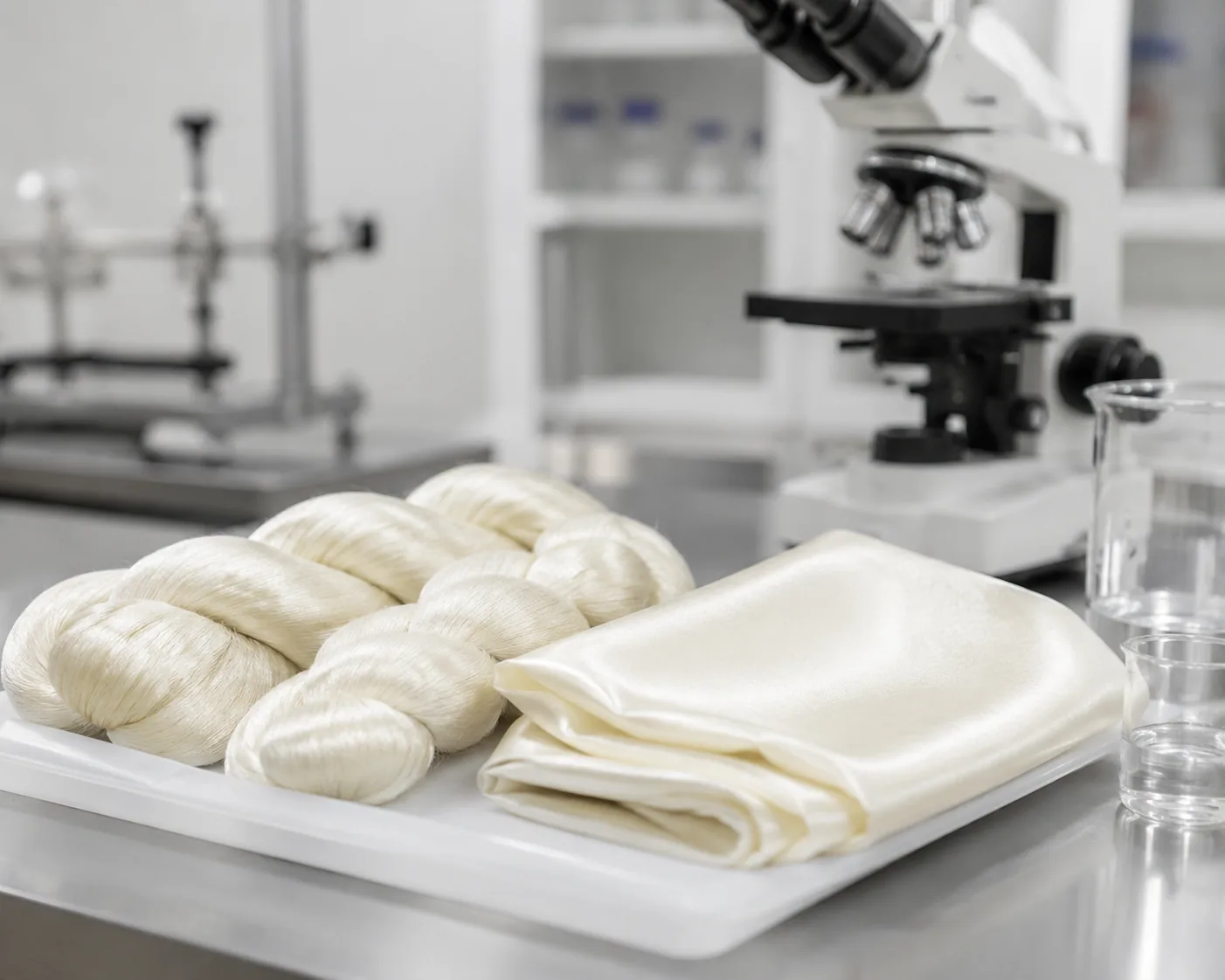
This article addresses only the first: laboratory testing of textile silk for compliance. The software tool is a different domain entirely, and the consumer burn test is a spot-check that the laboratory replaces with quantitative fiber-identification methods (below).
Why Silk Testing Splits Into Raw Silk and Silk Fabric
Within textile silk, the most important framing fact is that "silk testing" is not one test category. The standard and the parameters depend on whether the sample is the raw reeled fiber or the finished woven fabric:
| Domain | Product | What is tested | Governing standard |
|---|---|---|---|
| Raw silk | Reeled mulberry silk yarn (生丝) | Fiber quality: linear density, evenness, cleanness, tenacity, elongation | GB/T 1798-2008 (test methods) + GB/T 1797-2008 (grading) |
| Silk fabric | Woven, finished silk textile (丝织物) | Fabric performance: density, mass, strength, colorfastness, seam slippage | GB/T 15552-2015 (test methods & inspection) |
| Silk fabric — safety | All silk textile products | General textile safety: formaldehyde, pH, colorfastness, odor | GB 18401 (general textile safety) |
A hank of raw silk is tested for fiber evenness and cleanness because the question is "is this yarn good enough to weave." A finished silk scarf is tested for colorfastness and formaldehyde because the question is "is this product safe and durable in use." These are different objects with different standards.
Raw Silk Testing (GB/T 1798-2008)
Raw silk is the continuous filament reeled from silkworm cocoons (most commonly mulberry, Bombyx mori), sold as yarn before weaving. GB/T 1798-2008 (Methods of Testing for Raw Silk) defines its quality tests, and the results are graded under GB/T 1797-2008. The principal parameters:
- Linear density (denier / dtex) — the fineness of the silk filament, measured by weighing a defined length. This is the defining quality metric of raw silk.
- Evenness — the uniformity of the filament's thickness along its length, assessed by an evenness tester that compares the yarn against a standard board or electronically.
- Cleanness and neatness — the count and severity of defects (slubs, loops, waste) on the yarn surface.
- Tenacity and elongation — the breaking strength and elongation-at-break of the silk filament, measured on a tensile tester.
- Cohesion — the resistance of the filaments in the yarn to separation under abrasion.
- Wind defects and size deviation — additional quality indicators in the grading scheme.
Raw silk is traded internationally on these grades, and the GB/T 1797/1798 pair is the principal quality basis in raw-silk trade — a fact reflected in the standards' role in international silk commerce.
Silk Fabric testing (GB/T 15552-2015)
Once silk is woven into fabric, the test object changes from the yarn to the textile, and the standard changes accordingly. GB/T 15552-2015 (Testing Methods and Inspection Regulations for Silk Fabrics) defines the fabric-performance tests:
- Warp and weft density — the thread count per unit length in each direction.
- Mass per unit area (grammage) — the fabric weight, typically in g/m², with a deviation against the nominal value.
- Breaking strength and elongation — the fabric's tensile strength (strip or grab method).
- Seam slippage (纰裂) — the resistance of the fabric to yarns sliding apart at a seam under load — a key durability parameter for silk apparel.
- Pilling and snagging — surface-failure resistance.
- Dimensional change on washing — shrinkage.
- Colorfastness — to washing, water, perspiration, rubbing, and light, each a separate colorfastness test.
- Fiber content — the percentage of silk versus any other fiber (relevant for blends sold as "silk").
These are the items a silk-fabric product standard (for a specific product type — apparel silk, lining silk, decorative silk) draws on, with the applicable grade or limit set by that product standard.
Silk Fabric Safety (GB 18401)
Silk fabric is a textile product, and in addition to the performance tests above it must meet GB 18401 (National General Safety Technical Code for Textile Products), the umbrella textile-safety standard that applies to all textile products sold in China, silk included. GB 18401 classifies textiles into three categories by intended skin contact and sets mandatory limits for each:
| Category | Intended use | Key requirements |
|---|---|---|
| A | Infant products (≤ 36 months) | Strictest limits — formaldehyde ≤20 mg/kg, pH 4.0–7.5, no odor |
| B | Products in direct contact with skin (underwear, bedding, silk apparel) | Formaldehyde ≤75 mg/kg, pH 4.0–8.5 |
| C | Products not in direct contact with skin (jackets, curtains) | Formaldehyde ≤300 mg/kg, pH 4.0–9.0 |
All categories require colorfastness to water/perspiration/friction at defined minimum grades, no unusual odor, and no banned azo dyes (which cannot be present at all, as carcinogenic amines). Most silk apparel (silk being a skin-contact fabric) falls under category B, so the B limits — formaldehyde ≤75 mg/kg, the pH window, and the colorfastness minima — are the typical silk-product safety baseline.
Fiber Identification: The Lab Method That Replaces the Burn Test
The consumer "burn test" (silk smells like burnt hair because it is a protein fiber) is a spot-check, not a laboratory identification. In the laboratory, silk is identified and quantified as a fiber by methods that give a defensible result:
- Microscopy — the longitudinal and cross-section appearance of silk fibers under the microscope distinguishes silk from cotton, polyester, and other fibers.
- Chemical dissolution — silk, as a protein fiber, dissolves in specific reagents (e.g., sodium hypochlorite, or specific alkaline/acid systems) where cellulosic and synthetic fibers do not, enabling quantitative fiber-content analysis of blends.
- Infrared / combustion analysis — supporting identification of the fiber's chemical class.
These methods are what allow a test report to state "100 % silk" or "85 % silk / 15 % polyester" defensibly — something the burn test cannot do.
How to Choose the Right Test
- Raw silk fiber / yarn (reeled mulberry silk traded or supplied to weaving) → quality tests per GB/T 1798-2008, graded under GB/T 1797-2008.
- Silk fabric (woven, finished textile) → performance tests per GB/T 15552-2015, plus the GB 18401 safety category (A/B/C) appropriate to its skin-contact use.
- Fiber-content dispute ("is it really silk, and what percentage") → laboratory fiber identification by microscopy + chemical dissolution, not a consumer burn test.
Our Testing Capabilities
Beijing ZKGX Research conducts textile silk testing across raw silk and silk fabric:
- Raw silk — linear density, evenness, cleanness and neatness, tenacity and elongation, cohesion, and size deviation, per GB/T 1798-2008, with grading referenced to GB/T 1797-2008.
- Silk fabric — warp/weft density, mass per unit area, breaking strength, seam slippage, pilling, dimensional change, and the full colorfastness set (washing, water, perspiration, rubbing, light), per GB/T 15552-2015.
- Textile safety — the GB 18401 parameters: formaldehyde, pH, colorfastness, odor, and banned azo dyes, with the A/B/C category classification.
- Fiber identification — microscopy and chemical-dissolution methods for qualitative and quantitative fiber-content analysis, replacing the consumer burn test with a defensible result.
- Sample types — reeled raw silk, silk yarn, woven silk fabrics, silk apparel and accessories, and silk blends.
- Deliverable — a test report identifying the sample as raw silk or fabric, the standards applied, each measured value with its method citation, and pass/fail against the applicable limit or grade.
If you have a silk sample requiring verification, contact our testing team to scope the sample type, the parameters, and whether raw-silk grading, fabric performance, or GB 18401 safety is the applicable regime.
Frequently Asked Questions
What standard governs silk testing?
It depends on the form. Raw silk (reeled yarn) is tested under GB/T 1798-2008 and graded under GB/T 1797-2008. Silk fabric (woven textile) is tested under GB/T 15552-2015 and must also meet the general textile-safety standard GB 18401. The two forms have different standards.
Is the consumer burn test a valid silk identification method?
The burn test (silk, as a protein fiber, smells of burnt hair) is a field spot-check that distinguishes silk from cellulosic fibers. It is not a laboratory method and cannot quantify blends. The laboratory identifies and quantifies silk by microscopy and chemical-dissolution methods, which give a defensible fiber-content result.
Is "silk testing" the same as the Silk Test software tool?
No. The Silk Test software tool is a Micro Focus product for automated application testing — an IT product unrelated to textiles. Textile silk testing is the laboratory verification of silk fiber and fabric against textile standards (GB/T 1798, GB/T 15552-2015, GB 18401). They share a name only.
What is the GB 18401 category for silk apparel?
Most silk apparel is a skin-contact fabric and falls under category B, which requires formaldehyde ≤ 75 mg/kg, pH in the 4.0–8.5 window, defined colorfastness minima, no unusual odor, and no banned azo dyes. Infant silk products fall under the stricter category A.
What is the difference between raw silk testing and silk fabric testing?
Raw silk testing (GB/T 1798) measures fiber-quality parameters of the yarn — linear density, evenness, cleanness, tenacity. Silk fabric testing (GB/T 15552-2015) measures fabric-performance parameters — density, mass, strength, colorfastness, seam slippage. They are different objects at different stages of the supply chain.