Table of Contents
- What is surgical shadowless lamp testing?
- The standard stack: YY 9706.241-2020, IEC 60601-2-41, ISO 9680, GB 9706.1
- Central illuminance and the 40,000–160,000 lux specification
- Shadow dilution: the single- and double-obstruction test
- Color rendering: CRI (Ra) ≥ 85, R9, and the tissue-discrimination requirement
- Color temperature, depth of illumination, and illuminance uniformity
- Irradiance, temperature rise, and the infrared limit
- Ingress protection (IP54), mechanical durability, and the balancing arm
- Electrical safety: GB 9706.1 and EMC
- FAQ
- Our surgical shadowless lamp testing capabilities
What is surgical shadowless lamp testing?
Surgical shadowless lamp testing is the measurement and validation of the illuminance, shadow dilution, colour rendering, colour temperature, depth of illumination, irradiance, temperature rise, mechanical durability, and electrical safety of a surgical shadowless lamp (the "operating light" or "surgical luminaire") — the medical lighting device that illuminates a surgical or examination field without producing clinically interfering shadows. The output of a surgical lamp test is a dossier covering the central illuminance (40,000–160,000 lux at 1 m), the shadow dilution (the single- and double-obstruction shadow dilution ratio), the colour rendering (the general CRI Ra ≥ 85, with the special R9 deep-red rendering), the colour temperature (3000–6700 K adjustable), the depth of illumination (the working distance over which the illuminance is maintained), the irradiance (the infrared / radiant heat at the field), the temperature rise (at the surgical field and at the surgeon's head), the mechanical durability (the balancing arm cycle endurance, the drift, the rotation), and the electrical safety (per GB 9706.1 / IEC 60601-1 and the EMC per YY 9706.102 / IEC 60601-1-2).
The surgical shadowless lamp is one of the most safety-critical pieces of equipment in the operating room. A lamp with inadequate illuminance forces the surgeon to strain; a lamp with poor colour rendering makes arterial vs. venous blood indistinguishable; a lamp with high infrared output desiccates exposed tissue; a lamp that drifts or drops during a procedure can cause a catastrophic loss of illumination. The modern LED surgical shadowless lamp — with 20 to 120 individual LED emitters arranged in a circular dome, each with a precision reflector or lens — achieves the IEC 60601-2-41 performance baseline through the overlapping light cones that cancel shadows, the high CRI phosphor mixes that render tissue accurately, and the near-zero infrared output that protects tissue from heat damage.
The standards governing surgical shadowless lamp testing span the YY 9706.241-2020 Medical Electrical Equipment — Part 2-41: Particular Requirements for Basic Safety and Essential Performance of Surgical Luminaires and Luminaires for Diagnosis (the Chinese national standard, replacing the older YY 0627-2008, in force since 1 May 2023; modified adoption of IEC 60601-2-41:2013), the IEC 60601-2-41:2009 / EN IEC 60601-2-41:2021 (the international / European standard), the GB 9706.1-2020 (the general medical electrical equipment safety standard), the YY 9706.102-2021 (the EMC standard, ≡ IEC 60601-1-2), the ISO 9680:2014 (the dental operating light standard — a related but distinct product category), and the CIE S 026/E:2018 (the photobiological safety of optical radiation from luminaires used in healthcare). A surgical shadowless lamp placed on the Chinese market must satisfy the YY 9706.241-2020 type-test and GB 9706.1-2020 electrical safety, and is registered with the NMPA as a Class II medical device.
The standard stack: YY 9706.241-2020, IEC 60601-2-41, ISO 9680, GB 9706.1
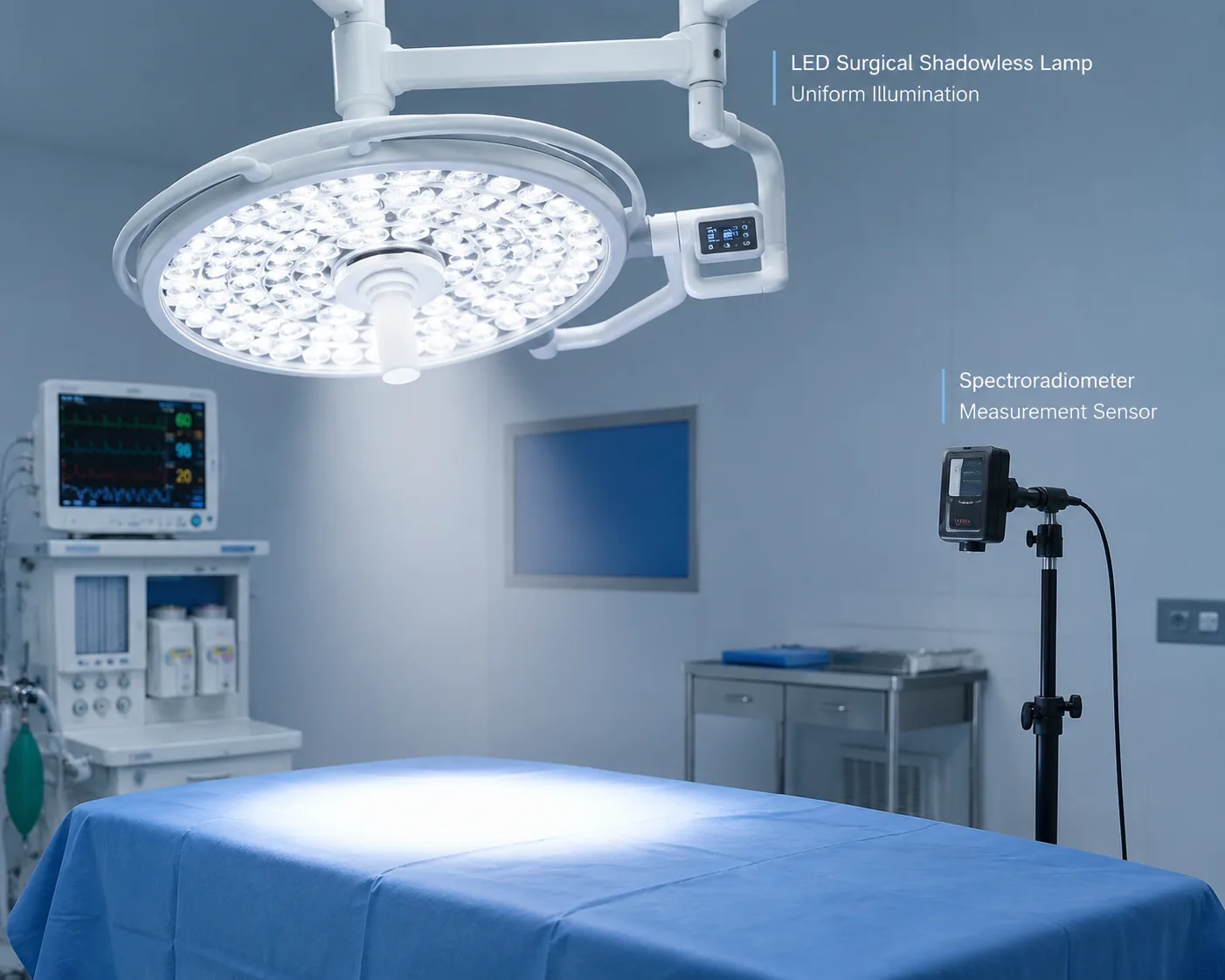
A complete surgical shadowless lamp testing project draws on a stack of Chinese national standards, international standards, and related product-family standards.
| Family | Standard | Scope |
|---|---|---|
| YY 9706.241-2020 | Medical Electrical Equipment — Part 2-41: Particular Requirements for Basic Safety and Essential Performance of Surgical Luminaires and Luminaires for Diagnosis | The Chinese national standard for surgical shadowless lamps; replaces YY 0627-2008 (in force since 1 May 2023); modified adoption (MOD) of IEC 60601-2-41:2013 |
| IEC 60601-2-41:2009 (Edition 2.1) | Medical electrical equipment — Part 2-41: Particular requirements for the basic safety and essential performance of surgical luminaires and luminaires for diagnosis | The international standard; the EN IEC 60601-2-41:2021 is the latest European adoption |
| GB 9706.1-2020 (≡ IEC 60601-1:2005 + A1:2012 + A2:2020) | Medical Electrical Equipment — Part 1: General Requirements for Basic Safety and Essential Performance | The general ME-device safety standard; the level-1 standard invoked by YY 9706.241 |
| YY 9706.102-2021 (≡ IEC 60601-1-2:2014) | Medical Electrical Equipment — Part 1-2: Electromagnetic Disturbances (EMC) | The EMC standard for the surgical lamp |
| GB 7000.1-2015 (≡ IEC 60598-1) | Luminaires — Part 1: General requirements and tests | The general luminaire safety standard (referenced for the non-medical aspects of the lamp) |
| GB/T 20145-2006 (≡ CIE S 009 / IEC 62471) | Photobiological Safety of Lamps and Lamp Systems | The photobiological safety of the LED light source |
| ISO 9680:2014 | Dentistry — Operating lights | The dental operating light standard (a related product category; not applicable to surgical luminaires but often cross-referenced) |
| CIE S 026/E:2018 | CIE System for Metrology of Optical Radiation for photobiological Applications | The photobiological metrology framework |
| CIE 13.3:1995 | Method of Measuring and Specifying Colour Rendering Properties of Light Sources | The CRI calculation method (Ra and R1–R14) |
The single most consequential fact for a Chinese manufacturer is that YY 9706.241-2020 (replacing YY 0627-2008) is the NMPA-mandated standard for surgical shadowless lamps, in force since 1 May 2023. The YY 9706.241-2020 must be used together with the GB 9706.1-2020 (general safety) and the YY 9706.102-2021 (EMC); a surgical lamp that was tested to the older YY 0627-2008 must be re-tested to the YY 9706.241-2020 for the NMPA renewal or new registration.
Central illuminance and the 40,000–160,000 lux specification
The central illuminance (Ec) — the illuminance at the centre of the illuminated field at the rated working distance (typically 1 m) — is the single most-cited specification of a surgical shadowless lamp. The YY 9706.241-2020 / IEC 60601-2-41 specifies:
- Minimum central illuminance: 40,000 lux (for the basic surgical luminaire)
- Maximum central illuminance: 160,000 lux (for the high-performance deep-cavity surgical luminaire)
- The illuminance must be adjustable within this range (the surgeon sets the illuminance for the procedure)
- The illuminance must be stable over time (no drift, no flicker)
The central illuminance is measured with a calibrated illuminance meter (lux meter) at the centre of the illuminated field at 1 m distance from the lamp head, with the lamp at the maximum rated illuminance setting. The measurement is taken in a dark room (ambient illuminance < 10 lux) to exclude the contribution of any ambient light.
Shadow dilution: the single- and double-obstruction test
The shadow dilution — the ability of the lamp to maintain illuminance at the surgical field when one or two obstructions (the surgeon's head, the surgeon's hands, an instrument) are placed between the lamp and the field — is the defining performance of a surgical shadowless lamp. The YY 9706.241-2020 / IEC 60601-2-41 specifies the shadow dilution test with the standard obstruction disks and the standard measurement geometry.
Test method:
- Place the lamp at the rated illuminance, at 1 m distance from the measurement plane.
- Measure the unobstructed illuminance at the centre of the field (Ec_0).
- Place a single obstruction (a standard disk, 120 mm diameter, representing the surgeon's head) at 500 mm from the lamp head, on the lamp-to-field axis.
- Measure the illuminance at the centre of the field with the single obstruction (Ec_1).
- Place a second obstruction (a second disk, 120 mm diameter, representing the surgeon's hand) at 700 mm from the lamp head, at an angle to the first.
- Measure the illuminance at the centre of the field with the double obstruction (Ec_2).
- Calculate the single-obstruction shadow dilution = Ec_1 / Ec_0 × 100 %.
- Calculate the double-obstruction shadow dilution = Ec_2 / Ec_0 × 100 %.
Acceptance — the single-obstruction shadow dilution ≥ 50 % (IEC minimum); premium LED lamps achieve ≥ 60-80 % single-obstruction. The double-obstruction shadow dilution ≥ 50 %. The higher the shadow dilution, the less shadow the lamp produces; a premium LED dome lamp with 120 LEDs achieves ≥ 70 % single-obstruction because each LED provides a different angle and the overlapping cones cancel the shadow.
Color rendering: CRI (Ra) ≥ 85, R9, and the tissue-discrimination requirement
The colour rendering of a surgical lamp is clinically the most critical optical parameter — it determines the surgeon's ability to distinguish arterial blood (bright red) from venous blood (dark red), to identify tissue viability (pink vs. pale/bluish), and to visualise tumour margins from healthy tissue. The YY 91000.241-2020 / IEC 60601-2-41 specifies:
- General Colour Rendering Index (CRI / Ra) ≥ 85 (IEC minimum) — premium LED lamps achieve Ra ≥ 95-98
- The special R9 value (deep red) is the supplementary index most important for surgery — the R9 renders the saturated red of oxygenated blood. The IEC standard recommends R9 > 40; premium LED lamps achieve R9 ≥ 85-97
- The R13 value (muscle colour) is also important — R13 renders the pink-red of muscle tissue
The CRI is measured by a spectroradiometer that captures the spectral power distribution of the lamp and computes the CRI Ra and the individual R1-R14 values per the CIE 13.3 method. The measurement is taken at the centre of the illuminated field, at the rated colour temperature.
The R9 value is the most-discriminating specification between a general LED light (R9 ~ 20-40, typical) and a surgical LED light (R9 ≥ 85). The R9 is the rendering of the saturated red Test Colour Sample (TCS9); a high R9 means that arterial blood, muscle, and other red tissues appear in their true colour, which is critical for the surgical discrimination. The R9 is not included in the Ra (the general CRI is the average of R1-R8); a lamp with Ra 95 may have R9 20 — misleading if the Ra is the only specification quoted.
Color temperature, depth of illumination, and illuminance uniformity
| Parameter | YY 9706.241 / IEC 60601-2-41 requirement | Measurement |
|---|---|---|
| Colour temperature (CCT) | 3000 K – 6700 K (adjustable); typical setting 4000-5000 K (neutral white) | Spectroradiometer at the centre of the field |
| Depth of illumination (the working distance over which the illuminance is ≥ 50 % of Ec) | ≥ 600 mm (IEC minimum); premium LED ≥ 1000-1500 mm | Lux meter moved along the lamp axis; the distance over which Ec drops to 50 % of the peak |
| Illuminance uniformity (the ratio of the minimum to the maximum illuminance across the illuminated field) | ≥ 0.50 (IEC minimum; the minimum illuminance is ≥ 50 % of the maximum across the field) | Lux meter scanned across the field |
| Luminous field diameter D10 | The diameter at which the illuminance is 10 % of Ec; typically 170-350 mm (adjustable) | Lux meter scanned radially |
| Luminous field diameter D50 | The diameter at which the illuminance is 50 % of Ec; typically 110-150 mm | Lux meter scanned radially |
The depth of illumination is the parameter that distinguishes a surgical shadowless lamp from a regular lamp — the surgical lamp maintains the illuminance over a deep working distance (≥ 600 mm), allowing the surgeon to see into a deep body cavity (the pelvis, the chest) without the illuminance dropping below a usable level. The illuminance uniformity ensures that the field is evenly lit, without hot spots or dark areas.
Irradiance, temperature rise, and the infrared limit
The irradiance (the radiant energy at the surgical field) and the temperature rise (the heat generated by the lamp at the surgical field and at the surgeon's head) are the safety-critical parameters that protect the patient and the surgeon from thermal injury and fatigue.
| Parameter | YY 9706.241 / IEC 60601-2-41 requirement | Measurement |
|---|---|---|
| Irradiance (total radiant energy at the field) | ≤ 1,000 W/m² (IEC limit) | Radiometer at the centre of the field, at 1 m |
| Temperature rise at the surgical field (ΔT_field) | The temperature rise at the field above ambient, under the lamp at full illuminance | Thermocouple at the field, after steady state (typically 1 h) |
| Temperature rise at the surgeon's head (ΔT_head) | The temperature rise at the surgeon's head position, under the lamp at full illuminance | Thermocouple at the head position |
The irradiance limit of 1,000 W/m² (the IEC 60601-2-41 limit) is the most-cited thermal parameter — it caps the total radiant energy (visible + infrared + ultraviolet) at the surgical field, protecting the exposed tissue from desiccation. The halogen surgical lamps of the older generation approached this limit (halogen produces significant infrared); the modern LED lamps are well below (LED produces near-zero infrared, typically < 100 W/m²), giving the LED a substantial safety margin.
The temperature rise at the surgical field and at the surgeon's head — measured after the lamp has been at full illuminance for 1 hour to reach steady state — is the more directly-experienced thermal parameter. A halogen lamp raises the field temperature by 5-10 °C; a modern LED lamp by ≤ 1-2 °C. The lower the temperature rise, the lower the desiccation risk and the surgeon's fatigue.
Ingress protection (IP54), mechanical durability, and the balancing arm
| Test | Requirement | Method |
|---|---|---|
| Ingress protection | IP54 minimum — dust-protected (no harmful dust ingress); splash-protected (water splashed from any direction has no harmful effect) | IEC 60529 / GB/T 4208 IP test |
| Balancing arm — drift | The lamp head, when placed in any position within the operating range, must not drift more than a defined distance over a defined time (the "drift test") | Place the lamp at various positions; measure the drift over 1 h |
| Balancing arm — rotation | Horizontal rotation ≥ 340°; vertical range ≥ 90°; smooth, without sticking | Manual rotation; verify the range and the smoothness |
| Balancing arm — cycle endurance | ≥ 10,000 cycles of the arm (open / close / reposition) without failure; premium manufacturers test ≥ 50,000 cycles | Cycle-test rig; the arm is opened, closed, and repositioned 10,000+ times |
| Sterile handle | Autoclavable at ≥ 134 °C (the standard autoclave cycle); no deformation, no colour change, no loss of grip | Autoclave the handle for 50+ cycles; inspect |
| Cleanability | Smooth, sealed surfaces; resistant to the standard hospital disinfectants (alcohol, quaternary ammonium, hypochlorite) | Wipe test with the standard disinfectants; no surface damage |
The IP54 rating is the minimum for the operating-room environment — the lamp must withstand the dust and the splashing that occur in the OR (the irrigation fluid, the blood splatter, the cleaning solutions). The balancing-arm endurance is the mechanical-durability test that verifies the arm will hold position and not drift during a procedure; a lamp with an inadequate arm drifts into the surgeon's view or drops out of position, compromising the illumination.
Electrical safety: GB 9706.1 and EMC
The surgical shadowless lamp is a medical electrical (ME) device and must satisfy:
- GB 9706.1-2020 (≡ IEC 60601-1) — general electrical safety: protective earth, leakage current, dielectric strength, mechanical hazards, thermal hazards, essential performance
- YY 9706.102-2021 (≡ IEC 60601-1-2) — electromagnetic compatibility (EMC) immunity and emissions
- YY 9706.241-2020 § 201 (the surgical-luminaire-specific clauses that modify the GB 9706.1 requirements for the lamp)
The electrical safety tests cover the enclosure leakage current, the patient leakage current (not applicable — the patient is not electrically connected to the lamp), the dielectric strength of the insulation, the protective-earth continuity, and the residual voltage after disconnection. The EMC tests cover immunity to ESD, radiated RF, EFT, surge, conducted disturbance, voltage dips, and radiated and conducted emissions per CISPR 11 / GB 4824. A modern LED surgical lamp with a switch-mode LED driver, a touch-screen controller, and a WiFi / Bluetooth module (for the camera integration) must satisfy all of these.
FAQ
What is the YY 9706.241-2020 standard and how does it relate to YY 0627-2008?
YY 9706.241-2020 is the current Chinese national standard for surgical shadowless lamps (in force since 1 May 2023), replacing the older YY 0627-2008. It is a modified adoption (MOD) of IEC 60601-2-41:2013 and must be used together with GB 9706.1-2020 and YY 9706.102-2021. A surgical lamp tested to YY 0627-2008 must be re-tested to YY 9706.241-2020 for the NMPA renewal.
What is the shadow dilution test and why does it matter?
The shadow dilution test measures the illuminance at the centre of the field when one or two obstructions (the surgeon's head, the surgeon's hands) are placed between the lamp and the field. The single-obstruction shadow dilution must be ≥ 50 % (the IEC minimum); premium LED lamps achieve ≥ 60-80 %. The shadow dilution is the defining performance of a surgical lamp — without it, the surgical field would be obscured by shadows during the procedure.
Why is R9 the most important CRI value for surgical lighting?
R9 is the colour rendering of the saturated red Test Colour Sample — the rendering of arterial blood, muscle, and other red tissues. A general LED light may have Ra 95 but R9 20, making arterial vs. venous blood indistinguishable; a surgical LED light achieves Ra ≥ 95 and R9 ≥ 85, rendering the red tissues in their true colour. R9 is not included in the Ra (the general CRI is the average of R1-R8) and must be specified separately.
What is the irradiance limit and why does it matter?
The irradiance (the total radiant energy at the surgical field) is capped at 1,000 W/m² per IEC 60601-2-41 to protect the exposed tissue from thermal desiccation. The halogen surgical lamps of the older generation approached this limit (halogen produces significant infrared); the modern LED lamps are well below (near-zero infrared), giving a substantial safety margin.
What ingress protection does a surgical lamp need?
A minimum of IP54 (dust-protected, splash-protected) per IEC 60529, to withstand the dust and the splashing (irrigation fluid, blood, cleaning solutions) of the operating-room environment. Premium lamps achieve IP65 or higher.
Our surgical shadowless lamp testing capabilities
Beijing ZKGX Research (ISO/IEC 17025 accredited, CMA- and CNAS-accredited testing laboratory) provides complete surgical shadowless lamp testing across the YY, IEC, GB, and ISO standard stack:
- YY 9706.241-2020 surgical luminaires and luminaires for diagnosis — full type-test: central illuminance 40,000-160,000 lux, shadow dilution (single and double obstruction), colour rendering (CRI Ra and R9), colour temperature, depth of illumination, illuminance uniformity, luminous field diameter (D10, D50), irradiance ≤ 1,000 W/m², temperature rise at the field and at the surgeon's head.
- IEC 60601-2-41 / EN IEC 60601-2-41:2021 — for the EU / international market.
- GB 9706.1-2020 (≡ IEC 60601-1) — general electrical safety: protective earth, leakage current, dielectric strength, mechanical hazards, thermal hazards, essential performance.
- YY 9706.102-2021 (≡ IEC 60601-1-2) — EMC immunity and emissions, in a semi-anechoic chamber.
- Shadow dilution — the single- and double-obstruction test with the standard 120 mm disks at the IEC geometry; ≥ 50 % acceptance.
- Colour rendering — spectroradiometer for the CIE 13.3 CRI Ra, R1-R14 (especially R9 ≥ 85 for the surgical application).
- Illuminance and uniformity — calibrated lux meter, the full D10 / D50 / uniformity-ratio measurement, the depth-of-illumination profile.
- Irradiance and temperature rise — radiometer ≤ 1,000 W/m²; thermocouple at the field and at the surgeon's head, after 1 h steady state.
- IP54+ ingress protection — IEC 60529 / GB/T 4208 dust and water-ingress test.
- Balancing arm — drift test, rotation range, cycle endurance ≥ 10,000 cycles.
- Sterile handle — autoclave cycle endurance, 50+ cycles at ≥ 134 °C.
- NMPA Class II registration support — YY 9706.241-2020 + GB 9706.1-2020 + YY 9706.102-2021 + product technical requirements (PTR).
Suitable product categories include: ceiling-mounted (pendant) single-dome and dual-dome LED surgical shadowless lamps; wall-mounted examination / minor procedure lamps; floor-standing mobile LED shadowless lamps; dental operating lights (per ISO 9680); integrated OR table / lamp systems. Each project is delivered with a full data report (test protocol, instrument calibration, raw illuminance / spectroradiometer / shadow-dilution data, statistical analysis, classification conclusion per YY 9706.241 / IEC 60601-2-41) in English and/or Chinese, with CMA/CNAS stamping. Contact Beijing ZKGX Research to scope the surgical shadowless lamp test applicable to your product and target market.