Table of Contents
- What is trehalose testing?
- The standard stack: USP, EP, JP, Chinese Pharmacopoeia, GB, FAO JECFA
- Assay: HPLC-RI and the 97.0–102.0 % specification
- Water content: the dihydrate vs anhydrous distinction and Karl Fischer
- Specific rotation and the α,α-trehalose identity
- Related substances, residual solvents, and elemental impurities
- Endotoxin, microbial limits, and the parenteral-grade specification
- Identification tests: IR, naphthol, glycine, and starch
- Enzymatic trehalose assay: the trehalase-GOD-POD method
- FAQ
- Our trehalose testing capabilities
What is trehalose testing?
Trehalose testing is the measurement and validation of the identity, assay, water content, specific rotation, related substances, residual solvents, elemental impurities, endotoxin, microbial limits, and identification of trehalose (α,α-trehalose dihydrate, CAS 6138-23-4; anhydrous CAS 99-20-7, C₁₂H₂₂O₁₁, MW 342.30 dihydrate, 342.30 anhydrous) — the non-reducing disaccharide of two glucose molecules linked in an α,α-1,1-glycosidic configuration that is used as a pharmaceutical excipient (lyophilisation protectant, cryoprotectant, protein stabiliser), a food additive (sweetener, texturiser, stabiliser, INS 965 / E965 not yet assigned — trehalose is GRAS in the US and permitted in the EU under Regulation (EC) 1333/2008 as a novel food), a cosmetic ingredient, and a biological-reagent protectant (the active component of stabilised formulations of vaccines, antibodies, enzymes, and cells). The output of a trehalose test is a dossier covering the assay (97.0–102.0 % on the anhydrous basis, by HPLC-RI), the water content (≤ 9.0 % for the dihydrate; ≤ 1.0 % for the anhydrous, by Karl Fischer), the specific rotation (+197° to +201°, identifying the α,α-configuration), the related substances (glucose, maltose, other disaccharides, by HPLC-RI), the residual solvents (ethanol, methanol, isopropanol, by headspace GC), the elemental impurities (Pb, As, Cd, Hg, Co, V, Ni, by ICP-MS per USP <232>/<233>), the endotoxin (≤ 0.25 EU/mg for the parenteral grade, by LAL), and the microbial limits (per USP <61>/<62>).
Trehalose is unique among disaccharides for its bioprotective property — it stabilises proteins, lipids, nucleic acids, and whole cells under harsh conditions (drought, freezing, heat, dehydration, oxidative stress) by replacing the hydrogen-bonding water around the biomolecule. This property — discovered in the resurrection plant, the tardigrade, and the desert-dwelling insects — has made trehalose the excipient of choice for the lyophilised biopharmaceutical (antibodies, vaccines, cell therapies) and for the stabilised dried-food and cosmetic formulations. The α,α-1,1-glycosidic linkage is non-reducing — unlike maltose (α-1,4) and lactose (β-1,4), trehalose does not react with primary amines in the Maillard reaction, making it the preferred sugar for protein formulations where the reducing sugars would degrade the protein.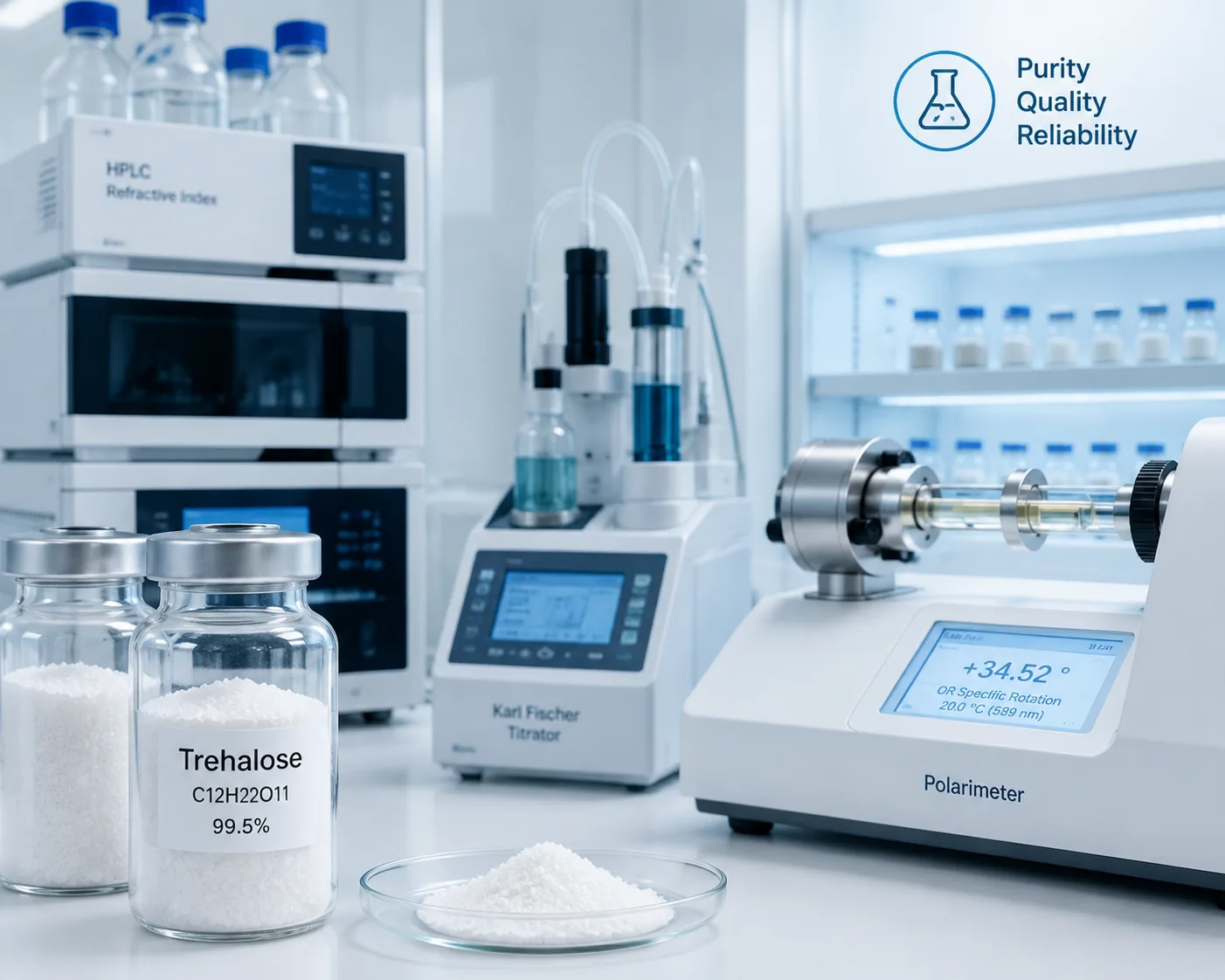
The standards governing trehalose testing span the USP Trehalose monograph (the US pharmacopeial reference for the dihydrate and the anhydrous grades), the EP 01/2018:2805 Trehalose Dihydrate monograph (the European pharmacopeial reference, harmonised with USP under the PDG), the JP Trehalose monograph (the Japanese pharmacopeial reference), the Chinese Pharmacopoeia Trehalose monograph (the Chinese pharmacopeial reference), the FAO JECFA Trehalose specification (the international food-additive reference), the GB 1886.x series (the Chinese food-additive standards), and the ICH Q3D elemental-impurity framework. A trehalose placed on the US pharmaceutical market must satisfy the USP monograph; on the EU market, the EP; on the Chinese pharmaceutical market, the Chinese Pharmacopoeia; on the Chinese food market, GB 1886.x.
The standard stack: USP, EP, JP, Chinese Pharmacopoeia, GB, FAO JECFA
A complete trehalose testing project draws on a stack of pharmacopeial and food-additive standards.
| Family | Standard | Scope |
|---|---|---|
| USP Trehalose | Trehalose and Trehalose Dihydrate monographs (USP-NF) | The US pharmacopeial reference; assay 97.0–102.0 %, water (KF), specific rotation, related substances (HPLC-RI), residual solvents, elemental impurities (<232>/<233>), endotoxin (LAL), microbial limits (<61>/<62>), identification (IR, naphthol, glycine, starch) |
| USP <232> / <233> | Elemental Impurities — Limits / Procedures | The USP elemental-impurity framework for trehalose |
| USP <467> | Residual Solvents | The USP residual-solvent framework |
| USP <61> / <62> | Microbial Examination | The USP microbial-limits framework |
| USP <85> | Bacterial Endotoxins (LAL) | The USP endotoxin framework for the parenteral-grade trehalose |
| USP <921> | Water Determination (Karl Fischer) | The USP water-content framework |
| EP 01/2018:2805 | Trehalose Dihydrate (European Pharmacopoeia) | The European pharmacopeial monograph; harmonised with USP under the PDG |
| JP Trehalose | Trehalose Hydrate monograph (Japanese Pharmacopoeia) | The Japanese pharmacopeial reference |
| Chinese Pharmacopoeia | 海藻糖 (Trehalose) monograph | The Chinese pharmacopeial reference for the dihydrate and anhydrous grades |
| GB 1886.x | Food additive — Trehalose | The Chinese national food-additive standard |
| FAO JECFA | Trehalose (INS — under evaluation; GRAS in the US) | The international food-additive specification |
| ICH Q3D | Elemental Impurities | The international elemental-impurity framework |
| ICH Q3C | Residual Solvents | The international residual-solvent framework |
The single most consequential fact for a Chinese manufacturer is that the Chinese Pharmacopoeia Trehalose monograph is the NMPA-mandated standard for pharmaceutical-grade trehalose in China, and GB 1886.x is the standard for food-grade trehalose. The pharmacopeial trehalose is typically harmonised across the USP, EP, JP, and CP — the four major pharmacopeias use the same test methods and the same acceptance limits, but differ in some procedural details (the chloride limit, the heavy-metals method, the identification test numbering).
Assay: HPLC-RI and the 97.0–102.0 % specification
The assay of trehalose is the quantitative measurement of the trehalose content, reported as a mass fraction on the anhydrous basis. The USP / EP / CP monograph specifies:
- Acceptance: NLT 97.0 % and NMT 102.0 % of trehalose (C₁₂H₂₂O₁₁), calculated on the anhydrous basis
The reference method is HPLC with refractive-index detection (HPLC-RI) — trehalose has no UV-absorbing chromophore (it is a saturated sugar), so the UV detector is not applicable. The HPLC-RI method uses an amino-column or a cation-exchange column in the calcium or lead form (e.g. Waters Sugar-Pak, Phenomenex Rezex RPM, Shodex SUGAR SP0810), with water or acetonitrile-water as the mobile phase, and the RI detector for the quantification against an external trehalose standard. The related substances (glucose, maltose) are quantified on the same chromatogram.
The assay is calculated on the anhydrous basis — the water content (measured by Karl Fischer) is subtracted, so the reported assay is the trehalose content of the dry substance, not the as-received mass. This is the standard convention for all pharmacopeial sugar monographs and allows comparison across grades (dihydrate, anhydrous, dried).
Water content: the dihydrate vs anhydrous distinction and Karl Fischer
Trehalose exists in two commercial forms — the dihydrate (the crystalline form with two molecules of water of crystallisation per trehalose molecule) and the anhydrous (the dried form with no water of crystallisation). The water content distinguishes the two forms.
| Grade | Water content (Karl Fischer) | Typical application |
|---|---|---|
| Trehalose dihydrate | ≤ 9.0 % (the theoretical water of crystallisation is 9.53 % for C₁₂H₂₂O₁₁·2H₂O) | The standard pharmaceutical and food grade; the dihydrate crystal is non-hygroscopic and free-flowing |
| Trehalose anhydrous | ≤ 1.0 % | The grade for moisture-sensitive applications (lyophilisation, moisture-sensitive protein formulations) |
The Karl Fischer titration (USP <921> Method Ic — the coulometric method for low water content, or Method Ia — the volumetric method for higher content) is the reference method. The Karl Fischer method uses a methanol-formamide solvent system (the formamide dissolves the trehalose, the methanol carries the Karl Fischer reagent) to overcome the limited solubility of trehalose in methanol alone.
Specific rotation and the α,α-trehalose identity
The specific rotation ([α]²⁰_D) identifies the α,α-1,1-glycosidic linkage of trehalose — the defining structural feature that makes trehalose a non-reducing sugar.
- Acceptance: +197° to +201° (USP / EP / CP, at 20 °C, sodium D-line, 100 mg/mL aqueous solution)
The α,α-trehalose has a specific rotation of ~+199° (a distinctive high positive rotation); the isomeric α,β-trehalose and β,β-trehalose (which do not occur naturally and are not produced commercially) have different specific rotations. The specific rotation test is the first-line identity test for the α,α-configuration — a specific rotation outside the +197° to +201° range indicates either an isomeric impurity or a degraded sample.
The measurement is performed on a polarimeter (e.g. Anton Paar MCP 5300) at 20 °C, with a 100 mg/mL aqueous solution of the trehalose in a 100 mm cell, at the sodium D-line (589 nm). The measurement must be made within 30 minutes of solution preparation (the trehalose can mutarotate slowly in solution).
Related substances, residual solvents, and elemental impurities
The related substances of trehalose are the process-related and degradation-related sugars — glucose (from hydrolysis), maltose (from the enzymatic isomerisation), and other disaccharides (from the fermentation substrate). The USP / EP monograph limits these by the HPLC-RI method used for the assay:
- Related substances — total impurities ≤ 1.5 % (USP); individual ≤ 0.5 %
- Glucose (the primary degradation product) — typically the dominant related substance
The residual solvents are the ethanol, methanol, and isopropanol from the crystallisation and the purification:
- Residual solvents per USP <467> / ICH Q3C — ethanol, methanol, isopropanol; each ≤ the ICH Q3C limit
- Headspace GC with FID detection; the method validated per ICH Q2(R2)
The elemental impurities are the heavy metals and the catalyst residues:
- Elemental impurities per USP <232> / <233> / ICH Q3D — Pb, As, Cd, Hg (the four Class 1 elements); Co, V, Ni (the Class 2A elements)
- ICP-MS (e.g. Perkin Elmer NexION 350X) — the reference method; the sample is dissolved in water and analysed directly
The trehalose QC laboratory typically runs the ICP-MS at the low-level specification (the sub-ppm level for the parenteral-grade trehalose), because the parenteral use is the most stringent for the elemental-impurity control.
Endotoxin, microbial limits, and the parenteral-grade specification
The trehalose used in the injectable pharmaceutical (the lyophilised antibody, the vaccine) must meet the parenteral-grade specification:
| Test | Parenteral-grade specification | Method |
|---|---|---|
| Bacterial endotoxin | ≤ 0.25 EU/mg (the typical parenteral-grade limit) | LAL (USP <85>) — the kinetic chromogenic or the gel-clot method; the Endosafe nexgen-PTS reader is a common instrument |
| Microbial limits | Total aerobic count ≤ 100 CFU/g; total yeast and mould ≤ 100 CFU/g; no E. coli, Salmonella, S. aureus | USP <61> / <62> |
| Bioburden | The in-process bioburden of the mother liquor and the wet crystal | USP <61> |
The endotoxin limit of ≤ 0.25 EU/mg is the tightest specification for a parenteral-grade sugar excipient — the endotoxin control is the most-discriminating test between the pharmaceutical-grade and the food-grade trehalose. The food-grade trehalose does not have an endotoxin specification; the pharmaceutical-grade must demonstrate the endotoxin control at every lot.
Identification tests: IR, naphthol, glycine, and starch
The identification of trehalose is confirmed by four tests per the USP / EP / JP / CP monographs:
| Test | Method | Positive result |
|---|---|---|
| Identification A — IR spectroscopy | FT-IR with ATR (attenuated total reflectance) | The infrared spectrum of the sample matches the reference spectrum of trehalose |
| Identification B — 1-naphthol (Molisch) test | To 1 mL of a 400 mg/mL sample solution, add 0.4 mL of 1-naphthol (1 in 20 in 95 % ethanol); gently add 2 mL of concentrated sulfuric acid | Violet ring forms at the interface |
| Identification C — glycine (non-reducing sugar) test | To 2 mL of a 40 mg/mL sample solution, add 1 mL of dilute HCl; keep at room temperature 20 min; add 4 mL of 40 g/L NaOH and 2 mL of 40 mg/mL glycine; heat in boiling water 10 min | No brown colour develops (confirming trehalose is a non-reducing sugar) |
| Identification D — starch test | To a 10 % trehalose solution, add several drops of iodine TS | No blue colour develops (confirming no starch contamination) |
The glycine test (Identification C) is the most diagnostically valuable — it distinguishes the non-reducing trehalose (no Maillard browning) from the reducing glucose, maltose, and lactose (which give a brown colour in the glycine-heat test). This test is the chemical proof of the non-reducing character of trehalose.
Enzymatic trehalose assay: the trehalase-GOD-POD method
For biological samples (cells, tissues, fermentation broths) where the trehalose concentration is low and the HPLC-RI method lacks sensitivity, the enzymatic trehalose assay is used:
- Trehalase hydrolysis — the enzyme trehalase cleaves trehalose into two molecules of glucose; the trehalase is specific for the α,α-1,1 bond and does not hydrolyse maltose (α-1,4), lactose (β-1,4), or sucrose (α-1,2)
- Glucose quantification — the released glucose is measured by the GOD-POD method (glucose oxidase / peroxidase / 4-aminoantipyrine / phenol), a colorimetric assay at 505 nm
- Specificity — the trehalase-GOD-POD is specific for trehalose; the other disaccharides (maltose, lactose) do not interfere, because the trehalase does not hydrolyse them
This method is the basis of the commercial trehalose assay kit (e.g. the Megazyme K-TREH, the BioSpectra trehalose kit) and is used in the biological-research laboratory for the stress-response and the carbohydrate-metabolism studies.
FAQ
What is the difference between trehalose dihydrate and anhydrous trehalose?
The dihydrate (CAS 6138-23-4) is the crystalline form with two molecules of water of crystallisation per trehalose molecule; the water content is ≤ 9.0 %. The anhydrous (CAS 99-20-7) is the dried form with ≤ 1.0 % water. The dihydrate is the standard pharmaceutical and food grade (non-hygroscopic, free-flowing); the anhydrous is for moisture-sensitive applications (lyophilisation).
What is the assay specification for trehalose?
The USP / EP / CP monograph specifies NLT 97.0 % and NMT 102.0 % of trehalose (C₁₂H₂₂O₁₁), calculated on the anhydrous basis, determined by HPLC-RI. The 102 % upper bound accommodates the analytical uncertainty and the moisture correction; the 97 % lower bound excludes significant impurity.
What is the specific rotation of trehalose and why does it matter?
The specific rotation is +197° to +201° at 20 °C (sodium D-line, 100 mg/mL aqueous solution). This identifies the α,α-1,1-glycosidic linkage — the defining structural feature of trehalose. The isomeric α,β- and β,β-trehalose have different specific rotations; a sample outside the +197° to +201° range indicates an isomeric impurity or degradation.
Why is the glycine test important for trehalose identification?
The glycine test (USP / EP Identification C) confirms that trehalose is a non-reducing sugar — no brown colour develops in the glycine-heat test, because trehalose does not have a free reducing end (the α,α-1,1 linkage blocks it). The reducing sugars (glucose, maltose, lactose) give a brown colour in this test. The glycine test is the chemical proof of the non-reducing character that makes trehalose the preferred sugar for protein formulations (no Maillard reaction).
What endotoxin limit applies to parenteral-grade trehalose?
The parenteral-grade trehalose must meet ≤ 0.25 EU/mg (by LAL, USP <85>) — the tightest specification for a parenteral sugar excipient. The food-grade trehalose does not have an endotoxin specification. The endotoxin control is the most-discriminating test between the pharmaceutical-grade and the food-grade.
Our trehalose testing capabilities
Beijing ZKGX Research (ISO/IEC 17025 accredited, CMA- and CNAS-accredited testing laboratory) provides complete trehalose testing across the USP, EP, JP, CP, GB, and FAO JECFA standard stack:
- USP Trehalose / Trehalose Dihydrate monograph — full conformance: assay 97.0–102.0 % (HPLC-RI), water content (KF), specific rotation +197° to +201°, related substances, residual solvents, elemental impurities (ICP-MS per USP <232>/<233>), endotoxin (LAL per USP <85>), microbial limits (USP <61>/<62>), identification (IR, naphthol, glycine, starch).
- EP 01/2018:2805 Trehalose Dihydrate — harmonised with USP under the PDG.
- JP Trehalose Hydrate monograph — for the Japanese market.
- Chinese Pharmacopoeia Trehalose monograph — for the NMPA-mandated pharmaceutical-grade test in China.
- GB 1886.x Chinese food-additive trehalose — for the Chinese food market.
- FAO JECFA Trehalose — for the international food market.
- Assay — HPLC-RI (amino-column or cation-exchange calcium/lead form); 97.0–102.0 % on the anhydrous basis; external trehalose standard.
- Water content — Karl Fischer (volumetric or coulometric); methanol-formamide solvent system; ≤ 9.0 % dihydrate, ≤ 1.0 % anhydrous.
- Specific rotation — polarimeter (e.g. Anton Paar MCP 5300) at 20 °C, sodium D-line; +197° to +201°.
- Related substances — HPLC-RI; glucose, maltose, other disaccharides; total ≤ 1.5 %.
- Residual solvents — headspace GC-FID; ethanol, methanol, isopropanol; per USP <467> / ICH Q3C.
- Elemental impurities — ICP-MS (Perkin Elmer NexION 350X); Pb, As, Cd, Hg, Co, V, Ni; per USP <232>/<233> / ICH Q3D; the low-level parenteral specification.
- Endotoxin — LAL (kinetic chromogenic or gel-clot, Endosafe nexgen-PTS); ≤ 0.25 EU/mg parenteral.
- Microbial limits — USP <61>/<62>; total aerobic count, yeast and mould, specified bacteria.
- Identification — FT-IR ATR; 1-naphthol (Molisch); glycine (non-reducing sugar); starch (iodine).
- Enzymatic trehalose assay — trehalase-GOD-POD colorimetric (Megazyme K-TREH or equivalent); for biological samples.
- Residue on ignition / sulfated ash — muffle furnace at 600 °C.
Suitable sample matrices include: pharmaceutical-grade trehalose dihydrate and anhydrous; food-grade trehalose; the parenteral (low-endotoxin) grade; lyophilised protein formulations; vaccine stabiliser formulations; cosmetic formulations; fermentation broths and biological samples. Each project is delivered with a full data report (test protocol, instrument calibration, raw HPLC-RI / KF / polarimeter / ICP-MS / LAL data, statistical analysis, identification-test evidence, classification conclusion per the applicable standard) in English and/or Chinese, with CMA/CNAS stamping. Contact Beijing ZKGX Research to scope the trehalose test applicable to your product and target market.