Table of Contents
- What is vaccine virus inactivation testing?
- The standard stack: WHO TRS, NMPA, FDA CBER, EMA, Chinese Pharmacopoeia
- The three inactivating agents: formaldehyde, β-propiolactone, binary ethyleneimine
- Inactivation kinetics: the log reduction value and the extrapolation principle
- Complete inactivation verification: the egg, cell-culture, and animal tests
- Antigenicity retention: haemagglutinin, neuraminidase, and the integrity of the epitopes
- Inactivating agent residue removal and residual limit
- Inactivation validation for the influenza, rabies, FMD, polio, and COVID-19 vaccines
- NMPA and Chinese Pharmacopoeia requirements
- FAQ
- Our vaccine virus inactivation testing capabilities
What is vaccine virus inactivation testing?
Vaccine virus inactivation testing is the laboratory demonstration that the live, replication-competent virus used to manufacture an inactivated (killed) vaccine has been completely inactivated by the chemical or physical inactivation procedure — that no residual infectious virus remains in the monovalent bulk, in any downstream intermediate, or in the final vaccine. The output of an inactivation study is a set of verification tests (in eggs, in cell culture, in animals, and by molecular methods) demonstrating the absence of detectable infectious virus to the limit of the assay, supported by inactivation kinetics showing that the log reduction achieved at the manufacturing-scale contact time exceeds the virus titre in the load by a substantial safety margin. The antigenicity of the inactivated virus (the haemagglutinin, the neuraminidase, the surface glycoproteins) must be retained through the inactivation, so that the inactivated vaccine remains immunogenic; the inactivating agent residue must be removed or hydrolysed below the residual limit so that the final vaccine is safe.
Inactivated vaccines are one of the two principal vaccine classes (alongside live-attenuated vaccines) and include the inactivated influenza vaccine (the largest by volume, ~500 million doses per year), the inactivated polio vaccine (IPV, part of the routine childhood immunisation), the inactivated rabies vaccine, the inactivated hepatitis A vaccine, the inactivated Japanese encephalitis vaccine, the inactivated tick-borne encephalitis vaccine, the inactivated SARS-CoV-2 (COVID-19) vaccine, and the veterinary inactivated foot-and-mouth disease (FMD) vaccine. Each is produced by growing the virus in a substrate (embryonated eggs, mammalian cells, or animal tissue), harvesting the virus-rich fluid, inactivating the virus by a chemical agent (formaldehyde, β-propiolactone, or binary ethyleneimine), purifying the inactivated virus, and formulating the final vaccine with or without an adjuvant. The inactivation step is the safety-critical step of the manufacturing process: an insufficient inactivation leaves live virus in the vaccine (the Cutter incident of 1955, in which incompletely-inactivated polio vaccine caused 40,000 cases of polio, is the founding disaster of the field); an over-aggressive inactivation destroys the antigenicity and the vaccine is non-immunogenic.
The standards governing vaccine virus inactivation testing span the WHO Technical Report Series (TRS) — the WHO recommendations for the production and control of each inactivated vaccine (influenza TRS 999 Annex 2; rabies TRS 941 Annex 2; polio TRS 910 Annex 2; Japanese encephalitis TRS 910 Annex 3), the FDA CBER guidance for the relevant inactivated vaccine, the EMA EMEA/CPMP/BWP note for guidance, the NMPA Technical Guideline for the Preclinical Research of Inactivated Vaccines (the SARS inactivated vaccine preclinical research technical points of 2003 and the COVID-19 preventive vaccine research and development technical guideline of 2020), the Chinese Pharmacopoeia vaccine monographs, and the published literature (Habtewold et al., Scientific Reports 2025, 15:33788 — the BEI vs formaldehyde inactivation kinetics of the FMD vaccine).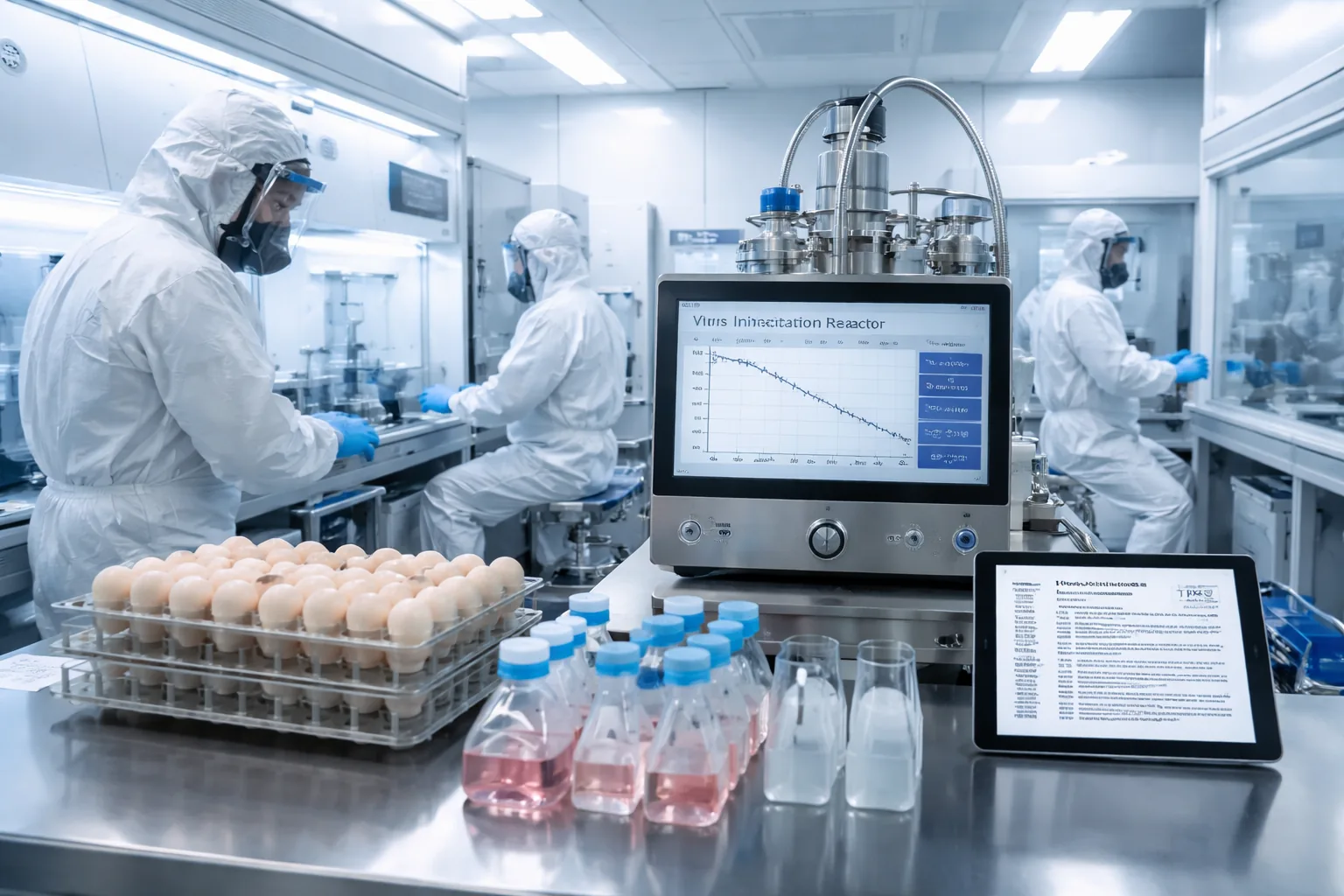
The standard stack: WHO TRS, NMPA, FDA CBER, EMA, Chinese Pharmacopoeia
A complete vaccine virus inactivation testing project draws on a stack of WHO, US, EU, and Chinese standards and guidelines.
| Family | Standard | Scope |
|---|---|---|
| WHO TRS 999 Annex 2 (2016) | Recommendations for the production and control of influenza vaccine (inactivated) — Section A.3.3.2 (Inactivation) and A.3.4.1 (Effective inactivation) | The WHO recommendations for inactivated influenza vaccine; the formaldehyde / BPL concentration (≤ 0.1 %), the inactivation procedure, and the egg-based complete-inactivation verification test |
| WHO TRS 941 Annex 2 (2007) | Recommendations for the production and control of rabies vaccine (inactivated) | The WHO recommendations for inactivated rabies vaccine; the BPL / β-propiolactone inactivation |
| WHO TRS 910 Annex 2 (1999, revised 2002, 2014) | Recommendations for the production and control of poliomyelitis vaccine (inactivated) | The WHO recommendations for IPV; the formaldehyde inactivation (the historical reference, after the Cutter incident) |
| WHO TRS 978 Annex 2 | Recommendations for the evaluation of animal cell cultures as substrates for biological medicinal products | The general cell-substrate viral safety framework |
| WHO TRS 1004 (and successors) | Guidelines on the quality, safety, and efficacy of vaccines | The general vaccine quality framework |
| FDA CBER | Guidance for Industry: for the evaluation of combination vaccines and the vaccine-specific Points to Consider | The US FDA expectations for the inactivated-vaccine inactivation dossier |
| EMA EMEA/CPMP/BWP | Note for Guidance on the Pharmacological and Toxicological Testing of Vaccines and the vaccine-specific notes | The EU expectations for inactivated vaccines |
| NMPA Technical Points for the Preclinical Research of SARS Inactivated Vaccine (2003) | The Chinese NMPA guideline on the inactivating-agent choice (formaldehyde, BPL) and inactivation-effect verification | The Chinese framework for inactivated-vaccine inactivation validation |
| NMPA Technical Guideline for the Research and Development of COVID-19 Preventive Vaccines (2020) | The Chinese NMPA COVID-19 vaccine guideline; the BPL inactivation of SARS-CoV-2 | The basis of the Chinese COVID-19 inactivated vaccines (Sinopharm, Sinovac) |
| Chinese Pharmacopoeia vaccine monographs | Influenza Vaccine (Inactivated), Rabies Vaccine (Inactivated), Hepatitis A Vaccine (Inactivated), Japanese Encephalitis Vaccine (Inactivated) monographs | The Chinese pharmacopeial requirements, including the effective-inactivation test and the inactivating-agent residue limit |
| Chinese Pharmacopoeia General chapter on the validation of virus removal / inactivation for blood products | The Chinese technical specification for inactivation validation (originally a 2008 CDE document, now in the Pharmacopoeia framework) | The framework adapted from blood products to inactivated vaccines |
| Habtewold et al., Scientific Reports 2025, 15:33788 | BEI vs formaldehyde inactivation kinetics of the FMD vaccine | The published reference for the inactivation-kinetics methodology and the comparison of inactivating agents |
The single most consequential fact for a Chinese manufacturer is that NMPA's inactivated-vaccine guidelines and the Chinese Pharmacopoeia vaccine monographs are the NMPA-mandated framework, with the inactivating-agent choice, the inactivation-effect verification, and the residue-removal validation as the three pillars of the inactivation dossier.
The three inactivating agents: formaldehyde, β-propiolactone, binary ethyleneimine
Three chemical inactivating agents dominate inactivated vaccine production, each with its own mechanism, kinetics, antigenicity impact, and residue-handling.
| Agent | Mechanism | Typical concentration | Typical contact time / temperature | Antigenicity impact | Residue handling | Typical use |
|---|---|---|---|---|---|---|
| Formaldehyde (HCHO) | Cross-links the viral proteins and the nucleic acid (forms methylene bridges between amino groups); the cross-linked virus is non-infectious | 0.1 % (1:4000 formalin, 37 % stock) — per WHO TRS, "the concentration by volume should not exceed 0.1 % at any time during inactivation" | 24-72 h at 37 °C or 7-14 days at 2-8 °C | Can over-cross-link and destroy epitopes; the original Cutter-incident problem (under-inactivation); also denatures some antigens at higher concentrations | Residual formaldehyde limit per pharmacopeia (typically ≤ 0.02 % in the final vaccine) | Inactivated polio (IPV), influenza (some manufacturers), hepatitis A, Japanese encephalitis, typhoid |
| β-Propiolactone (BPL) | Alkylates the viral nucleic acid (guanine, adenine) and proteins; the DNA / RNA is non-functional but the protein epitopes are largely preserved | 1:2000 to 1:5000 (≈ 0.025-0.1 %) per WHO TRS, ≤ 0.1 % | 24 h at 4 °C or 30 min at 37 °C, followed by hydrolysis at 37 °C | Minimal epitope damage; preferred where antigenicity preservation is critical | Hydrolyses to 3-hydroxypropionic acid (non-toxic) at 37 °C; the hydrolysis is validated to < limit of detection | Rabies, influenza (many manufacturers), SARS-CoV-2 (Sinopharm, Sinovac), human papillomavirus (some processes) |
| Binary Ethyleneimine (BEI) | Alkylates the viral nucleic acid via the ethyleneimine intermediate; prepared in situ from 2-bromoethylamine hydrobromide (BEA) and NaOH at 37 °C for 1 h (the BEI is "binary" because two reagents combine) | 1-3 mM BEI (typically 2 mM) | 24-28 h at 26-37 °C; the FMD standard is 26 h at 26 °C | Minimal epitope damage; preferred for the FMD vaccine because the FMD virus is an acid-labile picornavirus and is over-denatured by formaldehyde | Hydrolysed by sodium thiosulphate; the hydrolysis is validated to < limit of detection | FMD (the dominant inactivating agent), some veterinary vaccines |
The choice of inactivating agent is driven by the virus class, the antigenicity sensitivity, the regulatory precedent, and the manufacturing cost. The Habtewold et al. 2025 study directly compared BEI, formaldehyde, and the BEI+formaldehyde combination for the FMD vaccine and reported the inactivation kinetics for each — providing the benchmark data for the FMD-vaccine inactivation validation.
Inactivation kinetics: the log reduction value and the extrapolation principle
The inactivation kinetics is the time-course of the virus titre reduction during the inactivation procedure, sampled at multiple time points (0, 2, 4, 8, 12, 24, 28 h for a 26-h BEI inactivation, or 0, 6, 12, 24, 48, 72 h for a formaldehyde inactivation) and plotted as log₁₀ TCID₅₀/mL against time. The inactivation is typically first-order (log-linear) — the virus titre decreases by a constant fraction per unit time, giving a straight line on the log plot. The slope of the line is the inactivation rate constant, and the log reduction value at the manufacturing contact time is the difference between the titre at T₀ and the titre at the contact time.
The principle of inactivation validation: the log reduction achieved at the manufacturing contact time must exceed the virus titre in the load (the starting material) by a substantial safety margin — typically ≥ 8-10 log for a single inactivation step, ensuring that even a 10⁸ TCID₅₀/mL load is reduced below the limit of detection with a safety factor. The kinetics is run at the manufacturing scale (or in a qualified scale-down model), and the extrapolation of the log-linear curve to the manufacturing contact time is the basis of the inactivation claim.
The Habtewold et al. 2025 study reported the inactivation kinetics for the three inactivating agents against the FMD virus O-ETH/38/2005 — showing the log-linear decline over the 24-28 h time course, with the BEI and the BEI+formaldehyde combination achieving the complete inactivation within the validated contact time.
Complete inactivation verification: the egg, cell-culture, and animal tests
The kinetics supports the inactivation claim; the complete inactivation verification test confirms it on every manufacturing batch. The test methods per WHO TRS 999 Annex 2 Section A.3.4.1:
| Test | Substrate | Procedure | Acceptance |
|---|---|---|---|
| Egg-passage test (egg-derived vaccines) | Embryonated hen's eggs | Inoculate 0.2 mL of undiluted, 1:10, and 1:100 monovalent pool into allantoic cavities of 10 eggs per dilution (3 dilutions × 10 eggs = 30 eggs); incubate 33-37 °C for 3 days; ≥ 8 of 10 embryos must survive per dilution. Harvest 0.5 mL allantoic fluid per surviving egg; pool per dilution; inoculate 0.2 mL of each pool undiluted into a further 10 eggs. No haemagglutinin activity should be detected in the second passage. | Negative — no detectable viable influenza virus after two egg passages |
| Cell-culture passage test (cell-derived vaccines) | The mammalian cell substrate used for production (Vero, MDCK) | Inoculate the inactivated monovalent pool onto the production cell substrate; passage 2-3 times over 14 days; examine for CPE, haemadsorption, and haemagglutination | Negative — no CPE, no haemadsorption, no haemagglutination after 2-3 passages |
| Animal test (for some veterinary vaccines) | The target animal or a susceptible laboratory animal | Inoculate the inactivated vaccine; observe for the disease; sample for the virus | Negative — no disease, no virus detected |
| Molecular test (RT-PCR) | Cell culture | RT-PCR for the viral genome — a negative supports the inactivation claim but is NOT a substitute for the infectivity test (a positive RT-PCR reflects residual RNA, not residual infectivity) | Used as supportive, not as the primary |
The two-passage egg test is the gold standard for egg-derived vaccines (influenza, yellow fever); the three-passage cell-culture test is the gold standard for cell-derived vaccines (rabies, polio, Japanese encephalitis, SARS-CoV-2). The principle is to amplify any residual infectious virus through serial passage to a level at which it would be detected; a single passage may miss a low-level contamination because the residual virus is below the limit of detection of the direct titre assay.
The WHO TRS warns of the aggregation problem: some viruses (notably the influenza virus) aggregate in the inactivated bulk, so a small fraction of the virus is "shielded" inside an aggregate and is not detected by the titre assay (the aggregate is counted as one infectious unit but may contain many). The aggregation validation requires the laboratory to demonstrate that the test sensitivity is adequate, typically by spiking a known amount of infectious virus into an inactivated bulk and demonstrating that it is recovered and detected.
Antigenicity retention: haemagglutinin, neuraminidase, and the integrity of the epitopes
The inactivation procedure must preserve the antigenicity of the virus — the surface glycoproteins (haemagglutinin and neuraminidase for influenza, G-protein for rabies, capsid epitopes for FMD, spike for SARS-CoV-2) that are the targets of the protective immune response. An over-aggressive inactivation (high formaldehyde concentration, long contact time, high temperature) destroys the conformational epitopes and the vaccine is non-immunogenic.
The WHO TRS 999 Annex 2 Section A.3.4.2 specifies the haemagglutinin content test (single radial immunodiffusion against a reference antigen) and Section A.3.4.3 the neuraminidase activity test for the inactivated influenza vaccine; the comparable tests for rabies, polio, and the other inactivated vaccines are specified in their respective WHO TRS. The antigenicity retention is verified on every manufacturing batch and is part of the inactivation validation — the antigenicity of the inactivated bulk must be within the validated range that supported the clinical efficacy of the vaccine.
The Habtewold et al. 2025 study also measured the post-vaccination immune response (solid-phase competitive ELISA for the FMD antibody) in 20 calves vaccinated with the BEI-, formaldehyde-, and BEI+formaldehyde-inactivated FMD vaccines — providing a direct in-vivo measure of the antigenicity retention for each inactivating agent.
Inactivating agent residue removal and residual limit
The inactivating agent residue in the final vaccine must be below the residual limit set by the pharmacopeia and the national regulatory authority. The residue removal is typically achieved by the downstream purification steps (ultrafiltration, diafiltration, chromatography) and, for BPL, by hydrolysis at 37 °C.
| Agent | Residue | Residual limit | Method |
|---|---|---|---|
| Formaldehyde | Residual formaldehyde | ≤ 0.02 % (200 ppm) in the final vaccine (per pharmacopeia, e.g. Chinese Pharmacopoeia influenza vaccine monograph) | Acetyl-acetone colorimetric (the Nash reaction); HPLC |
| β-Propiolactone | Residual BPL + hydrolysis product 3-hydroxypropionic acid | No detectable BPL at the limit of detection (typically < 0.1 µg/mL) | GC-MS or LC-MS for BPL; titrimetry or LC-MS for the hydrolysis product |
| BEI | Residual BEI + hydrolysis product | No detectable BEI after sodium thiosulphate neutralisation | Iodometric titration; LC-MS |
The residue-removal validation is part of the inactivation dossier — the manufacturer demonstrates that the downstream purification removes the inactivating agent to below the limit, on every manufacturing batch.
Inactivation validation for the influenza, rabies, FMD, polio, and COVID-19 vaccines
The inactivation procedure varies by vaccine; the table summarises the dominant inactivating agent and the WHO reference for each.
| Vaccine | Dominant inactivating agent | WHO reference | Notes |
|---|---|---|---|
| Influenza (inactivated, egg-derived) | Formaldehyde or β-propiolactone (≤ 0.1 %) | WHO TRS 999 Annex 2 Section A.3.3.2 | The most widely used inactivated vaccine; the two-passage egg test is the gold-standard verification |
| Influenza (inactivated, cell-derived, Vero / MDCK) | Formaldehyde or β-propiolactone | WHO TRS 999 Annex 2 | The cell-derived verification uses the three-passage cell-culture test |
| Rabies (inactivated) | β-Propiolactone (1:4000-1:5000) | WHO TRS 941 Annex 2 | BPL is the dominant agent; the antigenicity (G-protein) is BPL-friendly |
| FMD (inactivated, veterinary) | Binary ethyleneimine (BEI, 1-3 mM, 26 h at 26 °C) | OIE Terrestrial Manual | BEI is the dominant agent; formaldehyde over-denatures the acid-labile FMD picornavirus |
| Polio (IPV) | Formaldehyde (1:4000 formalin, 12 days at 37 °C) | WHO TRS 910 Annex 2 | The historical reference, after the 1955 Cutter incident; formaldehyde is the only approved agent |
| Hepatitis A (inactivated) | Formaldehyde (1:4000) | WHO TRS 858 Annex 2 | Formaldehyde |
| Japanese encephalitis (inactivated) | Formaldehyde | WHO TRS 910 Annex 3 | Formaldehyde; the Vero-cell-derived inactivated JE vaccine (the Chengdu JE vaccine) is the largest by volume |
| SARS-CoV-2 / COVID-19 (inactivated, Vero-cell) | β-Propiolactone | NMPA COVID-19 preventive vaccine research and development technical guideline (2020) | The Chinese COVID-19 inactivated vaccines (Sinopharm BBIBP-CorV, Sinovac CoronaVac) use BPL on Vero-cell-derived SARS-CoV-2 |
NMPA and Chinese Pharmacopoeia requirements
In China, the inactivated-vaccine inactivation validation is regulated by:
- NMPA Technical Points for the Preclinical Research of SARS Inactivated Vaccine (2003) — the foundational Chinese inactivated-vaccine guideline; sets the inactivating-agent choice (formaldehyde, β-propiolactone), the inactivation-effect verification, and the residue-removal validation
- NMPA Technical Guideline for the Research and Development of COVID-19 Preventive Vaccines (2020) — the COVID-19 inactivated-vaccine guideline; the basis of the Chinese COVID-19 inactivated vaccines
- NMPA Technical Guideline for the Validation of Virus Removal / Inactivation of Biological Products — the general Chinese inactivation-validation framework (adapted from the ICH Q5A framework to include the inactivating-agent-specific requirements)
- Chinese Pharmacopoeia vaccine monographs — the Influenza Vaccine (Inactivated), Rabies Vaccine (Inactivated), Hepatitis A Vaccine (Inactivated), Japanese Encephalitis Vaccine (Inactivated), SARS-CoV-2 Vaccine (Inactivated) monographs; each specifies the effective-inactivation test, the antigenicity test, and the residue limit
- Chinese Pharmacopoeia general chapter on inactivation validation (originally the Blood Products Virus Removal / Inactivation Validation Technical Guideline of 2008, now in the Pharmacopoeia framework) — the technical methods for the inactivation validation
The Chinese COVID-19 inactivated vaccines (Sinopharm BBIBP-CorV, Sinovac CoronaVac) used β-propiolactone inactivation of the Vero-cell-derived SARS-CoV-2, with the inactivation validated per the NMPA COVID-19 guideline and the complete-inactivation verified by the three-passage cell-culture test on Vero cells. The Chinese inactivated-vaccine dossier is reviewed by the CDE (Center for Drug Evaluation) at NMPA and by the NIFDC (National Institutes for Food and Drug Control) for the lot release.
FAQ
What is the difference between vaccine virus inactivation and viral clearance (ICH Q5A)?
Vaccine virus inactivation is the intentional inactivation of the vaccine virus itself (the active substance) by a chemical agent, so that the vaccine contains non-infectious virus particles that retain antigenicity. Viral clearance (ICH Q5A) is the incidental removal / inactivation of viral contaminants from a biological product that is not itself a virus (e.g. a monoclonal antibody). The two share the test methodology but serve different purposes.
What are the three principal inactivating agents and how do they differ?
Formaldehyde (cross-links viral proteins and nucleic acid; used for polio, hepatitis A, influenza; can over-denature antigens), β-propiolactone (BPL) (alkylates nucleic acid; preserves protein epitopes better than formaldehyde; used for rabies, SARS-CoV-2, influenza), and binary ethyleneimine (BEI) (alkylates nucleic acid via the ethyleneimine intermediate; the dominant agent for FMD; prepared in situ from 2-bromoethylamine hydrobromide and NaOH).
How is complete inactivation verified?
By the egg-passage test (egg-derived vaccines; two passages of the inactivated bulk in embryonated eggs, with no haemagglutinin detected in the second passage) or the cell-culture passage test (cell-derived vaccines; 2-3 passages on the production cell substrate over 14 days, with no CPE / haemadsorption / haemagglutination). The principle is to amplify any residual infectious virus through serial passage to a level at which it would be detected.
What is the WHO concentration limit for the inactivating agent?
For inactivated influenza vaccine, WHO TRS 999 Annex 2 specifies that the formaldehyde or β-propiolactone concentration "should not exceed 0.1 % at any time during inactivation". For BPL, the typical concentration is 1:2000 to 1:5000 (0.025-0.1 %). For BEI, the typical concentration is 1-3 mM. The residue in the final vaccine must be below the pharmacopeia limit (formaldehyde ≤ 0.02 %; BPL and BEI below the limit of detection).
What was the Cutter incident and why does it matter?
The 1955 Cutter incident was the founding disaster of inactivated-vaccine safety: an incompletely-inactivated polio vaccine (manufactured by Cutter Laboratories) caused 40,000 cases of polio, with 200 paralyses and 10 deaths. The incident established the principle that the inactivation validation must include both the kinetics (showing that the contact time exceeds the time for complete inactivation) and the verification test (confirming complete inactivation on every batch).
Our vaccine virus inactivation testing capabilities
Beijing ZKGX Research (ISO/IEC 17025 accredited, CMA- and CNAS-accredited testing laboratory) provides complete vaccine virus inactivation testing across the WHO, NMPA, FDA, EMA, and Chinese Pharmacopoeia standard stack:
- WHO TRS inactivation validation — full validation of the inactivation kinetics, the complete-inactivation verification, the antigenicity retention, and the residue removal per WHO TRS 999 (influenza), TRS 941 (rabies), TRS 910 (polio, JE), and the vaccine-specific WHO guidelines.
- NMPA inactivated-vaccine guidelines — SARS inactivated vaccine preclinical research technical points (2003) and COVID-19 preventive vaccine research and development technical guideline (2020); the Chinese inactivated-vaccine dossier framework.
- Chinese Pharmacopoeia vaccine monographs — the Influenza (Inactivated), Rabies (Inactivated), Hepatitis A (Inactivated), Japanese Encephalitis (Inactivated), and SARS-CoV-2 (Inactivated) monographs; effective-inactivation test, antigenicity test, residue limit.
- Inactivation kinetics — log-linear kinetics at multiple time points; the log reduction value at the manufacturing contact time; extrapolation to the safety margin.
- Complete inactivation verification — egg-passage test (egg-derived vaccines; two passages; no haemagglutinin in the second passage); cell-culture passage test (cell-derived vaccines; 2-3 passages; no CPE, haemadsorption, haemagglutination); aggregation-validated test sensitivity.
- Antigenicity retention — haemagglutinin content (single radial immunodiffusion against reference antigen), neuraminidase activity, the vaccine-specific antigenicity tests.
- Inactivating agent residue — formaldehyde (acetyl-acetone colorimetric, HPLC), β-propiolactone and hydrolysis product (GC-MS, LC-MS), BEI and hydrolysis product (iodometric titration, LC-MS); per the pharmacopeia residue limits.
- Formaldehyde / BPL / BEI inactivation — validated for each of the three principal inactivating agents; concentration per WHO TRS (≤ 0.1 % formaldehyde or BPL; 1-3 mM BEI).
- SARS-CoV-2 / COVID-19 inactivated vaccines — BPL inactivation of Vero-cell-derived SARS-CoV-2 per the NMPA COVID-19 guideline; three-passage cell-culture verification on Vero.
- FMD (veterinary) — BEI inactivation per the OIE Terrestrial Manual; the Habtewold et al. 2025 inactivation kinetics as the benchmark.
Suitable product categories include: inactivated influenza (egg-derived and cell-derived); inactivated rabies (Vero-cell, chick-embryo, human diploid); inactivated polio (IPV); inactivated hepatitis A; inactivated Japanese encephalitis; inactivated tick-borne encephalitis; inactivated SARS-CoV-2 (COVID-19); inactivated veterinary vaccines (FMD, rabies, avian influenza, classical swine fever, Newcastle disease). Each project is delivered with a full data report (study protocol, inactivation kinetics curves, raw virus titre data, complete-inactivation verification data, antigenicity data, residue data, statistical analysis, conclusion per the applicable standard) in English and/or Chinese, with CMA/CNAS stamping. Contact Beijing ZKGX Research to scope the vaccine virus inactivation validation applicable to your product and target market.