What Is Feed Additive Testing and Why Does It Matter?
Feed additive testing is the systematic evaluation of substances added to animal feed — including vitamins, amino acids, enzymes, probiotics, preservatives, and mycotoxin binders — to verify their identity, purity, safety, stability, and efficacy before market authorization. Every year, the European Union alone requires approximately 450 million tons of feed for farm animals and another 10 million tons for pets. Ensuring that additives in this feed are safe and effective protects animal welfare, human health (through food of animal origin), and the environment.
Without rigorous testing, contaminated or substandard additives can enter the food chain, causing recalls, livestock losses, and public health incidents. In 2023, the EU's Rapid Alert System for Food and Feed (RASFF) recorded 54 serious feed incidents, with salmonella (16 cases), aflatoxin B1 (15 cases), ragweed (7 cases), and lead (3 cases) topping the list.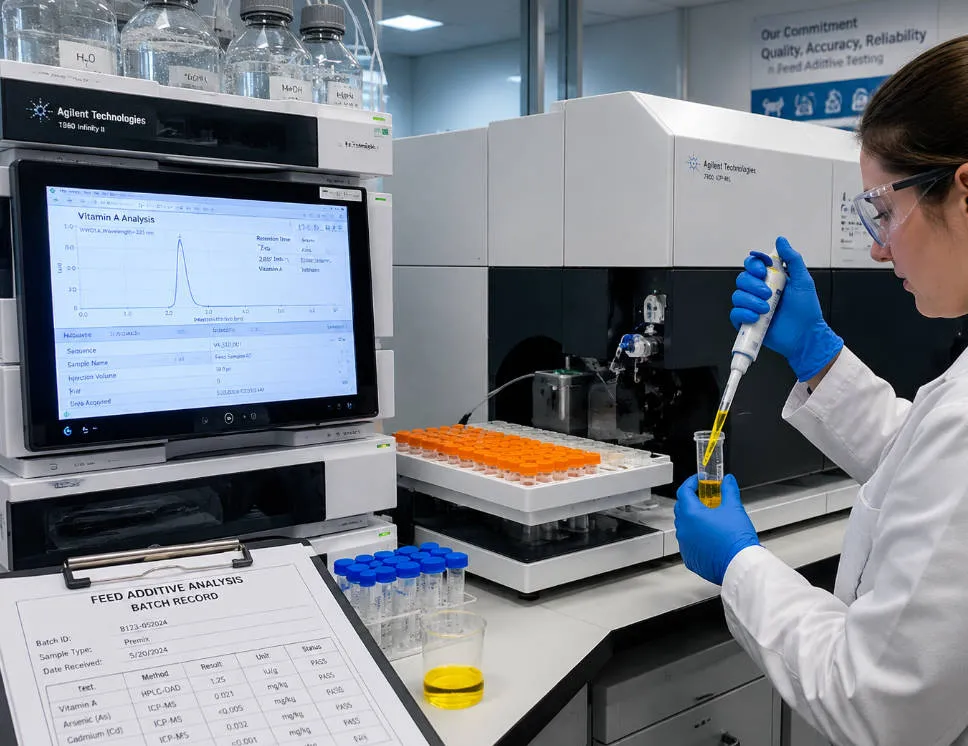
Key Regulations and Standards Governing Feed Additive Testing
Feed additive testing operates within a multi-layered regulatory framework. The table below summarizes the most important regulations and guidance documents:
|
Regulation / Standard |
Scope |
Key Requirements |
|---|---|---|
|
EU Regulation (EC) No 1831/2003 |
Authorization of additives in animal nutrition |
Defines additive categories, authorization procedure, labeling |
|
EU Commission Regulation (EC) No 429/2008 |
Detailed rules for dossier preparation |
Specifies study design, data reporting, efficacy demonstration |
|
Directive 2002/32/EC |
Undesirable substances in animal feed |
Sets maximum levels for heavy metals, mycotoxins, plant toxins, dioxins, PCBs |
|
EFSA FEEDAP Panel Guidance (2024 update) |
Efficacy assessment of feed additives |
In vitro/in vivo study requirements, endpoints per functional group |
|
ICCF Guidance #01 (2019) |
Stability testing of feed ingredients |
Shelf-life study design, statistical analysis, data reporting |
|
Regulation (EC) No 767/2009 |
Placing on the market and use of feed |
Labeling provisions, composition declarations |
|
FSA/FSS Guidance (UK) |
UK feed additive dossier requirements |
Identity, safety, efficacy — post-Brexit national standard |
|
FDA 21 CFR Part 571 (US) |
Food additive petitions for animal feed |
US pre-market approval requirements |
|
Assimilated Regulation (EC) 183/2005 |
Feed hygiene requirements |
HACCP, quality assurance for non-EU/UK manufacturers |
Feed Additive Categories and Their Testing Requirements
Under EU Regulation (EC) No 1831/2003, feed additives fall into five major categories, each with distinct testing obligations:
|
Category |
Examples |
Primary Testing Focus |
|---|---|---|
|
Technological additives |
Preservatives, antioxidants, emulsifiers, binders, acidity regulators, silage additives |
In vitro efficacy (feed characteristics); in vivo for mycotoxin binders |
|
Sensory additives |
Colorants, flavoring compounds |
Color measurement (reflectance spectroscopy), palatability trials |
|
Nutritional additives |
Vitamins, amino acids, trace elements, urea derivatives |
Bioavailability/bioequivalence studies; some exempt from efficacy testing |
|
Zootechnical additives |
Digestibility enzymes, probiotics, performance enhancers, stress-resilience additives |
Long-term in vivo trials with zootechnical endpoints |
|
Coccidiostats and histomonostats |
Anticoccidial substances |
Floor pen studies + anticoccidial sensitivity tests (AST) |
Identity and Characterization Testing
Before any safety or efficacy study begins, the additive must be fully characterized:
-
Composition analysis: Test the final form of the additive, not intermediates. If a proxy substance is used, evidence of equivalence is mandatory.
-
Impurity profiling: Test for all relevant impurities from the specified number of batches. For chemically synthesized additives, verify absence of process solvents and raw material residues.
-
Microbial contamination: Standard microbiological contaminants plus organism-specific testing (e.g., Bacillus cereus for Bacillus-containing products). Report limits of detection (LOD) and quantification (LOQ).
-
Whole Genome Sequencing (WGS): Required for bacterial and yeast strains (production or product organisms). WGS must confirm species identification, absence of functional antimicrobial resistance (AMR) genes, and absence of toxin/virulence factor genes.
-
Particle size and dusting potential: Particle size via laser diffraction; dusting potential via Stauber-Heubach method (reported in mg/m³).
-
Certificates of analysis: All testing must have laboratory accreditation. Certificates must be current and valid at time of submission.
safety testing: Target Species, Consumer, Worker and Environment
Safety assessment covers four domains:
Safety for the Target Species
-
Tolerance studies at multiples of the proposed use level
-
Must use the final form of the additive (not a proxy without equivalence evidence)
-
GLP compliance preferred; non-GLP studies require justification of quality systems
Safety for the Consumer
-
Exposure assessment using EFSA's FACE tool
-
Residue studies in edible tissues, milk, and eggs
-
Toxicological studies: genotoxicity, sub-chronic toxicity, chronic toxicity, carcinogenicity (as applicable)
Safety for the User/Worker
-
Inhalation toxicity testing
-
Eye irritation (in vitro methods encouraged)
-
Skin sensitization and skin irritation
-
Each formulation must be tested separately or extrapolation justified
-
Proteinaceous additives (enzymes, microorganisms) considered potential respiratory sensitizers
Safety for the Environment
-
Phase I assessment to determine if Phase II is needed
-
If Phase I not required, extensive rationale must be provided
-
For fermentation products from Gram-negative bacteria: analyze lipopolysaccharide (LPS) levels
Efficacy Testing: In Vitro and In Vivo Approaches
When In Vitro Studies Suffice
In vitro studies are acceptable for technological additives that affect only feed characteristics. At least three independent studies covering a representative range of feeds are required. Endpoints are specific to the functional group:
|
Functional Group |
Efficacy Endpoint |
|---|---|
|
Preservatives |
Inhibition of spoilage microorganisms over claimed period |
|
Antioxidants |
Protection against oxidative damage during processing/storage |
|
Emulsifiers |
Formation/maintenance of stable emulsions |
|
Binders |
Pellet durability (hardness, abrasion) |
|
Acidity regulators |
pH and/or buffering capacity in feeds |
|
Silage additives |
Dry matter preservation, pH, lactic acid ratio, ammonia nitrogen |
When In Vivo Studies Are Required
For zootechnical additives and substances acting within the animal, in vivo trials are mandatory. The number of studies scales with the scope of the application:
|
Application Scope |
Minimum Studies Required |
|---|---|
|
Single animal category |
3 in that category |
|
All poultry for fattening |
3 in chickens for fattening, or 2 in chickens + 1 in turkeys |
|
All porcine species |
3 covering weaned piglets and fattening pigs |
|
All terrestrial species |
3 in poultry + 3 in porcine + 3 in bovines |
|
All food-producing species |
Above + 1 in salmonids |
Coccidiostat Efficacy: Special Requirements
Coccidiostats require two types of studies:
-
Floor pen studies (poultry) or battery cage studies (rabbits): 3 studies with inocula from different EU regions, with UUC/IUC/IT design
-
Anticoccidial sensitivity tests (AST): 3 studies with field strains from geographically distinct EU locations
Contaminant and Impurity Analysis
Feed additives must be screened for contaminants with maximum levels set by Directive 2002/32/EC:
|
Contaminant Category |
Key Substances |
Typical Maximum Levels |
|---|---|---|
|
Heavy metals |
Arsenic, cadmium, lead, mercury |
2–10 mg/kg (varies by feed type) |
|
Mycotoxins |
Aflatoxin B1, deoxynivalenol (DON), zearalenone, ochratoxin A, fumonisins B1+B2 |
0.005–5 mg/kg (species-dependent) |
|
Dioxins and PCBs |
PCDDs, PCDFs, dioxin-like PCBs |
0.5–3 ng WHO-TEQ/kg |
|
Plant toxins |
Free gossypol, hydrocyanic acid, theobromine, volatile mustard oil |
Varies |
|
Nitrogenous compounds |
Nitrite, melamine |
15 mg/kg (nitrite in complete feed) |
|
Other |
Rye ergot (Claviceps purpurea), ragweed seeds (Ambrosia) |
1–1000 mg/kg |
For additives claiming mycotoxin binding capacity, efficacy must be demonstrated via in vivo studies measuring specific biomarkers:
|
Target Mycotoxin |
Key Efficacy Biomarker |
|---|---|
|
Aflatoxin B1 |
Aflatoxin M1 in milk/egg yolk |
|
Deoxynivalenol (DON) |
DON/metabolites in blood serum |
|
Zearalenone |
Zearalenone + alpha/beta-zearalenol in plasma |
|
Ochratoxin A |
Ochratoxin in kidney or blood serum |
|
Fumonisins B1+B2 |
Sphinganine/sphingosine ratio in blood/plasma/tissues |
Stability and Shelf-Life Testing
Stability data must be generated on at least three independent production batches under conditions mimicking commercial storage:
|
Test Matrix |
Minimum Duration |
Key Conditions |
|---|---|---|
|
Additive as produced/packaged |
Full anticipated shelf-life |
25°C/60% RH and 30°C/65% RH (or 40°C/75% RH) |
|
In premixture |
At least 6 months |
Intended storage conditions, commercial packaging |
|
In animal feed |
At least 3 months |
Commercial packaging, intended storage |
|
In animal drinking water |
Practical use duration |
Simulated pH, mineral content, temperature |
|
Processing stability (pelleting/extrusion) |
Process duration |
Record temperature, exposure time |
Statistical analysis follows a two-step approach:
-
Test poolability of batches (compare regression slopes)
-
Estimate shelf life at the point where the 95% confidence limit intersects the acceptance criterion
For multi-active additives, each active substance must be assessed separately. Enzyme stability is measured by activity assays.
Homogeneity and Mixing Uniformity Testing
Homogeneity must be verified with a minimum of 10 samples per batch, detailing:
-
Mixing operation (batch size, mixing time, formula)
-
Which section of the batch was sampled
-
Coefficient of variation (CV) for each test
-
Rationale for any discarded samples
Written statements cannot substitute for actual test results.
How to Choose a Feed Additive Testing Laboratory
Selecting the right laboratory is critical for regulatory acceptance. Key criteria:
|
Criterion |
What to Look For |
|---|---|
|
Accreditation |
ISO 17025, GLP compliance for toxicological studies |
|
Regulatory experience |
Demonstrated history with EU/UK/US feed additive dossiers |
|
Analytical scope |
Full contaminant panels, nutritional analysis, mycotoxin screening |
|
Method validation |
Validated methods for all target matrices (premix, feed, water, tissue) |
|
Reporting quality |
Raw data in digital format, chromatograms, certificates of analysis |
|
Animal welfare compliance |
Ethics committee approval, adherence to Directive 63/2010/EU |
Common Challenges in Feed Additive Testing
-
Using proxy substances without equivalence evidence: A top reason for dossier rejection. The final form of the additive must be tested, or equivalence rigorously demonstrated.
-
Expired certificates of analysis: Composition and impurity test results must fall within prescribed validity periods at time of submission.
-
Inadequate WGS analysis: Using outdated bioinformatic tools or insufficient methodologies for strain characterization can halt the assessment entirely.
-
Missing processing stability data: If the additive will be pelleted, stability at the processing temperature and duration must be demonstrated — including the proposal for label declarations when stability is compromised.
-
Underpowered efficacy studies: Sample sizes must achieve adequate statistical power (≥80% for major species, ≥75% for minor species and pets). Overparameterized statistical models reduce sensitivity.
-
Feed matrix mismatch: Efficacy studies must use feed compositions representative of the regulatory region where approval is sought. A study designed for US conditions may not satisfy EU requirements.
-
Microbial background interference: Feed matrices are rarely sterile. Background contamination can alter pH and microbial counts, confounding preservative and hygiene enhancer efficacy studies.
Analytical Methods Used in Feed Additive Testing
Different testing objectives require different analytical techniques. The following table summarizes the most commonly employed methods:
|
Test Type |
Analytical Method |
Application |
|---|---|---|
|
Composition / active substance |
HPLC, GC-MS, ICP-OES |
Quantification of vitamins, amino acids, minerals, organic compounds |
|
Enzyme activity |
Spectrophotometric activity assays |
Phytase, xylanase, protease, beta-glucanase activity (FTU/kg, U/kg) |
|
Mycotoxin screening |
LC-MS/MS, ELISA |
Multi-mycotoxin panels (aflatoxins, DON, ZEN, OTA, fumonisins, T-2/HT-2) |
|
Heavy metals |
ICP-MS, AAS |
Arsenic, cadmium, lead, mercury at sub-ppm levels |
|
Dioxins and PCBs |
HRGC/HRMS |
PCDD/Fs and dioxin-like PCBs (WHO-TEQ) |
|
Microbial contamination |
Plate counts, qPCR, WGS |
Total aerobic count, Enterobacteriaceae, Salmonella, Strain Identification |
|
Particle size |
Laser diffraction |
Volume-based distribution (D10, D50, D90) |
|
Dusting potential |
Stauber-Heubach method |
mg/m³ of airborne dust |
|
Stability markers |
HPLC, enzyme assay, pH, moisture |
Active substance degradation, moisture uptake, pH drift |
|
Nutritional analysis |
Proximate analysis (Weende), NIRS |
Crude protein, crude fat, crude fiber, crude ash, moisture |
|
Fatty acid profile |
GC-FID |
Omega-3/6 ratios, saturated/unsaturated fatty acids |
All methods must be validated in every matrix where the additive is used — pure form, premixture, complete feed, water, and biological tissues.
Labeling Compliance and What Testing Must Support
EU Regulation (EC) No 767/2009 requires that feed labels include:
-
Type of feed (feed material, complete, complementary, or compound)
-
Net quantity (mass or volume)
-
List of additives with functional group identification
-
Moisture content
-
Target species (if not suitable for all)
-
Minimum storage life ("use before" or "best before" date)
-
Composition listing ingredients in descending order by weight
-
Analytical constituents (crude protein, crude fiber, crude fat, crude ash for pet food)
Testing data directly supports these label claims. The proposed label text must reflect the conclusions of the safety assessment, processing stability data, and user/worker safety recommendations. Discrepancies between label claims and analytical data are a common reason for regulatory rejection.
Emerging Trends in Feed Additive Testing
1. In Vitro Methods Replacing Animal Studies
Regulatory authorities increasingly encourage in vitro approaches for skin irritation, eye irritation, and skin sensitization (Directive 63/2010/EU 3R principles). For efficacy, validated in vitro systems for enzyme activity in compound feeds may partially replace in vivo trials when combined with a reduced number of confirmatory animal studies.
2. Next-Generation Sequencing for Strain Characterization
Whole Genome Sequencing requirements are tightening. Modern bioinformatic tools must provide species-level identification, AMR gene detection, virulence factor screening, and plasmid localization. Outdated databases or insufficient analytical depth will result in assessment failure.
3. Multi-Mycotoxin Detection
Climate change is shifting mycotoxin prevalence patterns in Europe. LC-MS/MS-based multi-mycotoxin methods that simultaneously screen for 20+ compounds are becoming standard, replacing single-analyte ELISA approaches.
4. Environmental Impact Assessment
EFSA's updated guidance emphasizes greenhouse gas reduction claims for feed additives. Methane emission measurement using internationally recognized respiration chamber or SF6 tracer techniques must be conducted in long-term studies showing effect persistence.
5. Digital Raw Data Submission
Regulators now require raw data in digital format, including all individual data points, chromatograms, spectra, and analyst worksheets. This trend toward full data transparency demands robust laboratory information management systems (LIMS).
Frequently Asked Questions About Feed Additive Testing
Q: How many batches are required for stability testing? A: At least three independent production batches. If pilot batches are used, justification must demonstrate that pilot data reflects production-scale stability.
Q: Can literature studies substitute for in vivo efficacy trials? A: Only if the literature uses the identical active principle, at an equal or lower dose than proposed, in the same target species. Full papers in PDF format must be provided.
Q: What happens if efficacy studies are conducted outside the EU? A: Non-EU studies are accepted but must follow the same quality standards (GLP/GCP) and demonstrate relevance to EU farming conditions, including comparable animal breeds, diets, and husbandry practices.
Q: Is efficacy testing required for all nutritional additives? A: No. Vitamins, naturally occurring amino acids, and previously assessed trace element compounds are exempt from further efficacy demonstration. New forms (e.g., chelated minerals, protected amino acids) require bioavailability or bioequivalence studies.
Q: What is the Stauber-Heubach method? A: The internationally recognized method for measuring dusting potential of feed additives, reported in mg/m³. Other methods and measurement units are not accepted by regulatory authorities.
Q: How long does feed additive authorization typically take? A: The EFSA assessment phase typically takes 6–12 months, followed by European Commission authorization processing. UK authorization under FSA/FSS follows a parallel timeline post-Brexit.
Q: What are the most common reasons for dossier rejection? A: Using proxy substances without equivalence evidence, expired certificates of analysis, inadequate WGS analysis, missing processing stability data, and underpowered statistical designs rank among the top causes.
Summary
Feed additive testing is a multi-dimensional process spanning identity characterization, safety assessment across four domains (target species, consumer, worker, environment), efficacy demonstration through in vitro and in vivo studies, contaminant screening, stability testing, and homogeneity verification. EU Regulation (EC) No 1831/2003 and its implementing regulation (EC) No 429/2008, guided by EFSA FEEDAP Panel recommendations, define the gold standard. Success requires accredited laboratories, validated analytical methods, GLP-compliant toxicological studies, and rigorous statistical design. The margin for error is narrow — a single missing equivalence study or expired certificate can derail an entire authorization dossier.