What Does "Strain Identification" Mean in a Laboratory?
"Strain identification" in a microbiology laboratory is the taxonomic characterisation of a microbial isolate — determining the genus, species, and where required the strain, of a pure bacterial, yeast or fungal culture. It is the foundational step under every downstream decision: is this production strain the declared one (fermentation/probiotics), is this a pathogen or a contaminant (food/clinical), does this new isolate need a full safety evaluation (novel food strain), can we patent it (IP). The methods form a clear hierarchy of resolution — phenotypic/morphological → MALDI-TOF MS → 16S/ITS sequencing → whole-genome sequencing (WGS) + average nucleotide identity (ANI) — and the choice depends on how deep the identification must go. It is distinct from "strain identification" in three off-topic senses: plant-pathogen race identification (a seed-industry niche, CPPSI), cannabis-phenotype AI matching (visual, not laboratory), and metagenomics strain-profiling of whole communities (a research/computational workflow, not single-isolate identification). This article covers single-isolate microbial strain identification in the controlled laboratory setting.
Why the Method Hierarchy Matters
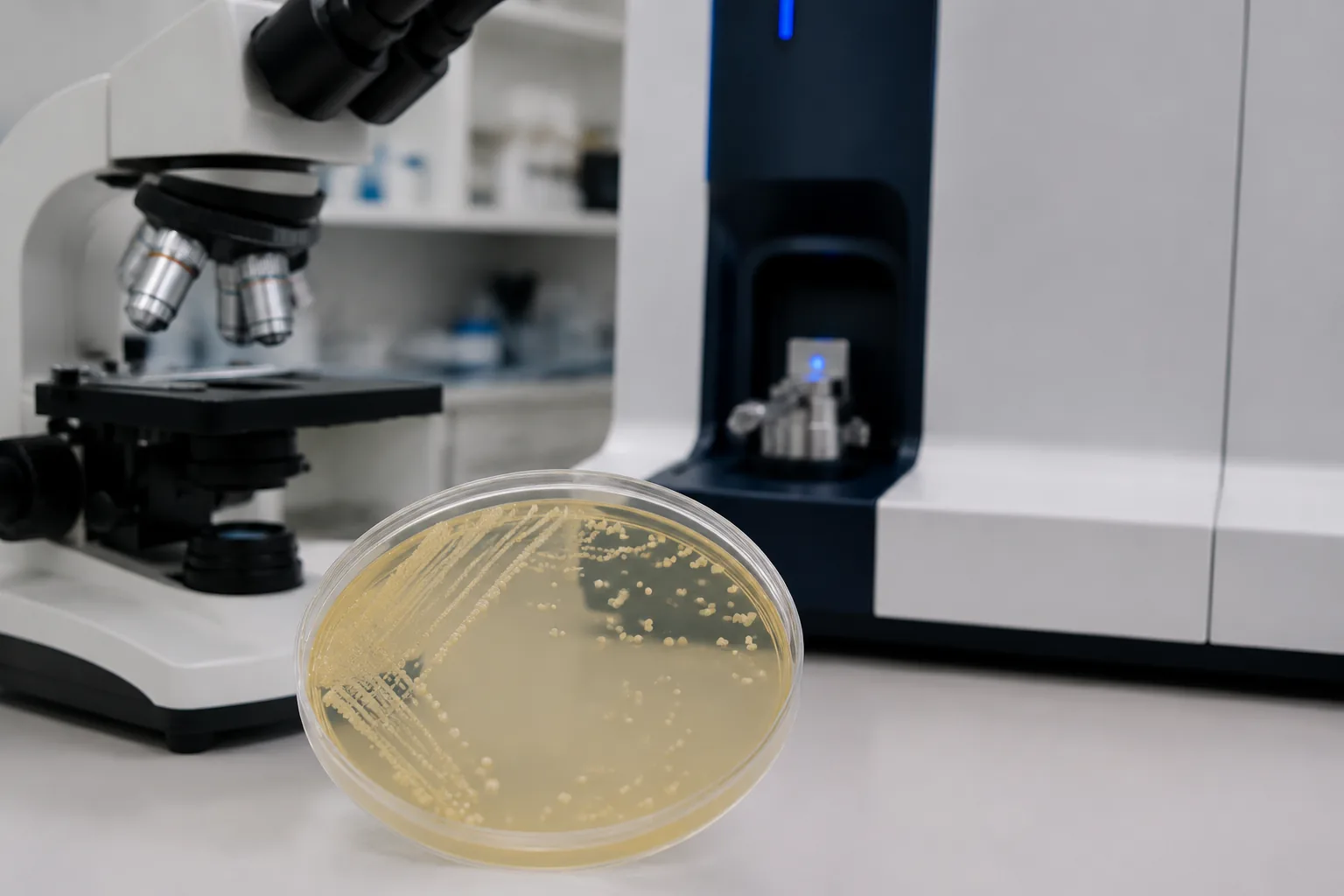
A strain can be identified to four increasing levels of resolution, and each level answers a different question. Selecting the wrong level is the most common cause of a useless report — an over-shallow method misses the species; an over-deep method wastes money on a question 16S would have answered.
| Level | Method | Resolves to | Typical use |
|---|---|---|---|
| 1. Phenotypic | Morphology, Gram stain, biochemical panels | Genus / species (presumptive) | Classical ID, food/clinical screening |
| 2. Proteomic | MALDI-TOF MS | Species (minutes, ~93 % genus accuracy) | Routine clinical/industrial ID |
| 3. Molecular — barcode | 16S rRNA (bacteria) / ITS (fungi) sequencing | Species (≥ 98.7 % similarity threshold) | Confirmatory species ID |
| 4. Genomic — whole genome | WGS + ANI / digital DNA-DNA hybridisation | Species (95–96 % ANI threshold) and strain | Novel species, strain-level, IP, safety evaluation |
The thresholds matter and are widely misapplied: ≥ 98.7 % 16S similarity is the operational species boundary, but two strains with identical 16S can still belong to different species (because 16S evolves too slowly to resolve close species), which is why 95–96 % ANI on whole genomes is the species-defining cut-off. Anyone reporting a "new strain" must use WGS, not 16S.
How Is Phenotypic / Morphological Identification Performed?
The classical first step that any strain identification still begins with:
- Colony and cell morphology — colony form, surface, pigment, edge on selective/non-selective agar; cell shape, size, arrangement, sporulation under the microscope.
- Gram stain — Gram-positive vs Gram-negative; the first great bifurcation of bacterial ID.
- Physiological / biochemical panels — carbon-source utilisation, enzyme activity, fermentation patterns, motility; manual or automated (API, VITEK 2, Biolog) panels.
Phenotypic ID is fast, cheap and indispensable for screening, but it is presumptive — many species share a phenotype, and atypical strains misidentify. It is the front end of the workflow, not the final word on a critical identification.
How Does MALDI-TOF MS Identify a Strain?
Matrix-assisted laser desorption/ionisation time-of-flight mass spectrometry (MALDI-TOF MS) has displaced classical biochemistry as the routine workhorse for species-level ID in clinical and industrial labs. It measures the ribosomal-protein mass fingerprint (mainly 2–20 kDa) of the isolate and matches it against a reference database:
- Speed — minutes per spot, vs a day or more for biochemical panels.
- Accuracy — ~93 % correct at genus level and high at species level against well-curated databases; Bruker MALDI Biotyper® and Vitek MS are the dominant platforms.
- Database scope — the industrial culture collections (CICC, CGMCC) have built MALDI-TOF databases covering thousands of species and > 10 000 strains of bacteria, yeast and filamentous fungi, so industrial isolates are well represented.
- Limitation — MALDI-TOF identifies to species, not to strain, and its accuracy falls on rare or atypical species not in the database. It is the fast, routine species-ID layer; strain-level resolution still needs sequencing.
How Does 16S rRNA / ITS Sequencing Work?
For a definitive species identification, the molecular barcode is sequenced:
- Bacteria — the 16S rRNA gene (~1500 bp), the universally conserved molecular clock; PCR-amplified with universal primers (27F/1492R), Sanger- or NGS-sequenced, and queried against type-strain databases (EzBioCloud, NCBI 16S). A hit at ≥ 98.7 % similarity is the species boundary.
- Fungi / yeast — the ITS region (ITS1-5.8S-ITS2), the fungal barcode, sequenced and queried against UNITE/NCBI.
- Confirmation — the result is the species assignment with the percent similarity and the database hits; for novel/ambiguous species the 16S is only the first screen, and whole-genome ANI decides the species boundary.
The well-documented trap: 16S similarity above 98.7 % but below the ANI 95 % equivalent leaves a band where two species cannot be separated by 16S alone — WGS is then required.
How Does Whole-Genome Sequencing Resolve to the Strain?
For strain-level resolution — novel-species description, strain-level differentiation (e.g. two probiotic Lactobacillus strains), IP/patent support, or the safety evaluation of a new food strain — WGS is the reference method:
- Average nucleotide identity (ANI) — whole-genome comparison; 95–96 % ANI is the species boundary. An isolate at 98.32 % ANI vs the type strain of species A and 82.53 % vs species B belongs unambiguously to species A.
- Strain typing — single-nucleotide variants (SNVs), MLST-from-genome, core-genome phylogeny, and pan-genome analysis resolve individual strains within a species.
- Functional annotation — gene content, virulence genes, antimicrobial-resistance genes, secondary-metabolite clusters; essential for safety evaluation.
- Chinese guidance — the WGS-based probiotic-strain-typing guide (BGI/industry) and GB 31615.2-2025 require new food-use strains to be characterised by strain identification + WGS + safety evaluation before use.
Short-read sequencing (Illumina) resolves SNVs but struggles with repetitive regions; long-read (PacBio HiFi, Oxford Nanopore) closes the genome and now matches PacBio parity for high-GC bacteria, so hybrid or long-read assembly is preferred for complete strain characterisation.
Why Strain Identification Is Mandatory in Food, Pharma and Probiotics
In regulated industries the identification is not optional — it is the entry condition for placing a microbial strain into a product:
- Food / probiotics — China GB 31615.2-2025 (食品用菌种安全性评价程序) requires new strains to undergo identification + WGS + safety evaluation (antibiotic resistance, animal pathogenicity, toxigenicity) before use; the strain must be deposited in a recognised culture collection (CICC, CGMCC, CMCC).
- Fermentation industry — the production strain must be confirmed as the declared species/strain to guarantee product quality and yield; contamination by a foreign strain is detected by re-identification.
- Pharma biologics — the production strain's species, origin and identification are documented for traceability and legality.
- Standard-strain management (GB 4789.28-2024) — laboratory working strains are traced back to the type/reference strain from a culture collection; the working strain must not exceed five passages from the received standard (passage 0), and re-identification confirms identity after each revival.
What Belongs on the Report?
A compliant strain-identification report states the method used, the resolution achieved, the database/reference compared against, and the percent similarity — and is explicit about what the result does and does not establish:
- Phenotypic — "presumptive X sp." (not a species confirmation).
- MALDI-TOF — "identified as X (log score / confidence value); species level".
- 16S / ITS — "species X at 99.x % similarity to type strain (EzBioCloud/NCBI); 16S cannot resolve close species".
- WGS + ANI — "species X at ANI xx.x % vs type strain (species boundary 95–96 %); strain-level profile / novelty".
For related microbiological services, see our Clean bench testing and cleanroom testing; for the pathogen-detection context, Health Food Testing for China SAMR.
FAQ
What is the difference between species identification and strain identification?
Species identification assigns the isolate to a named species (by 16S/ITS or MALDI-TOF, ≥ 98.7 % 16S similarity / 95–96 % ANI). Strain identification goes deeper — differentiating individual strains within a species — and requires WGS plus SNV/MLST/core-genome typing. A species ID does not prove two isolates are the same strain.
Why is 95–96 % ANI the species boundary, not 16S similarity?
Because 16S rRNA evolves too slowly to resolve closely related species — two species can share identical 16S yet differ at 90 % ANI. ANI compares the whole genome, so the 95–96 % cut-off is the operationally robust species boundary. 16S is the screen that narrows the candidate species; ANI is the decision.
Can MALDI-TOF MS identify a strain to the strain level?
No. MALDI-TOF MS identifies to species level via the ribosomal-protein fingerprint in minutes, at high accuracy against a curated database. It does not resolve strains within a species — that needs 16S/ITS for species confirmation and WGS for strain typing.
What Chinese standards govern microbial strain identification?
GB 31615.2-2025 (食品用菌种安全性评价程序) requires identification + WGS + safety evaluation for new food-use strains; GB 4789.28-2024 governs the standard strains and media used in food-microbiology testing; industrial strains are typed and deposited with CICC / CGMCC / CMCC. The WGS-based probiotic-strain-typing guide and feed-microbe safety guides add the strain-level requirement.
How many passages can a working strain undergo before re-identification?
Per GB 4789.28-2024 and standard-strain-management practice, the working strain must not exceed five passages from the standard strain received from a culture collection (which is passage 0), and the strain is re-identified after each revival to confirm it has not drifted or been contaminated.
Our Testing Capabilities
As an ISO/IEC 17025-accredited third-party laboratory, Beijing ZKGX Research provides microbial strain identification across the full method hierarchy:
- Phenotypic / morphological — colony and cell morphology, Gram stain, physiological/biochemical panels (API, VITEK, Biolog) for presumptive screening.
- MALDI-TOF MS — species-level identification in minutes against curated databases (Bruker MALDI Biotyper®), for routine clinical and industrial isolates.
- 16S rRNA / ITS sequencing — confirmatory species ID against EzBioCloud / NCBI type-strain databases, with the ≥ 98.7 % similarity threshold reported.
- Whole-genome sequencing + ANI — species boundary (95–96 % ANI), strain-level typing (SNV/MLST/core-genome), functional annotation (virulence/ARG/metabolite clusters), for novel species, probiotic/fermentation strain characterisation, IP support and GB 31615.2-2025 safety evaluation.
- Standard-strain management — GB 4789.28-2024 working-strain passage control, re-identification after revival, traceability to CICC/CGMCC/CMCC type strains.
Sample types include food and environmental isolates, clinical isolates, fermentation/probiotic production strains, novel-strain candidates, and laboratory standard strains. If you have a specific isolate type, target resolution (species / strain / novelty), or regulatory target (GB 31615.2 / GB 4789.28 / NMPA / FDA / EFSA), contact the laboratory to confirm the correct method, database and reporting format befOre testing.