Table of Contents
- What is health food testing in China?
- The regulatory framework: SAMR, CFE and the food safety Law
- Registration vs filing: which pathway applies to your product?
- The 24 permitted health function claims (2023 catalogue)
- Test category 1: physicochemical and functional ingredient analysis
- Test category 2: contaminant and heavy metal limits per GB 16740-2014
- Test category 3: microbiological safety per GB 29921
- Test category 4: toxicological safety evaluation per GB 15193
- Test category 5: stability testing per the SAMR stability guideline
- Test category 6: illegal-additive screening per the BJS methods
- Test category 7: functional evaluation — animal and human feeding trials
- Five imported ingredients that always require full registration testing
- Laboratory qualification: why CMA and CNAS are non-negotiable
- FAQ
- Our health food testing capabilities
What is health food testing in China?
Health food testing in China refers to the battery of physicochemical, microbiological, toxicological, stability, functional, and illegal-additive tests that a product must pass to be placed on the Chinese market as a 保健食品 (jiànkāng shípǐn, health food). Health food is one of four "special foods" regulated by the State Administration for Market Regulation (SAMR) under the Food Safety Law of the People's Republic of China, alongside infant formula, food for special medical purposes (FSMP), and food for special dietary use. Unlike general food, a health food may legally claim a specific health function (e.g. "helps maintain healthy blood lipid levels") or supplement vitamins and minerals — but it may not claim to treat disease, and every claim must be backed by test data submitted to SAMR.
A health food testing project is the laboratory backbone of either a registration or a filing application under the Administrative Measures for Health Food Registration and Filing (CFDA Order No. 22, 2020 revision). Imported health foods, products using raw materials outside the Health Food Raw Materials Catalogue, and products claiming one of the non-nutrient health functions must undergo the full registration track; the test battery for these products is markedly heavier than for the filing track. This article is organised around the seven test categories that a Chinese testing laboratory must cover for a health food application, and around the specific numerical limits and standards each category invokes — the level of detail that almost no English-language SERP article carries.
The regulatory framework: SAMR, CFE and the Food Safety Law
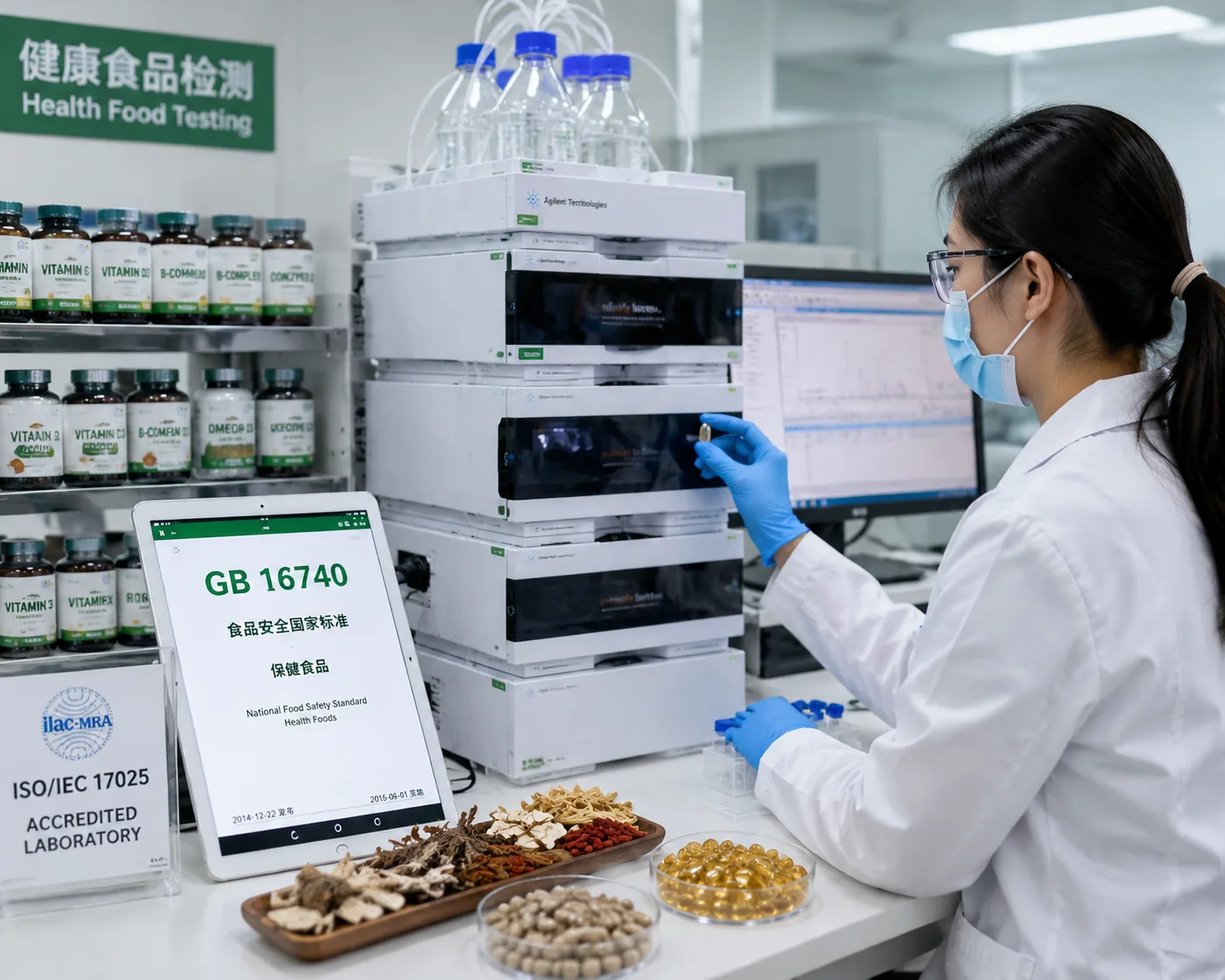
Three institutions sit above every health food testing project.
- State Administration for Market Regulation (SAMR) is the market supervisor that issues registration and filing certificates. Imported health foods — both registration and filing — are submitted directly to SAMR; domestic health foods register at SAMR but file at the provincial Administration for Market Regulation.
- Center for Food Evaluation (CFE) is the technical review body that evaluates the dossier SAMR receives, including the test reports from accredited laboratories.
- National Health Commission (NHC) issues the underlying food safety national standards (the GB series) that the laboratories test against, and approves new food raw materials, additives, and food contact materials.
The legal hierarchy, from the top down, is:
- Food Safety Law of the PRC (2009, last revised 2021) — establishes "special food" as a category subject to pre-market approval.
- Administrative Measures for Health Food Registration and Filing (CFDA Order No. 22, 2020 revision) — defines who must register, who may file, what materials to submit, and what testing is required for each track.
- GB 16740-2014, National Food Safety Standard for Health Food — the mandatory technical standard that sets physicochemical, contaminant, and microbiological limits for every health food on the market.
- Catalogue of Permitted Health Function Claims for Non-Nutrient Supplements (2023 edition) — the 24 functions that may be claimed.
- Technical Guiding Principles for Toxicological Testing and Evaluation of Health Food and its Raw Materials (2020 edition) — the toxicological evaluation procedure.
- Guiding Principles for Health Food Stability Testing (CFE/SAMR) — the long-term, accelerated, and stress testing protocol.
The single most consequential fact for a foreign manufacturer is that the testing required of your product is dictated by the regulatory pathway and the claim, not by a choice of standard. A product that files as a vitamin C tablet with no function claim needs a small subset of the GB 16740 tests; the same tablet claiming "helps antioxidant" needs the full toxicological and functional evaluation battery on top.
Registration vs filing: which pathway applies to your product?
The split between registration (注册) and filing (备案) is the first decision a health food project makes, and it determines the test battery.
| Attribute | Filing (备案) | Registration (注册) |
|---|---|---|
| Applies to | Domestic health foods using raw materials in the Health Food Raw Materials Catalogue; imported foods whose active ingredients are listed and whose formula fits the filing catalogue | Domestic health foods using raw materials outside the catalogue; all first-time-imported health foods (with the five grandfathered exceptions below); foods claiming non-nutrient health functions outside the catalogue |
| Certificate validity | Long-term (no expiry) | 5 years; renewal application 6 months before expiry |
| Test battery | Physicochemical + GB 16740 limits + stability | Full battery: physicochemical + GB 16740 + stability + toxicology + animal function + (for some functions) human feeding trials |
| Submission authority (imported) | SAMR | SAMR |
| Submission authority (domestic) | Provincial AMR | SAMR |
| Typical timeline | 2–5 months | 15–24 months (fastest 15 months for the five grandfathered imported ingredients) |
The five grandfathered imported ingredients — coenzyme Q10, fish oil, melatonin, broken Ganoderma lucidum spore powder, and spirulina — are required to take the registration track even though the same ingredients file domestically. They are the single most common category of imported health food registration, and the test battery is correspondingly well-defined (see the dedicated section below).
The 24 permitted health function claims (2023 catalogue)
On 31 August 2023, SAMR, the NHC, and the National Administration of Traditional Chinese Medicine jointly issued the Catalogue of Permitted Health Function Claims for Non-Nutrient Supplements (2023 edition). The catalogue reduced the historical 27 functions to 24 by removing three claims with weak scientific consensus ("improves growth and development", "promotes lactation", "improves skin oiliness") and renamed the remainder with a consistent "helps …" (有助于) prefix to bring the wording into line with the regulatory principle that health food does not treat disease.
The 24 permitted non-nutrient function claims are:
| # | Function claim (2023 wording) |
|---|---|
| 1 | Helps maintain immune function (有助于增强免疫力) |
| 2 | Helps antioxidant activity (有助于抗氧化) |
| 3 | Helps improve memory (辅助改善记忆) |
| 4 | Relieves visual fatigue (缓解视觉疲劳) |
| 5 | Soothes the throat (清咽润喉) |
| 6 | Helps improve sleep (有助于改善睡眠) |
| 7 | Relieves physical fatigue (缓解体力疲劳) |
| 8 | Helps control body fat (有助于控制体内脂肪) |
| 9 | Helps improve bone density (有助于改善骨密度) |
| 10 | Improves iron-deficiency anaemia (改善缺铁性贫血) |
| 11 | Helps improve acne (有助于改善痤疮) |
| 12 | Helps improve chloasma (有助于改善黄褐斑) |
| 13 | Helps improve skin hydration (有助于改善皮肤水份) |
| 14 | Helps regulate gut microbiota (有助于调节肠道菌群) |
| 15 | Helps digestion (有助于消化) |
| 16 | Helps maintain bowel regularity (有助于润肠通便) |
| 17 | Helps protect gastric mucosa (辅助保护胃黏膜) |
| 18 | Helps maintain healthy blood lipid levels (有助于维持血脂健康水平) |
| 19 | Helps maintain healthy blood glucose levels (有助于维持血糖健康水平) |
| 20 | Helps maintain healthy blood pressure levels (有助于维持血压健康水平) |
| 21 | Helps protect against ionising radiation (对电离辐射危害有辅助保护功能) |
| 22 | Helps improve hypoxia tolerance (有助于改善耐缺氧) |
| 23 | Helps excrete lead (有助于排铅) |
| 24 | Helps promote facial skin health (有助于促进面部皮肤健康) |
Each claim is supported by a SAMR-published functional evaluation guiding principle that specifies the animal model, the endpoint, the dose-response criterion, and (for some claims) the human feeding trial design. Nutritional supplements (vitamins and minerals) carry no function claim and are filed, not registered, if the raw material is in the catalogue.
Test category 1: physicochemical and functional ingredient analysis
Every health food — filing or registration — must declare the content of its functional ingredient(s) on the label, and that content must be verifiable by an accredited laboratory using a validated method. Functional ingredient analysis is the first test category, and the method of choice depends on the chemistry of the active.
| Functional ingredient | Typical method | Method basis |
|---|---|---|
| Coenzyme Q10 | HPLC-UV (270 nm, C18 column) | GB/T 22249, Health food — Determination of coenzyme Q10 |
| Fish oil EPA + DHA | Capillary GC-FID after methyl esterification | GB 5009.168 / GB 28304 |
| Melatonin | HPLC-UV or LC-MS/MS | GB/T 5009.170 |
| Broken Ganoderma lucidum spore powder | Triterpenoids by HPLC-UV; polysaccharides by phenol-sulfuric | Ganoderma raw material monograph |
| Spirulina | Protein (Kjeldahl, GB 5009.5); phycocyanin by spectrophotometry | Spirulina raw material monograph |
| Vitamins (A, D, E, B complex) | HPLC-DAD / LC-MS/MS | GB 5009.82 / .84 / .85 / .89 series |
| Minerals (Ca, Fe, Zn, Se) | ICP-OES / ICP-MS / AAS | GB 5009.92 / .90 / .241 / .93 |
| Anthocyanins, flavonoids, polyphenols | HPLC-DAD / UV-Vis | Raw material monograph or validated in-house method |
The report must state the method, the recovery, the repeatability, the quantification limit, and the measured value per dose unit. For registration the result must fall within 80–120 % of the label-declared content; for filing the same tolerance applies to the catalogue-listed dosage form. A functional ingredient result outside this band blocks the application.
Test category 2: contaminant and heavy metal limits per GB 16740-2014
GB 16740-2014 section 3.4 applies the "category-first" (类属优先) principle to contaminants: a health food is assigned to the general food category it most resembles (tablet → solid beverage, capsule → solid food, oral liquid → beverage), and the contaminant limits of that category in GB 2762 (the national standard for contaminants in foods) apply. Where the product has no analogous category, the GB 16740 Table 2 fallback limits apply. The fallback heavy-metal limits for products without an analogous food category are:
| Product form | Lead (Pb) | Total arsenic (As) | Total mercury (Hg) |
|---|---|---|---|
| General solid / semi-solid | ≤ 2.0 mg/kg | Per GB 2762 | Per GB 2762 |
| Bagged tea (袋泡茶剂) | ≤ 5.0 mg/kg | Per GB 2762 | Per GB 2762 |
| Liquid products | ≤ 0.5 mg/kg | ≤ 0.3 mg/kg | Per GB 2762 |
| Infant solid / semi-solid health food | ≤ 0.3 mg/kg | Per GB 2762 | Per GB 2762 |
| Infant liquid health food | ≤ 0.02 mg/kg | Per GB 2762 | Per GB 2762 |
The lead limit for infant liquid health food (0.02 mg/kg) is two orders of magnitude tighter than for a general solid product (2.0 mg/kg) — a direct reflection of the cumulative neurotoxicity of lead in the developing brain, and the single most common failure point for imported infant-formula-adjacent health foods. Pesticide residues are tested against GB 2763 (the national standard for pesticide maximum residue limits), and the analytical methods are the GB 5009 and GB 23200 series. Mycotoxins (aflatoxins B1, M1; ochratoxin A; deoxynivalenol) are tested against their respective GB 5009 methods where the raw material profile warrants.
Test category 3: microbiological safety per GB 29921
GB 16740-2014 section 3.5 mirrors the category-first principle for microbiology: the pathogen limits of GB 29921 for the analogous food category apply first. Where there is no analogous category, the GB 16740 Table 3 fallback limits apply, covering aerobic plate count, coliforms, moulds and yeasts, and the four marker pathogens (Salmonella spp., S. aureus, Listeria monocytogenes, and Cronobacter spp. for infant products).
The qualitative pathogen requirement is absolute: Salmonella shall not be detected in 25 g of product. Quantitative pathogens (S. aureus, L. monocytogenes in selected categories, Cronobacter in infant products) follow the GB 29921 n=5 sampling plan with c=0 or c=1 acceptance numbers and the m/M thresholds specified in the standard. Microbiological test methods are drawn from the GB 4789 series — the Chinese national food microbiology examination standards, equivalent in scope to ISO 6887 / ISO 6888 / FDA-BAM.
Test category 4: toxicological safety evaluation per GB 15193
The toxicological evaluation is the heaviest single test category for a registration product. It is governed jointly by the GB 15193 series (national food safety toxicological evaluation procedures) and by the SAMR Technical Guiding Principles for Toxicological Testing and Evaluation of Health Food and its Raw Materials (2020 edition). The evaluation follows a four-stage, weight-of-evidence procedure:
| Stage | Test | When required |
|---|---|---|
| Stage 1 | Acute oral toxicity (LD₅₀) in rodent | All registration products |
| Stage 2 | Three genotoxicity tests: bacterial reverse mutation (Ames, GB 15193.4), mammalian cell chromosomal aberration or micronucleus, and (where indicated) a third endpoint | All registration products |
| Stage 2 continued | 28-day oral toxicity in rodent | All registration products |
| Stage 3 | 90-day subchronic oral toxicity; teratogenicity; reproductive toxicity | Triggered by Stage 1–2 results, target population (infants, pregnant women), or high intake |
| Stage 4 | Chronic toxicity and carcinogenicity | Triggered only for specific concerns; rarely required for health food |
The default battery for a registration product is acute oral toxicity + three genotoxicity tests + 28-day oral toxicity, with the higher stages added based on the Stage 1–2 results and the target population. The Ames test within this battery is conducted per GB 15193.4-2014, the Chinese national food safety standard for bacterial reverse mutation — the same standard we cover in a separate article on the Ames test. An Ames-positive result blocks the application; an Ames-negative result, supported by negative mammalian cell and 28-day data, satisfies Stage 1–2 for most function claims.
Test category 5: stability testing per the SAMR stability guideline
The SAMR Guiding Principles for Health Food Stability Testing define the protocol used to assign the product's shelf life. Three test types are run in parallel on three commercial batches:
- Long-term test (长期试验). Stored at the labelled storage condition for the full shelf life. For a 24-month shelf life the testing points are 0, 3, 6, 9, 12, 18, and 24 months — seven time points. The 0-month data may be reused from the batch's hygiene test report.
- Accelerated test (加速试验). Stored at 37 ± 2 °C / 75 ± 5 % relative humidity, shielded from direct light, for 3 months. Used to predict degradation trend without waiting for the full shelf life.
- Stress (influencing factor) test (影响因素试验). High-temperature, high-humidity, strong-light, and freeze-thaw conditions run in the early development phase to identify the degradation pathway and inform the packaging choice.
The stability report must include the assay of the functional ingredient, the microbial count, the contaminant load, and (for capsules) the disintegration time at each time point. The labelled shelf life — most commonly 24 months — must be supported by the long-term test data, with the accelerated test as the corroborating prediction. A health food registration without a valid stability report cannot be granted a 24-month shelf life.
Test category 6: illegal-additive screening per the BJS methods
The illegal-additive test is the one category that most SERP articles do not mention but that every CFE review now scrutinises. Health foods that claim weight loss, anti-fatigue (aphrodisiac), blood-glucose lowering, blood-pressure lowering, or sleep improvement are systematically screened for the addition of prescription pharmaceuticals — additions that are illegal under the Food Safety Law and that have driven the majority of SAMR enforcement actions since the 2015 revision. The BJS series (保健食品检验与评价技术规范, Health Food Inspection and Evaluation Technical Specification) defines the screening methods, and modern laboratories run a single LC-MS/MS method that can flag up to 350 illegal additives in one injection.
The illegal additives most commonly detected by claim category are:
| Function claim category | Typical illegal additives detected |
|---|---|
| Weight loss (有助于控制体内脂肪) | Sibutramine, N-desmethylsibutramine, N,N-didesmethylsibutramine, fenfluramine, phenolphthalein, furosemide |
| Anti-fatigue (缓解体力疲劳) | Sildenafil, tadalafil, vardenafil, and their analogues (e.g. hydroxyhomosildenafil, thiohomosildenafil) |
| Blood glucose lowering (有助于维持血糖健康水平) | Glibenclamide, glimepiride, gliclazide, metformin, phenformin |
| Blood pressure lowering (有助于维持血压健康水平) | Reserpine, captopril, enalapril, nifedipine |
| Sleep improvement (有助于改善睡眠) | Diazepam, estazolam, alprazolam, zolpidem |
A confirmed illegal-additive positive is reported to SAMR and triggers immediate enforcement action against the manufacturer; for an applicant it terminates the registration. Modern LC-MS/MS screening reaches sub-mg/kg detection limits in a single run, and CFE reviewers specifically look for the BJS series report in every weight-loss, anti-fatigue, and glucose-regulation submission.
Test category 7: functional evaluation — animal and human feeding trials
A product claiming one of the 24 non-nutrient function claims must demonstrate efficacy in a functional evaluation conducted per the SAMR guiding principle for that claim. The evaluation is biological, not chemical — it tests whether the product actually does what the claim says. Two tiers of evaluation are used, and the tier required depends on the claim:
- Animal function test (动物功能试验). Uses a validated rodent model with defined endpoint. For "helps maintain immune function" this is the carbon-clearance test and the antibody-forming cell assay in mice; for "helps maintain healthy blood lipid levels" it is the high-fat-diet rat model with serum total cholesterol, LDL-C, HDL-C, and triglyceride endpoints; for "relieves physical fatigue" it is the weighted-swimming test with blood lactate, urea nitrogen, and hepatic glycogen endpoints. Required for most registration claims.
- Human feeding trial (人体试食试验). A double-blind, placebo-controlled trial in a defined subject population (typically 50–100 subjects per arm, 30+ days), with the same endpoint category as the animal test but translated to human clinical measurements. Required for the most consumer-facing claims — antioxidant, blood lipid, blood glucose, blood pressure, bone density — and for the five imported grandfathered ingredients in the relevant claim categories.
For the five imported registration ingredients the CIRS-documented test battery is explicit:
| Imported ingredient | Claim | Toxicology | Animal function | Human trial |
|---|---|---|---|---|
| Coenzyme Q10 | Helps maintain immune function | ✓ | ✓ | — |
| Coenzyme Q10 | Helps antioxidant | ✓ | ✓ | ✓ |
| Fish oil | Helps maintain healthy blood lipid levels | ✓ | ✓ | ✓ |
| Melatonin | Helps improve sleep | ✓ | ✓ | — |
| Broken Ganoderma lucidum spore powder | Helps maintain immune function | ✓ | ✓ | — |
| Spirulina | Helps maintain immune function | ✓ | ✓ | — |
The human feeding trial is the single longest-lead-time item in a health food registration; the trial design must be reviewed by an ethics committee, the protocol must be filed before enrolment, and the full trial typically takes 4–9 months from protocol to report. This is why a registration with a human-trial-requiring claim realistically takes 18–24 months from project start to certificate, and why the five grandfathered imported ingredients (which skip the human trial for the immune claim) are the pragmatic entry point for foreign manufacturers.
Five imported ingredients that always require full registration testing
Even when the same five ingredients can be filed domestically, an imported product in these ingredients must register. The full registration test battery, per CIRS and the 2020 toxicology guiding principles, is:
- Acute oral toxicity (Stage 1) — rodent LD₅₀.
- Three genotoxicity tests (Stage 2) — Ames (GB 15193.4), mammalian chromosomal aberration or micronucleus, plus a third endpoint where indicated.
- 28-day oral toxicity (Stage 2) — rodent.
- Animal function test — claim-specific.
- Human feeding trial — required for antioxidant CoQ10, blood-lipid fish oil.
- Physicochemical and functional ingredient analysis — label-claim content verification, 80–120 % band.
- Contaminant and heavy metal battery — per GB 2762 / GB 16740 Table 2.
- Microbiological battery — per GB 29921 / GB 16740 Table 3.
- Stability testing — long-term + accelerated, full shelf-life duration.
- Illegal-additive screening — BJS series LC-MS/MS, claim-relevant compound panel.
A complete set of these reports, issued by a CMA- and CNAS-accredited laboratory, is the technical core of the registration dossier. The expected registration timeline for the five grandfathered imported ingredients is 15 months in the fastest case, and 18–24 months for ingredients requiring a human feeding trial.
Laboratory qualification: why CMA and CNAS are non-negotiable
A test report from a laboratory without the right accreditations is not accepted by CFE, no matter how good the data are. Two accreditations are mandatory for health food testing in China:
- CMA (China Inspection Body and Laboratory Mandatory Approval, 检验检测机构资质认定) — issued by SAMR. Required for any test report submitted to a Chinese regulator. The CMA scope sheet lists, line by line, which products and which parameters the laboratory is qualified to test; a report on a parameter outside the CMA scope is invalid.
- CNAS (China National Accreditation Service for Conformity Assessment, 中国合格评定国家认可委员会) — the national accreditation body, ILAC MRA signatory. Required by most overseas regulators as proof of technical competence; many multinational manufacturers require CNAS in addition to CMA.
For health food specifically, the laboratory must hold CMA scope covering the GB 16740, GB 2762, GB 29921, GB 15193, GB 5009, and GB 4789 items applicable to the product form, and must hold the functional-evaluation capability (animal facility +, for human trials, a clinical-trial-qualified partner site) where the claim requires it. A laboratory that holds CMA for chemistry but not for toxicology cannot deliver a registration dossier on its own.
FAQ
What is the difference between registration and filing for health food in China?
Filing applies to domestic health foods whose raw materials are in the Health Food Raw Materials Catalogue and that carry no non-nutrient function claim; the certificate has no expiry and the test battery is limited to physicochemical, contaminant, microbial, and stability. Registration applies to imported health foods, products using catalogue-exempt raw materials, and products claiming one of the 24 non-nutrient functions; the certificate is valid for 5 years and the test battery adds toxicology, animal function, and (for some claims) human feeding trials.
How many health function claims are allowed?
The 2023 edition of the Catalogue of Permitted Health Function Claims for Non-Nutrient Supplements lists 24 claims (reduced from the historical 27 by removing "improves growth and development", "promotes lactation", and "improves skin oiliness"). Nutritional supplements (vitamins, minerals) do not carry a function claim and are filed.
What is the shelf life supported by the stability test?
The most common shelf life supported by the SAMR stability test protocol is 24 months, requiring long-term testing at 0, 3, 6, 9, 12, 18, and 24 months plus an accelerated test at 37 ± 2 °C / 75 ± 5 % RH for 3 months.
Why does the lead limit differ across product forms?
GB 16740-2014 applies a "category-first" principle: a health food is assigned the contaminant limits of the general food category it most resembles (per GB 2762). When no analogous category exists, the GB 16740 Table 2 fallback applies, which sets lead at 2.0 mg/kg for general solids, 5.0 mg/kg for bagged-tea forms, 0.5 mg/kg for liquids, and 0.02–0.3 mg/kg for infant forms — the tighter infant limit reflects the developmental neurotoxicity of lead.
Which imported health foods must register?
All first-time-imported health foods must register. Five imported ingredients — coenzyme Q10, fish oil, melatonin, broken Ganoderma lucidum spore powder, and spirulina — have well-defined test batteries and are the pragmatic entry point for foreign manufacturers, with the fastest certificate issuance around 15 months.
Our health food testing capabilities
Beijing ZKGX Research (ISO/IEC 17025 accredited, CMA- and CNAS-accredited testing laboratory) provides the complete health food testing battery for both registration and filing submissions under the Administrative Measures for Health Food Registration and Filing (CFDA Order No. 22), SAMR evaluation, and the GB 16740-2014 / GB 15193 / GB 2762 / GB 29921 / GB 5009 / GB 4789 / BJS technical framework.
We deliver all seven test categories from a single laboratory:
- Functional ingredient analysis — HPLC, LC-MS/MS, GC-FID, ICP-MS for CoQ10, EPA/DHA, melatonin, triterpenoids, phycocyanin, vitamins, minerals, anthocyanins, flavonoids, polyphenols, verified to 80–120 % of label claim.
- Contaminant and heavy metal testing — Pb, As, Hg, Cd per GB 2762 / GB 16740 Table 2, including the 0.02 mg/kg infant-liquid lead limit.
- Microbiological safety — pathogens and indicators per GB 29921 / GB 16740 Table 3, using GB 4789 methods.
- Toxicological evaluation — acute oral, three-test genotoxicity battery (including Ames per GB 15193.4), 28-day, 90-day, teratogenicity and reproductive toxicity per GB 15193 and the SAMR 2020 technical guiding principles.
- Stability testing — long-term (0/3/6/9/12/18/24 month), accelerated (37 ± 2 °C / 75 ± 5 % RH, 3 month), and influencing-factor tests per the SAMR Guiding Principles for Health Food Stability Testing.
- Illegal-additive screening — LC-MS/MS screening of up to 350 illegal additives per the BJS series, with claim-specific compound panels for weight-loss, anti-fatigue, glucose-regulation, blood-pressure, and sleep-claim products.
- Functional evaluation — claim-specific animal function tests (carbon clearance, weighted swimming, high-fat-diet lipid model, etc.) and partnership with ethics-cleared hospitals for the human feeding trials required for antioxidant, blood-lipid, blood-glucose, blood-pressure, and bone-density claims.
Suitable sample types include: tablets, hard and soft capsules, oral liquids, granules, powders, and bagged-tea forms; ingredients spanning CoQ10, fish oil, melatonin, broken Ganoderma lucidum spore powder, spirulina, vitamins, minerals, botanical extracts, and proteins; domestic registration, domestic filing, and imported registration projects under SAMR. Each project is delivered with a full CMA- and CNAS-stamped data report (test protocol, instrument calibration, raw data, statistical analysis, pass/fail judgement against each GB or BJS clause) ready for direct submission to CFE. Contact Beijing ZKGX Research to discuss the regulatory pathway applicable to your product and to scope the test battery.