What Is Insulating oil testing and Why Does It Matter
Insulating oil testing is the systematic analysis of the electrical, chemical, and physical properties of insulating fluids used in transformers, switchgear, load tap changers, and other electrical apparatus. The oil serves three critical functions: electrical insulation (preventing arcing and corona discharge), cooling (dissipating heat from core and windings), and preservation (protecting cellulose paper insulation from oxidation).
A single unexpected transformer failure can cost millions of dollars in equipment replacement, lost revenue from power outages, and environmental cleanup. Industry data shows that doubling the water content in transformer oil can halve the remaining service life of the asset. Regular insulating oil testing transforms the oil into a continuous early-warning diagnostic system, enabling operators to detect faults before they become catastrophic, extend transformer life from 20 to 40+ years, and maintain grid reliability.
Testing is performed on new oil (acceptance testing before filling), processed oil (after filling but before energization), and in-service oil (periodic condition monitoring). The results guide maintenance decisions: whether to filter and dry the oil, regenerate it, or replace it entirely.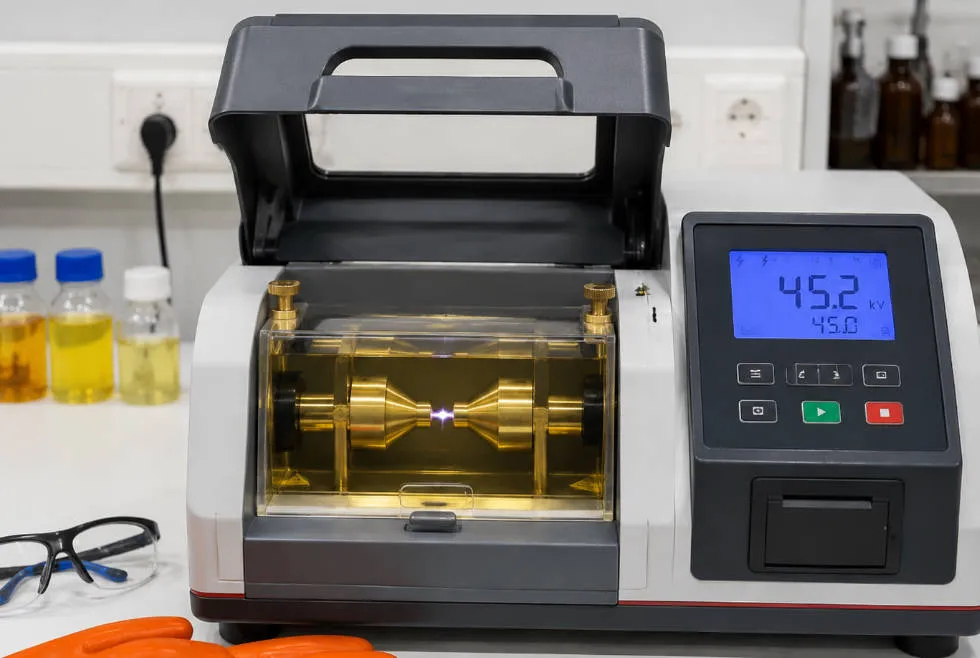
Key Insulating Oil Testing Standards (ASTM / IEC / IEEE)
|
Standard |
Scope |
Key Property |
|---|---|---|
|
ASTM D877 |
Dielectric breakdown voltage using disk electrodes |
BDV (new oil acceptance) |
|
ASTM D1816 |
Dielectric breakdown voltage using VDE electrodes |
BDV (in-service, moisture-sensitive) |
|
ASTM D924 |
Liquid power factor (dissipation factor) |
DDF / tan delta |
|
ASTM D971 |
Interfacial tension |
Polar contaminants, oxidation |
|
ASTM D1169 |
Specific resistance (resistivity) |
DC resistivity |
|
ASTM D1533 |
Karl Fischer moisture content |
Water content (ppm) |
|
ASTM D3612 |
Dissolved gas analysis |
Fault gas concentrations |
|
ASTM D5837 |
Furanic compounds |
Paper insulation degradation |
|
ASTM D664 / D974 |
Acid number / neutralization number |
Acidity (mg KOH/g) |
|
ASTM D3487 |
Specification for mineral insulating oil |
Comprehensive specification |
|
IEC 60156 |
Breakdown voltage at power frequency |
BDV (international standard) |
|
IEC 60296 |
Specification for unused mineral insulating oils |
New oil specification |
|
IEC 60422 |
Maintenance guidance for mineral oils |
In-service oil supervision |
|
IEC 60599 |
DGA interpretation for mineral oil |
Fault diagnosis |
|
IEEE C57.104 |
Interpretation of gases in oil-immersed transformers |
DGA interpretation |
|
IEEE C57.106 |
Acceptance and maintenance of insulating oil |
BDV limits by voltage class |
|
IEEE C57.147 |
Natural ester acceptance and maintenance |
Ester fluids |
|
IEC 62770 |
Unused natural esters for transformers |
Ester specification |
Electrical Properties Testing: Dielectric Strength, Resistivity, and Dissipation Factor
Dielectric Breakdown Voltage (BDV)
The dielectric breakdown voltage test measures the maximum electrical stress an insulating oil can withstand before arcing occurs between two electrodes. It is the most widely performed insulating oil test because it is quick, inexpensive, and directly indicates the presence of moisture, conducting particles, and polar contaminants.
Test procedure: Oil is placed in a test vessel with two electrodes separated by a defined gap (typically 2.5 mm for IEC 60156, 2.54 mm for ASTM). Voltage is increased at a controlled rate (2 kV/s for IEC, 0.5-3 kV/s for ASTM depending on method) until breakdown occurs. The test is repeated 5-6 times and results are averaged.
|
Condition |
Minimum BDV (IEC 60156) |
Minimum BDV (ASTM D877) |
|---|---|---|
|
New unused oil (as received) |
30 kV (70 kV after lab filtration) |
30 kV |
|
New oil in equipment, before energization |
55-60 kV (by voltage class) |
35-60 kV (by voltage class) |
|
In-service oil (good) |
40-60 kV (by voltage class) |
>30 kV |
|
In-service oil (poor) |
<30 kV |
<25 kV |
Dry, clean oil typically gives BDV values well above these minimums. Moisture is the most common contaminant reducing BDV—even a few ppm of water can significantly lower breakdown voltage in mineral oil.
Specific Resistance (Resistivity)
Resistivity measures the oil's ability to resist the flow of direct current, expressed in ohm-cm. It is measured at both 27 °C and 90 °C to cover the full operating temperature range.
|
Temperature |
Minimum Resistivity |
|---|---|
|
27 °C |
1,500 × 10^12 ohm-cm |
|
90 °C |
35 × 10^12 ohm-cm |
Resistivity decreases rapidly with temperature and is directly affected by polar contaminants. During service, resistivity tends to decrease as oxidation products accumulate.
Dielectric Dissipation Factor (DDF / Tan Delta)
The DDF measures the imperfection of the oil's dielectric nature—the leakage current that does not lead voltage by exactly 90°. A high tan delta indicates contamination by polar compounds, moisture, or oxidation products.
The DDF and resistivity are closely related: as resistivity decreases, tan delta increases. For this reason, both tests are not always required on the same sample. DDF tends to increase during service life as polar contaminants accumulate.
Chemical Properties Testing: Water Content, Acidity, and Furanic Compounds
Water Content (ASTM D1533 - Karl Fischer)
Moisture is the most damaging contaminant in transformer oil. Water affects both the oil's dielectric strength and the cellulose paper insulation. Paper is highly hygroscopic and absorbs water from the oil, reducing its mechanical strength and accelerating aging.
|
Water Content Level |
Assessment |
|---|---|
|
< 20 ppm |
Good (new oil) |
|
20-35 ppm |
Acceptable (in-service) |
|
35-50 ppm |
Monitor closely |
|
> 50 ppm |
Action required (drying needed) |
Water content is measured using the Coulometric Karl Fischer Titrator, which can accurately detect ppm-level moisture. The acceptable limit per IS-335(1993) is up to 50 ppm.
A critical interaction: in loaded transformers, oil temperature rises and water solubility increases. The paper releases water into the oil. Upon cooling, the moisture migrates back—but the cycle causes progressive paper degradation. Doubling the water content can halve the transformer's remaining working life.
Acidity (ASTM D664 / D974)
Acidity measures acidic contaminants formed by oxidation of the insulating oil, expressed in mg KOH per gram of oil (neutralization number). Acidic oil:
-
Increases water solubility in the oil (acid + water accelerate further degradation)
-
Deteriorates cellulose paper insulation
-
Causes internal corrosion of metal components
-
Leads to sludge formation, blocking cooling passages
|
Acidity Level (mg KOH/g) |
Assessment |
|---|---|
|
< 0.03 |
Good (new oil) |
|
0.03-0.1 |
Acceptable (in-service) |
|
0.1-0.2 |
Deteriorating |
|
> 0.2 |
Action required (oil change or regeneration) |
A darkening of oil color often accompanies rising acidity and is a visible warning sign.
Furanic Compounds (ASTM D5837)
Furanic compounds are organic molecules formed during thermal degradation of cellulose paper insulation. Their concentration directly correlates with the degree of polymerization (DP) of the paper—a measure of its remaining mechanical strength.
|
DP Value |
Paper Condition |
Remaining Life |
|---|---|---|
|
1,000-1,200 |
New paper |
Full life |
|
500-800 |
Moderately aged |
Significant remaining |
|
250-500 |
Significantly aged |
Limited |
|
< 200 |
End of life |
Paper is brittle, failure imminent |
Once paper insulation loses its mechanical strength, it cannot recover. Furan analysis provides a non-invasive estimate of paper condition without requiring access to the transformer internals.
PCB Content
Polychlorinated biphenyls (PCBs) were historically used as insulating fluids but are now banned under the Stockholm Convention as Persistent Organic Pollutants. All transformers should be tested for PCB content, as PCB-containing equipment requires special handling and disposal procedures.
Physical Properties Testing: Viscosity, Flash Point, Pour Point, and IFT
Viscosity
Viscosity measures the oil's resistance to flow—critical for the convective cooling function. Low viscosity means better oil circulation and more effective cooling. Viscosity increases as temperature decreases; the rate of increase should be minimized.
Flash Point (ASTM D92)
The flash point is the temperature at which the oil produces enough vapors to form a flammable mixture with air. For safety, transformer oil must have a high flash point—generally above 140 °C. This property is essential for fire prevention in substations and power plants.
Pour Point
The pour point is the minimum temperature at which oil flows under standard conditions. Paraffin-based oils have higher pour points due to wax content, while naphtha-based oils flow at lower temperatures. In cold climates, a low pour point is essential to maintain cooling circulation.
Interfacial Tension (IFT - ASTM D971)
IFT measures the attractive molecular force between water and oil at their interface, reported in dyne/cm or mN/m. New, clean oil exhibits high IFT. As oxidation products and polar contaminants accumulate, IFT decreases.
|
IFT Value (mN/m) |
Assessment |
|---|---|
|
> 40 |
Good (new oil) |
|
30-40 |
Fair |
|
20-30 |
Deteriorating |
|
< 20 |
Poor (sludge likely) |
IFT is one of the most sensitive indicators of oil oxidation and is used alongside acidity to assess the overall chemical health of the oil.
Dissolved Gas Analysis (DGA): Fault Detection in Transformers
Dissolved gas analysis is the most powerful diagnostic tool for detecting active faults inside oil-filled electrical equipment. Under electrical or thermal stress, insulating oil and paper decompose, generating characteristic gases. The type and concentration of dissolved gases reveal the nature and severity of the fault.
Fault Types and Key Gases
|
Fault Type |
Key Gas |
Typical Gas Composition |
|---|---|---|
|
Corona / partial discharge |
Hydrogen (H2) |
H2 + CH4, low C2H4 and C2H6 |
|
Arcing (high energy) |
Acetylene (C2H2) |
High H2, C2H2, minor C2H4 and CH4 |
|
Overheated cellulose (paper) |
Carbon monoxide (CO) |
CO + CO2 elevated |
|
Overheated oil (300 °F) |
Methane (CH4) + Ethylene (C2H4) |
CH4 + C2H4 dominant |
|
Overheated oil (1,112 °F) |
CH4 + H2 |
CH4 + H2, traces of C2H2 possible |
Interpretation Methods
-
Duval's Triangle: A graphical method plotting three gas ratios to classify fault type (partial discharge, thermal fault, electrical arcing)
-
IEEE C57.104: Provides concentration limits and gas rate thresholds for mineral oil transformers
-
IEC 60599: International guidance on DGA interpretation for mineral oil equipment
-
IEEE C57.146: DGA interpretation for silicone-immersed transformers
-
IEEE C57.155: DGA interpretation for natural and synthetic ester-immersed transformers
-
IEEE C57.139: DGA for load tap changers
DGA is typically performed annually on critical transformers and every 2-3 years on less critical units. Online DGA monitors provide continuous monitoring for the highest-value assets.
Insulating Oil Types and Their Testing Differences
Five types of insulating fluid are in common use today, each with distinct properties that affect testing requirements:
|
Fluid Type |
Moisture Tolerance |
Fire Safety |
Typical Application |
Key Testing Difference |
|---|---|---|---|---|
|
Mineral oil |
Low (BDV drops sharply with moisture) |
Moderate (flash point ~140 °C) |
Most common, existing fleet |
Standard ASTM/IEC methods |
|
Silicone fluid |
Low-moderate |
High (fire point >300 °C) |
High-fire-risk locations |
Requires <1 ms voltage switch-off (IEC 60156) |
|
Synthetic ester |
High (maintains BDV >30 kV at >400 ppm H2O) |
High |
New installations, retrofill |
IEEE C57.147 maintenance guide |
|
Natural ester (vegetable oil) |
Very high |
Very high |
Environmentally sensitive areas |
IEC 62770 specification |
|
HMWH (high molecular weight hydrocarbon) |
Moderate |
High |
Indoor substations |
ASTM D5222 fire point requirement |
Ester fluids can maintain breakdown voltage above 30 kV with more than 400 ppm water content—far exceeding mineral oil's tolerance. This is one reason esters last longer in service. However, ester fluids require different maintenance guidance standards (IEEE C57.147, IEC 61203).
Dielectric Breakdown Voltage Testing: Procedures and Standards Comparison
The three primary standards for BDV testing differ significantly in their procedures:
|
Parameter |
ASTM D877 |
ASTM D1816 |
IEC 60156 |
|---|---|---|---|
|
Electrode shape |
Flat disk (25.4 mm diameter) |
Mushroom / VDE (36 mm) |
Mushroom / spherical |
|
Electrode gap |
2.54 mm |
1 mm or 2 mm |
2.5 mm |
|
Voltage rise rate |
3 kV/s |
0.5 kV/s (2 mm) / 3 kV/s (1 mm) |
2 kV/s |
|
Stirring |
Not stirred |
Impeller required (200-300 rpm) |
Optional (impeller or magnetic bead) |
|
Number of breakdowns |
5 |
5 (or 10) |
6 |
|
Time between breakdowns |
1 min |
1-1.5 min |
2 min |
|
Breakdown detection |
Voltage drops <100 V |
Voltage drops <100 V |
Current ≥4 mA for ≥5 ms |
|
Voltage switch-off time |
Not specified |
Not specified |
<10 ms (mineral), <1 ms (silicone) |
|
Moisture sensitivity |
Low |
High |
Moderate |
ASTM D877 is the oldest method, insensitive to moisture, and now recommended only for acceptance testing of new oil. ASTM D1816 is more sensitive to moisture, particles, and oil aging—the IEEE has adopted D1816 as the preferred method for in-service oil evaluation. IEC 60156 is the international standard used in Europe, Asia, and much of the world, producing generally higher breakdown values than ASTM methods due to its uniform field electrode geometry.
Oil Sampling Best Practices
The quality of test results depends entirely on the quality of the sample. Poor sampling technique introduces contamination that produces misleading results.
Sampling Standards
-
USA: ASTM D923 (general sampling), ASTM D3613 (for DGA and water content)
-
International: IEC 60475 (sampling method), IEC 60567 (sampling for gas analysis)
Critical Sampling Rules
-
Clean the drain valve inside and out before drawing the sample
-
Flush thoroughly — remove at least 2 liters before collecting the sample to ensure it represents bulk oil, not bottom sludge
-
Use proper containers — glass syringes for DGA, glass or aluminum bottles for general testing. Never reuse engine oil bottles
-
Avoid contamination — do not sample in rain, snow, wind, or when relative humidity exceeds 50 %
-
Fill carefully — let oil flow down the side of the bottle to prevent air entrainment
-
Record temperature — oil temperature at sampling is critical for accurate water content interpretation
-
Take samples during steady load — sampling after a cool-down period gives misleadingly low BDV because moisture migrates from paper to oil during full-load operation
-
Store in the dark — mineral oil deteriorates under UV exposure
-
Ensure positive pressure — never sample from a transformer under negative pressure (air ingress causes failure)
-
Record complete metadata — transformer nameplate, fluid type, service history, breather type, fluid level, temperature
Safety
-
Verify PCB content before sampling (PCBs require special handling)
-
Use correct PPE and properly rated tools
-
Check for electrical and tripping hazards
-
Lock out / tag out before sampling
Testing Frequency and Maintenance Strategy
|
Transformer Category |
Recommended BDV Test Frequency |
DGA Frequency |
|---|---|---|
|
Critical (generator step-up, major transmission) |
Every 6 months |
Annually |
|
Important (distribution, substation) |
Annually |
Every 1-2 years |
|
Standard (pole-mounted, small distribution) |
Every 2-3 years |
Every 3-5 years |
|
New oil (acceptance testing) |
Per delivery |
Before energization |
|
After maintenance / oil processing |
Before re-energization |
Before re-energization |
IEC 60422 and IEEE C57.106 provide detailed guidance on testing frequency, acceptable limits by voltage class, and recommended actions when results fall into "fair" or "poor" categories.
Trending is essential — individual test results are less informative than trends over time. A sudden change in BDV, water content, or dissolved gas concentrations signals an active problem, even if individual values are still within acceptable limits.
On-Site vs. Laboratory Testing: Choosing the Right Approach
|
Factor |
On-Site Testing |
Laboratory Testing |
|---|---|---|
|
Speed |
Immediate results |
Days to weeks |
|
Contamination risk |
Sampling and handling |
Sampling + transport + storage |
|
Test scope |
Limited (BDV, moisture) |
Full suite (17+ parameters) |
|
Equipment cost |
Portable tester ($5K-$20K) |
No equipment needed |
|
Expertise required |
Operator training |
Lab technician expertise |
|
Best for |
Routine screening, emergency checks |
Comprehensive condition assessment, DGA |
|
DGA capability |
Limited / online monitors only |
Full gas chromatography |
For most utilities and industrial operators, a combination approach works best: on-site BDV screening at regular intervals, with samples sent to an accredited laboratory for comprehensive analysis (DGA, furans, acidity, IFT) annually or when on-site results show deterioration.
Common Insulating Oil Test Failures and Diagnostic Interpretation
|
Symptom |
Likely Cause |
Diagnostic Action |
Corrective Action |
|---|---|---|---|
|
Low BDV (< 25 kV) |
Moisture contamination |
Karl Fischer water content |
Dry and filter oil |
|
Low BDV with clear oil |
Dissolved gas, conductive particles |
DGA, particle count |
Degassing, filtration |
|
High acidity (> 0.2 mg KOH/g) |
Advanced oxidation |
IFT, color, DDF |
Oil regeneration or replacement |
|
Low IFT (< 20 mN/m) |
Oxidation products, sludge precursors |
Acidity, DDF, visual inspection |
Oil regeneration |
|
H2 elevated |
Partial discharge |
DGA with Duval's Triangle |
Internal inspection |
|
C2H2 present |
Arcing (high-energy fault) |
DGA, IEEE C57.104 interpretation |
Immediate investigation |
|
CO/CO2 rising |
Overheated cellulose paper |
Furan analysis, DP estimate |
De-load transformer, investigate hot spot |
|
High DDF / tan delta |
Polar contaminants, moisture |
Resistivity, water content |
Dry and filter |
|
Dark color |
Oxidation, particles, sludge |
Acidity, IFT, particle count |
Oil change or regeneration |
|
Low flash point |
Contamination with low-flash-point solvents |
Flash point test (ASTM D92) |
Identify contamination source, replace oil |
Summary
Insulating oil testing is the foundation of transformer condition monitoring. Three property categories—electrical (BDV, resistivity, DDF), chemical (water content, acidity, furans, DGA), and physical (IFT, viscosity, flash point)—work together to provide a complete picture of oil and transformer health. The dielectric breakdown voltage test remains the most widely used screening tool, while dissolved gas analysis provides the deepest diagnostic insight into active faults.
Three numbers define insulating oil quality: 30 kV (the minimum BDV for safe operation), 50 ppm (the maximum acceptable water content), and 0.2 mg KOH/g (the acidity threshold requiring oil regeneration). Test regularly, trend the results, and act on deterioration early—because replacing transformer oil costs thousands, while replacing a failed transformer costs millions.