Table of Contents
- What standards govern low-Borosilicate glass testing?
- How does low-borosilicate differ from high-borosilicate in composition?
- How is the coefficient of thermal expansion measured?
- What is the hydrolytic resistance test?
- How is thermal shock resistance qualified?
- How is chemical durability evaluated?
- How does low-borosilicate fit the pharmaceutical glass classification?
- FAQ
- Our low-borosilicate Glass testing service
What standards govern low-borosilicate glass testing?
Low-borosilicate glass testing is governed by the same family of international and national standards that govern borosilicate glass generally, but with the test thresholds and the classification tiers that reflect the lower-boron composition. The standards fall into four groups: the material specification standards that define what borosilicate glass is, the test-method standards that define how each property is measured, the pharmaceutical-glass classification standards that govern the use in drug packaging, and the laboratory-glassware specification standards that govern the use in the laboratory. A complete project identifies which of these groups the application belongs to before fixing the test scope.
The principal reference standards our laboratory works to are: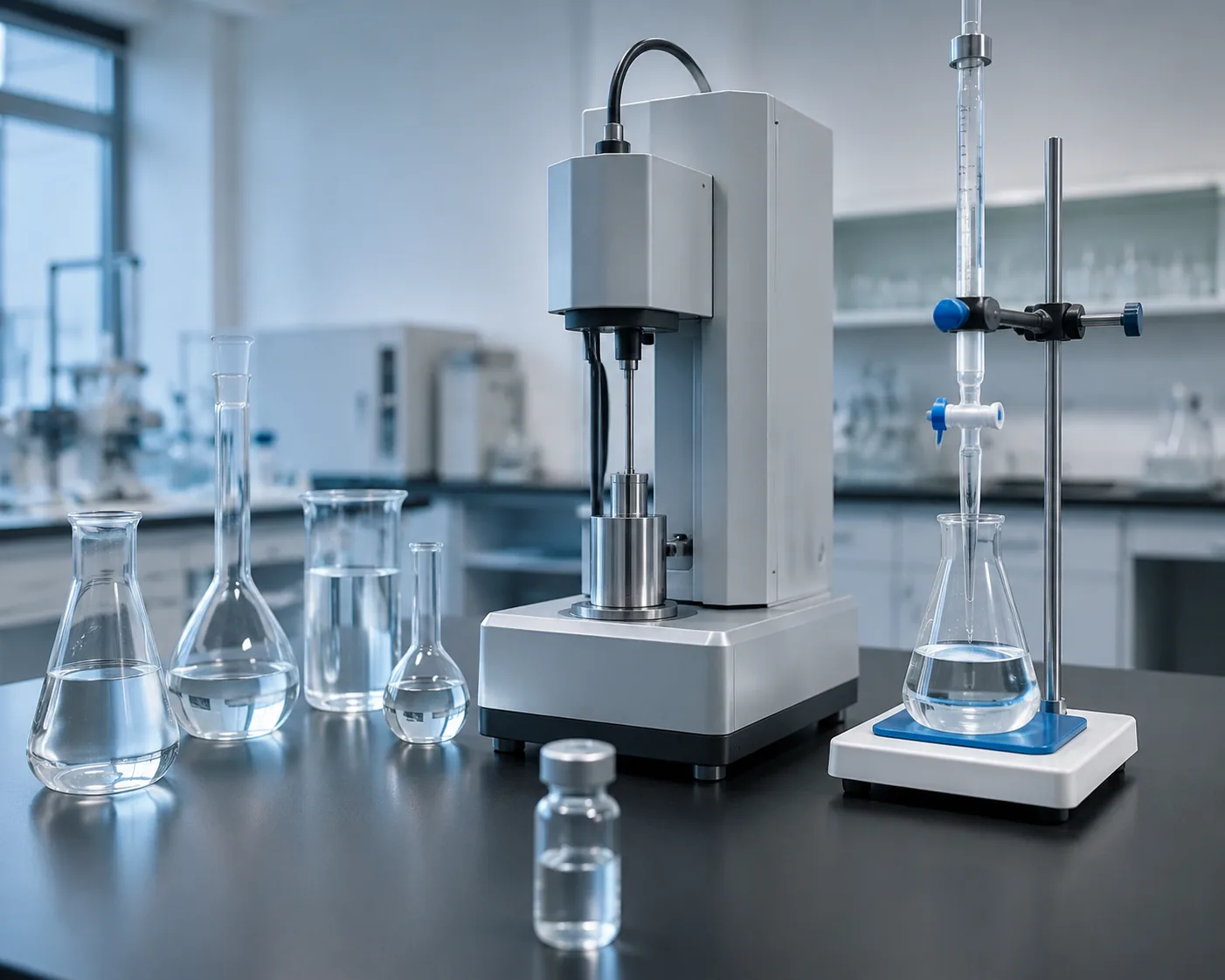
- ISO 3585, Borosilicate glass 3.3 — Properties (ISO catalog) — the international material specification for borosilicate glass 3.3, the high-boron grade with the 3.3 × 10⁻⁶ K⁻¹ coefficient of thermal expansion. ISO 3585 defines the composition, the thermal, the mechanical and the chemical properties that a glass must meet to qualify as borosilicate 3.3.
- ASTM E438, Standard Specification for Glass in Laboratory Apparatus (astm.org) — the U.S. classification of laboratory glass, distinguishing Type I (borosilicate, Classes A and B) from Type II (soda-lime). Borosilicate 3.3 is Type I, Class A; the lower-expansion and the amber grades are Type I, Class B.
- ISO 719, Glass — Hydrolytic resistance of glass grains at 98 °C — the grain-test method that classifies glass into the hydrolytic-resistance classes HGB 1 (the highest) to HGB 4 (the lowest). Borosilicate glass must meet HGB 1; low-borosilicate glass typically meets HGB 1 or HGB 2 depending on the composition.
- ISO 720, Glass — Hydrolytic resistance of glass grains at 121 °C — the more severe grain-test method used for the pharmaceutical-grade qualification. The Chinese adoption is GB/T 12416.2, and the pharmaceutical-grain-test standard is YBB00242003 for the 121 °C method.
- USP <660> Containers — Glass (USP) and EP 3.2.1 Glass Containers for Pharmaceutical Use — the pharmacopoeial classification of pharmaceutical glass into Type I (borosilicate), Type II (surface-treated soda-lime) and Type III (soda-lime), with the Surface Glass Test at 98.5 °C that determines the classification.
- GB/T 6582, Glass — Hydrolytic resistance of glass grains at 98 °C — Method of test and classification — the Chinese adoption of ISO 719. The Chinese pharmaceutical-grain-test framework is the YBB standard family (YBB00362004-2015 for the 98 °C method, YBB00242003 for the 121 °C method).
- ISO 4787, Laboratory glassware — Volumetric instruments — Methods for testing the capacity and for use — the calibration standard for the volumetric instruments made from the glass.
A point worth stating plainly because it affects every pharmaceutical-packaging project: the ISO 3585 / ASTM E438 material specification and the USP <660> / EP 3.2.1 pharmaceutical classification are not interchangeable. A glass that meets ISO 3585 as borosilicate 3.3 does not automatically meet USP Type I, because the pharmaceutical classification is based on the hydrolytic resistance measured by the Surface Glass Test at 98.5 °C, not on the thermal expansion coefficient. We confirm the application (laboratory apparatus, pharmaceutical packaging, cookware, lighting) and the target market before quoting, because the test scope is driven by the application and the market.
How does low-borosilicate differ from high-borosilicate in composition?
The distinction between low-borosilicate and high-borosilicate is the boron trioxide (B₂O₃) content, and the boron content is the property that determines the glass network's flexibility and, through it, the thermal expansion, the softening point, the chemical durability and the mechanical strength. Understanding the composition is the prerequisite for understanding why the two grades behave differently under test.
The typical compositions, drawn from the published product literature, are:
| Component | High-borosilicate glass (wt %) | Low-borosilicate glass (wt %) |
|---|---|---|
| Silica (SiO₂) | 78–82 | 70–75 |
| Boron trioxide (B₂O₃) | 8–13 | 4–8 |
| Alkali oxides (Na₂O, K₂O) | 3–5 | 6–10 |
| Alumina (Al₂O₃) | 2–4 | 1–3 |
The boron atoms in the B₂O₃ form B-O bonds that create a more open, flexible molecular network within the silica matrix. A higher boron content produces a more flexible network, which translates directly into a lower coefficient of thermal expansion (the network absorbs the thermal stress by flexing rather than by fracturing), a higher softening point, and a higher hydrolytic resistance (the more-borosilicate network is less susceptible to the water attack that leaches alkali ions). The low-borosilicate grade, with the lower B₂O₃ content and the correspondingly higher alkali content, has the higher thermal expansion, the lower softening point, the lower hydrolytic resistance and the lower cost (it melts at a lower temperature and tolerates wider process variation). The trade-off is the engineering decision the application makes: the high-borosilicate grade for the demanding thermal and chemical service, the low-borosilicate grade for the moderate service where the cost matters.
The composition is verified by X-ray fluorescence (XRF) spectroscopy, the non-destructive elemental-analysis method that quantifies the major and the minor oxides from the characteristic X-ray emissions of each element. A conformity project for a low-borosilicate composition begins with the XRF verification of the B₂O₃, the SiO₂, the alkali and the alumina contents, because the composition determines which of the downstream tests (the thermal expansion, the hydrolytic resistance) the glass can plausibly pass. A glass whose B₂O₃ content is below the low-borosilicate range is not a low-borosilicate glass — it is a soda-lime glass with a boron addition — and the test scope for soda-lime glass is different.
How is the coefficient of thermal expansion measured?
The coefficient of thermal expansion (CTE, α) is the property that defines the glass's response to temperature change — the fractional dimensional change per degree of temperature. It is the defining property of the borosilicate family (the "3.3" in borosilicate 3.3 is the CTE in 10⁻⁶ K⁻¹), and it is the property that the thermal-shock resistance, the sealing compatibility and the dimensional-stability predictions are built on.
The CTE is measured by dilatometry (the push-rod dilatometer), under ISO 7991 or the equivalent methods. A specimen of defined geometry is heated at a defined rate (typically 5 K/min) from ambient to the softening range, and the dimensional change is recorded by the dilatometer's push rod in contact with the specimen. The CTE is the slope of the dimension-versus-temperature curve over the defined reference range — typically 20–300 °C for borosilicate glass, with the value reported in 10⁻⁶ K⁻¹.
The CTE values for the borosilicate family span a range that reflects the composition:
- Borosilicate 3.3 (high-boron, ISO 3585) — CTE 3.3 × 10⁻⁶ K⁻¹. The lowest-expansion grade, with the highest thermal-shock resistance.
- Borosilicate 4.9 (lower-boron) — CTE 4.9 × 10⁻⁶ K⁻¹. A higher-expansion grade used in the pharmaceutical packaging and the specialty applications.
- Borosilicate 5.4 (amber / actinic) — CTE 5.4 × 10⁻⁶ K⁻¹. The amber-stained grade for the light-sensitive storage.
- Low-borosilicate (4–8 % B₂O₃) — CTE in the 4.0 to 6.5 × 10⁻⁶ K⁻¹ range typically, depending on the exact composition and the alkali content.
- Soda-lime glass — CTE approximately 9.0 × 10⁻⁶ K⁻¹. The baseline non-borosilicate container glass.
The CTE matters for two reasons. First, the thermal-shock resistance — the maximum temperature differential the glass can withstand without fracturing — scales inversely with the CTE, because the thermal stress that builds across a temperature gradient is proportional to the CTE and to the temperature difference. A borosilicate 3.3 glass with a CTE of 3.3 × 10⁻⁶ K⁻¹ survives a temperature differential of approximately 166 K, where a soda-lime glass with a CTE of 9.0 × 10⁻⁶ K⁻¹ fails at a much smaller differential. Second, the sealing compatibility — the ability to join the glass to another material (a metal electrode, a different glass) without setting up thermal stress on cooling — requires that the two materials have closely matched CTEs, and the CTE measurement is what qualifies the match.
The CTE measurement is the first test in a borosilicate-glass project, because it confirms the grade (the 3.3, the 4.9, the low-borosilicate range) and because the downstream tests (the thermal shock, the sealing) are interpreted against the CTE.
What is the hydrolytic resistance test?
The hydrolytic resistance is the property that determines how much alkali the glass releases into the water that contacts it, and it is the property the pharmaceutical classification and the laboratory-grade classification are built on. The hydrolytic-resistance test exposes the glass to water under defined conditions and measures the released alkali by titration, and the glass is classified by the titration result.
Two test methods apply, at two temperatures, for two purposes:
The grain test at 98 °C (ISO 719 / GB/T 6582). The glass is crushed to a defined grain size, a defined mass of the grains is immersed in water at 98 °C for a defined time, and the alkali released into the water is titrated with hydrochloric acid. The volume of HCl consumed (in mL of 0.01 M HCl per gram of glass grains) classifies the glass into the hydrolytic-resistance classes:
- HGB 1 — the lowest alkali release (≤ 0.10 mL of 0.01 M HCl per gram of grains). The borosilicate glasses.
- HGB 2 — low alkali release. The low-borosilicate and the better soda-lime glasses.
- HGB 3 — moderate alkali release.
- HGB 4 — high alkali release. The standard soda-lime glasses.
The grain test at 121 °C (ISO 720 / GB/T 12416.2). The more severe test, run at the autoclave temperature, with the alkali release measured in mL of 0.02 M HCl per gram of grains. The borosilicate glasses must meet the HGB 1 class under this method for the pharmaceutical-grade qualification. The 121 °C test is the standard for the pharmaceutical glass because it simulates the steam-sterilisation the container will undergo in service.
The Surface Glass Test at 98.5 °C (USP <660> / EP 3.2.1). The pharmacopoeial method, run on the intact container (not on crushed grains), with the inner surface exposed to water at 98.5 °C for 30 minutes and the released alkali titrated. The mL of HCl consumed per container classifies the glass into USP Type I, II or III. The surface test is the pharmacopoeial classification test, and it is the test the pharmaceutical regulator expects to see reported.
A subtlety worth stating: the grain test and the surface test answer different questions. The grain test measures the bulk glass composition (the crushed grains expose the bulk glass to the water), and it is the test that distinguishes the borosilicate composition from the soda-lime composition. The surface test measures the inner surface of the finished container, which may have been treated (de-alkalised) to improve its hydrolytic resistance, and it is the test that qualifies the container for the pharmaceutical use. A low-borosilicate container can meet a higher surface-test class than its grain-test class would predict, if the surface has been de-alkalised — and conversely, a high-borosilicate container can fail a surface-test class if the surface has been contaminated or damaged. Both tests are run on a pharmaceutical project, because they answer different questions.
How is thermal shock resistance qualified?
The thermal-shock resistance is the property that determines whether the glass survives a rapid temperature change — the move from a freezer to an oven, the pour of boiling water into a cold vessel, the transfer from a hot plate to a cool bench. The thermal-shock resistance is governed by the CTE (a lower CTE means a higher thermal-shock resistance) and by the mechanical strength, and it is qualified by the thermal-shock test.
The thermal-shock test, under ISO 7459 or the equivalent national methods, exposes the glass samples to a defined temperature differential and inspects for fracture. The standard procedure cycles the samples between two baths at defined temperatures — typically a hot bath (boiling water or a hot oven) and a cold bath (ice water or a chilled liquid) — and the temperature differential is increased in defined steps until the sample fractures. The maximum differential the sample survives without fracture is the thermal-shock resistance, reported in K (or °C).
The expected thermal-shock resistances, drawn from the published product literature, span the range set by the CTE:
- Borosilicate 3.3 — thermal-shock resistance approximately 166 K (the glass survives a 166-degree temperature differential without fracturing).
- Borosilicate 4.9 — lower thermal-shock resistance, reflecting the higher CTE.
- Low-borosilicate — thermal-shock resistance between the borosilicate 4.9 and the soda-lime, depending on the composition.
- Soda-lime glass — thermal-shock resistance approximately 40 K, roughly one-quarter of the borosilicate 3.3.
The thermal-shock test is the test that catches the application mismatch — the use of a low-borosilicate container in a high-thermal-shock service (the move from freezer to microwave, the autoclave of a cold-filled container) where the glass will fracture. A low-borosilicate container that passes the hydrolytic-resistance test for the food-contact or the pharmaceutical use can still fail the thermal-shock test if the application involves the rapid temperature change, and the thermal-shock test is the one that predicts this. The application — the cookware, the laboratory glassware, the pharmaceutical container, the lighting — determines the thermal-shock-resistance requirement, and the test is scoped against the application.
How is chemical durability evaluated?
The chemical durability is the property that determines how the glass withstands the chemical attack from the acids, the alkalis and the water it contacts in service. The chemical durability is governed by the composition (the boron and the alkali contents), and it is qualified by the durability tests under the acid, the alkali and the water exposure.
The acid resistance is measured under ISO 1776 (or the equivalent DIN 12116 method), where the glass surface is exposed to a defined acid (typically 6 M hydrochloric acid at boiling) for a defined time, and the mass loss per unit area is reported. The borosilicate glasses have the excellent acid resistance, because the silica network is resistant to the acid attack and the boron further stabilises the network. The low-borosilicate glasses have the very-good acid resistance — slightly lower than the high-borosilicate because the higher alkali content is more susceptible to the acid leaching.
The alkali resistance is measured under ISO 695 (or the equivalent DIN 52322 method), where the glass is exposed to a defined boiling alkali solution (a sodium hydroxide / sodium carbonate mixture) and the mass loss is reported. The alkali resistance is the borosilicate glass's weaker property — the alkali attacks the silica network itself, not just the surface ions — and the high-borosilicate and the low-borosilicate grades are both "good" rather than "excellent" on the alkali resistance. This is the reason borosilicate glassware is specified for the acid work but the strong-alkali work requires the more resistant materials.
The hydrolytic resistance (described above) is the water-exposure test, and it is the most critical durability property for the pharmaceutical and the food-contact applications, because the leached alkali is what contaminates the contents. The borosilicate 3.3 achieves the HGB 1 class; the low-borosilicate typically achieves the HGB 1 or the HGB 2 class.
The chemical durability profile — the acid, the alkali and the hydrolytic results together — defines the service envelope of the glass. A low-borosilicate glass with the good hydrolytic and acid resistance but the moderate alkali resistance is suitable for the food-contact, the pharmaceutical-packaging (with the appropriate surface test) and the moderate chemical laboratory work, but not for the strong-alkali service. A complete project reports all three durability properties, because the application-specific decision depends on all three.
How does low-borosilicate fit the pharmaceutical glass classification?
The pharmaceutical glass classification under USP <660> and EP 3.2.1 is the framework that determines whether a glass container is suitable for the pharmaceutical use, and the classification is the test the pharmaceutical regulator expects to see reported. The classification is built on the hydrolytic resistance, and the low-borosilicate glass occupies a specific position in the classification that the application must account for.
The USP / EP classification is:
- Type I (borosilicate) — the highest hydrolytic resistance. Suitable for most parenteral and non-parenteral products, including the most demanding applications. The borosilicate composition (high B₂O₃, low alkali) provides the inherent hydrolytic resistance that the Type I classification requires.
- Type II (surface-treated soda-lime) — the moderate hydrolytic resistance, achieved by the de-alkalisation of the inner surface of a soda-lime container. The surface treatment creates a 0.1–0.2 µm layer of the de-alkalised glass on the container's inner surface, which improves the hydrolytic resistance above the untreated soda-lime baseline. The Type II container is suitable for the acidic and the neutral aqueous parenterals, but the surface treatment can be damaged by the repeated washing and the autoclaving.
- Type III (soda-lime) — the moderate hydrolytic resistance of the untreated soda-lime. Suitable for the non-aqueous and the dry products, where the leached alkali is not a concern. Not suitable for the parenteral use.
The low-borosilicate glass occupies a position in this classification that depends on the exact composition and the surface treatment. A low-borosilicate glass with the higher end of the B₂O₃ range (6–8 %) and a clean inner surface can achieve the Type I classification on the Surface Glass Test, because the boron content provides the hydrolytic resistance that the test measures. A low-borosilicate glass with the lower end of the B₂O₃ range (4–6 %) and a less-controlled surface may achieve only the Type III classification, because the alkali content dominates the hydrolytic resistance. The classification is determined by the Surface Glass Test result, not by the composition, and a low-borosilicate glass of the same composition can be classified differently depending on the surface finish and the container geometry.
A practical point for the Chinese pharmaceutical-glass project: the Chinese framework uses the YBB standard family for the pharmaceutical packaging glass. The YBB 00242003 standard covers the 121 °C grain test, the YBB 00362004-2015 standard covers the 98 °C grain test, and the YBB standards distinguish the硼硅玻璃 (borosilicate, Type I equivalent) from the低硼硅玻璃 (low-borosilicate, a Chinese-specific category) from the钠钙玻璃 (soda-lime, Type III equivalent). The 低硼硅玻璃 is a recognised category in the Chinese YBB framework, with the defined composition range and the defined test thresholds, and a low-borosilicate pharmaceutical-glass project for the Chinese market must be tested and reported against the YBB standard that applies to the category. The Chinese pharmaceutical regulator (the NMPA) expects the YBB test report for the pharmaceutical packaging glass, and a USP <660> report — while scientifically equivalent — is not automatically accepted in the Chinese submission without the YBB-specific testing.
FAQ
Which standard should my low-borosilicate glass be tested to?
It depends on the application and the target market. For laboratory apparatus, ISO 3585 (material specification) and ASTM E438 (laboratory classification) apply. For pharmaceutical packaging, USP <660> / EP 3.2.1 (pharmaceutical classification) apply internationally, and the YBB standard family applies in China. For food contact, the food-contact-material framework of the destination market applies. We confirm the application and the target market before quoting.
What is the difference between low-borosilicate and high-borosilicate glass?
The boron trioxide content. High-borosilicate contains 8–13 % B₂O₃; low-borosilicate contains 4–8 % B₂O₃, with the correspondingly higher alkali content. The lower boron content of the low-borosilicate produces a higher coefficient of thermal expansion, a lower softening point, a lower hydrolytic resistance and a lower cost — the engineering trade-off that selects the low-borosilicate for the moderate service and the high-borosilicate for the demanding service.
Can low-borosilicate glass meet the USP Type I classification?
It depends on the exact composition and the surface finish. A low-borosilicate glass with the higher end of the B₂O₃ range and a clean, de-alkalised inner surface can meet the Type I classification on the Surface Glass Test at 98.5 °C. A low-borosilicate glass with the lower end of the B₂O₃ range may meet only the Type III classification. The classification is determined by the test result, not by the composition label, and the Surface Glass Test is what qualifies the classification.
Why does the hydrolytic resistance matter so much for pharmaceutical glass?
Because the leached alkali is what contaminates the drug product. A glass container that releases alkali into the drug solution changes the solution's pH, can precipitate the drug substance, and can introduce the extractable ions that the drug's stability study did not account for. The hydrolytic resistance test (the grain test and the surface test) is what qualifies the container for the drug-contact use, and the USP / EP classification is built on it.
What does the Chinese YBB framework require for the low-borosilicate pharmaceutical glass?
The YBB framework distinguishes the 低硼硅玻璃 (low-borosilicate) as a recognised category, with the defined composition range and the defined test thresholds. The YBB grain tests at 98 °C (YBB 00362004-2015) and at 121 °C (YBB 00242003) apply, with the hydrolytic-resistance class the low-borosilicate must meet. The NMPA expects the YBB test report for the Chinese pharmaceutical-packaging submission, and the report must name the YBB standard and the test method. We test against the YBB framework for the Chinese pharmaceutical-glass projects.
Our low-borosilicate glass testing service
Our laboratory provides low-borosilicate glass testing across the full standard stack — ISO 3585 for the material specification, ASTM E438 for the laboratory classification, ISO 719 / ISO 720 (and the GB/T 6582 / GB/T 12416.2 adoptions) for the hydrolytic-resistance grain tests, USP <660> / EP 3.2.1 for the pharmaceutical classification, the YBB standard family for the Chinese pharmaceutical framework, ISO 7991 for the thermal expansion, ISO 7459 for the thermal shock, and ISO 1776 / ISO 695 for the acid and the alkali durability. Each project begins with a scoping step that confirms the application (laboratory apparatus, pharmaceutical packaging, food contact, cookware, lighting), the target market, the product geometry, and the corresponding standard set, so the report you receive answers the question your regulator, your buyer or your quality system will actually ask.
We verify the composition by XRF; measure the coefficient of thermal expansion by dilatometry; run the hydrolytic-resistance grain tests at 98 °C and 121 °C with the HGB classification; run the Surface Glass Test at 98.5 °C with the USP / EP Type I / II / III classification; qualify the thermal-shock resistance by the cycling method; measure the acid and the alkali durability by the mass-loss methods; and for the Chinese pharmaceutical projects, test against the YBB standard family and report the 低硼硅玻璃 category. Reports are issued with the standard, the method, the measured value, the classification and the conformity conclusion explicitly stated, with the titration data and the dilatometry curves included where the result depends on them, in a format suitable for regulatory submission, buyer qualification, lot acceptance or grade-selection comparison.
To start a project, send us the glass type (low-borosilicate, with the B₂O₃ range if known), the application, the target market, the product geometry (sheet, tube, container, finished apparatus), and whether the project is material qualification, pharmaceutical-container classification, lot acceptance or grade-selection comparison. We will return a project scope, sample requirement, schedule and quotation, and begin testing on your confirmation.