What Is Borosilicate Glass testing?
Borosilicate glass testing is the laboratory verification of borosilicate glass 3.3 (the standard laboratory and pharmaceutical grade) against the international standards that define its composition, thermal performance, chemical durability, and pharmaceutical suitability — primarily ISO 3585 (borosilicate glass 3.3 properties), ASTM E438 (glass in laboratory apparatus, Type I Class A), and the pharmacopoeial glass-container standards USP ⟨660⟩ / EP 3.2.1 (Type I glass), plus the Chinese pharmaceutical YBB series for direct-contact drug packaging. A complete program confirms thermal shock resistance, hydrolytic resistance, chemical durability, and dimensional accuracy in one coordinated test package.
Borosilicate glass 3.3 is not a generic material name — the "3.3" denotes a coefficient of thermal expansion of 3.3 × 10⁻⁶ K⁻¹, roughly one-third of ordinary soda-lime glass. That single property is what allows a borosilicate beaker to move from a freezer to a hotplate without shattering, and it is the property the test program exists to verify. Beijing ZKGX Research Institute structures its borosilicate glass programs around the ISO 3585 property matrix, with each measurement traceable to the exact clause being verified.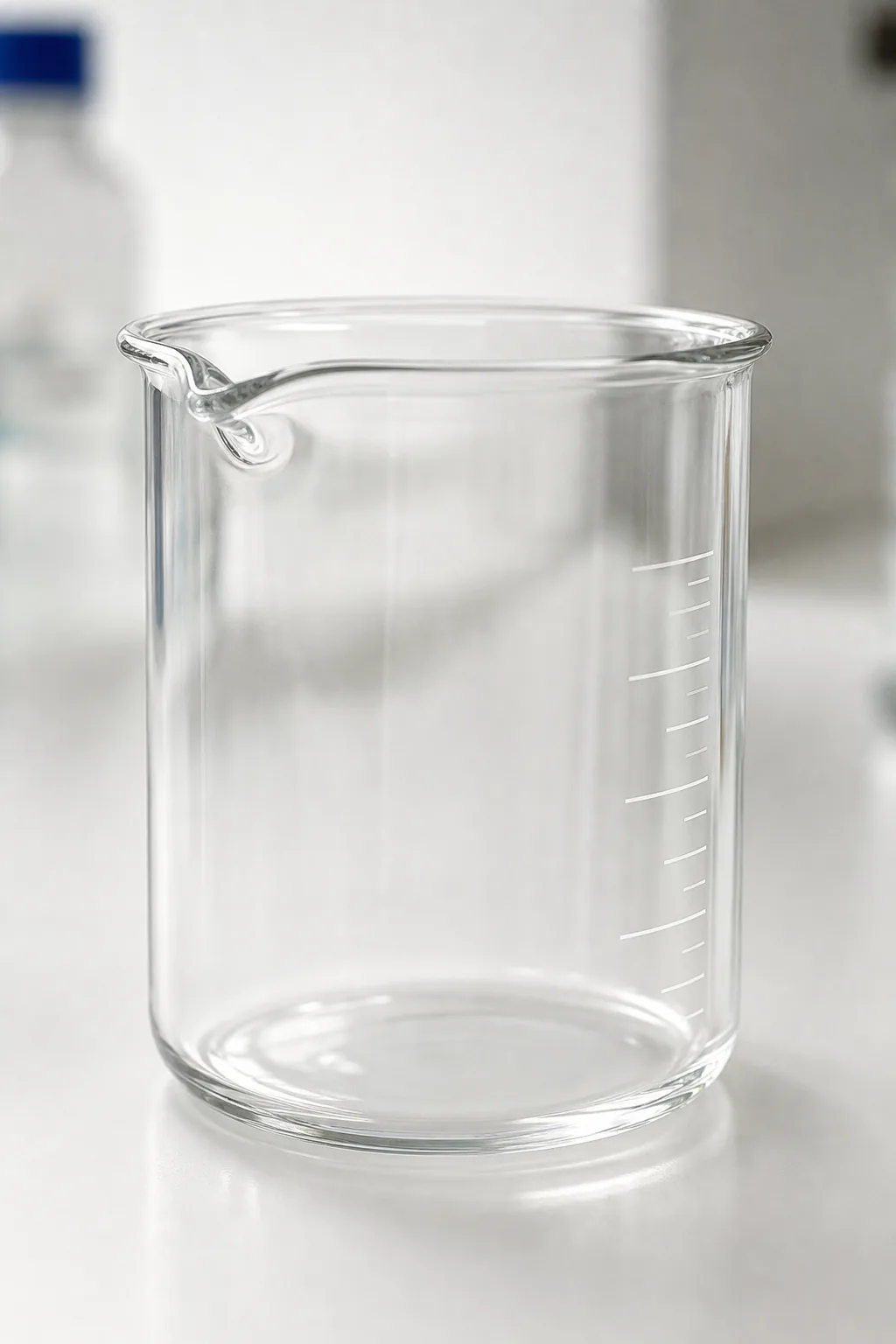
Why Borosilicate Glass Testing Matters
Borosilicate glass is selected for three reasons — and each one is a separate failure mode the test program targets:
- Thermal shock resistance — a glass that fails thermal shock will shatter during autoclaving, hotplate heating, or rapid temperature changes, destroying samples and injuring operators
- Chemical durability — a glass that leaches ions into the contents contaminates trace analyses, alters pharmaceutical pH, and fails hydrolytic resistance limits
- Dimensional and volumetric accuracy — laboratory glassware used for quantitative work (volumetric flasks, pipettes, burettes) must meet strict tolerance bands; out-of-tolerance glassware produces wrong analytical results
For pharmaceutical primary packaging (vials, pre-filled syringes, ampoules), the stakes are higher still: a borosilicate vial that fails hydrolytic resistance can release ions that interact with the drug product, shortening shelf life or causing immunogenic reactions. That is why pharmacopoeias worldwide classify borosilicate as Type I glass — the highest hydrolytic-resistance tier — and require testing to prove the classification.
Which Standards Govern Borosilicate Glass Testing?
There is no single global borosilicate standard; the framework is layered across material, apparatus, and pharmacopoeial standards:
| Standard | Scope | What it answers |
|---|---|---|
| ISO 3585:1998 | Borosilicate glass 3.3 — properties | What are the nominal properties (CTE, density, softening point, chemical durability) of the standard laboratory grade? |
| ASTM E438 | Glass in laboratory apparatus | Is this glass Type I Class A (borosilicate), Type I Class B, or Type II (soda-lime)? |
| USP ⟨660⟩ / EP 3.2.1 | Containers — glass | Does this pharmaceutical container meet Type I, II, or III hydrolytic resistance? |
| USP ⟨1660⟩ | Evaluation of inner surface durability | How does the inner surface of a pharma container perform under stress? |
| YBB 60032012 / YBB 30252012 (China) | Pharmaceutical borosilicate glass | Does this Chinese pharma packaging meet YBB Type I borosilicate requirements? |
| ISO 4787 | Volumetric glassware — calibration | Is the volumetric accuracy within Class A or Class B tolerance? |
| DIN 12217 / ISO 4791 | Laboratory glassware — material classification | Material-class markings (e.g., "3.3") and manufacturer ID |
| GB/T 6582 / ISO 719 | Hydrolytic resistance of glass grains at 98 °C | What is the hydrolytic class (HGB 1 through HGB 3 / ISO 719 classes)? |
Beijing ZKGX structures every borosilicate glass test report against this matrix so the client can see which clause of which standard each measurement satisfies — not just a pass/fail verdict.
What Are the Core Borosilicate Glass Test Items?
A complete program divides into five blocks. Each item maps to a clause, and each has a measurable acceptance threshold.
1. Coefficient of Thermal Expansion (CTE) Verification — ISO 3585 §4
The defining property. Measure the mean coefficient of linear thermal expansion between 20 °C and 300 °C using a dilatometer (push-rod or optical). Acceptance per ISO 3585 for borosilicate glass 3.3: (3.3 ± 0.1) × 10⁻⁶ K⁻¹. A CTE outside this band means the glass is not borosilicate 3.3 — it may be a higher-expansion grade (4.9 or 5.1) or, worse, a soda-lime substitute sold under a borosilicate label. This single test catches most counterfeit-grade material.
2. Thermal Shock Resistance Test
Subject samples (typically whole beakers, flasks, or representative coupons) to a defined temperature differential and verify no cracking. The ISO 3585 nominal thermal shock resistance for borosilicate 3.3 is approximately ΔT = 170 K for sudden immersion; for whole-vessel thermal shock testing per ASTM C149, the typical target is 220–260 °C differential without fracture. Soda-lime glass fails at roughly 40 °C — a three- to fourfold margin that is the practical reason borosilicate is specified for hotplate and autoclave work.
3. Hydrolytic Resistance Test (USP ⟨660⟩ / EP 3.2.1 / ISO 719 / ISO 720)
This is the pharmacopoeial classification test. Water (or specified aqueous media) is contacted with the glass under defined conditions; the extracted alkali is titrated and reported as mL of 0.01 M HCl per 10 g of glass grains, or as µg Na₂O equivalent per g for surface tests.
ISO 719 (grain test at 98 °C):
- HGB 1 (highest): ≤ 31 µg Na₂O / g — equivalent to USP Type I borosilicate
- HGB 2: 31–62 µg Na₂O / g
- HGB 3: 62–264 µg Na₂O / g
ISO 720 (grain test at 121 °C):
- Type I: ≤ 62 µg Na₂O / g
- Type II: 62–177 µg Na₂O / g
- Type III: 177–385 µg Na₂O / g
Borosilicate 3.3 tests as Type I / HGB 1 — the basis of its pharmaceutical classification. A batch that tests as Type II or III is either the wrong formulation or has surface degradation from poor annealing or repeated aggressive washing.
4. Chemical Durability — Acid, Base, and Salt Attack
Beyond the hydrolytic test, borosilicate is tested for resistance to specific chemistries:
- Acid resistance per ISO 1776 — mass loss in boiling 6 M HCl; borosilicate 3.3 typically ≤ 0.7 mg/dm²
- Alkali resistance per ISO 695 — mass loss in boiling equal-volume NaOH + Na₂CO₃ solution; borosilicate 3.3 typically ≤ 75 mg/dm² (alkali is the weak point of borosilicate, not acid)
- Salt solution resistance — long-term exposure to common laboratory salt solutions
Hydrofluoric acid (HF) is the universal exception — no glass resists HF, and the test program does not attempt to verify HF resistance.
5. Volumetric and Dimensional Accuracy (ISO 4787 / ISO 384)
For laboratory glassware used in quantitative analysis (volumetric flasks, pipettes, burettes, measuring cylinders), verify that the indicated volume is within Class A or Class B tolerance. Acceptance examples (ISO 4787 Class A):
- 100 mL volumetric flask: ± 0.10 mL
- 50 mL burette: ± 0.05 mL
- 25 mL pipette: ± 0.03 mL
Class B tolerance is typically double Class A. Pharmaceutical and ISO 17025-accredited laboratories must use Class A with batch certificates; Class B is acceptable only for educational or non-quantitative work.
Type I vs. Type II vs. Type III Pharmaceutical Glass — Don't Confuse Them
Three glass types coexist in pharmaceutical packaging, with very different chemistries and test outcomes:
- Type I (borosilicate 3.3) — highest hydrolytic resistance, used for direct contact with most drug formulations, especially injectables. The default for parenteral packaging.
- Type II (treated soda-lime) — soda-lime glass with a sulfur-based surface treatment that improves hydrolytic resistance; used for acidic aqueous products only, single-use
- Type III (soda-lime) — standard soda-lime; used for non-aqueous or solid dry products where leaching is not a concern
A common error is treating a Type II or Type III vial as Type I because it "looks like borosilicate." Beijing ZKGX labels every glass test report with which type the result establishes — so the pharmaceutical client can document the correct container-drug compatibility.
Borosilicate 3.3 vs. Low-Borosilicate Glass — Don't Confuse Them Either
China's pharmaceutical glass classification distinguishes borosilicate 3.3 (高硼硅) from low-borosilicate glass (低硼硅), and they are not interchangeable. The differences:
| Property | Borosilicate 3.3 | Low-borosilicate |
|---|---|---|
| B₂O₃ content | 12–13% | 6.5–10% |
| CTE | 3.3 × 10⁻⁶ K⁻¹ | 4.0–5.0 × 10⁻⁶ K⁻¹ |
| Hydrolytic class | USP Type I | Often Type I but with lower margin |
| Typical use | Premium pharma vials, lab glassware | Mid-tier pharma, oral-dose containers |
Beijing ZKGX offers a separate Low-borosilicate glass testing program covering the YBB low-borosilicate material standards. The two programs share test methods but apply different acceptance thresholds — they are not the same glass.
How Long Does Borosilicate Glass Testing Take?
A complete borosilicate 3.3 qualification program takes 3 to 4 weeks, dominated by the hydrolytic resistance grain test (multi-day exposure plus titration) and the volumetric calibration cycles. Thermal shock and CTE tests typically return within 5 to 7 working days. For pharmaceutical packaging qualification, the full USP ⟨660⟩ / EP 3.2.1 panel including inner-surface testing per USP ⟨1660⟩ can extend to 5 to 6 weeks.
Sample requirements: typically 10 to 20 representative samples of the product (or coupons cut from bulk glass), plus reference specimens for destructive tests. Pharmaceutical container testing requires the finished, washed, and annealed product as sold.
A formal test report is delivered within 5 to 7 working days after completion of each testing block, including raw data, titration traces, dilatometer curves, dimensional measurements, and a clear statement of which clauses were met.
What Makes a Borosilicate Glass Test Report Usable?
A report that only says "PASS" is useless when a regulator, customer, or auditor challenges the material claim. A defensible report — accepted by ISO 17025-accredited analytical labs, pharmaceutical GMP auditors, and pharmacopoeial authorities — must contain:
- Material identification — the actual measured CTE and B₂O₃ content, not just "borosilicate"
- Measured values with units and uncertainty — not "compliant," but "CTE 3.31 × 10⁻⁶ K⁻¹ (uncertainty ±0.05, ISO 3585 nominal 3.3 ± 0.1)"
- Standard-clause traceability — which paragraph of ISO 3585, ASTM E438, or USP ⟨660⟩ each result is judged against
- Hydrolytic class designation — Type I / II / III with the supporting titration data
- Volumetric certificate (for Class A glassware) — serial number, batch, calibration date, traceability chain
- Signed conclusion — accredited laboratory stamp and ISO/IEC 17025 reference
Beijing ZKGX borosilicate glass reports follow this structure as standard and are issued under the laboratory's ISO/IEC 17025 accreditation framework, with each measurement traceable to a recognized national or international standard.
Frequently Asked Questions
Is borosilicate glass testing mandatory?
For pharmaceutical primary packaging, yes — USP ⟨660⟩ / EP 3.2.1 / YBB Type I testing is mandatory before the container can be used in drug products. For general laboratory glassware, ISO 3585 / ASTM E438 conformance is the contractual default for any procurement specification. For high-temperature or aggressive-chemistry applications, the thermal shock and chemical durability tests are essential to safe operation.
Is all Pyrex borosilicate?
No. Corning distinguishes between PYREX (uppercase) — laboratory-grade borosilicate 3.3 — and pyrex (lowercase) — the consumer cookware brand, which in some markets (notably the United States) is now tempered soda-lime glass. Always verify the ASTM E438 Type I Class A designation before assuming borosilicate. Counterfeit "borosilicate" sold as soda-lime is a recurring problem caught by CTE testing.
What's the difference between borosilicate 3.3 and low-borosilicate glass?
Borosilicate 3.3 has higher B₂O₃ (12–13%) and lower CTE (3.3 × 10⁻⁶ K⁻¹); low-borosilicate has less B₂O₃ and higher CTE (~5 × 10⁻⁶ K⁻¹). They share methods but have different acceptance thresholds. Our low-borosilicate glass testing program covers the low-borosilicate tier under YBB standards.
Can borosilicate glass be used for UV spectrophotometry?
Not for deep-UV. Borosilicate blocks UV below approximately 300 nm; quartz (fused silica) cuvettes are required for measurements below that wavelength. Borosilicate is fine for visible-light and near-UV work above 300 nm. For higher-temperature or harsher environments, see our refractory material testing and high-temperature test programs for adjacent material categories.
How is borosilicate glass testing different from general glass testing?
General glass testing and Flat glass testing cover building, automotive, and container glasses — soda-lime compositions, mechanical strength, optical transmission for windows. Borosilicate glass testing adds the CTE verification, hydrolytic class, and pharmaceutical-suitability framework that those categories do not need. The test methods share some overlap (thermal shock, dimensional accuracy) but the acceptance thresholds are completely different. Ceramic testing covers a separate but related class of inorganic non-metallic materials.
References & Further Reading
- ISO 3585:1998 — Borosilicate glass 3.3 — Properties (iso.org)
- ASTM E438 — Standard specification for glass in laboratory apparatus (astm.org)
- USP ⟨660⟩ — Containers — Glass (usp.org)
- USP ⟨1660⟩ — Evaluation of the inner surface durability of glass containers (usp.org)
- EP 3.2.1 — Glass containers for pharmaceutical use (European Pharmacopoeia, edqm.eu)
- ISO 719:1985 — Hydrolytic resistance of glass grains at 98 °C (iso.org)
- ISO 720:1985 — Hydrolytic resistance of glass grains at 121 °C (iso.org)
- ISO 4787 — Volumetric glassware — calibration (iso.org)
- YBB 60032012 / YBB 30252012 — China pharmaceutical borosilicate glass standards (nmpa.gov.cn)