Flat Glass testing encompasses a comprehensive range of evaluation methods used to verify the quality, safety, and performance characteristics of flat glass products for architectural, automotive, and industrial applications. These testing procedures are critical for ensuring that flat glass meets stringent standards for mechanical integrity, optical clarity, thermal performance, and chemical durability.
This comprehensive guide covers all major flat glass testing methodologies, from mechanical strength evaluation to optical quality assessment. You'll learn how to measure surface stress, evaluate thermal shock resistance, assess optical properties, and ensure compliance with international testing standards.
What you'll learn in this guide:
- Mechanical testing methods (flexural strength, impact resistance)
- Optical testing procedures (transmittance, distortion, refractive index)
- thermal testing protocols (thermal shock, CTE measurement)
- Chemical durability testing (hydrolytic resistance, acid/alkali resistance)
- Surface stress measurement techniques
- Flatness and distortion evaluation
- Testing standards and certification requirements
- Quality control and documentation
Importance of Flat Glass Testing
Testing flat glass serves critical functions for product safety, regulatory compliance, and performance verification across diverse applications.
Key benefits of flat glass testing:
Structural integrity: Testing verifies that glass can withstand expected loads, impacts, and environmental stresses without failure, protecting building occupants and vehicle passengers.
Optical quality: Validation of visual clarity, color consistency, and distortion levels ensures that glass meets aesthetic and functional requirements for visibility and daylighting.
Thermal performance: Testing confirms that glass products achieve specified U-values, solar heat gain coefficients, and thermal shock resistance for energy efficiency and durability.
Chemical durability: Verification of resistance to environmental attack ensures long-term performance and prevents degradation that could compromise safety or appearance.
Regulatory compliance: Certified testing provides documentation required by building codes, automotive safety standards, and industry specifications for market access.
Quality assurance: Regular testing identifies manufacturing variations and process issues, enabling continuous improvement and consistent product quality.
Types of Flat Glass Products
Annealed Float Glass
Characteristics:
- Basic flat glass produced by floating molten glass on molten tin
- No heat treatment for increased strength
- Breaks into large, sharp shards
- Lowest strength among flat glass types
Testing requirements:
- Optical quality (distortion, inclusions)
- Thickness and flatness
- Chemical composition
- Light transmittance
Heat-Strengthened Glass
Characteristics:
- Heat-treated to approximately twice the strength of annealed glass
- Surface compressive stress: 3,500-7,500 psi (24-52 MPa)
- Fracture pattern similar to annealed glass
- Used where additional strength needed without safety glass requirements
Testing requirements:
- Surface stress measurement
- Fragmentation testing
- Dimensional tolerances
- Optical distortion
Fully Tempered (Toughened) Glass
Characteristics:
- Heat-treated to approximately four times the strength of annealed glass
- Surface compressive stress: >10,000 psi (>69 MPa)
- Breaks into small, relatively harmless pieces
- Meets safety glass requirements
Testing requirements:
- Surface stress verification
- Fragmentation test
- Impact resistance
- Dimensional stability (bow, warp, waviness)
Laminated Glass
Characteristics:
- Two or more glass plies bonded with interlayer (PVB, EVA, SentryGlas)
- Remains intact when broken (glass fragments adhere to interlayer)
- Provides safety, security, and acoustic benefits
- Used for automotive windshields, skylights, security glazing
Testing requirements:
- Adhesion strength
- Impact resistance
- Penetration resistance
- Interlayer durability
- Optical clarity
Coated Glass
Types:
- Low-E (low emissivity) coatings
- Solar control coatings
- Anti-reflective coatings
- Self-cleaning coatings
- Decorative coatings
Testing requirements:
- Coating durability
- Optical properties (transmittance, reflectance)
- Emissivity measurement
- Scratch resistance
- Environmental stability
Mechanical Testing Methods
Flexural Strength Testing
Purpose: Determine the bending strength and failure stress of flat glass
Test standards:
- ASTM C158: Standard Test Methods for Strength of Glass by Flexure
- EN 1288: Glass in Building - Determination of Bending Strength
Test methods:
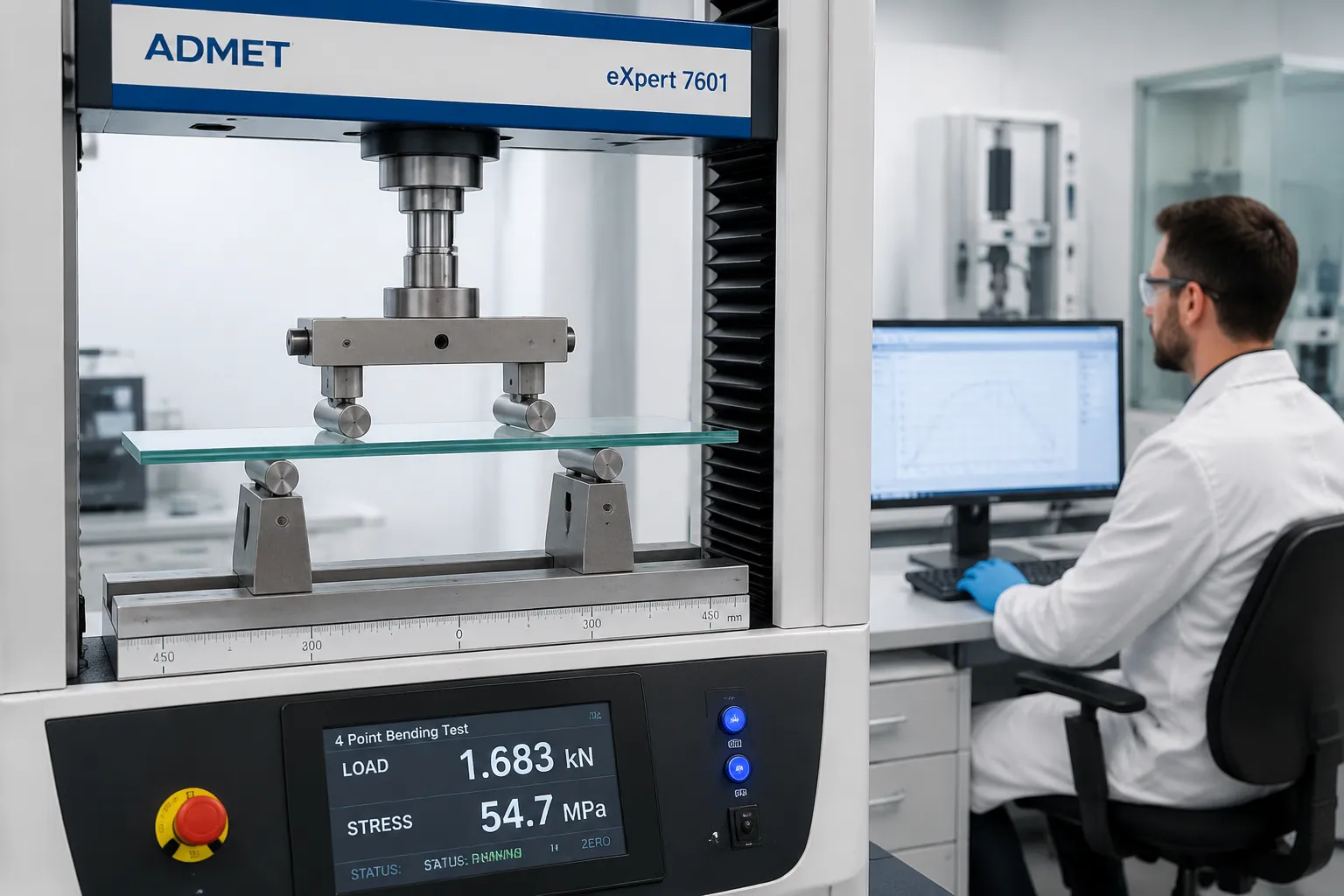
Four-point bending:
- Most common method for flat glass
- Uniform stress region between loading points
- Provides reliable strength data
- Sample dimensions specified by standard
Three-point bending:
- Simpler test setup
- Maximum stress at single loading point
- Used for smaller samples or specific applications
Test parameters:
- Loading rate: Controlled to standard specification
- Support span: Typically 100-400 mm depending on thickness
- Sample size: Minimum 10 samples for statistical significance
- Environmental conditions: 23±2°C, 50±5% RH
Acceptance criteria:
- Annealed glass: 40-60 MPa characteristic strength
- Heat-strengthened: 70-100 MPa
- Fully tempered: 120-200 MPa
Impact Resistance Testing
Purpose: Evaluate resistance to dynamic loading and impact events
Test methods:
Ball drop test (ASTM C149, EN 12600):
- Steel ball dropped from specified height
- Impact energy calculated from ball mass and drop height
- Pass/fail based on fracture pattern or penetration
- Used for safety glass certification
Pendulum impact test (EN 12600):
- Standardized impact body swings into glass
- Classifies glass by impact energy and breakage behavior
- Three classifications: 1, 2, and 3 (decreasing energy)
- Critical for architectural safety glass
Drop weight test:
- Glass panel mounted in frame
- Impactor dropped onto glass surface
- Energy absorption and penetration resistance measured
- Used for security and burglar-resistant glazing
Small particle impact:
- Sand or gravel impact testing
- Evaluates surface damage from erosion
- Important for automotive and exterior applications
Hardness Testing
Purpose: Measure resistance to surface indentation and scratching
Test methods:
Vickers microhardness (ASTM E384):
- Diamond indenter creates impression
- Load range: 10-1000 gf
- Hardness calculated from impression size
- Typical glass values: 500-700 HV
Knoop hardness:
- Asymmetric diamond indenter
- Better for brittle materials
- Lower risk of cracking during test
- Used for thin coatings and surface treatments
Nanoindentation:
- Very low loads (millinewtons)
- Measures hardness and elastic modulus
- Depth-sensing indentation
- Used for thin films and coatings
Tensile Strength Testing
Purpose: Determine ultimate tensile strength of glass (indirect measurement)
Challenges:
- Glass fails in tension, but gripping without premature failure is difficult
- Most tensile strength data derived from flexural tests
- Direct tensile testing requires specialized fixtures
Methods:
- Axial loading with compliant grips
- Indirect methods (bending tests preferred)
- Edge strength testing for cut glass
Optical Testing Methods
Light Transmittance and Reflectance
Purpose: Measure optical properties for energy performance and visual quality
Test standards:
- ASTM E308: Computing the Colors of Objects
- ISO 9050: Glass in Building - Determination of Light Transmittance
Measurements:
Visible light transmittance (VLT):
- Spectral range: 380-780 nm
- Percentage of visible light transmitted
- Critical for daylighting and glare control
- Typical values: 40-90% for clear glass
Solar energy transmittance (TSET):
- Spectral range: 300-2500 nm
- Total solar energy transmitted
- Used for calculating solar heat gain coefficient (SHGC)
- Important for energy efficiency ratings
UV transmittance:
- Spectral range: 300-380 nm
- Critical for preventing fading of interior materials
- Low-E glass typically blocks most UV radiation
Reflectance measurements:
- External and internal surface reflectance
- Affects visual appearance and bird safety
- Important for controlling solar gain
Equipment:
- Spectrophotometer with integrating sphere
- Wavelength accuracy: ±1 nm
- Calibration using certified reference standards
Optical Distortion Testing
Purpose: Evaluate visual quality and distortion in flat glass
Test methods:
Zebra board method (ASTM C1651):
- Glass placed in front of striped pattern (zebra board)
- Distortion visible as bent or broken lines
- Qualitative assessment of optical quality
- Used for automotive and architectural glass
Interferometry:
- Laser interference fringes reveal surface deviations
- Quantitative measurement of flatness
- Precision: sub-wavelength resolution
- Used for optical glass and high-precision applications
Moire deflectometry:
- Grid pattern projected through glass
- Deviations indicate surface irregularities
- Fast, full-field measurement
- Suitable for production line inspection
Acceptance criteria:
- Depends on application
- Automotive: Strict limits for driver visibility
- Architectural: More relaxed for decorative applications
- Optical: Extremely tight tolerances
Refractive Index Measurement
Purpose: Determine optical properties for lens and fiber optic applications
Test standards:
- ASTM C1648: Standard Test Method for Refractive Index of Glass
- ISO 8424: Raw Optical Glass - Refractive Index and Dispersion
Methods:
Abbe refractometer:
- Measures critical angle for total internal reflection
- Accuracy: ±0.0001
- Requires transparent, homogeneous sample
Ellipsometry:
- Polarized light reflection analysis
- Determines refractive index and thickness
- Used for thin films and coatings
Minimum deviation method:
- Prism sample required
- Highest accuracy method
- Used for precision optical glass
Typical values:
- Soda-lime glass: 1.51-1.52
- Borosilicate: 1.47-1.48
- High-index optical glass: 1.60-1.90
Thermal Testing Methods
Thermal Shock Resistance
Purpose: Evaluate resistance to rapid temperature changes
Test standards:
- ASTM C149: Standard Test Methods for Thermal Endurance of Glass
- ISO 7459: Glass Containers - Thermal Shock Resistance
Test method:
- Heat samples in oven to specified temperature
- Quickly transfer to cold water bath
- Inspect for cracking or breakage
- Determine temperature differential causing 50% failure
Procedure:
- Temperature differential: 20-150°C depending on glass type
- Transfer time: <10 seconds
- Number of samples: Minimum 30 for statistical analysis
- Water bath volume: Sufficient to maintain temperature
Acceptance criteria:
- Annealed soda-lime: 40-60°C
- Borosilicate: 120-180°C
- Fully tempered: May withstand higher differentials
Applications:
- Cookware and ovenware
- Laboratory glassware
- Pharmaceutical containers
- Lighting fixtures
Coefficient of Thermal Expansion (CTE)
Purpose: Determine dimensional stability with temperature changes
Test standards:
- ASTM E228: Standard Test Method for Linear Thermal Expansion
- ISO 7991: Glass - Determination of Linear Thermal Expansion
Methods:
Push-rod dilatometry:
- Sample heated at controlled rate
- Dimensional change measured by displacement sensor
- CTE calculated from slope of expansion curve
- Temperature range: typically 20-300°C
Interferometry:
- Optical interference fringes measure dimensional change
- Higher precision than push-rod method
- Used for precision optical applications
Typical CTE values (×10⁻⁶/°C):
- Soda-lime glass: 8.5-9.5
- Borosilicate glass: 3.2-3.5
- Fused silica: 0.5-0.6
- Aluminosilicate: 4.0-5.0
Importance:
- Matching CTE when sealing to other materials
- Thermal stress calculations
- Design of laminated and insulating glass units
Thermal Conductivity
Purpose: Determine heat transfer characteristics for energy performance
Test standards:
- ASTM C177: Standard Test Method for Steady-State Heat Flow
- ISO 8302: thermal insulation - Determination of Steady-State Thermal Resistance
Methods:
Guarded hot plate:
- Heat flow through sample measured
- Temperature gradient controlled
- Provides absolute thermal conductivity
- Suitable for monolithic and insulating glass
Heat flow meter:
- Calibrated heat flux transducers
- Faster than guarded hot plate
- Requires calibration standards
- Used for production quality control
Typical values (W/m·K):
- Soda-lime glass: 0.8-1.0
- Borosilicate: 1.1-1.2
- Low-iron glass: Similar to soda-lime
Applications:
- Energy performance calculations (U-value)
- Vacuum insulating glass (VIG) development
- High-temperature applications
Softening Point and Annealing Point
Purpose: Determine thermal processing parameters
Test standards:
- ASTM C338: Standard Test Method for Softening Point of Glass
- ISO 7884-8: Glass - Viscosity and Viscometric Fixed Points
Definitions:
Softening point (Littleton point):
- Temperature at which glass deforms under own weight
- Viscosity: approximately 10⁷·⁶ poise
- Used for forming and bending operations
Annealing point:
- Temperature at which internal stresses relieve in 15 minutes
- Viscosity: approximately 10¹³ poise
- Critical for controlling residual stress
Strain point:
- Temperature at which stresses relieve in 4 hours
- Viscosity: approximately 10¹⁴·⁵ poise
- Upper temperature limit for use
Typical temperatures (°C):
- Soda-lime: Softening ~730, Annealing ~540
- Borosilicate: Softening ~820, Annealing ~560
Chemical Testing Methods
Hydrolytic Resistance Testing
Purpose: Evaluate resistance to water attack and leaching
Test standards:
- ISO 719: Glass - Hydrolytic Resistance at 98°C
- ISO 720: Glass - Hydrolytic Resistance at 121°C
- USP <660>: Containers - Glass (pharmaceutical)
Methods:
Powder test (ISO 719):
- Glass ground to specific particle size
- Contact with water at 98°C for 60 minutes
- Titrate alkali extracted from glass
- Classification: HGB 1-3 (decreasing resistance)
Whole container test (ISO 720, USP):
- Container filled with water
- Autoclave at 121°C for specified time
- Measure pH or alkali concentration
- Classification: Type I, II, III glass
Importance:
- Pharmaceutical container selection
- Chemical compatibility assessment
- Long-term stability prediction
Acid and Alkali Resistance
Purpose: Evaluate chemical durability in aggressive environments
Test standards:
- ISO 8424: Raw Optical Glass - Resistance to Attack by Aqueous Alkaline Solution
- ISO 695: Glass - Resistance to Attack by Boiling Aqueous Alkali
Acid resistance:
- Sample immersed in boiling acid (typically HCl or H₂SO₄)
- Measure mass loss after specified time
- Classification: 1-4 (decreasing resistance)
- Important for laboratory glassware and chemical containers
Alkali resistance:
- Sample immersed in boiling alkaline solution (NaOH)
- Measure mass loss after specified time
- Classification: A1-A3 (decreasing resistance)
- Critical for detergent resistance and laboratory use
Applications:
- Laboratory glassware selection
- Chemical processing equipment
- Pharmaceutical packaging
- Food and beverage containers
Surface Cleanliness and Contamination
Purpose: Verify surface condition for coating application or bonding
Test methods:
Contact angle measurement (ASTM C813):
- Water droplet placed on surface
- Contact angle indicates surface energy
- Low angle = clean, high energy surface
- High angle = contaminated, low energy surface
Surface tension testing:
- Dyne pens or solutions
- Indicate surface energy levels
- Used for coating adhesion prediction
- Critical for automotive glass bonding
XPS/AES analysis:
- Surface chemical composition
- Detect contamination or treatment residues
- Used for problem-solving and process development
Surface Stress Measurement
Purpose of Surface Stress Testing
Heat-treated glass (heat-strengthened and tempered) develops surface compressive stress that increases strength. Testing verifies that:
- Adequate stress developed during heat treatment
- Stress uniform across glass surface
- Stress meets specification for glass classification
- Safety glass requirements achieved
Measurement Methods
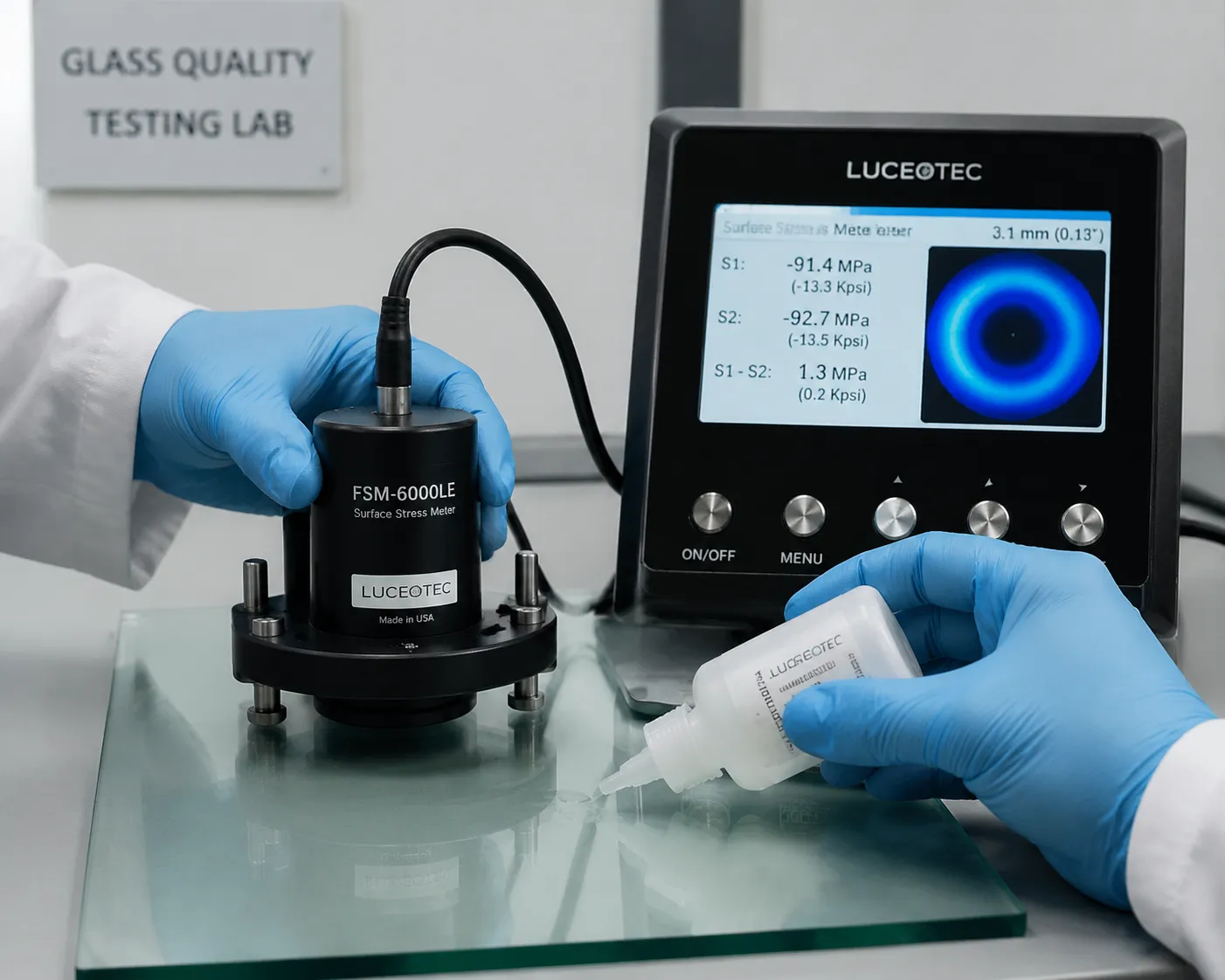
Polariscopy (ASTM C1279, ASTM C148):
Principles:
- Stress birefringence changes light polarization
- Observed as colored patterns or fringes
- Quantitative measurement with compensator
Procedure:
- Place glass in polariscope
- Apply immersion liquid for optical coupling
- Measure retardation at specified locations
- Calculate surface stress from retardation
Equipment:
- Surface stress meter (GASP, Orihara, Strainoptics)
- Compensator for quantitative measurement
- Light source and polarizer
Measurement locations:
- Center of glass
- Near edges (within 25 mm)
- Near corners
- Multiple locations for large panels
Acceptance criteria:
- Heat-strengthened: 3,500-7,500 psi (24-52 MPa)
- Fully tempered: >10,000 psi (>69 MPa)
- Some specifications require >12,000 psi (>83 MPa)
Stress Pattern Visualization
Photoelastic method:
- Polarizer reveals stress patterns
- Uniform color indicates even stress distribution
- Stress marks visible near edges and corners
- Used for qualitative assessment
Applications:
- Quality control for heat treatment
- Troubleshooting breakage issues
- Verifying proper tempering process
Flatness and Dimensional Testing
Overall Bow Measurement
Purpose: Measure deviation from flat plane over entire glass panel
Method:
- Place glass on inspection bench
- String steel wire along edges
- Elevate wire with feeler gauges at both ends
- Measure gap at midpoint
- Calculate bow = (gap - elevation) / length
Acceptance criteria (EN 12150):
- Overall bow: ≤ 3 mm/m for tempered glass
- Local bow: Measured with straight edge
- Depends on glass type and application
Waviness (Roller Wave) Measurement
Purpose: Measure periodic undulations from tempering process
Method:
- Place glass flat on inspection bench
- Position 300 mm straight edge perpendicular to roller direction
- Measure gap between glass and straight edge with feeler gauge
- Maximum gap indicates waviness
Causes:
- Tempering furnace roller contact
- Uneven heating or cooling
- Process parameter issues
Acceptance criteria:
- Typical specification: ≤ 0.3 mm per 300 mm
- Critical for architectural glazing
- More visible in reflective conditions
Warpage Measurement
Purpose: Measure edge distortion in tempered glass
Method:
- Lay glass flat on inspection bench
- Position 300 mm straight edge perpendicular to roller direction at edge
- Measure gap between glass and straight edge
- Maximum gap within 200 mm of edge
Acceptance criteria:
- Typically ≤ 0.5 mm per 300 mm
- Important for frame fitting
- Can cause installation difficulties
Thickness Measurement
Purpose: Verify glass thickness meets specification
Methods:
Mechanical measurement:
- Micrometer or dial gauge
- Multiple locations across panel
- Accuracy: ±0.01 mm
Ultrasonic measurement:
- Non-contact method
- Used for installed glass
- Requires calibration for glass type
Acceptance criteria:
- Nominal thickness ± tolerance
- EN 572: ±0.2 mm for 6-12 mm glass
- ASTM C1036: Similar tolerances
Testing Standards and Certification
International Standards
European Standards (EN):
- EN 12150: Thermally toughened soda lime silicate safety glass
- EN 1863: Heat strengthened soda lime silicate glass
- EN 1288: Determination of bending strength
- EN 12600: Pendulum impact test
- EN 1279: Insulating glass units
- EN 1096: Coated glass
American Standards (ASTM):
- ASTM C1036: Standard Specification for Flat Glass
- ASTM C1048: Standard Specification for Heat-Treated Flat Glass
- ASTM C1172: Standard Specification for Laminated Architectural Flat Glass
- ASTM C1279: Standard Test Method for Non-Destructive Photoelastic Measurement
ISO Standards:
- ISO 12543: Glass in building - Laminated glass
- ISO 9050: Determination of light transmittance
- ISO 10291: Determination of thermal transmittance
CE Marking Requirements
European Construction Products Regulation (CPR):
- Mandatory CE marking for construction glass
- Requires Factory Production Control (FPC)
- Initial type testing (ITT) by notified body
- Declaration of Performance (DoP)
Required tests for CE marking:
- Mechanical strength (bending, impact)
- Safety glass properties (fragmentation)
- Thermal transmittance (U-value)
- Solar energy properties
- Optical quality
- Durability tests (for coatings, IGUs)
Certification Bodies
TÜV Rheinland:
- Notified body for CE marking
- E4 marking for automotive glass
- Full range of glass testing services
- Global network of laboratories
Other major certification bodies:
- Intertek
- Bureau Veritas
- UL (Underwriters Laboratories)
Quality Control and Documentation
Factory Production Control (FPC)
Requirements:
- Documented quality management system
- Regular testing at specified intervals
- Traceability of materials and processes
- Calibration of measuring equipment
- Training of personnel
Testing frequency:
- Continuous: Dimensional checks, visual inspection
- Daily: Optical properties, surface stress
- Weekly: Mechanical strength sampling
- Annual: Comprehensive type testing
Documentation Requirements
Test reports:
- Test method reference
- Sample identification and origin
- Test conditions and equipment
- Individual test results
- Statistical analysis (mean, standard deviation)
- Pass/fail determination
Quality records:
- Incoming material testing
- In-process inspection records
- Final product testing
- Non-conformance reports
- Corrective actions
- Calibration certificates
Non-Conformance Handling
Procedures:
- Identify and isolate non-conforming product
- Document deviation from specification
- Investigate root cause
- Determine disposition (scrap, rework, concession)
- Implement corrective action
- Verify effectiveness
Common non-conformances:
- Insufficient surface stress
- Optical distortion exceeding limits
- Dimensional tolerances not met
- Fragmentation pattern non-compliant
- Coating defects
Frequently Asked Questions
What is the difference between annealed, heat-strengthened, and tempered glass?
Annealed glass is basic float glass with no heat treatment for increased strength. Heat-strengthened glass is heat-treated to approximately twice the strength of annealed glass, with surface stress of 3,500-7,500 psi. Fully tempered glass is heat-treated to approximately four times the strength of annealed glass, with surface stress exceeding 10,000 psi, and breaks into small, relatively harmless pieces.
Why is surface stress testing important for tempered glass?
Surface stress testing verifies that heat-treated glass has achieved the required compressive stress on its surface. This stress is what provides the increased strength and determines the fracture pattern. Without adequate surface stress, glass may not meet safety requirements or could fail unexpectedly in service.
How is thermal shock resistance tested?
Thermal shock resistance is tested by heating glass samples to a specified temperature, then quickly transferring them to a cold water bath. The temperature differential that causes 50% of samples to fail determines the thermal shock rating. Borosilicate glass can withstand temperature differentials of 120-180°C, while soda-lime glass typically withstands 40-60°C.
What optical tests are required for architectural glass?
Key optical tests for architectural glass include visible light transmittance (VLT), solar heat gain coefficient (SHGC), and U-value measurement. Optical distortion testing evaluates visual quality, while reflectance measurements determine aesthetic appearance and solar control properties. These tests determine energy performance ratings and compliance with building codes.
How often should glass testing be performed?
Testing frequency depends on the application and regulatory requirements. For CE marking, comprehensive type testing is required initially and when processes change. Factory production control requires daily, weekly, and annual testing depending on the parameter. Automotive and safety glass may have more stringent testing requirements specified by regulations.
What is the fragmentation test for tempered glass?
The fragmentation test involves breaking a tempered glass sample and analyzing the size and number of fragments. Safety glass standards specify minimum numbers of fragments per unit area (typically 40-400 fragments per 50×50 mm area depending on glass type). This test verifies that the glass will break safely into small pieces rather than large, dangerous shards.
How is coating durability tested for coated glass?
Coating durability is tested through accelerated aging procedures including humidity resistance, thermal cycling, UV exposure, and chemical resistance testing. Standards such as EN 1096 specify test methods and acceptance criteria for different coating types (A, B, C, D, S classes). Coating adhesion is evaluated by tape tests or cross-cut methods.
What causes roller wave distortion in tempered glass?
Roller wave distortion is caused by the glass contacting rotating rollers in the tempering furnace while the glass is in a semi-molten state. The glass conforms slightly to the roller surface, creating periodic undulations. Process parameters such as roller speed, heating temperature, and glass thickness affect the severity of roller wave distortion.
Conclusion
Flat glass testing provides the essential foundation for ensuring product quality, safety, and performance across architectural, automotive, and industrial applications. Comprehensive testing programs that include mechanical strength evaluation, optical quality assessment, thermal performance verification, and chemical durability testing enable manufacturers to deliver products that meet stringent standards and customer expectations.
Understanding testing methods, maintaining rigorous quality control, and achieving appropriate certifications ensures that flat glass products provide reliable performance throughout their service life. The investment in proper testing pays dividends through enhanced safety, regulatory compliance, and customer satisfaction.
Key takeaways:
- Mechanical testing verifies structural integrity and safety performance
- Optical testing ensures visual quality and energy efficiency
- Thermal testing confirms resistance to temperature extremes
- Chemical testing validates durability in service environments
- Surface stress measurement is critical for heat-treated glass
- Flatness and dimensional testing ensures proper fit and appearance
- CE marking and certification provide market access and regulatory compliance
- Comprehensive quality control maintains consistent product performance
The commitment to rigorous flat glass testing demonstrates manufacturer dedication to quality, safety, and customer satisfaction in this essential construction and industrial material.
Note: This article provides general guidance on flat glass testing methods. Always consult relevant standards (ASTM, EN, ISO), manufacturer specifications, and regulatory requirements for detailed testing procedures and acceptance criteria. Reference authoritative sources including ASTM International, European Committee for Standardization (CEN), and ISO for current standards.