Thermal oil testing is the systematic laboratory analysis of heat transfer fluids (also known as thermic oil, hot oil, or diathermic oil) to evaluate their chemical and physical condition. Thermal oils circulate through industrial heating systems at temperatures ranging from 150°C to 400°C, transferring thermal energy from a heat source to process equipment.
These systems are used across a vast range of industries — chemical processing, food manufacturing, pharmaceuticals, plastics and rubber, textile printing, asphalt production, wood processing, solar power plants, and waste heat recovery. In every case, the thermal oil is the lifeblood of the system. When it degrades, the entire system suffers.
Why thermal oil testing is critical:
-
Equipment protection: Degraded oil forms sludge, coke, and carbon deposits that coat heat exchangers, pumps, and valves — reducing efficiency and causing premature failure
-
Optimal heat transfer: As oil degrades, its thermal conductivity drops and viscosity changes, forcing the system to work harder and consume more energy
-
Safety: Thermal cracking produces light-end molecules that lower the flash point, creating fire and explosion hazards. Oxidation generates acidic compounds that corrode system components
-
Cost efficiency: Regular testing catches problems early, extending oil life from months to years and preventing unplanned shutdowns that can cost four days of lost production plus expensive repairs
-
Regulatory compliance: German industrial safety regulation (BetrSichV, Annex 2) requires analysis at least once a year. DIN 4754-1 governs sampling procedures
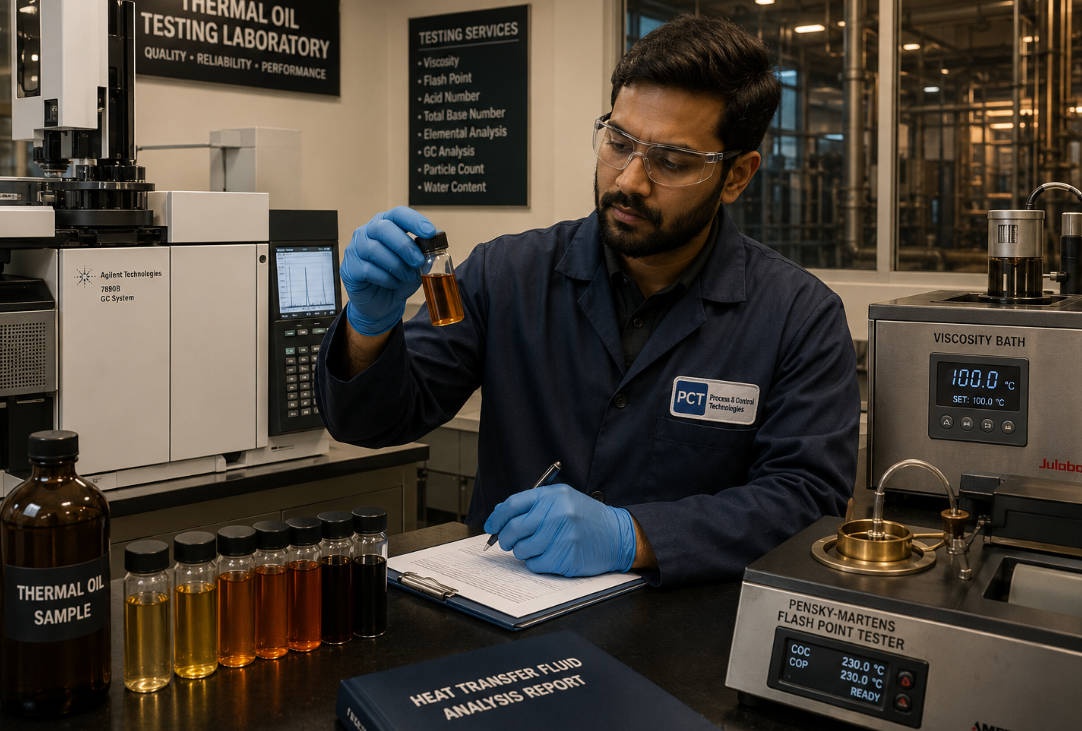
How Thermal Oil Degrades: The Three Mechanisms
Understanding how thermal oil degrades is the foundation of any testing program. There are three primary degradation mechanisms:
Thermal Cracking (Thermal Degradation)
Thermal cracking occurs when oil is heated past its maximum recommended film temperature — effectively boiling the fluid.
What happens:
-
Large oil molecules decompose into solid coke (90–95% carbon) and light-end molecules (low boilers)
-
The solid coke deposits on internal surfaces, forming an insulating layer that forces operators to increase temperatures further
-
The light-end molecules behave like water in the system — they reduce the flash point, lower viscosity, and increase vapor pressure
-
Remaining heavy molecules polymerize into a sludge-type material that coats components
Common causes:
-
Exceeding maximum film temperature in fired or electric immersion heaters
-
Low fluid velocity through the heater
-
Sudden shutdowns without proper cool-down circulation
-
Failed high-temperature or low-flow alarms
-
Improper flame propagation or burner alignment causing hotspots
Warning signs: Decreasing flash point, decreasing viscosity, pump cavitation
Oxidation
Oxidation occurs when hot thermal oil reacts with oxygen in air. It happens in all organic heat transfer fluids.
What happens:
-
The oxidation rate doubles every 20°F (11°C) above 200°F (93°C)
-
Organic acids form and undergo free radical polymerization
-
Fluid viscosity increases
-
Heavy, grease-like sludge accumulates in low-flow areas (expansion tanks, reservoirs)
-
Expansion tank fouling or corrosion is often the first visible sign
Prevention:
-
Keep the expansion tank below 120°F (48°C)
-
Install a cold-seal pot on the expansion tank vent or blanket the tank with nitrogen
-
Maintain positive net pump suction head (NPSH) to prevent air ingestion
-
Never continuously operate with the warm-up valve open
Warning signs: Darkening/browning of fluid, increasing viscosity, rising acid number, sludge in expansion tank
Contamination
Contamination catalyzes both thermal and oxidative degradation and introduces immediate operational problems.
|
Source |
Contaminant |
Risk |
|---|---|---|
|
New system startup |
Mill scale, weld spatter, slag, protective coatings |
Catalyzes degradation, blocks flow |
|
System cleaning |
Residual water-based cleaners, flushing fluids |
Water causes bumping and degradation |
|
Daily operation |
Air ingress, process material leaks |
Oxidation, cross-contamination |
|
Improper top-off |
Mixed fluid types, degraded reclaimed oil |
Accelerated degradation of new oil |
Critical rule: Never mix different thermal oils. Always use fresh fluid for top-off. Fluid "burped" out the vent or collected in drip pans should be discarded — not returned to the system.
Key Thermal Oil Testing Parameters
Flash Point Testing
The flash point is the lowest temperature at which oil vapors can ignite. It is one of the three most critical thermal oil quality indicators (alongside acid number and Conradson carbon residue).
Why it matters:
-
Thermal cracking creates low-boiling components that lower the flash point
-
A dropping flash point signals that the fluid is being thermally degraded
-
Low flash point creates serious fire and explosion hazards
Testing methods:
-
ASTM D92 (Cleveland Open Cup) — for higher flash point fluids
-
ASTM D93 (Pensky-Martens Closed Cup) — more precise for safety evaluation
Action threshold: A flash point drop of more than 30°C from the new fluid baseline warrants investigation or fluid replacement.
Viscosity Testing
Viscosity directly affects pumpability, heat transfer efficiency, and system performance.
What viscosity changes tell you:
|
Viscosity Change |
Degradation Mode |
Mechanism |
|---|---|---|
|
Increasing |
Oxidation |
Polymerization forms larger molecules → sludge |
|
Decreasing |
Thermal cracking |
Molecules break into lighter fractions |
|
Appears normal |
Both simultaneously |
Oxidation thickens while cracking thins — masks both problems |
This is why viscosity alone is not sufficient to assess oil condition. gas chromatography provides a more complete picture.
Testing method: ASTM D445 (kinematic viscosity)
Acid Number (TAN) Testing
The Total Acid Number (TAN) measures the concentration of acidic compounds in the oil — primarily from oxidation.
Why it matters:
-
Rising TAN indicates oxidative degradation
-
Acidic compounds corrode system components
-
Acids undergo polymerization → sludge formation
-
TAN is often the earliest indicator of oxidation problems
Testing method: ASTM D664 (potentiometric titration)
Action threshold: TAN increase of more than 1.0 mg KOH/g above new fluid baseline indicates significant oxidation.
Conradson Carbon Residue (CCR)
The Conradson Carbon Residue test measures the tendency of the oil to form carbonaceous deposits when heated — directly indicating the level of thermal degradation.
Why it matters:
-
Higher CCR means more coke and carbon deposits in your system
-
These deposits insulate heat transfer surfaces, forcing higher operating temperatures
-
A self-reinforcing degradation cycle begins
Testing methods:
-
ASTM D189 (Conradson method)
-
ASTM D4530 (micro method — requires smaller sample)
Action threshold: CCR exceeding 1.0% (or a significant increase from baseline) indicates advanced thermal degradation.
Thermal Stability Testing
Thermal stability evaluates how the fluid resists breakdown under prolonged high-temperature exposure. This is both a quality control test for new fluid and a condition monitoring test for used fluid.
Testing method: The fluid is heated to a specified temperature for a defined period, then analyzed for viscosity change, acid number change, and deposit formation.
Gas Chromatography Analysis
Gas chromatography (GC) is the most powerful tool for detecting both thermal cracking and oxidation simultaneously — even when they cancel each other out in viscosity readings.
What GC reveals:
-
The complete molecular weight distribution of the fluid
-
Presence of low boilers (thermal cracking products)
-
Presence of high boilers (oxidation/polymerization products)
-
Accurate comparison against new fluid baseline
Why GC is essential: Standard tests (viscosity, flash point, TAN) can miss simultaneous degradation modes. GC provides a clear, accurate picture of the thermal oil's true condition.
Water Content Testing
Water in thermal oil is dangerous — it can cause bumping (sudden violent boiling), corrosion, and accelerated degradation.
Testing method: ASTM D6304 (Karl Fischer titration)
Sources: Condensation, cooler leaks, residual water from cleaning, pressure testing with water
Critical rule: Never pressure test a thermal oil system with water. Use heat transfer fluid or inert gas.
Particle Count and Solid Contamination
Solid particles indicate carbon deposits, coke formation, corrosion products, or external contamination.
Testing methods:
-
Gravimetric analysis — weighing filtered solids
-
ISO particle counting (note: less useful for thermic oils due to fluid darkening)
Open Systems vs Closed Systems: Testing Differences
|
Factor |
Open System |
Closed System |
|---|---|---|
|
Air contact |
Hot oil contacts air |
Nitrogen blanket isolates oil from air |
|
Primary degradation |
Oxidation |
Thermal cracking |
|
Typical oil life |
Months to 2 years |
10–15 years |
|
Common industries |
Plastics, die casting, portable oil heaters |
Chemical processing, large industrial plants |
|
Key test focus |
TAN, viscosity, sludge |
Flash point, GC, CCR |
|
Temperature range |
Usually below 600°F (315°C) |
Up to 750°F (400°C) |
Open systems should be tested more frequently because oxidation is aggressive and difficult to prevent entirely. Closed systems can go longer between tests but require monitoring for thermal cracking, especially after power failures or process upsets.
How to Take a Proper Thermal Oil Sample
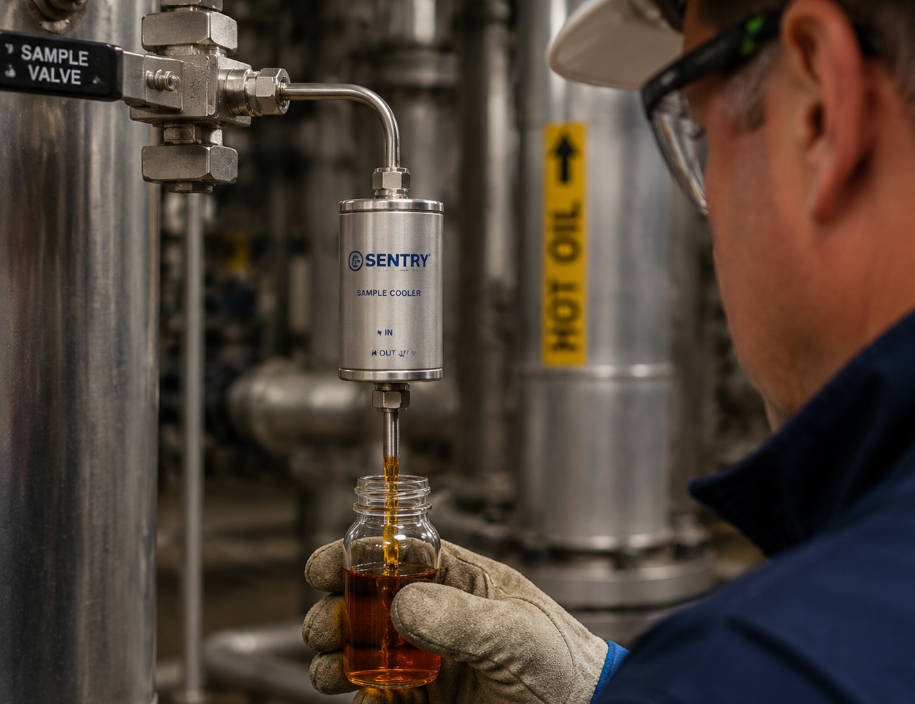
Sampling is as important as the analysis itself. A poorly taken sample gives misleading results — typically making the oil appear better than it actually is.
Correct sampling procedure (per DIN 4754-1):
-
Sample from a live part of the system — preferably near the heat user or suction side of the circulating pump
-
Never sample from the expansion tank or drain tank — these are stagnant areas
-
Fluid must be circulating at approximately 200°F (93°C)
-
Use a sample cooler (heat exchanger with cooling water) to prevent low-boiling components from escaping
-
Never let hot oil contact ambient air before cooling — escaping light ends make the oil appear less degraded
-
Put the sample directly into the sample jar — do not use intermediate containers
-
Release stagnant oil from the sampler first, then collect the representative sample
-
Collect at least 2 liters for comprehensive analysis
How Often Should Thermal Oil Be Tested
|
System Type |
Recommended Frequency |
Notes |
|---|---|---|
|
New systems |
After 1,000 hours of operation |
Establish baseline data |
|
Open systems |
Every 3–6 months |
High oxidation risk |
|
Closed systems |
Annually (minimum) |
Regulatory requirement in many jurisdictions |
|
After process upsets |
Immediately |
Power failures, pump failures, temperature excursions |
|
Before fluid change |
Always |
Establish system condition for proper replacement |
German regulation (BetrSichV) requires analysis at least once per year. Many insurance companies and industry standards also require annual testing.
Thermal Oil Boiler Inspection and Testing
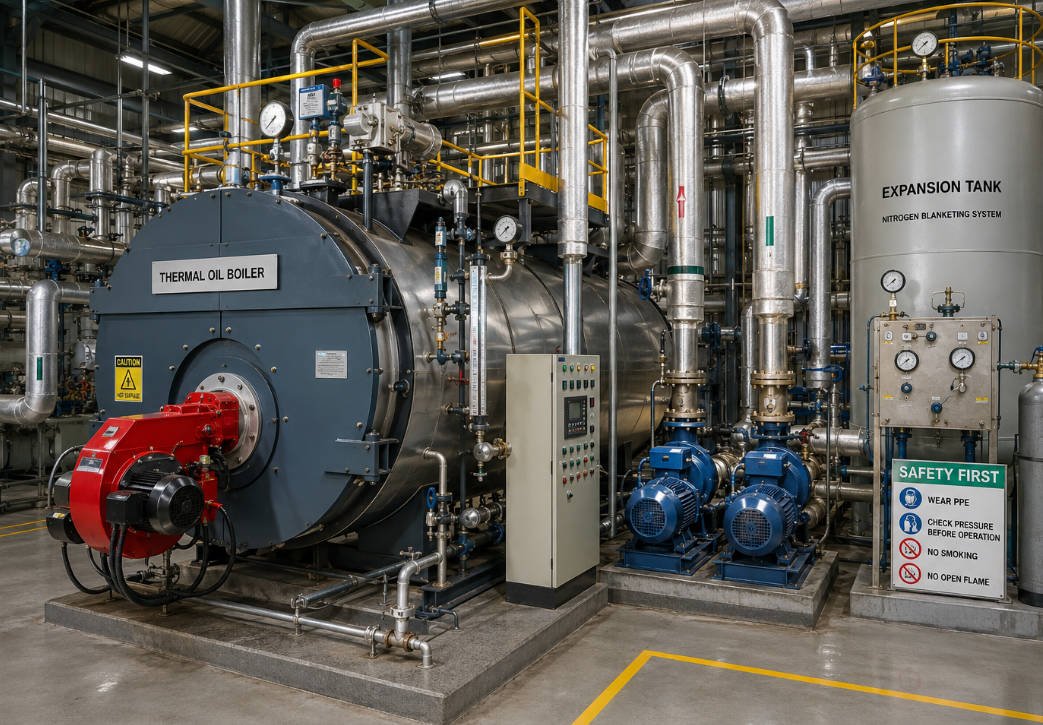
Thermal oil boilers require specialized inspection beyond standard boiler checks. The unique properties of thermal oil create specific inspection requirements:
External inspection focus areas:
-
Leakage points — thermal oil leaks easily cause fires; verify fire-fighting equipment
-
Gasket material — must use oil-resistant graphite gaskets with metal reinforcement, never rubber-asbestos gaskets
-
Differential pressure alarms — ensure flow monitoring and interlock devices are functional
-
Expansion tank — verify closed system with safety valve, level alarms, and over-pressure alarms
-
Circulation pumps — confirm backup pump is available and functional
-
Safety accessories — pressure gauges, thermometers within calibration period
Internal inspection focus areas:
-
Combustion chamber coils and convection tubes — check for deformation, expansion, leakage, and cracking
-
Weld joints and heat-affected zones — inspect for cracks
-
Filter inspection — clean during annual shutdown; check for debris indicating degradation
-
Thermal oil sampling — take at least 2 liters from the sampling cooler during shutdown
-
Oil testing — analyze residual carbon, acid value, viscosity, flash point, and pour point
When to Replace Your Thermal Oil
The decision to replace thermal oil depends on test results, system type, and operating conditions:
Typical oil life by application:
|
Application |
Expected Oil Life |
|---|---|
|
PVC extrusion (open system) |
4,000–6,000 hours |
|
Chemical processing (closed system) |
10–15 years |
|
Asphalt storage (closed, well-maintained) |
Up to 25 years |
|
Food processing (moderate temperature) |
3–5 years |
Key replacement indicators:
-
Flash point dropped more than 30°C from baseline
-
Viscosity changed more than ±30% from baseline
-
TAN increased more than 1.0 mg KOH/g above baseline
-
CCR exceeds 1.0%
-
System requires temperature increase of 30°F+ to maintain process output
-
Visible sludge, pump cavitation, or filter plugging
Replacement best practices:
-
Remove at least 95% of old fluid — degraded oil rapidly contaminates new oil
-
Consider a flushing agent for complete removal of residual fluid
-
Analyze the system condition (inspect pipes, boiler internals) before refilling
-
Perform a new fluid baseline analysis after refill
-
Never mix different fluid types
Choosing the Right Thermal Oil Testing Laboratory
|
Criteria |
Why It Matters |
|---|---|
|
Experience with heat transfer fluids |
Standard lubricant tests are not appropriate for thermal oils — GC and CCR are essential |
|
Gas chromatography capability |
The only reliable way to detect simultaneous thermal cracking and oxidation |
|
Comprehensive test package |
Flash point, viscosity, TAN, CCR, water content, and GC should all be included |
|
Trending and interpretation |
A good lab provides recommendations, not just numbers — comparing results over time |
|
Industry-specific knowledge |
Different industries have different failure modes and maintenance requirements |
|
Sample kits and logistics |
QR-coded bottles, shipping containers, and clear instructions simplify the process |
Red flags:
-
Labs that only perform standard lubricant oil tests (ISO particle count is useless for thermal oils due to fluid darkening)
-
Labs that cannot explain what the results mean for your specific system
-
Labs that do not offer gas chromatography
Thermal Oil Testing FAQ
What are the most important thermal oil tests?
The three most critical indicators are flash point, acid number (TAN), and Conradson carbon residue (CCR). Together they reveal thermal cracking, oxidation, and deposit formation — the three primary degradation modes.
Can thermal oil testing detect problems before they cause system damage?
Yes. A proper testing program with trending analysis can identify degradation months or years before it causes equipment failure. Early detection allows for corrective actions (additive treatments, partial fluid replacement, system adjustments) that extend oil life.
Why does my oil viscosity appear normal but the system is still having problems?
Simultaneous oxidation (which thickens oil) and thermal cracking (which thins oil) can cancel each other out in viscosity readings. Gas chromatography is required to detect this condition.
How should I sample thermal oil from my system?
Sample from a live, flowing part of the system at operating temperature (~200°F/93°C). Use a sample cooler to prevent light ends from escaping. Never sample from the expansion tank or drain tank. Follow DIN 4754-1 procedures.
Can I extend thermal oil life without complete replacement?
Yes. Regularly replacing 10% of the fluid can extend overall system fluid life significantly. Addressing the root cause of degradation (e.g., lowering expansion tank temperature, fixing nitrogen blanket, adjusting heater settings) is equally important.
What happens if I mix different thermal oil types?
Never mix different thermal oils. Different chemical compositions can react unpredictably, accelerating degradation and potentially causing system damage. Always consult your fluid supplier before changing products.
Summary
Thermal oil testing is not optional — it is the foundation of safe, efficient, and cost-effective heat transfer system operation. The three degradation mechanisms (thermal cracking, oxidation, and contamination) progress silently, and by the time symptoms appear at the process level, significant damage may already have occurred.
A comprehensive testing program — including flash point, viscosity, TAN, CCR, and gas chromatography — provides the early warning data needed to take corrective action before system performance is compromised. The cost of annual testing is always less than the cost of an unplanned shutdown.