Table of Contents
- What standards govern baby bottle testing?
- How are chemical migrants tested?
- What mechanical and physical tests are required?
- How is bisphenol A migration measured?
- How are heavy metals and lead in coatings tested?
- How do the Chinese GB standards structure the testing?
- What do migration simulants and conditions mean?
- FAQ
- Our baby bottle testing service
What standards govern baby bottle testing?
Baby bottle testing is governed by a layered set of standards that no single document covers. A baby bottle is simultaneously a child use and care article (subject to mechanical and structural safety), a food contact material (subject to chemical-migration limits), and a coated/decorated product (subject to the heavy-metal limits on paints and substrates). A complete conformity project draws from all three layers, and a report that quotes only one layer answers only one of the questions a regulator will ask.
The principal reference standards our laboratory works to are:
- EN 14350:2020+A1:2023, Child care articles — Drinking equipment — Safety requirements and test methods (BSI Knowledge) — the European standard for drinking equipment for young children (birth to 48 months), including feeding bottles, feeding teats, drinking cups, straws and related components. The 2020 edition consolidated and superseded the earlier two-part EN 14350-1:2004 (mechanical) and EN 14350-2:2004 (chemical) into a single document, and the 2023 amendment (A1) is the current version. It is developed by CEN/TC 252 (Child care articles) and covers materials, construction, performance, packaging and product information, with both the mechanical safety tests and the chemical-migration tests in one standard.
- 16 CFR 1511, Requirements for Pacifiers (U.S.) — the U.S. mechanical-safety regulation that applies to pacifiers; baby bottles themselves in the U.S. are governed primarily by the chemical-migration bans (BPA in 16 CFR 1170, lead and phthalates under CPSIA) and by ASTM F963 for the chemical-hazard provisions that apply to children's products generally.
- CPSIA (Consumer Product Safety Improvement Act of 2008) — the U.S. framework that set the lead limits for children's products: 90 ppm maximum lead in paints and coatings, 100 ppm maximum lead in substrates, fully enforceable since 2011. CPSIA also set the phthalate limits (DEHP, DBP, BBP at 0.1 % max in children's toys and care articles).
- ASTM F963, Standard Consumer Safety Specification for Toy Safety — the chemical-hazard provisions (soluble heavy metals in substrates) that apply to baby bottles as children's products.
- ASTM F1313, Standard Specification for Volatile N-Nitrosamine Levels in Rubber Baby Pacifier Nipples — the volatile nitrosamine limit that applies to rubber components (including natural-rubber teats) used in baby-feeding products.
- SOR/2016-180 (Infant Feeding Bottle Nipples) and SOR/2016-188 (Phthalates) — the Canadian regulations for infant-feeding-bottle nipples and for phthalates in consumer products.
- GB 38995-2020, Infant feeding bottles and teats (std.samr.gov.cn) — China's first mandatory national standard dedicated to baby bottles and teats. It covers plastic, glass, metal, ceramic, silicone and rubber bottles, with the technical requirements, test methods, inspection rules, and labelling/transport/storage requirements.
- GB 4806 series, Food contact materials and articles — the Chinese food-contact-material framework, which governs the chemical-migration requirements (BPA, phthalates, heavy metals, overall migration) that apply to the food-contact surfaces of baby bottles.
A point worth stating plainly because it affects every Chinese-market project: GB 38995-2020 is primarily a physical-safety standard. It covers the mechanical and structural requirements (capacity markings, small parts, edge sharpness, impact resistance), but the chemical-safety requirements (BPA, phthalates, heavy-metal migration) are governed by the GB 4806 series, not by GB 38995 itself. A conformity project for a Chinese-market baby bottle that quotes only GB 38995 is incomplete, because the chemical-migration testing the Chinese regulator expects was never scoped. We confirm the full standard set — GB 38995 for the physical, GB 4806 for the chemical — before quoting, because the two halves together define a conforming baby bottle for China.
How are chemical migrants tested?
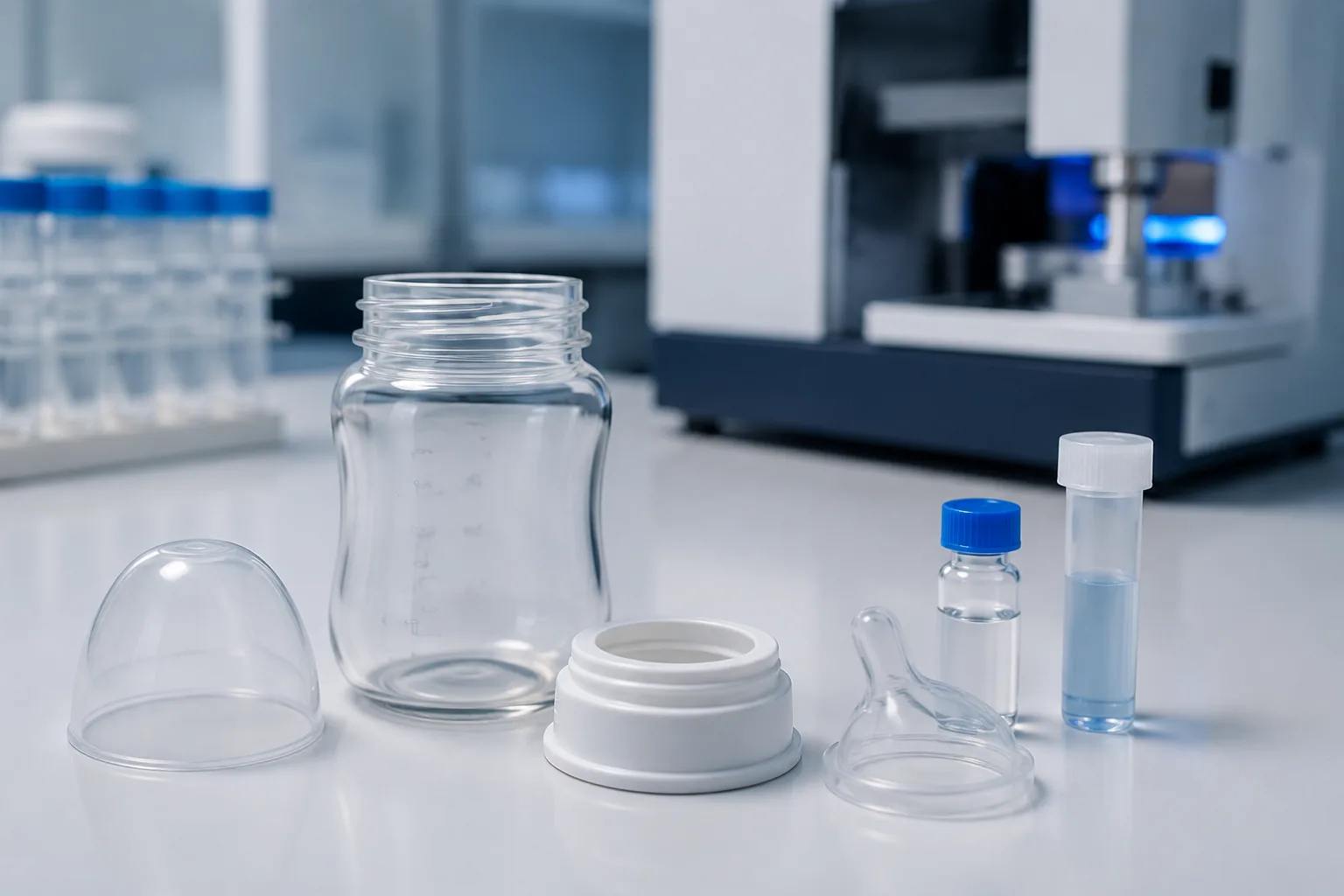
The chemical-migration testing answers the question: when milk, formula or water sits in the bottle under realistic use conditions — including heating, repeated washing, and storage — what chemical substances migrate from the bottle material into the food, and at what concentration? The answer is the property the regulatory limits are set against, and it is the property the public-health concern about baby bottles is built on.
The chemical-migration test programme for a baby bottle typically covers:
- Bisphenol A (BPA) and bisphenol analogues (BPS, BPF, BPAF, BPTMC) — the endocrine-disrupting monomer historically used in polycarbonate plastic, and its analogues that have replaced it in some materials. The migration of bisphenols is the test that the public attention and the regulatory bans (EU 2011, China 2011) are built on, and the test is now extended beyond BPA alone to the analogue suite because the substitutes have their own toxicological profiles.
- Phthalates (DEHP, DBP, BBP, DINP, DIDP, DnOP and others) — the plasticisers used in some plastics and rubbers, regulated under CPSIA at 0.1 % max in children's care articles. Phthalate content is measured directly in the material; phthalate migration is measured in the food simulant.
- Heavy metals (lead, cadmium, arsenic, antimony, mercury, barium, chromium, selenium) — the toxic-element migration from decorated glass (lead in the painted markings), from silicone (cadmium traces), and from the substrate generally. The element migration is measured in the food simulant under defined exposure conditions.
- Overall migration — the total mass of all substances that migrate from the material into the food simulant, regardless of identity. The overall-migration limit is the floor on the chemical-safety argument, and it catches the substances whose identity is unknown or unregulated but whose total mass exceeds the threshold.
- Volatile N-nitrosamines — the volatile carcinogens that can be present in vulcanised rubber components (natural-rubber teats), regulated under ASTM F1313 and the corresponding national adoptions.
The migration testing is run by exposing the bottle material to a defined food simulant under defined time-and-temperature conditions that simulate realistic use, then analysing the simulant for the target substances by the appropriate analytical method (HPLC with fluorescence detection for BPA, GC-MS for phthalates and volatiles, ICP-MS or AAS for the heavy metals, gravimetric for overall migration). The simulant, the exposure conditions and the analytical method are all specified by the standard, and the result is compared to the specific migration limit (SML) the standard sets for each substance.
A practical point from the published literature: the migration behaviour is not constant. Repeated use changes it. A published study of polycarbonate baby bottles marked "BPA free" found that approximately 27 % of the bottles had detectable residual BPA on first test, and 100 % released migrating BPA after repeated thermal stress (the dishwasher/boiling simulation), with a significant positive linear trend in the migrated BPA across the three consecutive stress tests. The lesson is that a single first-use migration measurement can under-report the real-life exposure of a baby using the bottle over weeks of daily washing — which is why the standards specify repeated-cycle migration testing for the bottles whose material degrades under thermal cycling, and why a project scoped to first-use migration only is not a complete picture.
What mechanical and physical tests are required?
The mechanical and physical tests verify that the bottle is structurally safe for an infant to use — that it does not break into sharp fragments, that it does not release small parts that could choke, that the nipple stays attached under pulling, and that the volume markings are accurate. These tests are the core of EN 14350's mechanical section and of GB 38995.
The mechanical-test set typically includes:
- Impact resistance (drop test and thermal-shock test). The bottle is dropped from a defined height onto a defined surface, or subjected to defined thermal cycling (high-temperature and low-temperature exposure per the Alfa Chemistry protocol), and inspected for cracking or fragmentation. A glass bottle must survive the defined drop without shattering into sharp fragments; a plastic or silicone bottle must survive without cracking. The thermal-impact test specifically addresses the breakage mode that occurs when a bottle is moved between temperature extremes (cold storage to warm milk, or hot washing to cool air).
- Boiling-water resistance. The bottle (and especially the teat) is exposed to boiling water for a defined period, simulating the sterilisation the bottle undergoes in routine use, and inspected for deformation, softening, or migration of components. A teat that deforms under boiling-water sterilisation fails the test.
- Tear strength and tensile strength of the teat. The teat is pulled, torn and stretched under defined forces, and the resistance to tearing is measured. The teat must not tear under the forces an infant can apply by sucking or chewing, because a torn teat is a small-parts choking hazard.
- Nipple pull-off / retention. The teat is pulled from the bottle collar with a defined force, simulating the pulling an infant applies, and the teat must remain secured. A teat that detaches under the defined pull is a choking hazard.
- Small parts. The bottle and its components are examined for parts that fit within the small-parts cylinder defined in the children's-products standards. Any component that fits (or that can become detached and fit) is a choking hazard and fails the test.
- Sharp points and sharp edges. The bottle and its components are examined for points and edges that could cut or puncture, using the sharp-point and sharp-edge testers defined in the children's-products standards.
- Flow rate of the teat. The liquid flow through the teat under defined conditions is measured, and the result classifies the teat into a flow-rate category (slow, medium, fast, variable). The flow rate matters because a too-fast flow can cause choking and a too-slow flow can frustrate feeding, and the labelling must match the measured flow.
- Capacity and volume-marking accuracy. The bottle's nominal volume and its volume markings are verified by filling with a measured volume of water and comparing the indicated volume to the actual. Markings that are inaccurate beyond the standard tolerance fail the test — a baby fed by volume markings that read high receives under-fed formula, with nutritional consequences.
The mechanical-test set is the part of the baby-bottle test programme that GB 38995 governs directly, and it is the part that the consumer-product safety authorities (CPSC in the U.S., the provincial market-surveillance authorities in China) enforce most actively because the failures are the ones that produce visible incidents — broken glass, detached teats, inaccurate volumes.
How is bisphenol A migration measured?
BPA migration deserves its own treatment because it is the single most-tested and most-regulated property of a baby bottle, and because the measurement has subtleties that the headline "BPA free" claim does not capture.
The BPA migration test exposes the bottle to a defined food simulant under defined time-and-temperature conditions, then analyses the simulant for BPA by high-performance liquid chromatography with fluorescence detection (HPLC-FLD) or liquid chromatography with mass-spectrometric detection (LC-MS/MS). The latter method is the more sensitive and the more capable of resolving the BPA analogues alongside the parent compound. The detection limit that matters is sub-ng/mL, because the regulatory migration limit for BPA in food-contact materials (set at 0.6 mg/kg in the EU regulation, with stricter provisions for baby bottles) is many orders of magnitude above the analytical detection limit, and the question the test answers is not "is there BPA" but "how much BPA is there, and is it below the limit".
Three findings from the published BPA migration literature bear on how the test is interpreted:
A bottle marked "BPA free" is not necessarily BPA-free on test. Published studies of polycarbonate bottles sold as "BPA free" have detected residual BPA in a significant fraction of samples on first test, and migrating BPA in essentially all samples after thermal stress. The "BPA free" claim refers to the intent of the formulation, not to an analytical result, and a laboratory test is the only way to confirm the claim.
The migration increases with thermal cycling. The same bottles that release low BPA on first use release significantly more after repeated exposure to heat (boiling water, dishwasher, microwave sterilisation). The mechanism is the progressive micro-cracking and the polymer-chain relaxation that the thermal cycling produces, which exposes previously-encapsulated BPA to the food simulant. This is why the standards specify repeated-cycle migration testing for the BPA-sensitive materials, and why a baby bottle that is analytically clean on first use is not guaranteed clean after months of daily sterilisation.
The BPA analogues migrate too. BPS, BPF, BPAF and the other bisphenols that have replaced BPA in some formulations have their own migration behaviour and their own toxicological profiles, and a test that measures only BPA misses the substitutes. The current analytical practice is the 16-bisphenol suite, run by UPLC-MS/MS, that resolves the full analogue set in one chromatographic run. A published study of baby bottles and sippy cups detected BPS, BPA, BPF, BPAF and BPTMC in the leachate, with detection frequencies exceeding 50 % for several analogues. The migration concentrations were low and below the regulatory limits, but the presence of the analogues is the finding that a BPA-only test would have missed, and it is the finding that motivates the analogue-suite method.
The BPA migration result is reported as the concentration in the food simulant (in ng/L or µg/L), compared to the specific migration limit, with the simulant and the exposure conditions named. A project that reports only "BPA: not detected" without the method, the detection limit and the simulant is not a defensible BPA-migration result — it is a screening result, and the difference matters when the report is submitted to a regulator or used in a recall defence.
How are heavy metals and lead in coatings tested?
The heavy-metal testing for baby bottles splits into two distinct concerns: the migration of heavy metals from the food-contact surface into the food, and the content of lead (and other regulated metals) in the painted coatings and decorations on the outside of the bottle. The two are tested by different methods against different limits, and conflating them is a common error.
Heavy-metal migration from the food-contact surface is tested by exposing the contact surface to a defined food simulant under defined conditions, then analysing the simulant for the target elements (lead, cadmium, arsenic, antimony, mercury, barium, chromium, selenium and others, per the standard's element list) by ICP-MS, ICP-OES or atomic absorption spectroscopy. The result is the concentration of each element in the simulant, compared to the specific migration limit. The food-contact migration is governed by the food-contact-material standards (the GB 4806 series in China, the EU regulation 10/2011 in Europe).
Lead and heavy-metal content in coatings and substrates is tested by X-ray fluorescence (XRF) spectroscopy, the non-destructive elemental-analysis method that the CPSC and equivalent regulators use for lead-screening of children's products. The XRF instrument measures the lead content (and the cadmium, mercury, arsenic and antimony content) of the painted markings on the bottle directly, without sample preparation, and the result is compared to the CPSIA limits: 90 ppm lead in paints and coatings, 100 ppm lead in the substrate. The XRF is the method the independent consumer-safety testing organisations have used to identify lead-painted baby bottles and to drive the resulting recalls — and the published record of those recalls is the evidence that the lead-in-coatings problem is real and continuing, not historical.
A practical point from that published record: the lead-in-coatings problem is concentrated in decorated glass bottles. The painted markings on glass — the brand logos, the volume graduations, the decorative patterns — are the components where the lead paint has been found, and a single brand's glass bottles can test positive for lead in the paint across multiple designs and multiple production years. The modern plastic bottles, by contrast, do not test positive for lead in any component — the plastics supply chain does not use lead-based colorants or stabilisers in the modern formulations. This is why the consumer-safety testing focuses the XRF screening on the painted glass components, and why a baby-bottle heavy-metal project that tests only the food-contact surface and ignores the painted markings is missing the component where the lead actually is.
The lead in a painted glass baby bottle is not a food-contact migration hazard in the direct sense (the paint is on the outside), but it is a hazard because the paint degrades — it chips, it wears, it is ingested by a mouthing infant — and the ingested lead is the exposure. The CPSIA limits apply regardless of whether the painted surface is a food-contact surface, and a baby-bottle project must test the painted components for lead content as well as the food-contact surface for lead migration.
How do the Chinese GB standards structure the testing?
The Chinese baby-bottle standard framework splits the conformity into two documents that must be quoted together, because neither covers the other's scope. The split is the single most important structural fact for a Chinese-market project, and it is the fact that the "test to GB 38995" specifications most often miss.
GB 38995-2020, Infant feeding bottles and teats, is the mandatory physical-safety standard. It applies to bottles and teats made of plastic, glass, metal, ceramic, silicone rubber or rubber — the full material range on the Chinese market. It specifies:
- Technical requirements for the physical structure: capacity and volume-marking accuracy, small-parts safety, edge sharpness, nipple retention, impact resistance, and the other mechanical properties described in the mechanical-test section above.
- Test methods for each requirement, so that the conformity argument is reproducible across laboratories.
- Inspection rules for the lot-acceptance and the type-test regime.
- Labelling, transport and storage requirements — the product information, the use instructions, the safety warnings, and the labels that a conforming product must carry.
What GB 38995 does not cover is the chemical safety. The BPA, the phthalates, the heavy-metal migration, the overall migration — these are governed by the GB 4806 series, the Chinese food-contact-material framework, which applies to baby bottles because the bottle is a food-contact article regardless of its physical-safety certification.
GB 4806 series, Food contact materials and articles, covers the chemical-migration requirements:
- GB 4806.1 — the general safety standard for food-contact materials, the framework document.
- GB 4806.2-2015 — the specific standard for milk nipples (teats), including the silicone and rubber teat components.
- GB 4806.7-2016 — the specific standard for plastic food-contact materials and articles, covering the plastic bottle bodies.
- GB 4806.11-2016 — the specific standard for food-contact rubber materials, covering any rubber components.
- GB 9685-2016 — the standard for the use of additives in food-contact materials, which governs the chemical substances permitted in the bottle material and their migration limits.
A Chinese-market baby-bottle conformity project draws from both: GB 38995 for the physical, the GB 4806 series for the chemical. A project scoped to GB 38995 alone — and we receive specifications that read this way — produces a report that satisfies the physical-safety inspection but not the chemical-safety inspection, and a bottle with such a report can be rejected at Chinese market-surveillance sampling because the chemical testing was never run. We confirm the full standard set at scoping, because the cost and the timeline of a complete Chinese-market project are driven by the combined scope, not by GB 38995 alone.
A related Chinese regulatory point: the production and sale of baby bottles containing BPA has been banned in China since 2011 (mirroring the EU 2011 ban), and the phthalate content limit for the bottle materials is 0.1 % total for the six regulated phthalates, with no intentional addition permitted. These are enforced through the GB 4806 chemical framework, not through GB 38995, and they are the chemical limits most often cited in Chinese baby-bottle market-surveillance actions.
What do migration simulants and conditions mean?
The migration simulant and the exposure conditions are the two parameters that determine whether a migration test result reflects realistic use or an artefact of the test design, and they are the two parameters a conformity report must name explicitly because a result quoted without them is ambiguous.
The food simulant is the liquid that stands in for the food (milk, formula, water) in the migration test. The standard specifies the simulant based on the food type the article will contact: water for aqueous foods, dilute acetic acid for acidic foods, ethanol solution for alcoholic or fatty foods, and the defined iso-octane or modified-polyphenylene-oxide substitutes for fatty foods. For baby bottles, the relevant simulant is typically water (for the formula-preparation and water-storage use) and 50 % ethanol (for the fatty-milk use, because milk fat is the component most likely to extract non-polar migrants from the plastic). The choice of simulant changes the result — a published study found that the BPA concentration in 50 % ethanol simulant was approximately 1.4 times the concentration in water simulant for the same bottles, because the ethanol extracts the bisphenols more aggressively than the water does. A report that quotes a migration result without naming the simulant is reporting a number whose meaning depends on an unspecified variable.
The exposure conditions are the time and the temperature the simulant is in contact with the bottle material. The standard specifies the conditions to simulate realistic use: for baby bottles, the typical conditions include 40 °C for 24 hours (simulating room-temperature storage), 70 °C for 2 hours (simulating warm-formula contact), and 100 °C for 30 minutes or the boiling-water immersion (simulating sterilisation and hot-milk contact). The conditions matter because migration is temperature-dependent — higher temperatures release more of the migrants — and because the repeated-cycle testing (multiple exposures, simulating daily use over weeks) produces a different result from the single-exposure testing.
The published studies that have examined the simulant and condition effects are the evidence base for these choices. The BPA migration that increases with ethanol content (water < 10 % ethanol < 50 % ethanol), the migration that increases with thermal cycling (first-use < post-wash < post-repeated-wash), and the volatile-migrant profile that differs between polypropylene, Tritan and silicone are all findings that the simulant-and-condition design of the test is meant to capture. A laboratory that runs the migration test at the standard's specified simulant and conditions produces a result that is comparable across lots and across laboratories, and a laboratory that runs the test at non-standard conditions produces a result that is not.
A complete migration report states, for each measured substance, the simulant, the exposure temperature, the exposure time, the number of cycles, the analytical method, the detection limit, the measured concentration and the specific migration limit. Anything less leaves the result open to challenge on the conditions, the method or the limit, and for a baby-bottle project submitted to a regulator or used in a recall defence, that openness is a liability.
FAQ
Which standards should my baby bottle be tested to?
It depends on the target market and the bottle material. For the European market, EN 14350:2020+A1:2023 covers the full safety requirement set (mechanical and chemical). For the U.S. market, CPSIA sets the lead (90 ppm paint / 100 ppm substrate) and phthalate (0.1 %) limits, with ASTM F963 and ASTM F1313 for the chemical hazards and the volatile nitrosamines. For the Chinese market, GB 38995-2020 covers the physical safety and the GB 4806 series covers the chemical migration — both must be quoted together. We confirm the target market and the material before quoting.
Is "BPA free" a guarantee that the bottle has no BPA?
No. "BPA free" is a formulation intent, not an analytical result. Published studies have detected residual BPA in bottles sold as "BPA free", and migrating BPA in essentially all such bottles after thermal stress. The only way to confirm the absence of BPA (and of the BPS, BPF and other analogues) is the migration test by HPLC-FLD or LC-MS/MS, run under the standard's specified simulant and exposure conditions.
Why does the Chinese project require both GB 38995 and GB 4806?
GB 38995-2020 is the physical-safety standard (capacity, small parts, edges, impact, nipple retention, markings). The chemical safety — BPA, phthalates, heavy-metal migration, overall migration — is governed by the GB 4806 food-contact-material series. A Chinese-market baby bottle must conform to both, and a report that quotes only GB 38995 is incomplete for the chemical-safety inspection that Chinese market surveillance performs.
Do you test the painted markings on glass bottles for lead?
Yes. The painted decorations and volume markings on glass baby bottles are the components where the lead-in-coatings problem has been found, and we test them by XRF for lead, cadmium, mercury, arsenic and antimony content, against the CPSIA limits (90 ppm lead in paint, 100 ppm lead in substrate) for the U.S. market and the equivalent limits for other markets. The XRF is the method the CPSC uses for lead screening, and it is the method that has identified the lead-painted baby bottles that have been recalled.
What sample do you need for a full migration test programme?
Multiple bottle units (typically 6 to 10) of the production lot, because the migration testing consumes units across the simulant/condition/cycle matrix and the mechanical testing consumes additional units. The exact count depends on the standard, the material and the test scope, and we confirm the sample requirement after scoping the project.
Our baby bottle testing service
Our laboratory provides baby bottle testing across the full standard stack — EN 14350:2020+A1:2023 for the European market, CPSIA / ASTM F963 / ASTM F1313 for the U.S. market, SOR/2016-180 and SOR/2016-188 for the Canadian market, and GB 38995-2020 plus the GB 4806 series for the Chinese market. Each project begins with a scoping step that confirms the target market, the bottle material (plastic, glass, silicone, metal, ceramic, rubber) and the bottle components (body, teat, collar, cap, decorations), and maps the test programme to the corresponding standards, so the report you receive answers the question your regulator, your retailer or your quality system will actually ask.
We run the chemical-migration tests (BPA and the bisphenol analogue suite by LC-MS/MS, phthalates by GC-MS, heavy-metal migration by ICP-MS, overall migration by gravimetry, volatile N-nitrosamines by GC-TEA), the heavy-metal content tests (lead, cadmium, mercury, arsenic, antimony by XRF on the painted and substrate components), the mechanical-and-physical tests (impact, boiling-water resistance, teat tear strength, nipple retention, small parts, sharp points, flow rate, capacity and marking accuracy), and the migration-simulant-and-condition matrix the standard specifies. Reports are issued with the standard, the simulant, the exposure conditions, the analytical method, the measured value, the limit and the conformity conclusion explicitly stated, with the chromatograms and the XRF spectra included where the result depends on them, in a format suitable for regulatory submission, retailer qualification, lot acceptance or recall defence.
To start a project, send us the bottle material, the component list, the target market, the applicable standard if known (or let us confirm it), and whether the project is full conformity, lot acceptance, recall-defence testing or material-comparison screening. We will return a project scope, sample requirement, schedule and quotation, and begin testing on your confirmation.