Table of Contents
- What standards govern bone repair material testing?
- How are chemical and phase composition verified?
- How is mechanical performance tested?
- How is in vitro bioactivity and biocompatibility evaluated?
- How is degradation behaviour characterised?
- How is drug-release performance measured?
- How does the Chinese framework classify bone repair materials?
- FAQ
- Our bone repair material testing service
What standards govern bone repair material testing?
Bone repair material testing is governed by a multi-layered standard set that spans the material-composition standards (what the calcium phosphate or the bioceramic must be), the biological-evaluation standards (how the material interacts with cells and tissues), the mechanical-performance standards (how the material behaves under load), and the application-specific standards (how the specific product form — the cement, the scaffold, the granule — is qualified). A complete conformity project draws from all four layers, and the applicable standards depend on the material class (the calcium-phosphate ceramic, the calcium-phosphate cement, the bioactive glass, the polymer composite, the hybrid), the product form, and the target market.
The principal reference standards our laboratory works to are:
- ISO 13779 series, Implants for surgery — Hydroxyapatite (ISO catalog) — the international product standard for the hydroxyapatite-based bone-repair materials, covering the ceramic (Part 1), the coating (Part 2), the chemical analysis and the phase purity (Part 3), and the powder (Part 6).
- ASTM F1088, Standard Specification for Beta-Tricalcium Phosphate for Surgical Implantation (astm.org) — the U.S. material-composition specification for the β-TCP, covering the chemical and the crystallographic requirements, the Ca/P ratio, the elemental impurity limits, and the phase purity.
- ASTM F1185, Standard Specification for Composition of Medical-Grade Hydroxyapatite for surgical implants — the composition specification for the medical-grade hydroxyapatite.
- ASTM F451, Standard Specification for Acrylic Bone Cement — the specification for the PMMA bone cement, covering the mechanical and the setting properties that the non-resorbable bone-cement products are qualified against.
- ISO 10993 series, Biological evaluation of medical devices — the biological-evaluation framework (Part 5 cytotoxicity, Part 6 implantation, Part 10 sensitisation, Part 11 systemic toxicity), applied to the bone-repair material in its finished, sterilised form.
- ASTM D6319 / ISO 10993-5 — the in-vitro cytotoxicity, the cell-adhesion, and the cell-proliferation assays that evaluate the material's biocompatibility.
- YY/T 0683-2008, β-Tricalcium phosphate for surgical implants (std.samr.gov.cn) — the Chinese national adoption of the β-TCP material specification, covering the chemical, the crystallographic, and the phase-purity requirements specific to the Chinese market.
- GB/T 16886 series — the Chinese adoption of the ISO 10993 biological-evaluation framework (Part 5 cytotoxicity, Part 6 implantation, etc.).
- The Chinese national standard for osteoinductive calcium-phosphate bioceramics, administered by TC110 under the NMPA, covering the osteoinductive CaP ceramics that go beyond the osteoconductive baseline.
A point worth stating plainly because it affects every project: the bone repair material is classified as a medical device (or, for some drug-loaded formulations, a drug-device combination product), and the regulatory pathway determines the full test scope. The Chinese NMPA classifies the calcium-phosphate bone cements and the bioceramic granules as the Class III implantable medical devices for the non-structural bone-defect filling (the四肢和脊柱的非结构性植骨), per the NMPA 2017 Announcement No. 14 on the calcium-phosphate / calcium-silicate bone-filling materials. The drug-loaded bone repair materials (the bone cement carrying the puerarin, the bisphosphonate, or the antibiotic) may be classified as the drug-device combination products, with the additional drug-substance testing and the drug-release kinetics requirements. We confirm the material class, the product form, the drug-loading status, and the target market before quoting, because the test scope is driven by these factors.
How are chemical and phase composition verified?
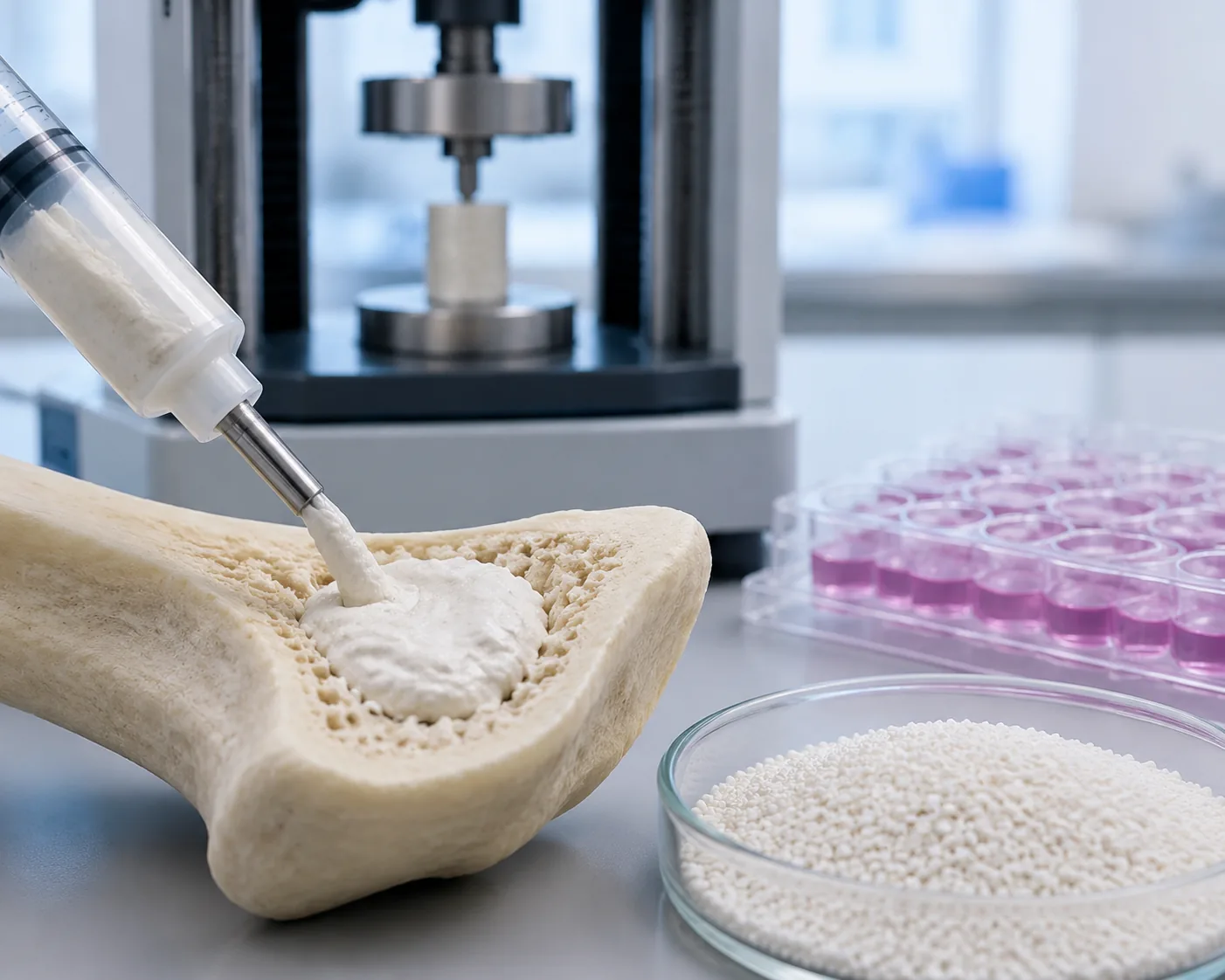
The chemical and the phase composition of the bone repair material are the properties that determine the material's biological behaviour — the osteoconductivity (the Ca/P ratio, the phase purity), the bioactivity (the HAp formation, the ion release), and the degradation (the solubility of the calcium-phosphate phase). The composition is verified by the combination of the elemental analysis and the crystallographic analysis.
The elemental analysis — the calcium, the phosphorus, and the trace-element determination — is performed by the ICP-OES or the ICP-MS, after the acid digestion of the material. The Ca/P molar ratio is calculated from the measured calcium and phosphorus, and the result is compared to the stoichiometric value (1.67 for the HAp, 1.50 for the β-TCP). The trace elements (the strontium, the magnesium, the sodium, the silicon for the silicon-nitride composites, and the toxic heavy metals — the lead, the arsenic, the cadmium, the mercury) are reported against the regulatory limits, with the 500 mg/kg threshold above which each trace element must be identified and quantified (per the ISO 13779-6 powder specification).
The crystallographic analysis — the phase identification and the quantitative phase analysis (QPA) — is performed by the X-ray diffraction (XRD) with the Rietveld refinement. The XRD pattern resolves the crystalline phases present (the HAp, the α-TCP, the β-TCP, the MgO for the magnesium-phosphate cements, the silicon nitride for the Si₃N₄ composites), and the Rietveld refinement quantifies each phase's weight fraction. The phase purity is critical: the β-TCP material (per ASTM F1088) must meet the defined crystallographic and the impurity-phase limits; the HAp material (per ISO 13779) must meet the foreign-phase limits (the α-TCP, the CaO, the TTCP); the composite bone cement must have its component phases (the unreacted MgO, the reaction product struvite-K for the magnesium-phosphate cements) quantified, because the residual unreacted phase and the reaction-product phase both affect the material's performance.
The functional-group analysis by the FTIR (the ATR or the transmission mode) confirms the molecular bonding — the phosphate (PO₄³⁻) stretching and bending vibrations, the hydroxyl (OH⁻) stretching, the carbonate (CO₃²⁻) substitution — and it is the method that detects the B-type and the A-type carbonate apatite substitutions that distinguish the biological from the synthetic HAp.
A practical point from the published bone-repair-material patent literature: the composition of the composite bone cement is not a single value but a formulation — the magnesium-phosphate bone cement comprises the MgO and the NaH₂PO₄ in the defined molar ratio, with the nano-silicon-nitride at the defined weight fraction (15 to 30 wt%), with the optional drug loading (the puerarin at 100 to 200 µmol/L) and the curing liquid (the gallic-acid aqueous solution at 30 µM/L). Each component must be verified by the appropriate analytical method, and the composition report documents the measured values alongside the formulation targets, because the composite's performance depends on the composition being as formulated.
How is mechanical performance tested?
The mechanical performance of the bone repair material determines whether the material can maintain the structural integrity at the defect site, support the load transfer during the healing period, and resist the premature failure. The mechanical properties are governed by the phase composition, the porosity, the particle-packing density, and the curing condition, and they are measured under the defined test methods.
The compressive strength is the primary mechanical test for the bone cements and the bioceramic scaffolds, because the compressive loading is the dominant load mode in the bone-defect application. The test is performed on the cylindrical specimens (commonly 6 mm diameter × 12 mm height for the bone cements, per the published patent testing), cured under the defined conditions (37 °C, 100 % humidity, 72 hours), loaded on the universal testing machine at the defined crosshead speed (1 mm/min), and the maximum compressive stress at failure is reported in MPa. The published patent data on the nano-silicon-nitride / magnesium-phosphate composite bone cement shows the compressive strength ranging from 32.2 MPa (the pure MgP cement, the control) to 52.7 MPa (15 wt% Si₃N₄) to 73.6 MPa (30 wt% Si₃N₄), demonstrating the reinforcement effect of the silicon-nitride addition and the importance of the composition in achieving the target strength.
The setting time (for the injectable bone cements) is the time from the mixing of the powder and the liquid to the transition from the slurry to the solid state, measured under the defined conditions (commonly 37 °C). The setting time must be within the surgical window — long enough for the injection and the moulding, short enough for the structural integrity within the operative time. The published patent data reports the setting time of 6 to 10 minutes for the nano-Si₃N₄ / MgP cement, a range suitable for the clinical injection.
The injectability is the ability of the cement paste to be extruded through the defined cannula (simulating the clinical delivery), measured as the percentage of the paste successfully injected versus the paste retained in the syringe. The injectability is governed by the powder-to-liquid ratio, the particle-size distribution, and the rheology of the setting paste, and it is the test that qualifies the cement for the minimally-invasive delivery.
The porosity and the pore-size distribution are measured by the mercury intrusion porosimetry or the micro-CT, because the porosity governs both the mechanical strength (higher porosity = lower strength) and the biological performance (the interconnected porosity enables the cell infiltration and the vascularisation). The balance — the porosity high enough for the biological function but low enough for the mechanical function — is the engineering trade-off the material design optimises, and the porosity measurement is the test that verifies the balance.
How is in vitro bioactivity and biocompatibility evaluated?
The in-vitro bioactivity and the biocompatibility are the properties that determine whether the bone repair material supports the cell attachment, the cell proliferation, and the cell differentiation, and whether it induces the hydroxyapatite formation in the simulated body fluid. These properties are evaluated by the cell-culture assays and the bioactivity assays, under the ISO 10993 biological-evaluation framework.
The Cytotoxicity test (ISO 10993-5 / GB/T 16886.5) evaluates whether the material's extract is toxic to the cultured cells, with the 70 % cell-viability threshold as the pass criterion. The cytotoxicity is the screening test — a cytotoxic material is not tested further — and it is the first test in the biological-evaluation programme for the bone repair material.
The cell-adhesion and the cell-proliferation assays evaluate the material's ability to support the cell attachment and the cell growth on its surface. The assays are run with the relevant cell types — the rBMSCs (the rat bone-marrow mesenchymal stem cells) for the osteogenic evaluation, the L929 fibroblasts for the general biocompatibility — cultured on the material surface for the defined periods (1, 3, 7, 14 days). The cell-adhesion morphology is observed by the SEM, and the cell proliferation is quantified by the CCK-8 assay (the optical density at 490 nm, proportional to the viable cell number). The published patent data on the nano-Si₃N₄ / MgP cement shows the OD values of 0.47 / 0.76 / 1.06 (at 1 / 3 / 7 days) for the drug-loaded composite, compared to 0.32 / 0.54 / 0.69 for the pure MgP control, demonstrating the cell-proliferation-promotion effect of the silicon-nitride and the drug.
The cell-differentiation assay evaluates the material's ability to promote the osteogenic differentiation — the stem cells' differentiation into the osteoblasts, the bone-forming cells. The alkaline-phosphatase (ALP) activity is the early marker of the osteogenic differentiation, measured by the ALP kit (the p-nitrophenylphosphate substrate, the OD at 405 nm, normalised to the protein content). The published patent data shows the ALP activity of 0.033 / 0.086 / 0.151 (at 4 / 7 / 14 days) for the drug-loaded composite, compared to 0.026 / 0.066 / 0.117 for the pure MgP control, demonstrating the differentiation-promotion effect.
The antibacterial test evaluates the material's ability to inhibit the bacterial adhesion and the bacterial growth on its surface — the property that prevents the biomaterial-associated infection, the major cause of the implant failure. The test is run with the relevant bacterial strains (the Staphylococcus aureus, the Escherichia coli — the two most common implant-infection pathogens), by the co-culture method (the bacteria at 5 × 10⁵ CFU/mL, 24-hour incubation, the bacterial recovery and counting) or the zone-of-inhibition method. The published patent data shows that the silicon-nitride addition provides the antibacterial effect, with the bacteriostasis rate increasing with the Si₃N₄ content — the dual-function material (the anti-infection and the osteogenesis promotion) that the patent's innovation targets.
The in-vitro bioactivity test evaluates the material's ability to form the hydroxyapatite layer on its surface in the simulated body fluid (SBF), per the Kokubo method. The SBF immersion (37 °C, up to 28 days, with the solution refreshed periodically) is followed by the SEM examination for the HAp morphology, the FTIR for the phosphate and the carbonate bands, and the XRD for the HAp phase. The HAp formation is the indicator of the bioactive bonding — the material's ability to bond directly to the host bone through the apatite interface — and it is the test that qualifies the bioactive-ceramic and the bioactive-glass materials.
How is degradation behaviour characterised?
The degradation behaviour — the rate and the mechanism of the material's dissolution and resorption in the physiological environment — is the property that determines whether the material is replaced by the new bone at the rate compatible with the healing. The degradation is characterised by the in-vitro immersion test, and it is the property that distinguishes the bioresorbable bone repair materials (the calcium-phosphate cements, the β-TCP ceramics, the bioactive glasses) from the non-resorbable materials (the PMMA cement, the metals).
The in-vitro degradation test immerses the material specimens in the defined solution — the Tris-HCl buffer (the pH ~7.4, the simulated physiological solution) or the SBF (the ion-concentration-matched solution) — at 37 °C for the extended period (up to 84 days, with the solution refreshed weekly). The degradation is measured by:
The weight-loss rate — the specimen is removed at the defined time points (1, 7, 14, 21, 28, 35, 42, 49, 56, 63, 70, 84 days), dried, and weighed, and the weight loss is calculated as (W₀ − Wₜ) / W₀ × 100 %. The weight-loss curve is the primary degradation data, and the published patent data shows the 12-week weight loss of 44.3 wt% (30 wt% Si₃N₄), 32.2 wt% (15 wt% Si₃N₄), and 25.1 wt% (pure MgP control), demonstrating the degradation-acceleration effect of the silicon-nitride addition.
The pH change — the pH of the immersion solution is measured at each time point, and the pH curve reveals the dissolution behaviour (the acidic dissolution of the residual sodium dihydrogen phosphate, the alkaline dissolution of the silicon nitride). The pH must remain within the physiologically acceptable range (approximately 7.2 to 7.5), because the excessive pH deviation can cause the adverse biological response. The published patent data shows the pH range of 7.23 to 7.44 across the 12-week period, confirming the controllable pH behaviour.
The surface-morphology change — the SEM images at the defined immersion time points (21 days, 35 days) reveal the degradation morphology (the surface pitting, the needle-like appearance, the material loss). The SEM degradation images are the qualitative confirmation of the weight-loss data, and they reveal whether the degradation is uniform (the surface dissolution) or localised (the pitting, the cracking).
The ion-release measurement — the calcium, the phosphate, the magnesium, the silicate ions released into the immersion solution are measured by the ICP-OES at each time point, and the ion-release curve characterises the dissolution kinetics and the ion release that drives the biological response. The magnesium release from the MgP cement, the silicate release from the Si₃N₄ composite, and the calcium / phosphate release from the calcium-phosphate phases are the ion-release profiles that the degradation monitoring tracks.
The degradation rate must be matched to the bone-healing rate — the material that degrades too slowly remains in the defect and inhibits the bone remodelling, while the material that degrades too quickly loses the mechanical support before the new bone can form. The degradation-test data is the basis for the degradation-rate prediction, and the target is the degradation rate that matches the 3-to-6-month bone-healing window for most applications.
How is drug-release performance measured?
The drug-loaded bone repair materials — the bone cements carrying the puerarin, the bisphosphonate, the antibiotic, or the growth factor — require the drug-release testing that characterises the release kinetics, the total drug release, and the release mechanism. The drug release is the property that determines whether the local drug delivery achieves the therapeutic concentration at the defect site for the defined duration, and it is the test that qualifies the drug-device combination product.
The in-vitro drug-release test immerses the drug-loaded material specimens in the defined release medium (the PBS at pH 7.0, the simulated physiological solution) at 37 °C in the constant-temperature shaking incubator, and the supernatant is collected at the defined time points (1, 3, 5, 7, 14, 21, 28 days), with the fresh medium replenished after each collection. The drug concentration in the collected supernatant is measured by the UV-Vis spectrophotometry (the absorbance at the drug's characteristic wavelength) or the HPLC, and the cumulative drug release is calculated against the standard curve.
The published patent data on the nano-Si₃N₄ / MgP cement shows the characteristic drug-release profile:
- The burst release in the first 5 days — approximately 54 % (30 wt% Si₃N₄) or 59 % (15 wt% Si₃N₄), the surface-adsorbed drug that is rapidly released on the initial immersion.
- The sustained release through day 28 — reaching 95 % (30 wt% Si₃N₄) or 87 % (15 wt% Si₃N₄), the drug incorporated in the material matrix that is released by the diffusion and the degradation.
The burst-release / sustained-release profile is the dual-phase release characteristic of the drug-loaded bone cement, and the balance — enough burst release for the early therapeutic effect (the anti-infection, the anti-inflammatory), enough sustained release for the long-term effect (the osteogenesis promotion) — is the design target the formulation optimises. The drug-release test quantifies this balance, and the report documents the cumulative release curve, the burst-release percentage, and the total release percentage alongside the material formulation.
For the drug-device combination product, the drug-release testing extends to the drug-substance characterisation (the identity, the purity, the potency of the loaded drug), the drug-stability testing (the drug's chemical stability in the cement matrix over the shelf life), and the in-vivo drug-release correlation (the comparison of the in-vitro release to the in-vivo release in the animal model). These are the tests that the drug-device combination product requires beyond the pure-device bone repair material, and the regulatory pathway for the drug-device combination is more complex than for the pure device.
How does the Chinese framework classify bone repair materials?
The Chinese framework for the bone repair material testing is administered by the NMPA, and it applies the international ISO / ASTM standards with the Chinese-specific adoption and the additional registration requirements. The bone repair materials are classified as the Class III implantable medical devices, and the registration requires the full physical-chemical characterisation, the biological evaluation, and for most categories, the clinical investigation.
The Chinese framework draws from:
- YY/T 0683-2008, β-Tricalcium phosphate for surgical implants — the Chinese material specification for the β-TCP, covering the chemical, the crystallographic, and the phase-purity requirements.
- The Chinese national standard for osteoinductive calcium-phosphate bioceramics (std.samr.gov.cn) — the standard for the osteoinductive CaP ceramics that go beyond the osteoconductive baseline, administered by TC110 under the NMPA. This standard is the Chinese-specific framework for the calcium-phosphate bioceramics that have demonstrated the osteoinductive property (the ability to induce the bone formation at the non-osseous site), and it is the framework that distinguishes the osteoinductive from the merely osteoconductive materials.
- GB/T 16886 series — the Chinese adoption of the ISO 10993 biological-evaluation framework.
- The NMPA 2017 Announcement No. 14 — the registration technical guidelines for the calcium-phosphate and the calcium-silicate bone-filling materials, covering the synthetic calcium-phosphate bioceramics, the calcium-silicate bioactive glasses, and the calcium-phosphate bone cements for the non-structural bone-defect filling (the四肢和脊柱的非结构性植骨).
Three features of the Chinese framework affect the project scoping:
The osteoconductive vs osteoinductive distinction. The osteoconductive materials (the HAp, the β-TCP, the biphasic calcium phosphates) provide the scaffold for the bone growth but do not actively induce the bone formation. The osteoinductive materials (the specific CaP compositions, the surface-modified ceramics, the growth-factor-loaded materials) actively induce the bone formation, even at the non-osseous sites. The osteoinductive property requires the additional characterisation (the in-vivo osteoinduction test in the animal model, the intramuscular implantation), and the Chinese osteoinductive-CaP-bioceramic standard is the framework that qualifies this property.
The drug-loaded combination products. The bone repair materials carrying the drugs (the puerarin, the bisphosphonate, the antibiotic, the growth factor) are classified as the drug-device combination products, with the additional testing for the drug substance (the characterisation, the stability, the release kinetics) and the combination-product-specific regulatory pathway. The Chinese NMPA has the specific guidelines for the drug-device combination products, and the project scope includes the drug-specific testing alongside the device-specific testing.
The clinical-investigation requirement. The NMPA registration for the Class III bone-repair material requires the clinical-investigation data, conducted in the Chinese clinical sites under the NMPA-approved protocol, for most product categories. The non-clinical engineering testing (the composition, the mechanical, the biological evaluation, the degradation, the drug release) is the prerequisite that supports the clinical-investigation application, and the complete test report must be available before the clinical investigation begins.
A complete Chinese-market project tests the bone repair material against the YY/T 0683 (or the applicable material standard), the GB/T 16886 (biological evaluation), the applicable mechanical and degradation test methods, the drug-release test (for the drug-loaded products), and reports the results in Chinese for the NMPA registration. A bone repair material tested for the FDA or the EU MDR submission can usually be reported for the NMPA submission without the additional mechanical or biological testing, but the report must be re-issued in the Chinese format, and the clinical investigation must be conducted in the Chinese sites.
FAQ
Which standard should my bone repair material be tested to?
It depends on the material class, the product form, and the target market. For the HAp-based materials, the ISO 13779 series (international) or GB/T equivalents (China). For the β-TCP, the ASTM F1088 (U.S.) or YY/T 0683-2008 (China). For the bone cements, the ASTM F451 (PMMA reference) and the applicable NMPA guidelines (calcium-phosphate cements). For the biological evaluation, the ISO 10993 / GB/T 16886 series. For the drug-loaded products, the additional drug-substance testing and the drug-release kinetics. We confirm the material class, the product form, the drug-loading status, and the target market before quoting.
What is the difference between osteoconductive and osteoinductive materials?
The osteoconductive materials (the HAp, the β-TCP, the BCP) provide the passive scaffold for the bone growth — they guide the bone formation along their surface, but they do not actively induce it. The osteoinductive materials actively induce the bone formation, even at the non-osseous sites, through the specific composition, the surface chemistry, or the incorporated growth factors. The osteoinductive property requires the additional in-vivo testing (the intramuscular implantation in the animal model), and the Chinese osteoinductive-CaP-bioceramic standard is the framework for this property.
How long does the in-vitro degradation test run?
The standard duration is up to 84 days (12 weeks) of immersion in the Tris-HCl or the SBF at 37 °C, with the solution refreshed weekly and the specimens removed at the defined time points for the weight-loss, the pH, and the SEM characterisation. The 12-week duration corresponds to the early phase of the bone healing (the 3-month window), and the degradation rate at 12 weeks is the data point that predicts whether the material will resorb at the clinically appropriate rate.
My bone cement carries a drug — what additional testing is required?
The drug-device combination product requires the drug-substance characterisation (the identity, the purity, the potency of the loaded drug), the drug-release kinetics (the cumulative release curve, the burst-release percentage, the sustained-release profile), the drug stability (the chemical stability in the cement matrix over the shelf life), and the combination-product-specific regulatory pathway. The NMPA has the specific guidelines for the drug-device combination products, and the test scope includes the drug-specific testing alongside the device-specific testing.
Can the injectable bone cement be tested for the clinical-injection suitability?
Yes. The injectability test (the percentage of the paste successfully extruded through the defined cannula) and the setting-time test (the time from the mixing to the solidification) are the tests that qualify the cement for the minimally-invasive delivery. The injectability must be sufficient for the clinical delivery through the defined injection device, and the setting time must be within the surgical window. The published patent data reports the setting time of 6 to 10 minutes for the nano-Si₃N₄ / MgP cement, a range suitable for the clinical injection.
Our bone repair material testing service
Our laboratory provides bone repair material testing across the full standard and material-class stack — the ISO 13779 series (HAp), the ASTM F1088 (β-TCP), the YY/T 0683-2008 (Chinese β-TCP), the NMPA calcium-phosphate bone-filling guidelines, the GB/T 16886 biological evaluation, and the drug-release testing for the drug-device combination products. Each project begins with a scoping step that confirms the material class (the HAp, the β-TCP, the BCP, the magnesium-phosphate cement, the bioactive glass, the polymer composite, the silicon-nitride composite), the product form (the cement, the scaffold, the granule, the block), the drug-loading status, the target market, and the regulatory pathway, so the report you receive answers the question your regulator, your clinician or your quality system will actually ask.
We verify the chemical and the phase composition by the ICP-OES / ICP-MS and the XRD Rietveld refinement; measure the mechanical performance by the compressive strength, the setting time, and the injectability; evaluate the biocompatibility by the ISO 10993-5 cytotoxicity, the CCK-8 cell proliferation, the ALP cell differentiation, and the antibacterial tests; characterise the degradation by the Tris-HCl / SBF immersion with the weight-loss, the pH, the SEM, and the ion-release measurement; measure the drug release by the in-vitro release kinetics in the PBS; and characterise the bioactivity by the SBF immersion with the HAp-formation analysis. Reports are issued with the standard, the method, the measured values, the formulation targets, and the conformity conclusion explicitly stated, with the XRD patterns, the SEM images, the degradation curves, and the drug-release profiles included where the result depends on them, in a format suitable for the FDA submission, the EU MDR technical documentation, the NMPA registration dossier, or the internal R&D evaluation.
To start a project, send us the material class and composition, the product form, the drug-loading status (and the drug identity if applicable), the target market, the regulatory pathway, and the specific test scope you require (or let us confirm it). We will return a project scope, sample requirement, schedule and quotation, and begin testing on your confirmation.