Table of Contents
- What standards govern chitosan testing?
- How is the degree of deacetylation measured?
- How is molecular weight determined?
- What spectroscopic methods identify chitosan?
- How are thermal and crystalline properties characterized?
- How do application-specific tests qualify chitosan?
- What does the Chinese GB 29941 standard cover?
- FAQ
- Our chitosan testing service
What standards govern chitosan testing?
Chitosan testing is governed by a small set of dedicated biopolymer standards, supplemented by the wide range of general analytical-method standards that the dedicated standards reference. The dedicated standards exist because chitosan's defining parameters — the degree of deacetylation and the molecular weight distribution — are not adequately measured by the generic polymer-test methods, and because chitosan's biomedical and food applications carry regulatory expectations that a generic test report does not satisfy.
The principal reference standards our laboratory works to are: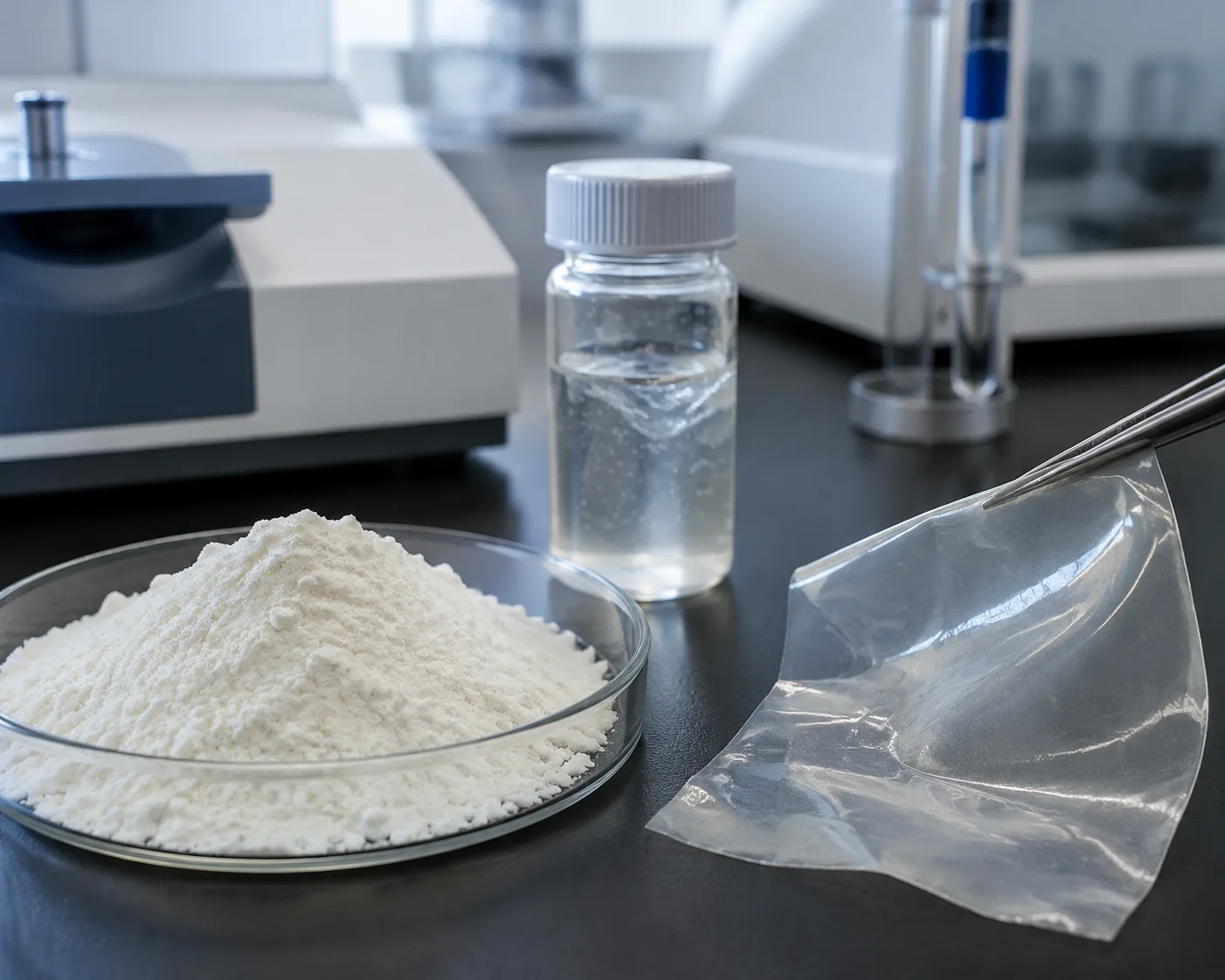
- ASTM F2103, Standard Guide for Characterization and Testing of Chitosan Salts as Starting Materials Intended for Use in Biomedical and Tissue-Engineered Medical Product Applications (astm.org) — the master characterization guide for chitosan. It defines the parameters that must be characterized to confirm the identity, the consistency and the functionality of a chitosan lot: degree of deacetylation, molecular weight, viscosity, moisture, ash, heavy metals, proteins, bioburden, and the relevant physical and chemical properties. The guide is recognized by the FDA as the consensus standard for chitosan used in tissue-engineered medical products.
- ASTM F2602, Standard Test Method for Determining the Molar Mass of Chitosan by Size Exclusion Chromatography with Multi-Angle Light Scattering Detection (SEC-MALS) (astm.org) — the companion test method to F2103 for the molecular-weight measurement. It specifies the SEC-MALS procedure for chitosan chlorides, chitosan glutamates and chitosan base, with the multi-angle light-scattering detection that returns the absolute molar mass without the column-calibration assumptions that compromise conventional SEC.
- GB 29941, National food safety Standard for Food Additives — Deacetylated Chitin (Chitosan) (std.samr.gov.cn) — the Chinese food-additive specification for chitosan, covering the quality requirements (degree of deacetylation, viscosity, drying loss, ash, heavy metals) that a chitosan lot must meet to be used as a food additive in the Chinese market.
- ISO 10993, Biological evaluation of medical devices — the biocompatibility framework for chitosan destined for medical-device or tissue-engineering applications, run on chitosan fabricated into the device form rather than on the raw polymer.
- The general analytical-method standards — NMR spectroscopy, FTIR spectroscopy, XRD, elemental analysis, DSC, TGA, titration, HPLC — referenced by F2103 and GB 29941 for the individual property measurements.
A common misconception in specifications we receive is that "chitosan testing" is a single test. It is not. The degree of deacetylation and the molecular weight are independent parameters measured by independent methods, and a chitosan lot conforms to its grade only when both are in specification. A conformity report that quotes only the degree of deacetylation, or only the molecular weight, answers only half the question a customer or a regulator will ask. ASTM F2103 exists precisely to make the full parameter set explicit, and a project scoped to F2103 covers all of it.
How is the degree of deacetylation measured?
The degree of deacetylation (DD) is the single most important parameter of a chitosan sample. It is the percentage of the repeat units that have been converted from the N-acetylamide form (the chitin starting material) to the free-amine form (the chitosan product). The DD governs the chitosan's solubility in dilute acid, its charge density (the free amines protonate and make chitosan a cationic polyelectrolyte), its gelling behaviour, its antimicrobial activity, and its capacity for chemical derivatization. A chitosan with a low DD behaves more like chitin (insoluble, weak activity); a chitosan with a high DD behaves more like the idealized fully-deacetylated product (acid-soluble, high activity). ASTM F2103 and the academic literature agree that DD is the parameter that must be measured, but they offer several methods that answer the question at different accuracies and different costs.
¹H NMR spectroscopy is the reference method. The NMR spectrum resolves the acetyl-group protons (the N-acetyl peak near δ 2.0 ppm) from the sugar-ring protons (H1 near δ 4.8 ppm, H2 near δ 3.1 ppm, the H3-H6 envelope near δ 3.6-3.8 ppm), and the DD is calculated from the ratio of the acetyl-peak area to a reference peak area. The method is direct — it counts the acetyl groups and the glucosamine units, rather than inferring the DD from a correlated property — and it is the method ASTM F2103 cites for the DD measurement. The ¹³C NMR spectrum provides complementary information, and advanced NMR methods (homonuclear band-selective, pure-shift NMR) can resolve the pattern of acetylation, not just the average DD — a property that affects chitosan's enzymatic degradation behaviour but that the simpler DD methods do not capture.
FTIR spectroscopy is the most widely used alternative, because the equipment is more accessible than NMR and the measurement is faster. The DD is calculated from the ratio of the amide-band area (the C=O peak near 1648 cm⁻¹, whose intensity scales with the acetyl content) to a reference band that does not change with the DD (the C-H stretching or the C-O-C skeletal band). The method is empirical — the peak-area ratio must be calibrated against NMR-reference samples — and it is less accurate than NMR on borderline DD values, but for routine lot-acceptance work it is the practical choice.
Elemental analysis (EA) calculates the DD from the carbon-to-nitrogen mass ratio. Fully deacetylated chitosan has a C/N ratio of 5.145 (7.5 % hydrogen, 8.7 % nitrogen); fully acetylated chitin has a C/N ratio of 6.861 (6.9 % nitrogen). The measured C/N ratio falls between these two endpoints and yields the DD. The method is accurate when the elemental analyzer is well-calibrated and the chitosan is free of nitrogen-containing impurities; protein residue, in particular, biases the nitrogen measurement and inflates the apparent DD.
Potentiometric and conductometric titration dissolve the chitosan in acid and titrate with base, with the endpoint detected by pH electrode (potentiometric) or by conductivity (conductometric). The titration counts the free-amine groups, and the DD is calculated from the amine-group moles relative to the total repeat-unit moles. The method is simple and inexpensive, and it is the historical referee method for DD, but it is sensitive to the chitosan's purity and to the presence of acidic or basic impurities.
The choice among these methods for a given project is driven by the required accuracy and the application. For biomedical-grade chitosan under ASTM F2103, NMR is the reference and FTIR is the routine. For food-additive chitosan under GB 29941, the titration method is commonly applied. For research-grade work where the pattern of acetylation matters, the advanced NMR methods are the only route. A laboratory that reports only one method without stating which, and without the calibration traceability, leaves the DD result open to challenge.
How is molecular weight determined?
The molecular weight (more precisely, the molar mass and its distribution) is the second defining parameter of a chitosan grade. It governs the chitosan's solution viscosity, its film-forming and gel-forming behaviour, its mucoadhesion, and its degradation kinetics in service. A chitosan with a high molecular weight produces viscous solutions and slow-degrading materials; a chitosan with a low molecular weight produces low-viscosity solutions and fast-degrading materials, and at the oligosaccharide end of the range the biological activity profile changes qualitatively. The molecular-weight measurement is specified under ASTM F2602 by SEC-MALS — size-exclusion chromatography with multi-angle light-scattering detection.
The SEC-MALS measurement runs as follows. The chitosan is dissolved in the mobile phase (an acidic aqueous buffer that keeps the chitosan in solution), injected onto a size-exclusion column that separates the chains by hydrodynamic volume, and the eluent flows through a multi-angle light-scattering detector and a refractive-index detector in series. The MALS detector measures the angular dependence of the scattered light at each elution slice, and the absolute molar mass at each slice is calculated from the light-scattering equation — without column calibration, without reference standards, and without the assumptions that compromise conventional SEC. The refractive-index detector measures the concentration at each slice, and the two signals together produce the full molar-mass distribution: the weight-average molar mass (Mw), the number-average molar mass (Mn), and the polydispersity index (PDI = Mw/Mn).
The PDI is a property ASTM F2103 explicitly reports. Commercial chitosans typically have polydispersity values between 1.5 and 3.0 — a range that reflects the heterogeneous deacetylation and the chain-scission the production process produces. A chitosan with a PDI near 1.5 is relatively uniform; a chitosan with a PDI near 3.0 contains a broad mix of chain lengths, which may matter if the application is sensitive to the low-molecular-weight tail (rapid degradation) or the high-molecular-weight tail (high viscosity, slow dissolution).
Two older molecular-weight methods remain in use as alternates, and a complete project should name which is applied. Conventional SEC with column calibration against polymer standards (pullulan, dextran, polyethylene oxide) returns a relative molar mass — the molar mass the chitosan would have if it behaved like the calibration standard — and the result depends on the standard chosen, because chitosan's hydrodynamic volume per unit mass differs from the standards'. Intrinsic viscosity with the Mark-Houwink equation converts a measured intrinsic viscosity to a viscosity-average molecular weight, and the result is accurate when the Mark-Houwink constants for the specific chitosan-solvent-temperature system are known. Both methods are useful for relative comparisons within a chitosan family; neither is a substitute for the absolute molar mass that SEC-MALS returns. ASTM F2602 exists precisely because the relative methods were not adequate for the biomedical regulatory submission, and a project scoped to F2103 should use F2602 for the molecular-weight measurement.
What spectroscopic methods identify chitosan?
Identification — confirming that a sample is chitosan, and distinguishing it from chitin and from chitosan derivatives — is the first question a conformity project answers, before the DD and the molecular-weight measurements. The spectroscopic methods supply the identification, and each one also contributes characterization information beyond the identity.
FTIR spectroscopy is the most widely applied identification method, and the literature analysis confirms it is the most-published chitosan technique. The chitosan FTIR spectrum exhibits the characteristic bands: N-H symmetric stretching near 3345 cm⁻¹, the overlapping N-H and O-H stretching envelope from 3215-3315 cm⁻¹, C-H stretching near 2864 cm⁻¹, the Amide I band near 1648 cm⁻¹, the Amide II band near 1594 cm⁻¹, the N-H bending from the free amine near 1573 cm⁻¹, the C-O-C antisymmetric stretching near 1150 cm⁻¹, and the C-O skeletal stretching near 1026 cm⁻¹. The relative intensities of the amide bands and the amine bands carry the DD information; the band positions distinguish α-chitin, β-chitin and chitosan; and the spectrum can confirm the success of a derivatization reaction by the appearance or disappearance of the functional-group bands. The method is fast, requires minimal sample preparation, and is the routine identification tool.
NMR spectroscopy supplies the identification and the DD in one measurement, as described above. The ¹H NMR spectrum is the definitive identification: the H1, H2, H3-H6 and N-acetyl peaks appear at their characteristic chemical shifts, and no other common biopolymer produces the same pattern.
X-ray diffraction (XRD) characterizes the crystalline structure. The chitosan diffractogram exhibits two main peaks at approximately 10° and 20° 2θ. The 10° peak corresponds to the 020 plane (the acetylated-amine group, the residual chitin crystallinity); the 20° peak corresponds to the 110 plane (the free-amine group, the chitosan crystallinity). As the DD increases, the 10° peak shifts to higher angle and its intensity decreases, and the 20° peak shifts to lower angle — a behaviour that allows XRD to estimate the DD by the crystallinity-index method. β-chitosan, which differs from α-chitin in its intermolecular packing, lacks the 10° peak; chitosan nanoparticles show a weakened and broadened 20° peak, indicating reduced crystallinity. XRD is the method that distinguishes the allomorph (α vs β) and that tracks the crystallinity change that processing (milling, derivatization) produces.
Elemental analysis (EA) supplies the bulk carbon, hydrogen and nitrogen content, and the C/N ratio yields the DD as described. EA is also the method that catches the protein-contaminated chitosan, because the elevated nitrogen content is the tell.
UV-Vis spectroscopy has a more specialized role: the chitosan-in-solution concentration is measured by the Cibacron Brilliant Red complex (absorbance at 575 nm), the first-derivative UV method quantifies the DD from the acetylglucosamine absorbance near 203 nm, and the ninhydrin assay quantifies the free-amine content by the 570 nm absorbance. These are the methods used when the chitosan is in a matrix (a solution, a formulation, a food product) and must be quantified rather than identified.
The identification is complete when at least two of these methods agree — FTIR for the functional-group confirmation and NMR or XRD for the structural confirmation. A single-method identification is weaker, because each method has its ambiguities (FTIR can misidentify a chitosan derivative as chitosan; XRD cannot distinguish a low-DD chitosan from chitin); the cross-method confirmation is what makes the identification defensible.
How are thermal and crystalline properties characterized?
The thermal and crystalline properties of chitosan are characterized for two reasons: to qualify the chitosan for a thermal-processing application (extrusion, film-casting, sterilization), and to confirm that the chitosan as received matches the grade's thermal signature (a fingerprint that catches a misgraded or contaminated lot).
Differential scanning calorimetry (DSC) measures the heat flow into or out of the chitosan as a function of temperature. The chitosan DSC thermogram exhibits two characteristic events: an endotherm below 100 °C corresponding to the loss of adsorbed water, and an exotherm near 300 °C corresponding to the decomposition of the chitosan pyranose ring. The melting point of chitosan, where detectable, is on the order of 110 °C, though chitosan's semi-crystalline and hydrogen-bonded structure means the melting endotherm is broad and the melting point is less sharply defined than for a low-molecular-weight crystal. The water-loss endotherm is the practically important feature, because it quantifies the moisture content that affects the chitosan's handling, dissolution and weight-based dosing.
Thermogravimetric analysis (TGA) measures the chitosan mass as a function of temperature. The TGA curve exhibits two main weight-loss steps: the first, from 50 to 110 °C, is the absorbed-water loss (typically 5-8 % for solid chitosan); the second, from 190 to 330 °C, is the depolymerization and the saccharide-ring decomposition (on the order of 50 % weight loss at around 300 °C for solid chitosan). The derivative thermogravimetry (DTG) curve resolves the degradation steps more sharply, and the DD dependence is visible: a higher DD produces a larger high-temperature weight loss. TGA is the measurement that confirms the chitosan's thermal stability under the processing conditions it will see in service, and it is the measurement that catches a chitosan whose thermal signature differs from the grade's — a difference that indicates either a misgraded lot or a contamination.
XRD, described above for the identification, also characterizes the crystalline structure and its response to processing. The crystallinity index calculated from the XRD peaks is a property that changes with the DD (the free-amine-rich chitosan is more crystalline than the acetyl-rich chitin), with the milling (milling destroys the crystalline structure), and with the derivatization (N-acylation with longer acyl chains sharpens the 10° peak and expands the crystal lattice). The XRD crystallinity is the property that correlates with the chitosan's solubility, its swelling behaviour and its mechanical properties in the fabricated form, and it is the measurement that confirms the chitosan's structural integrity through a processing step.
The thermal and crystalline characterization is not always a regulatory requirement — F2103 does not mandate DSC and TGA the way it mandates the DD and the molecular weight — but it is a routine part of a complete chitosan characterization, and it is indispensable when the chitosan is destined for a thermal-processing application or when a lot is being investigated for a performance failure.
How do application-specific tests qualify chitosan?
The DD, the molecular weight, and the spectroscopic-thermal identification characterize the chitosan as a material. The application-specific tests qualify the chitosan for the application it is destined for — and these tests vary by application, because the chitosan in a wound dressing, in a food additive, in a water-treatment flocculant, and in a drug-delivery nanoparticle is qualified against different performance criteria.
For biomedical and tissue-engineering chitosan, ASTM F2103 defines the full parameter set, and the biocompatibility evaluation under ISO 10993 qualifies the chitosan in its fabricated form. The F2103 parameters extend beyond the DD and the molecular weight to include the moisture, the ash (the residual inorganic content from the production), the heavy metals (the lead, arsenic, cadmium, mercury that the shell-waste raw material can carry), the protein residue (the residual protein from the deproteinization step, measured because protein contamination affects the immunogenicity), and the bioburden (the microbial limits for a material destined for a medical device). A biomedical-grade chitosan project reports all of these; a project that reports only the DD and the molecular weight is incomplete for the biomedical submission.
For food-additive chitosan, GB 29941 defines the quality requirements, and the use of chitosan as a food additive is further governed by GB 2760 (the food-additive use standard, which specifies the permitted applications and the maximum use levels). The GB 29941 parameters include the degree of deacetylation, the viscosity, the drying loss, the ignited residue (ash), and the heavy-metal limits. A food-additive chitosan project reports against GB 29941 and confirms that the intended use is permitted under GB 2760.
For nanoparticle and drug-delivery chitosan, the characterization extends to the particle-level properties: the particle size and the size distribution (the polydispersity index, PDI) by dynamic light scattering, the surface charge (the zeta potential) by electrophoretic light scattering, the encapsulation efficiency of the loaded active, the in-vitro release kinetics, and the morphology by electron microscopy. These tests characterize the formulated chitosan nanoparticle rather than the raw chitosan, and they are the tests that qualify the formulation for its delivery application. Representative values from the published literature illustrate the parameter ranges: chitosan-coated nanoliposomes with particle sizes from 84 nm to 580 nm, PDI values below 0.5, zeta potentials that shift from negative (−33 mV) for the uncoated liposome to positive (+33.7 mV) for the chitosan-coated liposome, and encapsulation efficiencies up to 89 %.
For film and coating chitosan, the characterization extends to the film's mechanical properties (tensile strength, elongation), the barrier properties (water-vapour permeability, oxygen transmission), and the optical properties (transparency, colour). These tests qualify the chitosan film for the packaging or coating application.
The common thread across the application-specific tests is that they qualify the chitosan in the form it will be used, not just as a raw material. A chitosan that conforms to ASTM F2103 as a raw material can still fail in a specific application if the application-specific properties are not met, and the application-specific tests are the check that catches this. A complete project scopes both the raw-material characterization and the application-specific qualification, and reports them as the two complementary halves of the conformity argument.
What does the Chinese GB 29941 standard cover?
GB 29941, the National Food Safety Standard for Food Additives — Deacetylated Chitin (Chitosan), is the Chinese specification that a chitosan lot must satisfy to be used as a food additive in the Chinese market. It is the counterpart, for the food-additive application, of ASTM F2103 for the biomedical application — same product, different regulatory framework, different parameter emphasis.
GB 29941 applies to chitosan produced from chitin or from crustacean (shrimp, crab) shell waste, by the decalcification, deproteinization and deacetylation sequence. The standard specifies:
- The degree of deacetylation, as the defining parameter of chitosan (the property that distinguishes it from the chitin precursor).
- The viscosity, measured at a defined concentration (10 g/L) and temperature (20 °C), reported in mPa·s. The viscosity is the application-critical property for the food-additive uses — thickening, film-forming, clarifying — because it determines the chitosan's effect on the food matrix at the use level.
- The drying loss (the moisture content), because the moisture affects the chitosan's weight-based dosing and its microbial stability in storage.
- The ignited residue (ash), the residual inorganic content from the shell-waste raw material, because excessive ash indicates incomplete decalcification.
- The heavy-metal limits, because the shell-waste raw material can carry lead, arsenic, cadmium and mercury from the marine environment, and the food-additive application requires these to be below the toxicological thresholds.
The use of chitosan as a food additive is governed by GB 2760, the Standard for Uses of Food Additives, which specifies the permitted food categories and the maximum use levels. Under GB 2760, chitosan (deacetylated chitin) is permitted as a thickening and coating agent in applications including rice (maximum use level 0.1 g/kg), and as a clarifying agent in fruit and vegetable juices, plant-based beverages and beer. A GB 29941 conformity project that does not also confirm the GB 2760 use permission is incomplete, because a chitosan that meets the quality specification is not automatically permitted in every food category.
A cross-regime consideration that affects specifications we receive: ASTM F2103 and GB 29941 are not interchangeable. A chitosan lot that has been characterized under F2103 for biomedical use does not automatically satisfy GB 29941 for food-additive use, because the parameter sets and the limits differ. A chitosan intended for both markets must be tested against both standards, and the report must name each standard it addresses. We confirm the target application and the target market before quoting, because the standard set is determined by the answers.
FAQ
Which standard should my chitosan be tested to?
It depends on the application and the market. Biomedical and tissue-engineering chitosan is characterized under ASTM F2103, with the molecular weight measured under ASTM F2602 and the biocompatibility under ISO 10993. Food-additive chitosan for the Chinese market is tested under GB 29941, with the use permission confirmed under GB 2760. We confirm the application and the market before quoting, because the parameter sets differ.
What is the degree of deacetylation, and why does it matter?
The DD is the percentage of the chitosan's repeat units that carry a free amine (rather than the N-acetyl group of the chitin precursor). It is the single most important chitosan parameter because it governs the solubility in dilute acid, the cationic charge density, the gelling behaviour, the antimicrobial activity and the capacity for chemical derivatization. ASTM F2103 and the academic literature treat the DD as the parameter that must always be measured, and the method chosen (NMR, FTIR, elemental analysis, titration) is driven by the required accuracy and the application.
Why is SEC-MALS specified for the molecular weight rather than conventional SEC?
Conventional SEC with column calibration returns a relative molar mass — the molar mass the chitosan would have if it behaved like the calibration standard (pullulan, dextran) — and the result depends on the standard chosen. SEC-MALS returns the absolute molar mass from the light-scattering equation, without calibration assumptions, and it is the method ASTM F2602 specifies because the relative methods were not adequate for the biomedical regulatory submission. For routine lot-to-lot comparison a relative method may suffice; for a conformity report or a regulatory submission, SEC-MALS is the reference.
Can you identify whether my sample is chitosan or chitin?
Yes. FTIR spectroscopy distinguishes chitosan from chitin by the relative intensities of the amide bands (stronger in chitin) and the amine bands (stronger in chitosan); XRD distinguishes them by the crystalline-peak pattern; and ¹H NMR confirms the DD that separates chitosan (high DD) from chitin (low DD). A cross-method identification is the defensible approach, because each method has its ambiguities.
Do you test chitosan nanoparticles or films as well as the raw chitosan?
Yes. Raw chitosan is characterized under ASTM F2103 / GB 29941. Chitosan nanoparticles are characterized for particle size, PDI, zeta potential, encapsulation efficiency and morphology by DLS, zeta-potential analysis and SEM. Chitosan films are characterized for tensile properties, barrier properties and optical properties. The application-specific tests qualify the chitosan in the form it will be used, and a complete project covers both the raw-material characterization and the application-specific qualification.
Our chitosan testing service
Our laboratory provides chitosan testing across the full standard and method stack — ASTM F2103 for the biomedical-grade characterization guide, ASTM F2602 for the SEC-MALS molecular-weight measurement, GB 29941 for the Chinese food-additive specification, ISO 10993 for the biocompatibility evaluation, and the full range of analytical-method standards for the individual property measurements. Each project begins with a scoping step that confirms the application (biomedical, food additive, nanoparticle, film, water treatment), the target market, and the corresponding standard set, so the report you receive answers the question your customer, your regulator or your quality system will actually ask.
We measure the degree of deacetylation by ¹H NMR (the reference method) with FTIR, elemental analysis and titration as the routine alternatives; we measure the molecular weight and the polydispersity by SEC-MALS under ASTM F2602; we identify the chitosan and distinguish it from chitin and chitosan derivatives by FTIR, NMR and XRD; we characterize the thermal properties by DSC and TGA and the crystalline structure by XRD; we run the heavy-metal, ash, moisture and bioburden tests under F2103 and GB 29941; and we run the application-specific tests — particle size and zeta potential for nanoparticles, tensile and barrier for films, release kinetics for drug-delivery systems — for the formulated chitosan. Reports are issued with the standard, the method, the measured value, the limit and the conformity conclusion explicitly stated, with the spectra and the chromatograms included where the result depends on them, in a format suitable for regulatory submission, customer qualification, lot acceptance or failure investigation.
To start a project, send us the chitosan grade and the manufacturer's datasheet, the application and the target market, the standard you believe applies (or let us confirm it), and whether the project is raw-material characterization, application-specific qualification, or both. We will return a project scope, sample requirement, schedule and quotation, and begin testing on your confirmation.