Table of Contents
- What is copper busbar testing?
- The standard stack: GB/T 5585, IEC 61439, EN 13601, ASTM B187, JIS H 3140
- Material classification: T1, TU1, T2, T3, TMY, plated
- Material test 1: Conductivity (% IACS) and the four-wire resistance method
- Material test 2: Tensile strength, elongation, hardness
- Material test 3: Chemical composition — Cu purity, oxygen content
- Surface-treatment test: plating thickness and the 96-hour salt spray
- Dimensional inspection: width, thickness, flatness, edge radius
- IEC 61439-1 type tests: temperature rise, dielectric, short-circuit withstand
- Contact resistance and the four-wire measurement
- FAQ
- Our copper busbar testing capabilities
What is copper busbar testing?
Copper busbar testing is the measurement and validation of the material, mechanical, electrical, surface-treatment, and dimensional properties of a copper busbar — the rectangular, tubular, or shaped solid copper conductor used in low- and medium-voltage switchgear, distribution panels, transformers, generator connections, EV battery packs, and renewable-energy collection systems to carry high current with minimal loss. The output of a copper busbar test is a dossier covering the conductivity (≥ 97-101 % IACS depending on grade), the mechanical properties (tensile strength 195-450 MPa, elongation 6-40 %, Vickers hardness 40-120 HV), the chemical composition (Cu purity ≥ 99.90 %, oxygen ≤ 10 ppm for oxygen-free grades), the plating thickness and corrosion resistance (5-25 µm Sn/Ni/Ag with ≥ 96 h salt spray), the dimensions (width, thickness, flatness, edge radius), and — when the busbar is part of an assembly — the IEC 61439-1 type tests (temperature rise, dielectric withstand, short-circuit withstand, creepage and clearance, IP protection degree, mechanical operation).
A copper busbar is the spine of any power-distribution system. It carries currents from a few hundred amperes (LV distribution) to tens of thousands of amperes (generator bus, EV fast-charging), at voltages from 400 V (commercial building LV) to 36 kV (MV substation busbar). The busbar's performance determines the efficiency (the I²R loss, which becomes heat), the safety (the temperature rise, the short-circuit withstand, the creepage and clearance), and the reliability (the contact resistance at bolted joints, the corrosion of the plating) of the entire electrical system. A busbar that is under-sized for its current will overheat and fail; a busbar with poor plating will corrode and develop high contact resistance; a busbar with insufficient mechanical strength will deform under short-circuit electromagnetic force. Copper busbar testing is the verification that the busbar meets the design specification and the applicable standard for each of these properties.
The standards governing copper busbar testing span the Chinese GB/T 5585.1-2005 Copper and aluminium busbar for electrical purposes — Part 1: Copper busbar, the international IEC 61439-1:2020 Low-voltage switchgear and controlgear assemblies (the type-test framework for the assembly that the busbar is part of), the European EN 13601:2013 Copper and copper alloys — Copper busbar for electrical purposes, the American ASTM B187/B187M-16 Standard Specification for Copper, Bus Bar, Rod, and Shapes and General Purpose Rod, Bar, and Shapes, and the Japanese JIS H 3140 Copper busbar. A copper busbar placed on the Chinese market must satisfy GB/T 5585.1-2005 and, when part of an assembly, the applicable IEC 61439-1 / GB 7251 type test.
The standard stack: GB/T 5585, IEC 61439, EN 13601, ASTM B187, JIS H 3140
A complete copper busbar testing project draws on a stack of Chinese, international, European, American, and Japanese standards.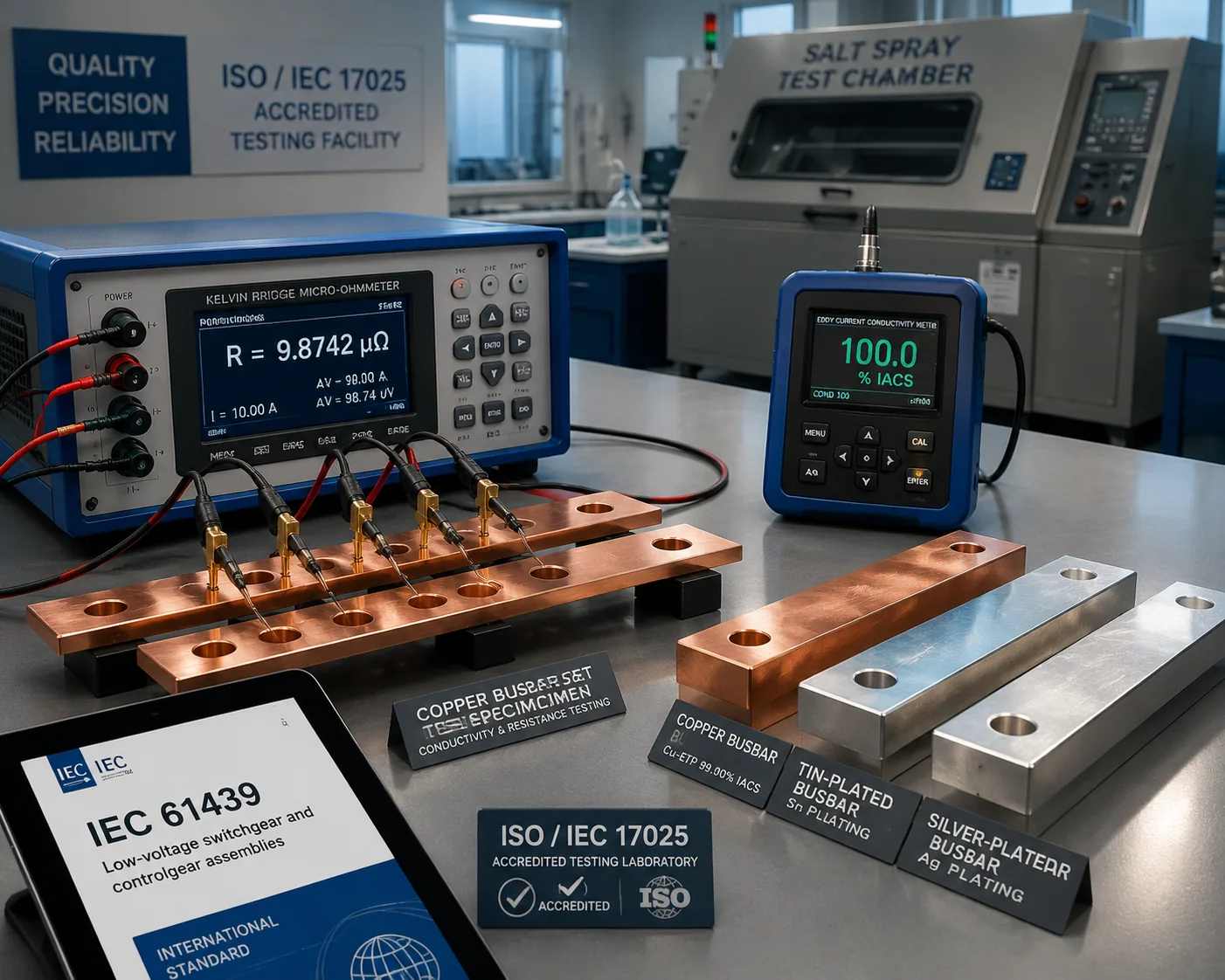
| Family | Standard | Scope |
|---|---|---|
| GB/T 5585.1-2005 | Copper and aluminium busbar for electrical purposes — Part 1: Copper busbar | The Chinese national standard for copper busbar; material grade (T2, TU1, TU2), dimensions (thickness × width), tolerances, mechanical properties, electrical resistivity, test methods |
| GB/T 5585.2-2005 | Part 2: Aluminium and aluminium alloy busbar | The companion standard for aluminium busbar (cross-reference) |
| GB/T 5231-2012 | Wrought copper and copper alloy chemical composition | The Chinese standard for the chemical composition of the copper grades used in busbar |
| GB/T 11021-2014 | Electrical insulation — Thermal endurance properties — Thermal classification | The Chinese thermal-class (A/E/B/F/H/C) standard for the insulation on the busbar |
| IEC 61439-1:2020 | Low-voltage switchgear and controlgear assemblies — Part 1: General rules | The international type-test framework; 12 type tests including temperature rise, dielectric, short-circuit withstand — the framework that applies when the busbar is in an assembly |
| IEC 60468:1974 | Methods of measurement of resistivity of metallic materials | The international resistivity measurement method |
| IEC 60068-2-11 (salt mist) and IEC 60068-2-52 (cyclic salt mist) | Environmental testing — salt mist | The international salt-spray methods for the plated busbar |
| EN 13601:2013 | Copper and copper alloys — Copper busbar for electrical purposes | The European copper busbar standard; harmonised with the German DIN 46435 |
| ASTM B187/B187M-16 | Standard Specification for Copper, Bus Bar, Rod, and Shapes | The US copper busbar specification; C11000, C10200, C10100 |
| ASTM B152/B152M-13 | Standard Specification for Copper Sheet, Strip, Plate, and Rolled Bar | The US copper flat product specification (cross-reference for busbar) |
| JIS H 3140:2018 | Copper busbar | The Japanese copper busbar standard |
| GB/T 2423.17-2008 (≡ IEC 60068-2-11) | Environmental testing — Salt mist | The Chinese salt-spray method |
| GB/T 4955-2005 (≡ ISO 2177) | Metallic coatings — Measurement of coating thickness — Coulometric method | The Chinese plating-thickness method (anodic dissolution) |
| GB/T 16921-2005 (≡ ISO 3497) | Metallic coatings — Measurement of coating thickness — X-ray spectrometric methods | The Chinese plating-thickness method (XRF) |
| ISO 6892-1 | Metallic materials — Tensile testing — Part 1: Room temperature | The international tensile-test method |
| ISO 6507-1 | Metallic materials — Vickers hardness test | The international Vickers hardness method |
| IEEE C37.20 | Standard for Metal-Enclosed Low-Voltage Power Circuit Breaker Switchgear | The US switchgear standard that invokes busbar type tests |
The single most consequential fact for a Chinese manufacturer is that GB/T 5585.1-2005 is the NMPA / SAMR-mandated standard for copper busbar, and when the busbar is part of a switchgear / panelboard / motor control centre, the IEC 61439-1 / GB 7251.1 type tests also apply, including the temperature rise, the dielectric withstand, and the short-circuit withstand that verify the busbar's performance in service.
Material classification: T1, TU1, T2, T3, TMY, plated
Copper busbar is classified by the purity of the copper, the state (annealed soft O, hard R), and the surface treatment. The Chinese GB/T 5585 grade designations (cross-referenced to the ASTM and EN designations) define the material specifications.
| Grade (GB/T) | Description | Cu purity | Conductivity (% IACS) | Oxygen content | Typical tensile (MPa) | ASTM equivalent | EN equivalent |
|---|---|---|---|---|---|---|---|
| T1 / TU1 | Oxygen-free electronic copper | ≥ 99.95 % | ≥ 101 % | ≤ 10 ppm | 200-250 (O) | C10200 (OFC) | Cu-OFE |
| T2 | Electrolytic tough-pitch (ETP) copper | ≥ 99.90 % | ≥ 100 % | 200-400 ppm | 220-280 (O) | C11000 (ETP) | Cu-ETP |
| T3 | General-purpose phosphorised copper | ≥ 99.70 % | ≥ 98 % | variable | 240-300 (O) | C11300 | Cu-FRHC |
| TMY | Hard-state T2 busbar (cold-worked, R-state) | ≥ 99.90 % | ≥ 97 % | 200-400 ppm | 350-450 (R) | C11000 (H) | Cu-ETP (H) |
| TM (soft, O-state) | Annealed soft busbar | ≥ 99.90 % | ≥ 100 % | 200-400 ppm | 200-260 (O) | C11000 (O) | Cu-ETP (O) |
| Tin-plated T2 | T2 copper with 5-25 µm tin plating | (T2 base) | (T2 base) | (T2 base) | (T2 base) | ASTM B33 (tin-plated wire); ASTM B545 (tin plating) | EN 13601 tin-plated |
| Silver-plated T2 | T2 copper with 5-15 µm silver plating | (T2 base) | (T2 base) | (T2 base) | (T2 base) | ASTM B298 (silver-plated wire) | EN 13601 silver-plated |
| C10100 (OFE) | Highest-purity oxygen-free electronic copper | ≥ 99.99 % | ≥ 101 % | ≤ 5 ppm | 200-250 (O) | C10100 | Cu-OFE |
| Special alloys (CdCu, CuCrZr, CuZr) | Copper alloys with cadmium, chromium, zirconium for elevated-temperature strength | 99.0-99.6 % | 75-95 % | n/a | 400-600 | C16200 / C18150 / C15000 | EN alloys |
The selection of the grade is driven by the application: T2 (C11000 ETP) is the workhorse for general LV and MV busbar; T1 / TU1 (C10200 OFC) is preferred for high-frequency, welding, vacuum, and hydrogen-sensitive applications (no hydrogen embrittlement); TMY (hard R-state) is preferred where the busbar is a structural element (no bending, vibration-resistant); tin-plated for outdoor, marine, and high-humidity; silver-plated for high-current contacts and sulphur-rich environments.
Material test 1: Conductivity (% IACS) and the four-wire resistance method
The conductivity of the copper busbar is the single most important material property — it directly determines the I²R loss and the temperature rise. The conductivity is expressed as a percentage of the International Annealed Copper Standard (% IACS), where 100 % IACS = resistivity 1.7241 µΩ·cm (annealed copper at 20 °C).
Reference method — four-wire resistance measurement (IEC 60468) — A defined length L (typically 1 m) of the busbar is held at constant temperature (20 ± 0.5 °C); a known DC current I (typically 10-100 A) is passed through the busbar through the outer "current" leads; the voltage drop V across the inner "voltage" leads (separated by the measured length L) is measured with a high-impedance voltmeter. The resistance R = V/I; the resistivity ρ = R × A / L where A is the cross-sectional area; the conductivity σ = (1.7241 / ρ) × 100 % IACS.
Acceptance per GB/T 5585.1-2005:
- T1 / TU1: ≥ 101 % IACS (resistivity ≤ 1.707 µΩ·cm)
- T2: ≥ 100 % IACS (resistivity ≤ 1.724 µΩ·cm)
- T3: ≥ 98 % IACS
- TMY (hard R-state): ≥ 97 % IACS
A modern conductivity meter (e.g. the Sigmascope SMP10, the Fischer SigmaScope) uses the eddy-current method and gives a direct % IACS reading without the four-wire setup — used for production-line QC. The four-wire method remains the reference for the type test and for arbitration.
Material test 2: Tensile strength, elongation, hardness
The mechanical properties verify that the busbar will withstand the forming (bending, punching) during fabrication and the electromagnetic load (the Lorentz force between parallel busbars under short-circuit current) during service.
| Property | Method | Acceptance per GB/T 5585.1-2005 |
|---|---|---|
| Tensile strength | ISO 6892-1 (room-temperature tensile test on a machined specimen) | T2 soft (O): 195-260 MPa; TMY hard (R): 245-345 MPa |
| Elongation | ISO 6892-1 (the elongation at fracture, on the same tensile specimen) | T2 soft (O): ≥ 35 %; TMY hard (R): 6-15 % |
| Vickers hardness | ISO 6507-1 (HV 5 or HV 10) | T2 soft (O): 40-65 HV; TMY hard (R): 80-120 HV |
| Bend test | GB/T 232 (bend around a mandrel of defined radius, no cracking) | T2 soft (O): bend radius 1 × thickness, no crack; TMY hard (R): bend radius 2 × thickness, no crack |
The bend test is a fabrication-control test — a busbar that cracks when bent to the standard radius cannot be installed in the panel shop. The tensile test verifies the heat-treat state (soft vs hard) and the chemical composition (impurities that embrittle the copper reduce the elongation).
Material test 3: Chemical composition — Cu purity, oxygen content
The chemical composition of the copper is the foundation of the conductivity and the workability. The grade is defined by the Cu purity and the oxygen content.
| Analyte | Method | Acceptance |
|---|---|---|
| Cu purity | X-ray fluorescence (XRF, per GB/T 26042) for production-line; ICP-OES or ICP-MS (per GB/T 5121) for reference | T1 / TU1 ≥ 99.95 %; T2 ≥ 99.90 %; T3 ≥ 99.70 % |
| Oxygen content | Inert-gas fusion (LECO, per GB/T 3884.10) for OFC; metallographic cross-section for ETP | TU1 ≤ 10 ppm; T1 ≤ 10 ppm; T2 (ETP) 200-400 ppm |
| Impurities (Ag, As, Bi, O, Pb, S, Sb, Se, Te) | ICP-OES per GB/T 5121 | Each per the grade limit (typically ≤ 5-50 ppm each) |
The oxygen content is the key distinguishing parameter between TU1 (oxygen-free, ≤ 10 ppm, immune to hydrogen embrittlement, used in vacuum devices and welding) and T2 (ETP, 200-400 ppm oxygen as Cu₂O, susceptible to hydrogen embrittlement at high temperature, used in general busbar). The XRF measurement of Cu purity is the production-line QC method; the ICP-OES is the reference method; the LECO oxygen is the method that distinguishes OFC from ETP.
Surface-treatment test: plating thickness and the 96-hour salt spray
Copper oxidises in air (forming cupric oxide that raises contact resistance), so most busbars are plated with tin, nickel, or silver for corrosion protection, solderability, and contact-resistance stability.
| Treatment | Thickness | Thickness method | Salt spray |
|---|---|---|---|
| Tin plating | 5-25 µm (production-line: 5-10 µm electroplated; 10-25 µm hot-dip) | Coulometric (GB/T 4955, ISO 2177) or XRF (GB/T 16921, ISO 3497) | ≥ 96 h to first white rust per IEC 60068-2-11 / GB/T 2423.17 (5 % NaCl, 35 °C); ≥ 720 h for the EBest heavy-duty specification |
| Nickel plating | 5-20 µm | Coulometric or XRF | ≥ 96 h, often ≥ 240 h for the more corrosion-resistant nickel |
| Silver plating | 5-15 µm | Coulometric or XRF | ≥ 96 h; silver tarnishes (sulphide) but does not corrode |
| Adhesion | (qualitative) | Bend test (180° around a mandrel, no peeling) per ASTM B571; or the standard "quill-stamp" adhesion test | — |
The Salt spray test (IEC 60068-2-11 for the steady-state salt mist; IEC 60068-2-52 for the cyclic salt mist) is the corrosion-resistance benchmark — the plated busbar is exposed to a 5 % NaCl mist at 35 °C for the declared duration (96 h typical; 720 h for premium outdoor / marine grades), and the surface is inspected for white rust (the first sign of plating corrosion), red rust (the substrate corrosion), and blistering / peeling. The salt-spray result is the single most-cited plating-quality metric after the thickness.
Dimensional inspection: width, thickness, flatness, edge radius
The dimensional tolerance of the busbar determines the fit in the panel, the contact area at bolted joints, and the consistency of the current-carrying capacity.
| Dimension | Tolerance per GB/T 5585.1-2005 (typical) | Method |
|---|---|---|
| Width (W) | ± 0.15 mm for W up to 25 mm; ± 0.30 mm for W 25-100 mm; ± 0.40 mm for W 100-300 mm | Caliper or CMM |
| Thickness (T) | ± 0.05 mm for T up to 5 mm; ± 0.08 mm for T 5-10 mm; ± 0.10 mm for T 10-30 mm | Micrometer or CMM |
| Flatness | ≤ 1 mm per metre of length | Surface plate and feeler gauge |
| Edge radius | Full-round edge (R = 0.5 × T typical) or slightly-round edge (R = 1.0-2.0 mm) per the customer's specification | Optical comparator or profile projector |
| Squareness (cut end) | ≤ 0.5° from square | Precision square |
| Hole position (for the bolted joints) | ± 0.1 mm typical (production-grade); ± 0.05 mm for precision CNC | CMM |
The edge radius is not just aesthetic — the rounded edge reduces the electric-field concentration (the corona onset at MV) and is therefore a safety-critical dimensional feature for MV busbar.
IEC 61439-1 type tests: temperature rise, dielectric, short-circuit withstand
When the copper busbar is part of a low-voltage switchgear assembly, panelboard, or busbar trunking system (busway), the IEC 61439-1:2020 type tests apply — a set of 12 mandatory tests that verify the assembly's performance under service conditions. The busbar is the central element of each of these tests.
| Type test | What it verifies | Busbar role |
|---|---|---|
| § 10.10 Temperature rise | The busbar temperature rise ≤ 70 K at the rated current (after steady state); measured by thermocouples at the joints and at the mid-span | The busbar I²R loss is the dominant heat source; the busbar cross-section, the joint contact resistance, and the ventilation determine the temperature rise |
| § 10.9 Dielectric properties | Power-frequency withstand 2.5 kV (for rated operational voltage ≤ 300 V) or 3.5 kV (for 300-690 V) applied for 1 min, no flashover or breakdown; impulse withstand 8 kV (for ≤ 300 V) or 12 kV (for 300-690 V), no flashover | The clearance and creepage distances between busbar phases and to ground |
| § 10.11 Short-circuit withstand | The peak current I_pk (the dynamic electromagnetic force) and the short-time withstand current I_cw for 1 s, no busbar deformation, no joint failure | The busbar mechanical strength against the Lorentz force under short-circuit; the bracing, the supports, the joint design |
| § 10.2 Clearance and creepage | The minimum distances in air (clearance) and over the insulation surface (creepage) per the rated voltage and the pollution degree | The busbar-to-busbar and busbar-to-ground spacing |
| § 10.3 Protection circuit continuity | The effective grounding of the busbar enclosure | The busbar-to-ground path |
| § 10.7 IP protection degree | The ingress protection of the enclosure that contains the busbar | The busbar is internal, but the IP test is run with the busbar energised in some cases |
| § 10.8 Mechanical operation | The mechanical durability of the moving parts that interact with the busbar (the breaker contacts) | — |
| § 10.4, § 10.5, § 10.6 | (Other tests — not directly busbar-related) | — |
The temperature-rise test and the short-circuit withstand test are the most busbar-critical — and the most expensive to run (the temperature-rise requires the full-rated current for the time to steady state, often 4-8 hours; the short-circuit requires a high-power test laboratory with a short-circuit generator). A copper busbar that passes the GB/T 5585 material tests may still fail the IEC 61439-1 temperature-rise test if the cross-section is under-sized for the rated current, or fail the short-circuit test if the bracing is insufficient.
Contact resistance and the four-wire measurement
The contact resistance at the bolted joints between busbar sections is the single most important diagnostic of the joint quality — and a key contributor to the temperature rise. A high contact resistance at a joint causes localised heating (I²R loss concentrated at the joint), which accelerates oxidation, which raises the contact resistance further, in a runaway cycle that ends in joint failure.
| Test | Method | Acceptance |
|---|---|---|
| Joint contact resistance | Four-wire micro-ohmmeter (a Kelvin-bridge instrument with 10-100 A test current and µV-level voltage measurement) across the bolted joint | ≤ 0.5 × the resistance of an equivalent length of busbar (per IEC 61439-1 Annex E); typical < 10 µΩ for a 100 mm² joint |
| Joint torque | Torque wrench on the bolted joint per the manufacturer's specification | Per the bolt diameter and the plating (typically 20-80 N·m) |
| Temperature rise at the joint | Thermocouple at the joint, under the full rated current | ≤ 70 K (per IEC 61439-1 § 10.10) |
The contact resistance is measured with a micro-ohmmeter (a Kelvin-bridge instrument with a high test current 10-100 A to swamp the thermoelectric and inductive effects, and a µV-level voltage measurement). The four-wire method eliminates the lead resistance and the contact resistance of the instrument's own clips. The measured joint resistance is compared to the resistance of an equivalent length of busbar; a joint with a contact resistance above 0.5 × the equivalent-length busbar resistance fails IEC 61439-1.
FAQ
What is the GB/T 5585 standard and how does it compare to EN 13601 and ASTM B187?
GB/T 5585.1-2005 is the Chinese national standard for copper busbar (material, dimensions, mechanical, electrical, test methods). EN 13601:2013 is the European equivalent. ASTM B187/B187M-16 is the US equivalent (covering C11000, C10200, C10100 grades). The three are technically aligned but use different grade designations (T2 / C11000 / Cu-ETP). A busbar placed on the Chinese market must satisfy GB/T 5585.1-2005; on the EU market EN 13601; on the US market ASTM B187.
What is the difference between T1/TU1 (OFC) and T2 (ETP) copper busbar?
T1 / TU1 is oxygen-free copper (Cu ≥ 99.95 %, oxygen ≤ 10 ppm, ≥ 101 % IACS), immune to hydrogen embrittlement, used for high-frequency, vacuum, and welding applications. T2 is electrolytic tough-pitch copper (Cu ≥ 99.90 %, oxygen 200-400 ppm as Cu₂O, ≥ 100 % IACS), the workhorse for general busbar. T2 is susceptible to hydrogen embrittlement at high temperature (the Cu₂O + H₂ → Cu + steam reaction embrittles the copper); T1/TU1 is not.
What is the IEC 61439-1 short-circuit withstand test and why does it matter?
The IEC 61439-1 § 10.11 short-circuit withstand test applies the peak short-circuit current I_pk (the dynamic electromagnetic force that tends to deform the busbar) and the short-time withstand current I_cw for 1 second, verifying that the busbar does not deform and the joints do not fail. The busbar must be mechanically braced to withstand the Lorentz force between parallel busbars under the short-circuit current — a bracing failure leads to busbar collapse and arc flash.
Why is the salt spray test 96 hours and what does it verify?
The 96-hour salt spray (5 % NaCl mist at 35 °C per IEC 60068-2-11) is the standard plating-quality benchmark — it verifies that the tin / nickel / silver plating protects the copper substrate from corrosion under humid / saline conditions. The first white rust (the plating's own corrosion product) should not appear before 96 h; the red rust (the copper substrate corrosion) should not appear at all. The 96 h is a minimum; premium outdoor / marine grades specify 720 h.
How is the conductivity of a copper busbar measured?
The reference method is the four-wire resistance measurement (IEC 60468): a known DC current is passed through the busbar, the voltage drop across a defined length is measured, and the resistance is converted to conductivity (% IACS). The production-line method is the eddy-current conductivity meter (e.g. Fischer SigmaScope), which gives a direct % IACS reading without the four-wire setup. The acceptance per GB/T 5585.1-2005 is ≥ 100 % IACS for T2 and ≥ 101 % IACS for T1/TU1.
Our copper busbar testing capabilities
Beijing ZKGX Research (ISO/IEC 17025 accredited, CMA- and CNAS-accredited testing laboratory) provides complete copper busbar testing across the GB/T, IEC, EN, ASTM, and JIS standard stack:
- GB/T 5585.1-2005 copper busbar — material grade (T1, TU1, T2, T3, TMY), dimensions and tolerances, mechanical properties (tensile, elongation, hardness, bend), electrical resistivity / conductivity (% IACS), surface quality.
- Conductivity — four-wire resistance per IEC 60468 with a 10-100 A test current; % IACS reporting against the GB/T 5585 grade limit; eddy-current meter for production-line QC.
- Tensile / elongation / hardness — ISO 6892-1 tensile on a machined specimen; ISO 6507-1 Vickers hardness HV 5 / HV 10; bend test per GB/T 232.
- Chemical composition — Cu purity by XRF (GB/T 26042) or ICP-OES (GB/T 5121); oxygen content by inert-gas fusion (LECO); per the grade limit.
- Plating thickness — Coulometric per GB/T 4955 / ISO 2177; XRF per GB/T 16921 / ISO 3497; per the plating specification (5-25 µm Sn, 5-20 µm Ni, 5-15 µm Ag).
- Salt spray — IEC 60068-2-11 / GB/T 2423.17 steady-state salt mist; IEC 60068-2-52 cyclic salt mist; 96 h standard, up to 720 h for marine / outdoor grades.
- IEC 61439-1 type tests (when the busbar is part of an assembly) — § 10.10 temperature rise at the rated current; § 10.9 dielectric withstand (power-frequency 2.5-3.5 kV and impulse 8-12 kV); § 10.11 short-circuit withstand (I_pk peak and I_cw 1 s); § 10.2 clearance and creepage.
- Contact resistance — four-wire micro-ohmmeter (Kelvin-bridge) on the bolted joints; ≤ 0.5 × equivalent-length busbar resistance per IEC 61439-1 Annex E.
- Dimensional inspection — width, thickness, flatness, edge radius, hole position by CMM; per the GB/T 5585.1-2005 tolerances.
- EN 13601 / ASTM B187 / JIS H 3140 conformity — for the EU, US, and Japanese markets.
Suitable product categories include: bare copper busbar (rectangular, tubular); tin-plated, nickel-plated, silver-plated busbar; hard (TMY) and soft (TM) state; laminated flexible busbar; braided flexible connectors; copper busbar trunking system (busway); copper busbar PCB (the EBest Circuit application). Each project is delivered with a full data report (test protocol, instrument calibration, raw measurement data, statistical analysis, classification conclusion per the applicable standard) in English and/or Chinese, with CMA/CNAS stamping. Contact Beijing ZKGX Research to scope the copper busbar test applicable to your product and target market.