What Standard Governs Fire Blanket Testing in China?
Fire blanket testing in China is governed by XF 1205-2014 Fire Blankets (originally issued as GA 1205; the GA-to-XF prefix change reflects the public-safety industry-standard renumbering, technical content unchanged). This is the public-safety industry standard that defines the product classification, technical requirements, test methods, and inspection rules for fire blankets sold in the Chinese market. It classifies fire blankets by both function and by extinguishing capability grade, and it sets the test panel that a batch must clear for each grade.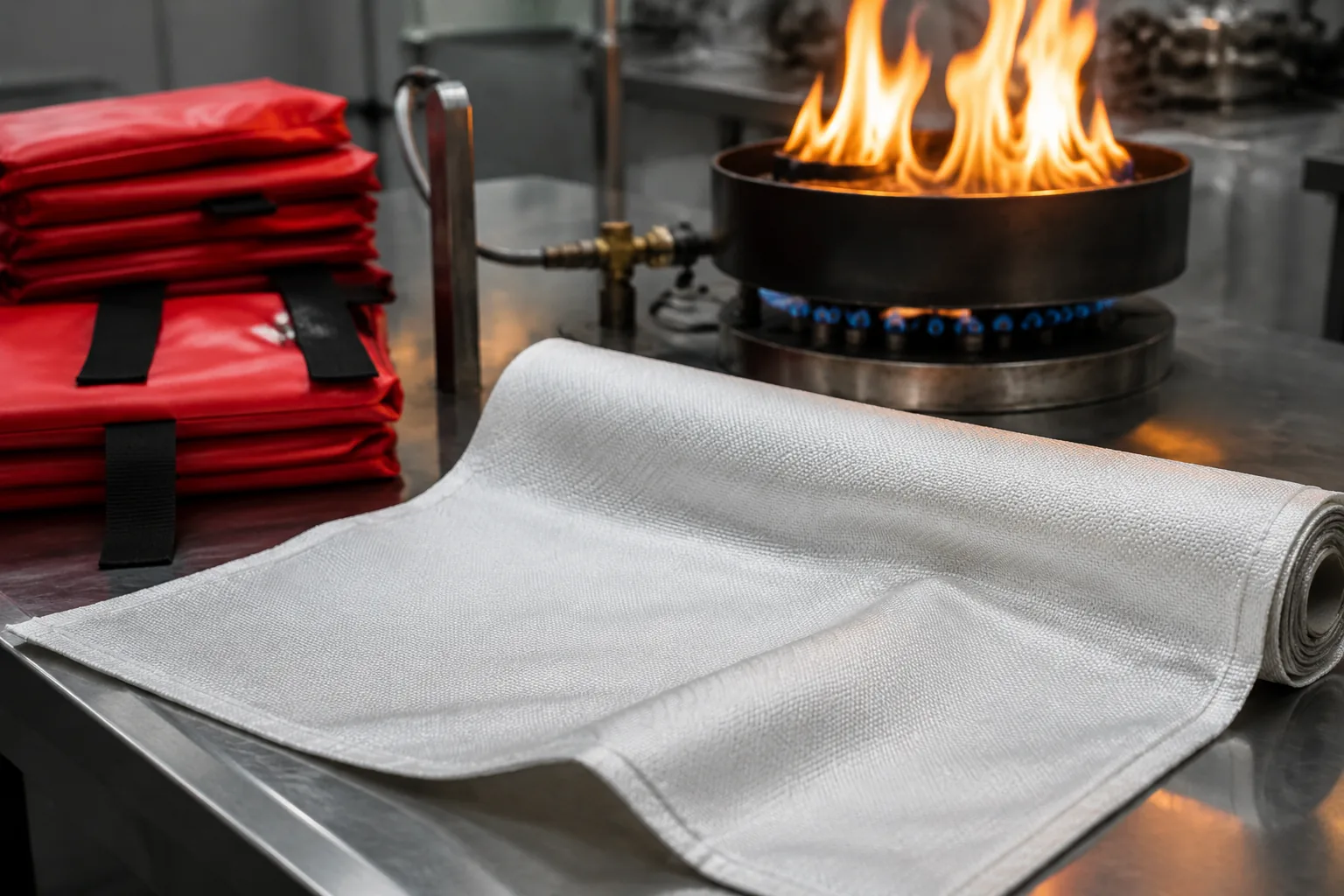
The standard recognises two functional categories: general-purpose fire blankets (普通灭火毯), designed to smother small incipient fires — kitchen oil-pan fires, waste-bin fires, small electrical fires — and escape fire blankets (逃生灭火毯), designed to be wrapped around a person for fire-escape, with stricter thermal-insulation requirements. Within these categories, the product is graded by its extinguishing capability in the standard oil-pan fire test — a larger oil-pan fire that the blanket can extinguish means a higher grade.
The European counterpart is EN 1869:2019 Fire Blankets — the harmonised standard for CE marking of fire blankets under the EU PPE Regulation. EN 1869's core test is a 3-litre cooking-oil fire brought to auto-ignition, and the test is the basis for the CE mark that allows a fire blanket to be sold in Europe. The US has no single national fire-blanket product standard equivalent to EN 1869 or XF 1205; the CPSC has historically evaluated fire blankets to the predecessor British standard BS 6575, and UL participates in voluntary-standard development, but there is no mandatory US product-standard regime for residential fire blankets as of the latest published work.
Knowing the destination framework up front decides the test panel — a fire blanket for the Chinese market is tested to XF 1205; for the European market, to EN 1869; and the two are not cross-accepted.
How Is the Extinguishing Effectiveness (Oil-Pan Fire) Test Performed?
The oil-pan fire test is the headline test — it is what classifies a fire blanket by its extinguishing capability. The test is conceptually simple: ignite a defined fuel load in a defined pan, let it burn to a defined steady state, deploy the blanket over the pan, and verify that the fire is extinguished without re-ignition. The execution is tightly specified.
Under XF 1205: the standard uses an oil-pan fire fuelled by a defined liquid fuel (heptane or commercial gasoline), with the pan size scaled to the grade being tested — a larger pan for a higher grade. The blanket is deployed over the burning pan in the prescribed manner. The pass criteria are: the fire is extinguished, no re-ignition occurs within the defined observation period, and the blanket itself remains intact (it must not ignite, melt, or develop holes that would let flame through). The grade classification follows: a blanket that extinguishes the largest test pan is the highest grade.
Under EN 1869 Annex C (cooking-oil fire test): the test uses 3 litres of fresh rapeseed oil (no additives), in a circular pan of 345 ± 5 mm diameter. The oil is heated on a cooker until it reaches auto-ignition — the temperature range is 340–380 °C (target 350–370 °C). At auto-ignition, the oil fire is fully developed and self-sustaining. The blanket is then deployed (placed, not thrown) over the burning pan. The blanket remains in place for a defined period, then is removed. Pass criteria: no visible flames after blanket removal; no re-ignition within 3 minutes of removal; some oil remains in the pan (the blanket extinguished the fire, it did not simply allow the fuel to be consumed); the blanket itself remains intact and did not ignite.
Under EN 1869 Annex D (heptane fire test): a supplementary test using heptane as fuel verifies general fire-suppression capability independent of the cooking-oil-specific scenario. The pass criteria are the same — extinguishment, no re-ignition, blanket intact.
The oil-pan test is the test that catches the products that "look like fire blankets but do not extinguish fires" — the consumer-test literature documents fire blankets that failed to cover the fire effectively, that let flames escape at the edges, or that ignited themselves. The standard test removes the operator-skill variable by specifying the deployment procedure, and the pan-fire size is controlled so that the test result reflects the blanket's capability, not the firefighter's.
What Are the Flame Resistance Requirements?
A fire blanket must not become part of the fire. XF 1205 specifies flame-resistance requirements not only for the blanket body material but also for every component — the sewing thread, the hand-pull tabs, and the edge-binding tape. Each of these is tested separately for flame resistance, because a non-flame-resistant thread or binding can ignite and propagate flame across the blanket.
Test method (per GB/T 5454 or the XF 1205 method): specimens of ≥ 300 × 300 mm, at least 3 specimens per material. The specimen is exposed to a defined ignition source for a defined time, and after the source is removed, the damage length, afterflame time, and afterglow time are measured. The thresholds are set so that the material self-extinguishes quickly — a long afterflame time means the blanket continues to burn after the ignition source is removed, which is the failure mode that turns a fire-suppression tool into a fire source.
The three-component rule (body + thread + binding) is what catches the cheap blankets that use a flame-resistant glass-fibre body but a non-flame-resistant polyester thread or binding — the body survives the fire but the thread burns, the seam opens, and the blanket falls apart in use. An XF 1205 report that tests only the body material and not the thread and binding is incomplete.
What Are the Heat Resistance Requirements?
Heat resistance is the property that decides whether the blanket can be deployed over a fire without degrading. XF 1205 specifies a heat-resistance test in which the blanket is exposed to a defined high-temperature source for a defined duration, and after exposure the specimen must show no breakage, no cracking, no melting, and no obvious scorching on the unexposed face. Specimens are ≥ 500 × 500 mm, at least 3 specimens.
The heat-resistance test is stricter for escape blankets than for general-purpose blankets — an escape blanket is wrapped around a human body, so its unexposed face must remain at a touchable temperature for long enough to allow egress. The general-purpose blanket is deployed over a fire and left, so its thermal-insulation requirement is lower.
The materials that meet both flame resistance and heat resistance are, in practice, a short list: glass fibre fabric (woven, with or without a fire-resistant film or silicone coating), oxidised acrylic (pre-oxidised PAN), and vermiculite-coated glass fibre. These materials do not melt, do not support combustion, and maintain structural integrity at the temperatures a small-pan fire produces (300–600 °C). The materials that fail are the ones that melt (polyester, polypropylene) or that ignite (untreated cotton) — and these are the materials found in counterfeit or substandard blankets that pass visual inspection but fail the standard tests.
How Do Size and Handling Affect Performance?
A fire blanket that is too small for the fire cannot extinguish it — the blanket must cover the entire fire area with margin, so that no flame escapes at the edges. XF 1205 specifies standard sizes: 1.0 × 1.0 m, 1.2 × 1.2 m, 1.5 × 1.5 m, 1.8 × 1.2 m and others, with defined dimensional tolerances. The rule of thumb is that the blanket's coverage area should be at least 2× the fire area — a blanket barely larger than the fire pan will have flame escape at the edges, as the consumer-test literature documented.
Handling / deployment test: XF 1205 and EN 1869 both include a handling test that verifies the blanket can be extracted from its storage pouch and deployed within a defined time by a single person. The test is not a formality — the field-test literature documented that deploying a fire blanket on a real fire is harder than it looks, and a blanket that is difficult to extract from its pouch or that does not unfold smoothly wastes the critical first seconds when the fire is still small. The handling test verifies the pouch design, the pull-tab mechanism, and the blanket's flexibility (it must not be stiff enough to resist unfolding).
Electrical insulation: for fire blankets that may be used on electrical fires (a common use case — a blanket over a burning appliance), XF 1205 and EN 1869 include an electrical-resistance test verifying the blanket is non-conductive at the voltage the application implies. This is the property that makes a fire blanket safer than water on an electrical fire.
What Is the EV Fire Blanket Explosion Risk?
The most recent research finding on fire blankets — published jointly by the NFPA Fire Protection Research Foundation (FPRF) and the UL Fire Safety Research Institute (FSRI) — is the explosion risk when fire blankets are used on electric-vehicle (EV) battery fires. This finding has changed how large fire blankets (EV-size, 6 × 8 m or larger) are evaluated.
The mechanism: when a fire blanket is deployed over a burning EV, it eliminates visible flaming by denying oxygen to the vehicle fire — the blanket works as designed for the vehicle's combustible-material fire. But the lithium-ion battery's thermal runaway continues under the blanket, producing flammable battery gases (hydrogen, hydrocarbons, carbon monoxide). These gases accumulate in the volume under the blanket, in an oxygen-depleted atmosphere. If air is later reintroduced (the blanket is lifted, a gust gets under the edge), the mixture of unburned flammable gas and air can be within the explosive range, and an ignition source (a hot surface, an electrical arc) can trigger a deflagration.
The research evidence: FPRF and FSRI conducted separate experiments in which EV fire blankets were deployed on EVs with confirmed battery-pack thermal-runaway involvement. In both programmes, the blanket eliminated flaming but gas accumulation under the blanket was measured, and the explosion hazard was identified as a risk to firefighters operating near the vehicle. The FSRI Phase 3 experiments (2025) tested two deployment scenarios — blanket-only (no water) and blanket combined with under-vehicle water suppression — to answer the questions: are blankets effective at controlling an EV fire until water arrives? Can blankets slow or stop thermal-runaway propagation? When should blankets be removed?
The implication for fire-blanket testing: the EV-fire-blanket application is not covered by the standard XF 1205 or EN 1869 oil-pan test, which validates a blanket for a cooking-oil or heptane fire in a defined pan. The EV application introduces a sustained, high-energy, gas-producing fire that the standard tests do not model. For EV fire blankets, the standard oil-pan test is necessary but not sufficient — additional testing for heat resistance at EV-fire temperatures (600–1000 °C sustained), gas-permeability under the blanket, and the removal-timing protocol is what the current research is developing.
How Does the Chinese Framework Map to International Standards?
| Scope | China | Europe (EN) | US / International |
|---|---|---|---|
| Fire blanket product standard | XF 1205-2014 (GA 1205) | EN 1869:2019 | — (no equivalent mandatory standard) |
| Cooking-oil fire test | Oil-pan fire (heptane/gasoline) by grade | EN 1869 Annex C (3L rapeseed oil, auto-ignition) | — |
| Heptane / general fire test | Oil-pan fire | EN 1869 Annex D | — |
| Flame resistance | XF 1205 (GB/T 5454 method) | EN 1869 fabric test | — |
| Electrical insulation | XF 1205 | EN 1869 electrical test | — |
| EV fire blanket | — (not in standard scope) | — (not in standard scope) | FPRF/FSRI research, no standard yet |
The EN 1869 cooking-oil test (3L rapeseed oil, auto-ignition, defined pan) and the XF 1205 oil-pan test (heptane/gasoline, graded pan sizes) test the same property — extinguishing capability — but with different fuels and different classification logics. A blanket tested to XF 1205 will generally perform well in an EN 1869 test (the physical mechanism — oxygen exclusion — is the same), but the certification is not cross-accepted, and a blanket for the European market must carry the CE mark with the EN 1869 test report.
Our Testing Capabilities
Beijing ZKGX Research provides fire blanket testing against XF 1205-2014 and EN 1869:2019.
Extinguishing effectiveness:
- Oil-pan fire test (XF 1205, graded by pan size)
- Cooking-oil fire test (EN 1869 Annex C, 3L rapeseed oil, auto-ignition, 345 mm pan)
- Heptane fire test (EN 1869 Annex D)
- Re-ignition verification (3-minute post-removal observation)
Flame resistance:
- Body material, sewing thread, hand-pull tabs, edge-binding — each tested separately
- Damage length, afterflame time, afterglow time (≥300×300 mm, ≥3 specimens)
Heat resistance:
- High-temperature exposure, no breakage / cracking / melting / scorching (≥500×500 mm, ≥3 specimens)
Physical and handling:
- Dimensional verification (size tolerances)
- Deployment / handling test (extraction and unfold time)
- Electrical insulation resistance
If you need an XF 1205 type-test report for a domestic fire-blanket release, an EN 1869 test report for CE marking and European export, a cooking-oil-fire performance verification, or a flame-resistance audit of all blanket components — contact our laboratory with the blanket type (general-purpose / escape), declared size, target grade, and applicable standard, and we will scope the test plan.
FAQ
What is the difference between XF 1205 and EN 1869?
XF 1205-2014 is the Chinese public-safety industry standard for fire blankets; EN 1869:2019 is the European harmonised standard for CE marking. Both test extinguishing capability with a standard liquid-fuel fire, but the fuels and classification differ: XF 1205 uses heptane/gasoline in graded oil-pans; EN 1869 uses a 3-litre rapeseed-oil fire brought to auto-ignition (340–380 °C). The physical mechanism (oxygen exclusion) is the same, so a blanket that passes one generally performs well in the other, but the certifications are not cross-accepted — the report must cite the destination standard.
Why must the sewing thread and edge-binding be tested separately for flame resistance?
Because a flame-resistant glass-fibre body with a non-flame-resistant polyester thread or binding can fail in service — the thread ignites, the seam opens, and the blanket falls apart while deployed over a fire. XF 1205 requires all components (body, thread, tabs, binding) to be tested for flame resistance, not just the body material, because the blanket's integrity in fire depends on every component surviving. A report that tests only the body material is incomplete.
Are fire blankets suitable for electric-vehicle (EV) battery fires?
This is an active research area. The NFPA/FSRI research (2025) demonstrated that a fire blanket deployed over a burning EV eliminates visible flaming but does not stop battery thermal runaway — flammable gases accumulate under the blanket and create an explosion risk if air is reintroduced. Fire blankets may be useful for controlling an EV fire until water suppression arrives, but the blanket-removal timing and the explosion hazard must be managed. Standard XF 1205 / EN 1869 tests (designed for cooking-oil pan fires) do not model the sustained, gas-producing EV-battery fire, so the standard tests are necessary but not sufficient for the EV application.
Can a fire blanket be reused after deployment?
No — both XF 1205 and EN 1869 classify fire blankets as single-use. After deployment, the blanket has been exposed to fire temperatures and may have suffered degradation (thermal stress, contamination by fuel or combustion products, seam damage) that is not visible but compromises its next-use performance. A used fire blanket must be discarded and replaced.
What size fire blanket do I need?
The blanket must cover the entire fire area with margin — the rule of thumb is that the blanket's coverage area is at least 2× the fire area. For a domestic kitchen oil-pan fire (typical pan 200–300 mm), a 1.0 × 1.0 m or 1.2 × 1.2 m blanket is adequate. For industrial or automotive applications, larger sizes (1.8 × 1.2 m or larger) are needed to cover the larger potential fire area. A blanket that is too small will have flame escape at the edges, as the field-test literature documented.