What Standard Governs Laminated Glass testing in China?
Laminated glass testing in China is governed by GB 15763.3-2009 Safety Glazing Materials in Building — Part 3: Laminated Glass (replacing GB 9962-1999). This is the mandatory baseline for building laminated glass — it is within the scope of the China Compulsory Certification (CCC) system, and laminated safety glass cannot be sold for building applications without a valid CCC certificate citing GB 15763.3. A revised edition, GB/T 15763.3-2025, has been published — note the change from mandatory GB to recommended GB/T in the new edition, which affects how the standard is invoked in certification and procurement.
The standard defines laminated glass as two or more glass plies bonded by a polymer interlayer — most commonly PVB (polyvinyl butyral), but also EVA (ethylene vinyl acetate) and SGP (ionoplast structural) for higher-performance applications. The product is classified by its impact resistance into three categories (II-1, II-2, III), each defined by the drop height it must survive in the bag-shot impact test. The interlayer's function is the defining property: when the glass breaks, the interlayer holds the fragments in place, preventing the shard-spray that makes ordinary annealed glass a laceration hazard.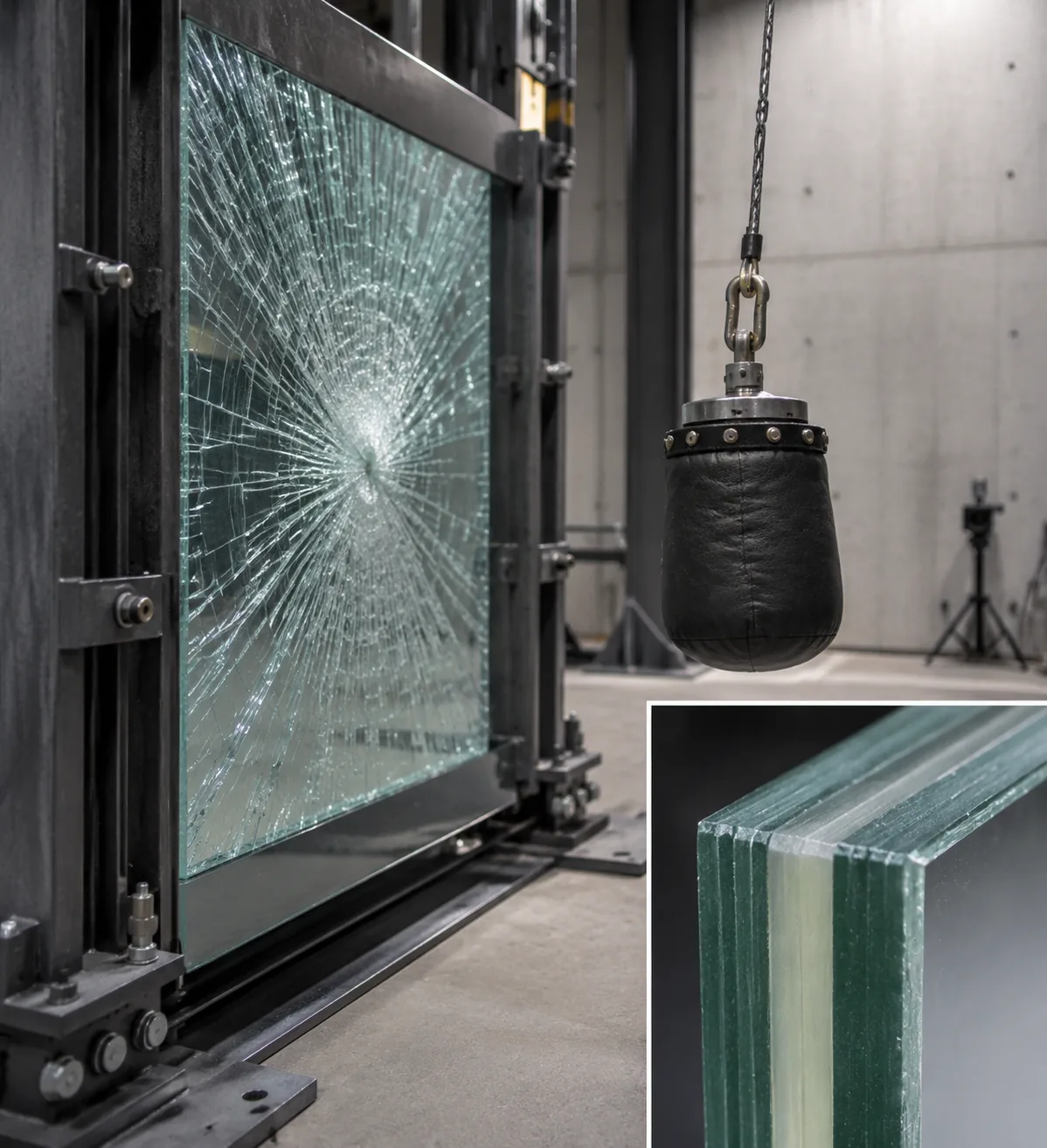
The international references are ISO 12543 (laminated glass, multi-part), EN 14449 (European laminated glass product), ANSI Z97.1 (US safety glazing), and the SGCC (Safety Glazing Certification Council) certification for the US market. The EN and ANSI frameworks set their own impact-test parameters and classification, and a laminated glass tested to GB 15763.3 will generally satisfy EN 14449 but the report must cite the destination framework.
What Is the Bag-Shot (Shot-Bag) Impact Test and How Is It Classified?
The shot-bag impact test (霰弹袋冲击) is the headline safety test for laminated glass — it is what classifies the product into its impact-resistance grade. The test simulates a human-body impact by dropping a weighted, soft impactor (a canvas bag filled with lead shot) from a defined height onto a vertical full-size test pane.
The impactor: a bag of 45 kg ± 0.1 kg, filled with φ2.5 mm lead shot, suspended on a pendulum or drop-rig. The bag impacts the centre of a 1930 × 864 mm test specimen mounted vertically in a rigid steel frame.
The classification by drop height:
| Category | Drop height | Application |
|---|---|---|
| II-1 | 1200 mm | Highest impact resistance — full human-body fall from height, balustrades, overhead glazing |
| II-2 | 750 mm | Medium — general safety glazing, doors, partitions |
| III | 300 mm | Basic — the minimum impact class, lower-risk locations |
Pass criteria: the specimen must either not break, or break "safely" — meaning the glass cracks but the interlayer retains the fragments and the shot-bag does not penetrate through the pane. A break that produces a through-penetration (the bag passes through the laminated pane) or that produces large shards of glass detached from the interlayer is a fail. The test is run at the height for the declared category, with the drop repeated at defined positions on the pane.
The test frame rigidity is critical — a frame that flexes on impact absorbs energy that should go into the glass, producing a falsely-favourable result. The standard specifies the frame's minimum stiffness, and a laboratory with an under-rigid frame is testing to a lower effective energy than the standard implies.
What Is the Ball-Drop Impact and Peel Test?
The ball-drop impact and peel test (落球冲击剥离性能) is the second impact test — it uses a smaller, harder impactor (a steel ball of defined mass) dropped from a defined height onto a smaller test specimen. The purpose is different from the shot-bag: the shot-bag tests whether the pane stops a human body; the ball-drop tests whether the interlayer retains the glass fragments after a localised point impact.
Test method: a steel ball (defined mass and diameter) is dropped from a defined height onto the centre of a horizontal test specimen. After impact, the specimen is examined for: (a) whether the ball penetrated through the pane, and (b) the extent of delamination between the broken glass and the interlayer.
Pass criteria: the ball must not penetrate through the laminated pane, and the interlayer-glass bond must not show a large-area delamination around the impact point. A defined amount of localised delamination in the immediate impact zone is acceptable (the interlayer has to stretch to absorb the impact energy), but a delamination that extends far beyond the impact point indicates that the interlayer-glass adhesion is too low.
The ball-drop test catches the adhesion problem that the shot-bag test does not: a laminated glass with low adhesion can pass the shot-bag (the pane stops the bag) but fail the ball-drop (the fragments peel away from the interlayer over a wide area, leaving a dangerous glass-fall). The adhesion balance — high enough to retain fragments, low enough to allow the interlayer to stretch and absorb energy — is the core quality target of the lamination process.
How Are Radiation (UV) and Humidity Resistance Tested?
Laminated glass in building service is exposed to sunlight (UV) and to humidity (condensation, rain, washdown). The interlayer must survive both without degrading — PVB and EVA interlayers are polymers, and polymers degrade under sustained UV or moisture exposure. GB 15763.3 defines two durability tests:
Radiation resistance (耐辐照性): the specimen is exposed to a defined UV radiation dose (typically using a xenon-arc or fluorescent-UV source that simulates solar UV), and after exposure the specimen is examined for discoloration, bubbling, or delamination of the interlayer. The test verifies that the interlayer does not yellow, cloud, or separate from the glass under long-term sunlight exposure — the failure mode that produces the "foggy laminated glass" seen on old building facades and automotive windshields.
Humidity resistance (耐湿性): the specimen is placed in a high-humidity environment (a climate chamber at defined temperature and humidity, or in boiling water for the rapid version) for a defined duration, and examined for bubbles, delamination, or discoloration at the edge and in the body. The test simulates the moisture ingress that attacks the interlayer-glass bond at the cut edge — the edge is where the interlayer is exposed to the environment, and moisture ingress at the edge is the dominant field-delamination mechanism.
The combination of radiation and humidity testing catches the two long-term interlayer-degradation modes. A laminated glass that passes impact but fails radiation will discolour in service; one that passes impact but fails humidity will delaminate at the edges in service. Both tests are part of the CCC certification panel because both are common field-failure modes.
What Is the Boil Test (Resistance to Heat)?
The boil test (耐煮沸性) is the rapid version of the humidity test — it accelerates moisture and temperature attack on the interlayer-glass bond by immersing the specimen in boiling water for a defined duration (typically 2 hours). After boiling, the specimen is examined for bubbles, delamination, or interlayer separation.
Why boiling: the boiling-water immersion combines the worst-case moisture exposure (the specimen is fully immersed in liquid water at 100 °C) with thermal stress (the 100 °C temperature is above the interlayer's softening point for some PVB formulations). It is the most aggressive of the humidity-family tests and is used as a rapid screen for interlayer-glass adhesion quality.
What it catches: a boil-test failure indicates that the interlayer-glass bond is weak — typically from insufficient adhesion (wrong moisture content in the PVB before lamination, inadequate autoclave pressure/temperature, or contamination of the glass surface before lamination). The field-defect literature documents that the same root causes produce the bubbles, delamination, and edge failure seen in service — so the boil test is a predictor of long-term field performance, not just a factory-quality check.
How Is Interlayer Adhesion Measured?
Interlayer adhesion — the bond strength between the polymer interlayer and the glass — is the property that makes laminated glass "laminated." Too-low adhesion: the glass peels away from the interlayer on impact, producing dangerous shard fall. Too-high adhesion: the interlayer cannot stretch to absorb impact energy, and the pane punctures rather than flexing. The adhesion must be within a defined window, and the test measures where it sits.
Test methods: GB 15763.3 specifies the peel test, in which a strip of interlayer is peeled from a broken-glass substrate at a defined angle and rate, and the peel force is measured. The result is reported in N/mm. Complementary methods include the pummel test (a controlled fragmentation pattern correlated to adhesion level) used in some production environments.
Adhesion balance: the peel force is not "higher is better." A PVB laminated glass with an adhesion level that is too high will puncture on impact rather than retaining the fragments safely; one with adhesion that is too low will delaminate. The window for building-safety laminated glass is defined in the standard and in the interlayer manufacturer's processing guidelines, and a laboratory adhesion test that reports only the peel force without stating the applicable window is not interpretable.
The adhesion is sensitive to the PVB moisture content at lamination (the field-defect literature specifies < 0.5 % moisture for PVB before lamination), the autoclave cycle (temperature, pressure, hold time), and the glass-surface cleanliness. A boil-test or humidity-test failure usually traces to one of these, and the adhesion test confirms the root cause.
How Does Edge Stability Testing Relate to Field Performance?
The GB 15763.3 tests verify the product as manufactured — but the dominant field-failure mode for laminated glass is edge delamination, which develops over years of exposure at the cut edge. The edge-stability test protocols used in the industry (documented in the Eastman/GPD literature and in ASTM work) complement the GB tests by predicting the long-term edge performance.
Natural exposure (edge stability): laminated specimens with exposed edges are mounted on a south-facing rack at 45° in a hot, humid climate (Miami, Florida is the reference site) and rated periodically for edge delamination depth and length. The Edge Stability Number (ESN) is a weighted sum of the delamination depth bands, with deeper delamination weighted more heavily (the ESN formula: ESN = 1×PCT1 + 4×PCT2 + 9×PCT3 + 16×PCT4 + 25×PCT5, where PCTn is the percentage of edge length with delamination in depth band n). Lower ESN = better edge stability; ESN < 500 is considered exceptional.
Salt fog (ASTM B117): specimens are exposed to a 5 % saline fog at 35 °C for 12 weeks, simulating a marine climate in accelerated form. The salt-fog test is a faster predictor of the edge delamination that natural exposure would produce over years.
Sealant compatibility: sealants and adhesives in contact with the laminate edge can chemically attack the interlayer. The test exposes sealant-contacted laminate edges to a UV-condensation cycle (16 h UV at 66 °C + 8 h condensation at 60 °C) for 3500 hours, rating the edge effect (bubble depth, discoloration, delamination) at intervals.
These edge-stability protocols are not part of GB 15763.3's mandatory panel, but they are the tests that predict whether a laminated glass will delaminate at the edge after 5–10 years in a real building. For high-end facade projects, specifying these protocols alongside the GB 15763.3 tests is what distinguishes a 5-year-facade product from a 25-year-facade product.
How Does the GB Framework Map to International Standards?
| Scope | China | International (ISO) | Europe (EN) | US (ANSI / ASTM) |
|---|---|---|---|---|
| Laminated glass product | GB 15763.3-2009 (GB/T 15763.3-2025) | ISO 12543 | EN 14449 | ANSI Z97.1 |
| Laminated glass test methods | GB/T 15763.3 | ISO 12543-2 to -6 | EN ISO 12543-2 to -6 | ASTM C1172 / C1048 |
| Impact (human-body) | Shot-bag 45 kg | ISO 12543-4 impact | EN 12600 (pendulum) | ANSI Z97.1 (shot-bag) |
| UV / humidity durability | GB 15763.3 radiation + humidity | ISO 12543-4 | EN ISO 12543-4 | — |
The impact-test methods differ across frameworks: GB 15763.3 and ANSI Z97.1 both use a shot-bag (different mass and drop-height definitions), while EN 12600 uses a pendulum with a twin-tyre impactor. The classification systems are therefore not directly interchangeable — a GB 15763.3 Class II-1 is not the same energy as an EN 12600 Class 1(B)1, though both indicate high impact resistance. For multi-market product, the impact test must be run and reported against each destination framework.
Our Testing Capabilities
Beijing ZKGX Research provides laminated glass testing against GB 15763.3-2009 (and the 2025 revision) and the ISO / EN / ANSI reference frameworks.
Impact safety (the core type tests):
- Shot-bag (45 kg) impact, classification II-1 / II-2 / III by drop height (1200 / 750 / 300 mm)
- Ball-drop impact and peel — penetration resistance and fragment retention
Durability:
- Radiation resistance (UV exposure, interlayer discoloration/degradation)
- Humidity resistance (climate chamber, edge and body delamination)
- Boil test (2-hour boiling-water immersion)
Adhesion:
- Peel test (interlayer-to-glass bond strength, N/mm)
- Adhesion window verification
Optical and dimensional:
- Light transmittance, distortion
- Thickness, edge quality, flatness
Edge stability (predictive, for high-end facade specification):
- Natural-exposure edge-stability rating (ESN)
- Salt fog (ASTM B117) accelerated edge delamination
- Sealant compatibility (UV-condensation cycle, 3500 h)
Standards cross-reference: ISO 12543, EN 14449, ANSI Z97.1, EN 12600.
If you need a GB 15763.3 type-test report for CCC certification, a shot-bag impact classification, a UV/humidity/boil durability qualification, an interlayer adhesion peel test, or an edge-stability prediction for a facade specification — contact our laboratory with the laminated glass type (PVB / EVA / SGP interlayer, number of plies, glass type annealed/tempered), the target impact class, and the applicable standard, and we will scope the test plan.
FAQ
What is the difference between the shot-bag test and the ball-drop test?
The shot-bag (45 kg, soft impactor) tests whether the pane stops a human-body fall — it classifies the glass into impact grades II-1 / II-2 / III. The ball-drop (small hard impactor) tests whether the interlayer retains glass fragments after a localised point impact — it catches adhesion problems that the shot-bag does not. A laminated glass with low adhesion can pass the shot-bag (the pane stops the bag) but fail the ball-drop (fragments peel away from the interlayer over a wide area). Both are needed because they catch different failure modes.
Why does the interlayer adhesion need to be in a window, not as high as possible?
Because too-high adhesion prevents the interlayer from stretching on impact. The interlayer's energy-absorption mechanism is elongation — it stretches to decelerate the impactor. If the adhesion is so high that the interlayer cannot stretch, the pane punctures instead of flexing. If the adhesion is too low, the fragments peel away on impact. The adhesion must be within a defined window, and a peel-force test that reports only the number without the window is not interpretable.
What is the boil test and why is it a predictor of field performance?
The boil test immerses the specimen in boiling water for ~2 hours — it is the most aggressive of the humidity-family tests, combining full immersion with 100 °C temperature. A boil-test failure indicates weak interlayer-glass adhesion from root causes (PVB moisture content, autoclave cycle, glass-surface contamination) that also produce the bubbles, delamination, and edge failure seen in service after years of exposure. So the boil test is both a factory quality check and a field-performance predictor.
Is GB 15763.3 testing mandatory for building laminated glass?
Yes — laminated safety glass for building applications is within the scope of the China Compulsory Certification (CCC) system, and GB 15763.3 is the certification basis. The 2025 revision changes the standard's designation from mandatory GB to recommended GB/T, which affects how it is invoked in certification but the CCC scope for safety glazing remains. A laminated glass sold for building applications in China requires a valid CCC certificate; for export, the destination framework (EN 14449, ANSI Z97.1) applies instead.
What is edge stability and why does it matter for facade laminated glass?
Edge stability is the interlayer's resistance to delamination at the cut edge under long-term moisture and UV exposure. The edge is where the interlayer is exposed to the environment, and moisture/chemical ingress at the edge is the dominant field-delamination mechanism — producing the foggy, bubbly, or separated edges seen on aging facades. The GB 15763.3 humidity and boil tests screen for this, but the industry edge-stability protocols (natural exposure ESN, salt fog, sealant compatibility) predict the long-term performance more directly. For a facade specified to last 25 years, the edge-stability tests are what distinguish a durable product from one that delaminates in 5 years.
What Standard Governs Laminated Glass Testing in China?
Laminated glass testing in China is governed by GB 15763.3-2009 Safety Glazing Materials in Building — Part 3: Laminated Glass (replacing GB 9962-1999). This is the mandatory baseline for building laminated glass — it is within the scope of the China Compulsory Certification (CCC) system, and laminated safety glass cannot be sold for building applications without a valid CCC certificate citing GB 15763.3. A revised edition, GB/T 15763.3-2025, has been published — note the change from mandatory GB to recommended GB/T in the new edition, which affects how the standard is invoked in certification and procurement.
The standard defines laminated glass as two or more glass plies bonded by a polymer interlayer — most commonly PVB (polyvinyl butyral), but also EVA (ethylene vinyl acetate) and SGP (ionoplast structural) for higher-performance applications. The product is classified by its impact resistance into three categories (II-1, II-2, III), each defined by the drop height it must survive in the bag-shot impact test. The interlayer's function is the defining property: when the glass breaks, the interlayer holds the fragments in place, preventing the shard-spray that makes ordinary annealed glass a laceration hazard.
The international references are ISO 12543 (laminated glass, multi-part), EN 14449 (European laminated glass product), ANSI Z97.1 (US safety glazing), and the SGCC (Safety Glazing Certification Council) certification for the US market. The EN and ANSI frameworks set their own impact-test parameters and classification, and a laminated glass tested to GB 15763.3 will generally satisfy EN 14449 but the report must cite the destination framework.
What Is the Bag-Shot (Shot-Bag) Impact Test and How Is It Classified?
The shot-bag impact test (霰弹袋冲击) is the headline safety test for laminated glass — it is what classifies the product into its impact-resistance grade. The test simulates a human-body impact by dropping a weighted, soft impactor (a canvas bag filled with lead shot) from a defined height onto a vertical full-size test pane.
The impactor: a bag of 45 kg ± 0.1 kg, filled with φ2.5 mm lead shot, suspended on a pendulum or drop-rig. The bag impacts the centre of a 1930 × 864 mm test specimen mounted vertically in a rigid steel frame.
The classification by drop height:
| Category | Drop height | Application |
|---|---|---|
| II-1 | 1200 mm | Highest impact resistance — full human-body fall from height, balustrades, overhead glazing |
| II-2 | 750 mm | Medium — general safety glazing, doors, partitions |
| III | 300 mm | Basic — the minimum impact class, lower-risk locations |
Pass criteria: the specimen must either not break, or break "safely" — meaning the glass cracks but the interlayer retains the fragments and the shot-bag does not penetrate through the pane. A break that produces a through-penetration (the bag passes through the laminated pane) or that produces large shards of glass detached from the interlayer is a fail. The test is run at the height for the declared category, with the drop repeated at defined positions on the pane.
The test frame rigidity is critical — a frame that flexes on impact absorbs energy that should go into the glass, producing a falsely-favourable result. The standard specifies the frame's minimum stiffness, and a laboratory with an under-rigid frame is testing to a lower effective energy than the standard implies.
What Is the Ball-Drop Impact and Peel Test?
The ball-drop impact and peel test (落球冲击剥离性能) is the second impact test — it uses a smaller, harder impactor (a steel ball of defined mass) dropped from a defined height onto a smaller test specimen. The purpose is different from the shot-bag: the shot-bag tests whether the pane stops a human body; the ball-drop tests whether the interlayer retains the glass fragments after a localised point impact.
Test method: a steel ball (defined mass and diameter) is dropped from a defined height onto the centre of a horizontal test specimen. After impact, the specimen is examined for: (a) whether the ball penetrated through the pane, and (b) the extent of delamination between the broken glass and the interlayer.
Pass criteria: the ball must not penetrate through the laminated pane, and the interlayer-glass bond must not show a large-area delamination around the impact point. A defined amount of localised delamination in the immediate impact zone is acceptable (the interlayer has to stretch to absorb the impact energy), but a delamination that extends far beyond the impact point indicates that the interlayer-glass adhesion is too low.
The ball-drop test catches the adhesion problem that the shot-bag test does not: a laminated glass with low adhesion can pass the shot-bag (the pane stops the bag) but fail the ball-drop (the fragments peel away from the interlayer over a wide area, leaving a dangerous glass-fall). The adhesion balance — high enough to retain fragments, low enough to allow the interlayer to stretch and absorb energy — is the core quality target of the lamination process.
How Are Radiation (UV) and Humidity Resistance Tested?
Laminated glass in building service is exposed to sunlight (UV) and to humidity (condensation, rain, washdown). The interlayer must survive both without degrading — PVB and EVA interlayers are polymers, and polymers degrade under sustained UV or moisture exposure. GB 15763.3 defines two durability tests:
Radiation resistance (耐辐照性): the specimen is exposed to a defined UV radiation dose (typically using a xenon-arc or fluorescent-UV source that simulates solar UV), and after exposure the specimen is examined for discoloration, bubbling, or delamination of the interlayer. The test verifies that the interlayer does not yellow, cloud, or separate from the glass under long-term sunlight exposure — the failure mode that produces the "foggy laminated glass" seen on old building facades and automotive windshields.
Humidity resistance (耐湿性): the specimen is placed in a high-humidity environment (a climate chamber at defined temperature and humidity, or in boiling water for the rapid version) for a defined duration, and examined for bubbles, delamination, or discoloration at the edge and in the body. The test simulates the moisture ingress that attacks the interlayer-glass bond at the cut edge — the edge is where the interlayer is exposed to the environment, and moisture ingress at the edge is the dominant field-delamination mechanism.
The combination of radiation and humidity testing catches the two long-term interlayer-degradation modes. A laminated glass that passes impact but fails radiation will discolour in service; one that passes impact but fails humidity will delaminate at the edges in service. Both tests are part of the CCC certification panel because both are common field-failure modes.
What Is the Boil Test (Resistance to Heat)?
The boil test (耐煮沸性) is the rapid version of the humidity test — it accelerates moisture and temperature attack on the interlayer-glass bond by immersing the specimen in boiling water for a defined duration (typically 2 hours). After boiling, the specimen is examined for bubbles, delamination, or interlayer separation.
Why boiling: the boiling-water immersion combines the worst-case moisture exposure (the specimen is fully immersed in liquid water at 100 °C) with thermal stress (the 100 °C temperature is above the interlayer's softening point for some PVB formulations). It is the most aggressive of the humidity-family tests and is used as a rapid screen for interlayer-glass adhesion quality.
What it catches: a boil-test failure indicates that the interlayer-glass bond is weak — typically from insufficient adhesion (wrong moisture content in the PVB before lamination, inadequate autoclave pressure/temperature, or contamination of the glass surface before lamination). The field-defect literature documents that the same root causes produce the bubbles, delamination, and edge failure seen in service — so the boil test is a predictor of long-term field performance, not just a factory-quality check.
How Is Interlayer Adhesion Measured?
Interlayer adhesion — the bond strength between the polymer interlayer and the glass — is the property that makes laminated glass "laminated." Too-low adhesion: the glass peels away from the interlayer on impact, producing dangerous shard fall. Too-high adhesion: the interlayer cannot stretch to absorb impact energy, and the pane punctures rather than flexing. The adhesion must be within a defined window, and the test measures where it sits.
Test methods: GB 15763.3 specifies the peel test, in which a strip of interlayer is peeled from a broken-glass substrate at a defined angle and rate, and the peel force is measured. The result is reported in N/mm. Complementary methods include the pummel test (a controlled fragmentation pattern correlated to adhesion level) used in some production environments.
Adhesion balance: the peel force is not "higher is better." A PVB laminated glass with an adhesion level that is too high will puncture on impact rather than retaining the fragments safely; one with adhesion that is too low will delaminate. The window for building-safety laminated glass is defined in the standard and in the interlayer manufacturer's processing guidelines, and a laboratory adhesion test that reports only the peel force without stating the applicable window is not interpretable.
The adhesion is sensitive to the PVB moisture content at lamination (the field-defect literature specifies < 0.5 % moisture for PVB before lamination), the autoclave cycle (temperature, pressure, hold time), and the glass-surface cleanliness. A boil-test or humidity-test failure usually traces to one of these, and the adhesion test confirms the root cause.
How Does Edge Stability Testing Relate to Field Performance?
The GB 15763.3 tests verify the product as manufactured — but the dominant field-failure mode for laminated glass is edge delamination, which develops over years of exposure at the cut edge. The edge-stability test protocols used in the industry (documented in the Eastman/GPD literature and in ASTM work) complement the GB tests by predicting the long-term edge performance.
Natural exposure (edge stability): laminated specimens with exposed edges are mounted on a south-facing rack at 45° in a hot, humid climate (Miami, Florida is the reference site) and rated periodically for edge delamination depth and length. The Edge Stability Number (ESN) is a weighted sum of the delamination depth bands, with deeper delamination weighted more heavily (the ESN formula: ESN = 1×PCT1 + 4×PCT2 + 9×PCT3 + 16×PCT4 + 25×PCT5, where PCTn is the percentage of edge length with delamination in depth band n). Lower ESN = better edge stability; ESN < 500 is considered exceptional.
Salt fog (ASTM B117): specimens are exposed to a 5 % saline fog at 35 °C for 12 weeks, simulating a marine climate in accelerated form. The salt-fog test is a faster predictor of the edge delamination that natural exposure would produce over years.
Sealant compatibility: sealants and adhesives in contact with the laminate edge can chemically attack the interlayer. The test exposes sealant-contacted laminate edges to a UV-condensation cycle (16 h UV at 66 °C + 8 h condensation at 60 °C) for 3500 hours, rating the edge effect (bubble depth, discoloration, delamination) at intervals.
These edge-stability protocols are not part of GB 15763.3's mandatory panel, but they are the tests that predict whether a laminated glass will delaminate at the edge after 5–10 years in a real building. For high-end facade projects, specifying these protocols alongside the GB 15763.3 tests is what distinguishes a 5-year-facade product from a 25-year-facade product.
How Does the GB Framework Map to International Standards?
| Scope | China | International (ISO) | Europe (EN) | US (ANSI / ASTM) |
|---|---|---|---|---|
| Laminated glass product | GB 15763.3-2009 (GB/T 15763.3-2025) | ISO 12543 | EN 14449 | ANSI Z97.1 |
| Laminated glass test methods | GB/T 15763.3 | ISO 12543-2 to -6 | EN ISO 12543-2 to -6 | ASTM C1172 / C1048 |
| Impact (human-body) | Shot-bag 45 kg | ISO 12543-4 impact | EN 12600 (pendulum) | ANSI Z97.1 (shot-bag) |
| UV / humidity durability | GB 15763.3 radiation + humidity | ISO 12543-4 | EN ISO 12543-4 | — |
The impact-test methods differ across frameworks: GB 15763.3 and ANSI Z97.1 both use a shot-bag (different mass and drop-height definitions), while EN 12600 uses a pendulum with a twin-tyre impactor. The classification systems are therefore not directly interchangeable — a GB 15763.3 Class II-1 is not the same energy as an EN 12600 Class 1(B)1, though both indicate high impact resistance. For multi-market product, the impact test must be run and reported against each destination framework.
Our Testing Capabilities
Beijing ZKGX Research provides laminated glass testing against GB 15763.3-2009 (and the 2025 revision) and the ISO / EN / ANSI reference frameworks.
Impact safety (the core type tests):
- Shot-bag (45 kg) impact, classification II-1 / II-2 / III by drop height (1200 / 750 / 300 mm)
- Ball-drop impact and peel — penetration resistance and fragment retention
Durability:
- Radiation resistance (UV exposure, interlayer discoloration/degradation)
- Humidity resistance (climate chamber, edge and body delamination)
- Boil test (2-hour boiling-water immersion)
Adhesion:
- Peel test (interlayer-to-glass bond strength, N/mm)
- Adhesion window verification
Optical and dimensional:
- Light transmittance, distortion
- Thickness, edge quality, flatness
Edge stability (predictive, for high-end facade specification):
- Natural-exposure edge-stability rating (ESN)
- Salt fog (ASTM B117) accelerated edge delamination
- Sealant compatibility (UV-condensation cycle, 3500 h)
Standards cross-reference: ISO 12543, EN 14449, ANSI Z97.1, EN 12600.
If you need a GB 15763.3 type-test report for CCC certification, a shot-bag impact classification, a UV/humidity/boil durability qualification, an interlayer adhesion peel test, or an edge-stability prediction for a facade specification — contact our laboratory with the laminated glass type (PVB / EVA / SGP interlayer, number of plies, glass type annealed/tempered), the target impact class, and the applicable standard, and we will scope the test plan.
FAQ
What is the difference between the shot-bag test and the ball-drop test?
The shot-bag (45 kg, soft impactor) tests whether the pane stops a human-body fall — it classifies the glass into impact grades II-1 / II-2 / III. The ball-drop (small hard impactor) tests whether the interlayer retains glass fragments after a localised point impact — it catches adhesion problems that the shot-bag does not. A laminated glass with low adhesion can pass the shot-bag (the pane stops the bag) but fail the ball-drop (fragments peel away from the interlayer over a wide area). Both are needed because they catch different failure modes.
Why does the interlayer adhesion need to be in a window, not as high as possible?
Because too-high adhesion prevents the interlayer from stretching on impact. The interlayer's energy-absorption mechanism is elongation — it stretches to decelerate the impactor. If the adhesion is so high that the interlayer cannot stretch, the pane punctures instead of flexing. If the adhesion is too low, the fragments peel away on impact. The adhesion must be within a defined window, and a peel-force test that reports only the number without the window is not interpretable.
What is the boil test and why is it a predictor of field performance?
The boil test immerses the specimen in boiling water for ~2 hours — it is the most aggressive of the humidity-family tests, combining full immersion with 100 °C temperature. A boil-test failure indicates weak interlayer-glass adhesion from root causes (PVB moisture content, autoclave cycle, glass-surface contamination) that also produce the bubbles, delamination, and edge failure seen in service after years of exposure. So the boil test is both a factory quality check and a field-performance predictor.
Is GB 15763.3 testing mandatory for building laminated glass?
Yes — laminated safety glass for building applications is within the scope of the China Compulsory Certification (CCC) system, and GB 15763.3 is the certification basis. The 2025 revision changes the standard's designation from mandatory GB to recommended GB/T, which affects how it is invoked in certification but the CCC scope for safety glazing remains. A laminated glass sold for building applications in China requires a valid CCC certificate; for export, the destination framework (EN 14449, ANSI Z97.1) applies instead.
What is edge stability and why does it matter for facade laminated glass?
Edge stability is the interlayer's resistance to delamination at the cut edge under long-term moisture and UV exposure. The edge is where the interlayer is exposed to the environment, and moisture/chemical ingress at the edge is the dominant field-delamination mechanism — producing the foggy, bubbly, or separated edges seen on aging facades. The GB 15763.3 humidity and boil tests screen for this, but the industry edge-stability protocols (natural exposure ESN, salt fog, sealant compatibility) predict the long-term performance more directly. For a facade specified to last 25 years, the edge-stability tests are what distinguish a durable product from one that delaminates in 5 years.