What Standards Govern Plug valve testing in China?
Plug valve testing in China is governed by a two-standard stack: a product standard that defines the valve's design and ratings, and a pressure-test standard that defines how its strength and tightness are verified. The two are not interchangeable — a plug valve must pass both.
GB/T 13927-2022 Pressure Testing for Industrial Valves (replacing the 2008 edition) is the pressure-test standard, managed by TC188 (the national valve technical committee). It covers shell strength, seat tightness, and backseat tests for all industrial metal valves, including plug valves. The test methods and pressure ratios in GB/T 13927 are technically equivalent to ISO 5208.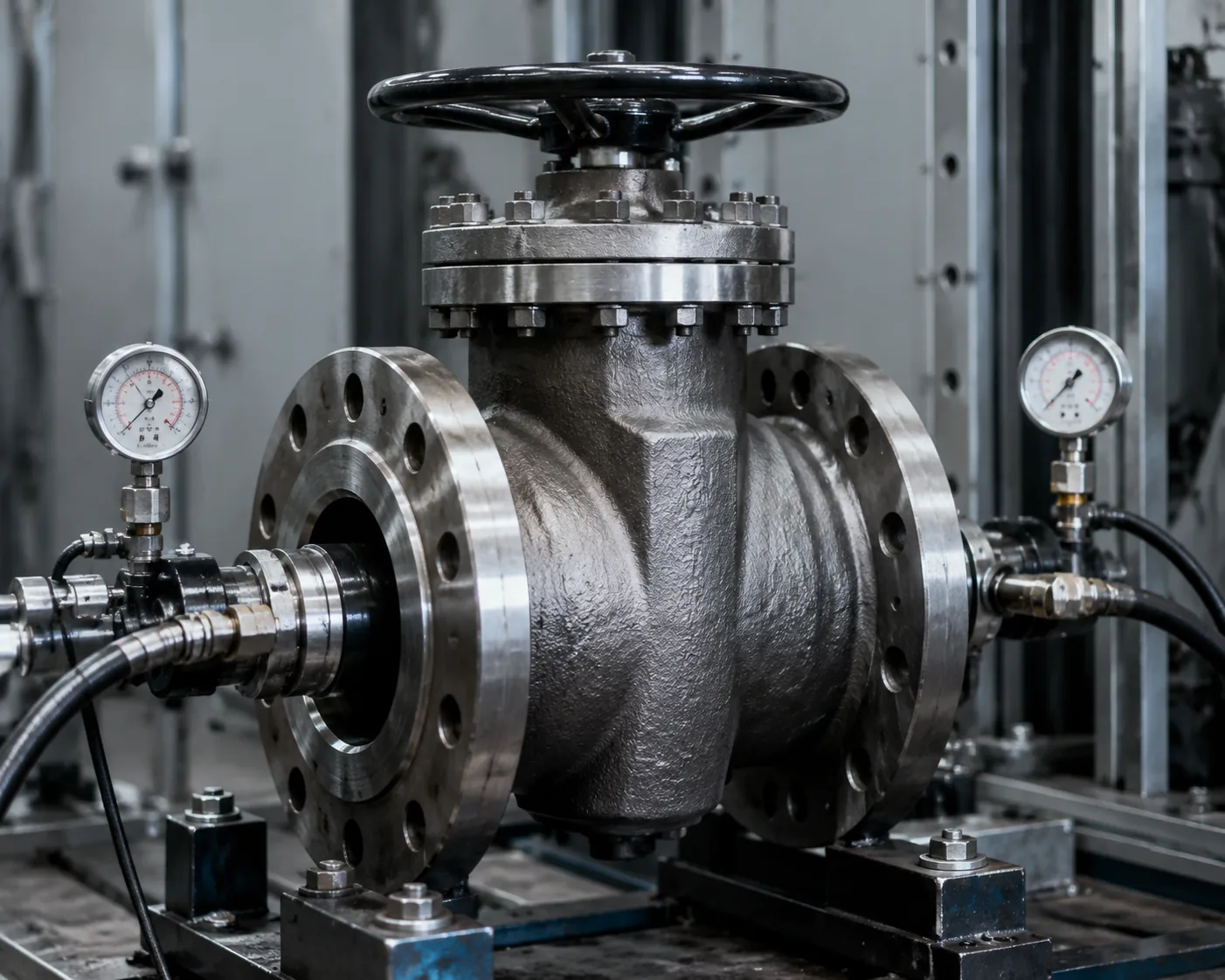
GB/T 22130 Steel Plug Valves is the product standard for steel plug valves, defining the structural types (lubricated, non-lubricated, sleeved, eccentric), the pressure-temperature ratings, the materials, and the inspection rules. For fluoroplastic-lined plug valves (衬氟旋塞阀), GB/T 26479 Technical Conditions for Fluoroplastics-Lined Valves is the applicable product standard — the lining changes both the pressure-temperature rating and the test method (the lining cannot be tested at the full shell pressure a steel-only valve would take). For pipeline plug valves in oil-and-gas service, GB/T 19672 (= API 6D) is the pipeline-valve product standard that adds the requirements for buried service, pigging compatibility, and pipeline-specific pressure testing.
For international trade, the counterparts are API 599 (steel and ductile-iron plug valves), API 598 (valve inspection and test), API 607 / API 6FA (fire test for soft-seated quarter-turn valves), and ISO 5208 (pressure testing). The test ratios are aligned — GB/T 13927 and API 598 both use shell test at 1.5× rated and seat test at 1.1× rated — but the report must cite the specific standard the buyer's contract invokes, because the acceptance criteria (allowable leakage rates) differ in detail.
How Is the Shell (Body) Strength Test Performed?
The shell test (壳体试验) verifies that the valve body, bonnet, and all pressure-containing joints can withstand the rated pressure without structural failure. It is the test that catches casting defects, weld defects, and bonnet-joint design errors — the failures that would produce a burst in service.
Test pressure: for liquid (hydrostatic) testing, the test pressure is 1.5× the cold working pressure (CWP) at the valve's rated class. The CWP is the maximum allowable working pressure at ambient temperature, defined by the valve's pressure-temperature rating per GB/T 12224 (= ASME B16.34). A Class 150 plug valve (CWP ~20 bar at ambient for carbon steel) is shell-tested at ~30 bar; a Class 300 valve is shell-tested at ~78 bar.
Test setup: the valve is partially open (so pressure fills the body cavity), both end connections are blinded, and the test medium (water, or for gas testing air/nitrogen) is introduced and pressurised. The pressure is held for a defined duration that depends on valve size — larger valves require longer hold times to allow any slow seepage to become visible. The valve's entire external surface — body, bonnet joint, gland flange, drain plugs — is inspected for visible leakage, structural damage, or permanent deformation.
Acceptance: no visible leakage through the pressure boundary, no structural damage, no permanent deformation. A shell test that produces visible seepage at a casting defect is a hard fail — the body is rejected, not re-tested.
Test medium: water is the default hydrostatic medium. Gas (air or nitrogen) is used where water contamination is unacceptable (oxygen service, cryogenic pre-test, valves that cannot be dried) — but a gas shell test carries stored energy and requires additional safety measures. The test medium choice is stated in the report because gas and liquid give different leak-detection sensitivity.
How Is the Seat Tightness Test Performed?
The seat tightness test (密封试验) verifies that the closed valve holds pressure across the seat without excessive leakage. It is the test that defines the valve's function — a plug valve that passes the shell test but leaks through the seat cannot shut off flow.
Test pressure: 1.1× the rated pressure (CWP for liquid test, lower for gas test per the standard). The valve is fully closed, the upstream end is pressurised, and the downstream end is open to atmosphere or to a leak-collection arrangement where the leakage is measured.
Test direction: plug valves are tested in the direction that produces the worst-case sealing condition. For a metal-seated plug valve, the plug's seal depends on the pressure differential pushing the plug against the seat — so the test direction that unseats the plug is the one that matters. For a sleeved (PTFE-lined) plug valve, the sleeve provides the seal and the test direction is less critical but still specified.
Acceptance — the leakage-rate framework: GB/T 13927 defines allowable seat leakage rates by rate class (Table 4), and the rate a plug valve must meet depends on its seal type. The key distinction:
- Resilient / soft-seated valves (PTFE or PFA sleeved): typically zero visible leakage — the soft seal is expected to be bubble-tight.
- Metal-seated valves: a defined maximum volumetric leakage rate, scaled by valve size, is allowed. Metal seats cannot be zero-leakage in principle because the metal-to-metal contact has surface roughness; the standard defines the maximum acceptable rate.
This is the critical difference between a soft-seated and a metal-seated plug valve in procurement specification: the soft-seated valve gives bubble-tight shutoff but is limited in temperature and fire resistance; the metal-seated valve survives high temperature and fire but allows a defined small leakage. A plug valve specification that does not state the seal type and the applicable leakage class is not scoped correctly.
What Is the Backseat Test and When Does It Apply?
The backseat test (上密封试验) applies to valves with a backseat — a sealing surface between the stem and the bonnet that engages when the valve is fully open, allowing the gland packing to be replaced under pressure. Not all plug valves have a backseat (many plug valves have a simple gland without a backseat provision), so this test is conditional on the design.
Test method: the valve is fully open (so the backseat is engaged), the gland packing is loosened or removed, and the upstream end is pressurised to 1.1× rated pressure. The backseat must hold, preventing leakage past the stem with the packing removed or slack. The duration depends on valve size — typically 15 seconds for < 2 inch valves, 60 seconds for larger.
Acceptance: no visible leakage past the backseat. A backseat that leaks cannot be used for in-service packing replacement, and the valve must be isolated for any stem-seal maintenance.
For plug valves without a backseat, this test is not performed, and the stem seal is verified only by the shell test (which checks the gland packing under shell pressure) and the seat test (which checks the gland packing at seat pressure with the valve closed).
How Is the Fire Test Applied to Soft-Seated Plug Valves?
Soft-seated plug valves (PTFE/PFA sleeved) cannot survive a fire without special design — the polymer sleeve melts and the valve loses both shutoff and shell integrity. For applications where the valve must maintain some level of tightness after a fire (hydrocarbon service, offshore platforms, emergency shutdown systems), the fire test is the qualification.
Fire-test standards: API 607 / API 6FA (the two internationally accepted fire-test standards for quarter-turn valves) and ISO 10497. The valve is subjected to a defined hydrocarbon fire that heats the valve body to ~760–980 °C for a defined duration (typically 30 minutes), with the valve in the closed position under rated pressure. During and after the fire, the valve's external and seat leakage is measured.
Pass criteria (API 607): during the burn, the external leakage must not exceed a defined rate; after cool-down, the valve must still operate (open and close against low pressure), and the seat leakage through the cycled valve must not exceed a defined rate. The test does not require the valve to be leak-free during or after the fire — it requires the leakage to stay within defined limits, so that a fire does not escalate into an uncontrollable release.
Test implication: a plug valve qualified to API 607 carries a fire-tested designation, and this is required for hydrocarbon service in most offshore and many onshore applications. A soft-seated plug valve without fire-test qualification cannot be used in these services — the buyer specifies API 607, and the test report is the evidence. Metal-seated plug valves inherently survive fire (no polymer to melt) and may not need the API 607 test, though some buyers still specify it.
How Are Torque and Operation Tests Performed?
The torque / operation test verifies that the valve can be opened and closed within the specified torque limit — the property that decides whether the actuator (manual, pneumatic, electric) can operate the valve in service. For plug valves, torque is a particular concern because the plug rotates in a sleeve or against a metal seat, and the friction between them determines the operating torque.
Test method: the valve is cycled open-closed-open under defined pressure differential (typically at rated pressure, in the worst-case sealing direction), and the torque is measured with a torque wrench or torque sensor on the stem. The measured torque is compared to the manufacturer's declared maximum operating torque. The test is typically run over multiple cycles (10–100 for a functional check, more for a durability qualification) to verify that the torque does not drift upward as the seat wears or the lubricant degrades.
For lubricated plug valves: the torque depends critically on the lubricant — the field-maintenance literature documents that a dried-out lubricated plug valve's torque can rise by an order of magnitude, seizing the valve. The torque test on a new valve must verify the torque with the specified lubricant, and the field-maintenance schedule must re-inject lubricant at the interval that keeps the torque within the actuator's capacity.
For sleeved plug valves: the torque depends on the interference fit between the plug and the sleeve, which changes with temperature and wear. A sleeved plug valve's torque typically rises at low temperature (sleeve contracts, interference increases) and may rise over service life as the sleeve wears unevenly.
The torque test is where a plug valve specification that does not state the actuator torque requirement produces field failures — an undersized actuator cannot operate a valve whose torque is within the valve spec but above the actuator capacity.
How Does the GB/T Framework Map to International Plug Valve Standards?
| Scope | China (GB/T) | International (ISO) | US (API / ASME) |
|---|---|---|---|
| Valve pressure test method | GB/T 13927-2022 | ISO 5208 | API 598 |
| Steel plug valve product | GB/T 22130 | — | API 599 |
| Pipeline valves (= API 6D) | GB/T 19672 | ISO 14313 | API 6D |
| Fluoroplastic-lined valves | GB/T 26479 | — | — |
| Pressure-temperature ratings | GB/T 12224 | — | ASME B16.34 |
| Fire test for soft-seated QTV | — | ISO 10497 | API 607 / API 6FA |
The test ratios are aligned: GB/T 13927 and API 598 both use shell 1.5× CWP and seat 1.1× rated, so a plug valve tested to GB/T 13927 will generally pass API 598 and vice versa. The differences are in the leakage-rate tables (GB/T 13927 and ISO 5208 use rate classes A–E; API 598 uses size-scaled droplets-per-minute), in the documentation format, and in the specific test-fluid temperature. For export to a US-API market, the report should cite API 599 (product) and API 598 (test); for an ISO market, ISO 5208 (test); for the domestic market, GB/T 22130 and GB/T 13927. A plug valve sold across all three markets carries three sets of certification.
Our Testing Capabilities
Beijing ZKGX Research provides plug valve testing against GB/T 13927-2022 (pressure test), GB/T 22130 (steel plug valve product), GB/T 26479 (fluoroplastic-lined), and the API / ISO reference frameworks.
Pressure testing (GB/T 13927-2022):
- Shell strength test (1.5× CWP hydrostatic or pneumatic)
- Seat tightness test (1.1× rated, both directions, leakage-rate class per Table 4)
- Backseat test (where the design includes a backseat)
- Test-medium selection (water / air / nitrogen) per the valve's service
Product qualification (GB/T 22130 / GB/T 26479):
- Pressure-temperature rating verification
- Material verification (PMI, chemistry)
- Dimensional inspection (face-to-face, flange, stem)
- Fluoroplastic-lining continuity and thickness (for lined valves)
Functional:
- Torque test at rated differential pressure, open and closed
- Multi-cycle durability qualification
- Flow coefficient (Cv) measurement
Fire test (API 607 / ISO 10497): fire qualification for soft-seated plug valves in hydrocarbon service.
If you need a GB/T 13927 pressure-test report for a domestic plug-valve release, a GB/T 22130 product qualification, an API 599 / API 598 report for a US-bound export, an API 607 fire-test certificate, or a torque qualification for actuator sizing — contact our laboratory with the valve type (lubricated / sleeved / eccentric / lined), seal type (soft / metal), size, pressure class, and applicable standard, and we will scope the test plan.
FAQ
What is the difference between GB/T 13927 and API 598?
GB/T 13927-2022 is the Chinese industrial-valve pressure-test standard, technically equivalent to ISO 5208. API 598 is the US valve inspection and test standard. The test ratios are aligned (shell 1.5× CWP, seat 1.1× rated), but the allowable leakage tables differ in format: GB/T 13927 / ISO 5208 use volumetric rate classes (A–E), while API 598 uses size-scaled droplets-per-minute for liquid and bubbles-per-minute for gas. A valve that passes one will generally pass the other, but the report must cite the specific standard the buyer invokes.
Why does a soft-seated plug valve require zero leakage while a metal-seated valve allows a defined rate?
Because the seal mechanism is different. A soft (PTFE/PFA) sleeve deforms to fill the surface roughness between plug and body, producing a bubble-tight seal — and the standard requires zero visible leakage because the soft seal is capable of it. A metal-to-metal seat has surface roughness that no amount of seating force can fully eliminate, so the standard allows a small defined volumetric leakage scaled by valve size. The trade is: soft-seated gives tighter shutoff but lower temperature and no fire resistance; metal-seated gives higher temperature and fire survival but allows a small leak.
Is the API 607 fire test mandatory for all plug valves?
No — it is mandatory only for soft-seated valves in services where fire survival is specified (hydrocarbon processing, offshore, emergency shutdown). Metal-seated plug valves inherently survive fire (no polymer component to melt) and typically do not need the API 607 test. But many buyers specify the fire test for all quarter-turn valves in hydrocarbon service regardless of seat type, as a common purchasing requirement. The fire test report is the evidence the valve can maintain defined leakage limits during and after a fire.
What does the torque test reveal about a plug valve?
It reveals whether the valve can be operated by the specified actuator in service. The torque depends on the friction between plug and seat/sleeve, which changes with pressure differential, temperature, lubricant condition (for lubricated plug valves), and wear over service life. A new-valve torque test verifies the valve is within the actuator's capacity; a multi-cycle test verifies the torque does not drift upward as the valve wears. A plug valve whose torque rises above the actuator capacity will seize in service — the dominant field-failure mode for lubricated plug valves whose lubricant has dried out.
Can a fluoroplastic-lined plug valve be tested at the same pressure as a steel-only valve?
Not necessarily. The lining (PTFE/PFA) has a lower pressure-temperature rating than the steel body, and GB/T 26479 sets the lined-valve rating based on the lining, not the steel. A lined Class 150 plug valve may be derated to a lower pressure at elevated temperature because the lining softens. The pressure-test method (GB/T 13927) is the same, but the test pressure is computed from the lined-valve rating, not the bare-steel rating. A lined-valve report must state the pressure-temperature rating used for the test.