What Is Spring Steel and What Standard Governs It?
Spring steel is a family of high-carbon and alloy steels engineered to deform elastically under load and return to shape on unloading — the property that makes it the material of leaf springs, coil springs, valve springs, and all elastic fasteners. The defining requirement is a high yield strength with a high yield-to-tensile ratio (屈强比), so that the steel can be loaded close to its elastic limit in service without taking permanent set. The Chinese product standard is GB/T 1222-2025 Spring Steel (replacing the 2016 edition), covering hot-rolled, forged, and cold-drawn round, square, and flat bar and wire rod in nominal diameters up to 120 mm (bar) and 40 mm (rod).
The GB/T 1222 standard is managed by TC183 (the national steel technical committee) and classifies spring steel into three metallurgical families — carbon, silicon-manganese, and chromium (with chromium-vanadium and silicon-chromium variants). The three families differ in carbon content, alloying, hardenability, and — critically — in their tendency to decarburise during heat treatment, which is the single most decisive factor for spring fatigue life.
The international references are EN 10089 (European hot-rolled spring steel), JIS G 4801 (Japanese spring steel, with the SUP grades such as SUP9), ASTM A682 / A689 / A125 (US spring steel strip/bar and heat-treated helical springs), and the SAE J403 / J775 grades. The chemistry is closely aligned across frameworks — a 60Si2MnA under GB/T 1222 is essentially the same steel as SUP6 under JIS and 61SiCr7 under EN — but the test reporting must cite the specific standard because the acceptance thresholds differ at the margins.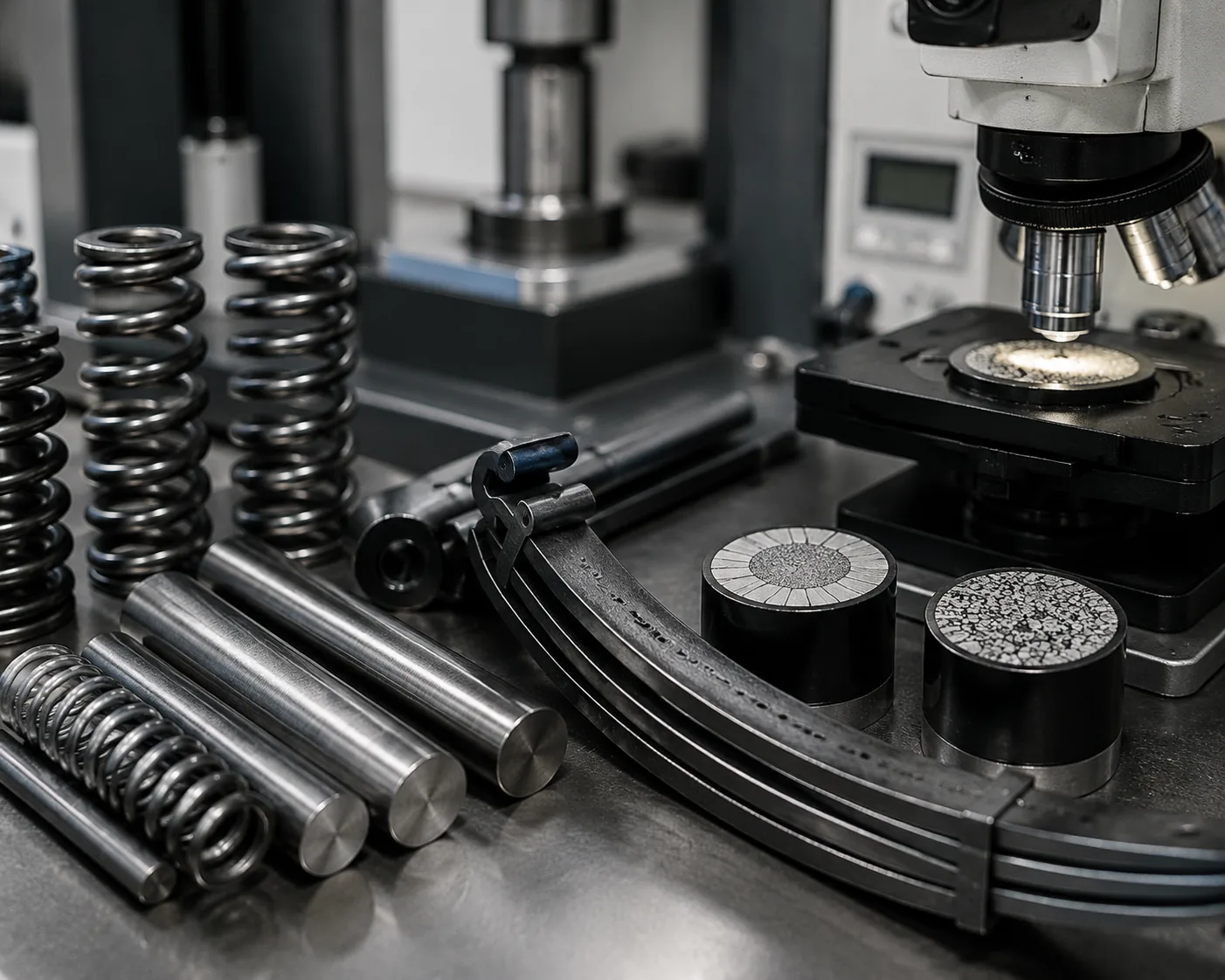
How Do the Three Spring Steel Families Compare?
The three metallurgical families in GB/T 1222 are selected by application because they trade strength, hardenability, and decarburisation resistance differently.
| Family | Representative grades | Carbon (wt %) | Key alloying | Hardenability | Decarburisation tendency |
|---|---|---|---|---|---|
| Carbon | 65, 70, 65Mn | 0.62 – 0.70 | low Mn (0.17–0.37 % in 65Mn) | low — water-quench, small sections only | moderate |
| Silicon-manganese | 60Si2MnA, 55Si2Mn | 0.52 – 0.60 | 1.5 – 2.0 % Si | higher — oil-quench, larger sections | high — Si accelerates surface decarburisation |
| Chromium / Cr-V | 55Cr3 (SUP9), 50CrVA | 0.46 – 0.59 | 0.65 – 1.10 % Cr (some + V) | high — critical diameter up to ~70 mm | low — Cr slows carbon diffusion |
The selection logic is not "stronger is better" — it is application-driven:
65Mn (carbon): cheapest, easiest to process, used for general-purpose elastic elements where the section is small enough to water-harden and the service stress is moderate — spring washers, clips, low-stress flat springs. Its low hardenability limits it to thin sections; a thick 65Mn part will not through-harden.
60Si2MnA (silicon-manganese): the workhorse for automotive leaf springs and coil springs. The silicon raises the elastic limit and yield ratio, and the oil-hardenability allows larger sections. The trade-off is the high decarburisation tendency — silicon promotes carbon loss at the surface during hot rolling and heat treatment, and decarburised surface is the primary initiation site for fatigue cracks. A 60Si2MnA spring requires surface peening or grinding to restore the fatigue strength that decarburisation removes. After 850 °C quench + 450 °C temper, the fatigue limit reaches approximately 780 MPa.
55Cr3 / SUP9 (chromium): chosen for larger-section springs where through-hardening matters and where decarburisation control is critical — heavier leaf springs, torsion bars, high-cycle coil springs. The chromium lowers the carbon diffusion rate at the surface, so the decarburised layer is thinner for the same heat-treatment exposure. This is the chromium-system advantage: comparable strength to 60Si2MnA, but better fatigue performance in service because the surface retains its carbon.
Knowing the grade up front decides the test panel. A 65Mn washer is tested for hardness and a simple set-test; a 60Si2MnA leaf spring is tested for decarburisation depth, fatigue, and surface defect; a 50CrVA valve spring is tested for high-cycle fatigue and non-metallic inclusion rating (because inclusions initiate fatigue in high-stress, high-cycle service).
What Is the Decarburisation Test and Why Is It Critical?
Decarburisation — the loss of carbon from the steel surface during heating — is the single most consequential test in spring steel quality control, because it directly destroys the property the steel was selected for: surface fatigue strength.
The mechanism: when spring steel is heated for hot rolling, forging, or quenching, carbon at the surface oxidises and diffuses away, leaving a softer, lower-carbon layer. The result is a surface that has lost the martensitic hardness and high yield strength of the bulk material. A decarburised surface layer is where fatigue cracks initiate — the soft surface cannot support the service stress, a crack forms at the decarburised-steel interface, and the crack propagates inward under cyclic load.
The magnitude of the effect is documented in the metallurgical literature: a decarburised layer of just 0.1 mm depth causes a significant reduction in fatigue limit; when the decarburised layer develops free ferrite at the surface, the fatigue limit drops by approximately 50 %. For a spring designed to a fatigue limit calculated from the bulk hardness, this is a catastrophic loss — the spring will fail in service at loads well below its rated capacity.
The test method (per EN 10218-1 and the GB/T 1222 framework): a transverse metallographic specimen is cut, mounted, polished, and etched; the microstructure is examined at 200× magnification. The decarburised depth is measured as the mean of 8 measurements at the ends of four diameters located at 45° to each other, starting from the zone of maximum decarburisation. The acceptance threshold depends on the steel grade and the section size — silicon-manganese grades carry a larger allowed depth than chromium grades, reflecting their inherent higher tendency, but the threshold is tight because the fatigue consequence is severe.
The practical implication for procurement: a spring steel test report that gives tensile and hardness but omits decarburisation depth is missing the property that most strongly predicts service failure. A batch with excellent bulk mechanicals and a deep decarburised layer will produce springs that fail in fatigue far earlier than the design life — and the failure will trace to the surface, not the bulk.
What Are the Mechanical Property Requirements?
The mechanical block of GB/T 1222 sets the tensile, yield, and hardness requirements for each grade in its heat-treated condition (quench + temper). The relevant heat-treatment parameters are specified alongside the thresholds, because the mechanicals are meaningless without the heat-treatment context. For representative grades after their standard quench-and-temper:
- Tensile strength (Rm): typically 980 – 1275 MPa range depending on grade and section
- Yield strength (ReL / Rp0.2): typically ≥ 785 MPa, with the yield-to-tensile ratio (屈强比) being the quality discriminator — a high ratio (> 0.8) is what makes the steel a spring steel
- Elongation (A5): percentage ductility at fracture, typically ≥ 8–9 % for spring grades (lower than structural steel, because the strength is the priority)
- Section shrinkage (Z): reduction of area at fracture
- Hardness (HBW): typically measured in the annealed delivery condition for bar stock
The mechanical test methods are per GB/T 228.1 (metallic materials tensile testing), the Chinese equivalent of ISO 6892-1. For wire, the tensile test is run on the full wire cross-section per EN 10002-1. The hardness test is per GB/T 231 (Brinell) for bar stock.
The diagnostic pattern in a mechanical report: a low yield-to-tensile ratio indicates under-tempering (the steel is too hard and brittle, will snap not yield); a low elongation with high tensile indicates over-hardening; a low tensile with normal elongation indicates under-quenching or insufficient carbon. Each pattern points to a different heat-treatment or chemistry fault.
How Is Fatigue Performance Tested?
Fatigue is the property that spring steel is ultimately selected for — a spring that fails in fatigue has failed its primary function. The fatigue test cyclically loads a specimen (or a finished spring) between defined stress limits until fracture, and the number of cycles to failure is the fatigue life. Repeated at several stress levels, the data defines the S-N curve and the fatigue limit (the stress below which the steel survives an effectively infinite number of cycles).
Material-level fatigue test (GB/T 3075 / ISO 1143): a standard round specimen is loaded in axial tension-compression or rotating bending at a defined stress amplitude and mean stress. The test runs to a high cycle count (typically 10⁶ – 10⁷ cycles) to establish the fatigue limit. For a 60Si2MnA heat-treated to its standard condition, the fatigue limit is approximately 780 MPa — the number that drives the spring design.
Spring-level fatigue test: the finished spring (coil, leaf) is cycled between its service deflection limits on a fatigue test rig, typically to 10⁵ – 10⁶ cycles for automotive springs or 10⁷+ for valve springs. This is the test that combines material, surface, and geometry effects — a spring with good material but a surface defect or decarburised layer will fail the spring-level test even though the material-level specimen passes.
The surface effect: fatigue in springs initiates at the surface, almost without exception. The surface finish (as-rolled, ground, peened), the decarburisation depth, and the presence of surface defects (cracks, folds, inclusions breaking the surface) together determine the fatigue life. This is why shot peening — which puts the surface into compressive residual stress — is so effective at extending spring fatigue life; it directly counters the surface-initiation mechanism. A shot-peened spring can have 10× or longer fatigue life than the same spring unpeened, from the same steel.
The non-metallic inclusion rating (per GB/T 10561 / ISO 4967) is the metallurgical screen that catches the inclusions that will become fatigue initiation sites. For high-cycle valve springs, the inclusion rating is as important as the tensile strength — a single Type D (globular oxide) inclusion at the surface will start a fatigue crack regardless of the bulk properties.
How Are Spring Steel Wire and Surface Defects Tested?
For spring steel in wire form (used for coil springs, wire forms, and cold-coiled springs), the test panel extends beyond the bulk mechanicals to the formability and surface tests that predict coiling and service performance. The EN framework for cold-drawn spring steel wire defines these clearly:
Torsion test: a straight wire specimen is clamped at both ends and one end is twisted at uniform speed until fracture. The number of complete rotations to fracture is the torsion ductility — a measure of the wire's ability to deform without cracking. Low torsion count indicates brittleness, typically from excessive drawing reduction or improper heat treatment.
Coiling / wrapping test: the wire is wound tightly around a mandrel (typically 2–3× the wire diameter) and inspected for surface cracks. A wire that cracks on coiling will crack when formed into a spring.
Bending test: the wire is bent in U-form around a mandrel (2–3× diameter depending on wire size). Used for thicker wire where torsion testing is less representative.
Surface defect inspection (deep etch / eddy current): the wire surface is examined for seams, laps, cracks, and inclusions. Deep etching in acid reveals surface defects visually; eddy-current testing provides a continuous, automated screen on production wire. For high-stress spring applications, even a small surface seam becomes a fatigue initiation site — the surface defect test is the screen that catches these.
Decarburisation inspection: as above — metallographic measurement on a transverse section at 200×, 8 measurements averaged.
The combination of these tests is what certifies a spring steel wire for a specific end use. A wire that passes tensile but fails torsion cannot be cold-coiled into a spring without cracking. A wire that passes torsion but has surface seams will produce springs that fail in fatigue. The test panel covers all of these because each catches a different failure mode.
How Does the GB/T Framework Map to International Spring Steel Standards?
| Scope | China (GB/T) | International (EN / ISO) | Japan (JIS) | US (ASTM / SAE) |
|---|---|---|---|---|
| Spring steel bar/rod product | GB/T 1222-2025 | EN 10089 | JIS G 4801 (SUP grades) | ASTM A682 / A689, SAE J403 |
| Oil-tempered spring wire | GB/T 18983 | EN 10270-2 | JIS G 3561 | ASTM A229 / A230 |
| Heat-treated helical spring | — | EN 13906-1 | JIS B 2704 | ASTM A125 |
| Tensile test method | GB/T 228.1 | ISO 6892-1 | JIS Z 2241 | ASTM E8 / A370 |
| Decarburisation | GB/T 1222 (micro) | EN 10218-1 | JIS G 0558 | ASTM E1077 |
| Non-metallic inclusions | GB/T 10561 | ISO 4967 | JIS G 0555 | ASTM E45 |
The grades are closely aligned chemically across frameworks: 60Si2MnA (GB) ≈ 61SiCr7 (EN) ≈ SUP6 (JIS) ≈ 9260 (SAE). A test report for export should cite the destination framework's grade designation alongside the Chinese one, because a buyer searching for "SUP6 testing" will not recognise "60Si2MnA" and vice versa. The test methods are similarly aligned — GB/T 228.1 and ISO 6892-1 are technically equivalent — but the report should cite the specific standard the buyer's contract invokes.
Our Testing Capabilities
Beijing ZKGX Research provides spring steel testing against the GB/T 1222-2025 product standard and the EN / JIS / ASTM reference frameworks.
Mechanical properties (GB/T 228.1 / ISO 6892-1):
- Tensile strength, yield strength, elongation, section shrinkage
- Yield-to-tensile ratio (the spring-steel quality discriminator)
- Brinell / Rockwell / Vickers hardness
Decarburisation (critical):
- Metallographic measurement at 200×, 8-point average depth
- Total and free-ferrite decarburised layer depth
- Reporting against grade-specific thresholds
Fatigue:
- Material-level high-cycle fatigue (GB/T 3075), S-N curve, fatigue limit
- Spring-level fatigue cycling on finished springs
- Surface-condition effect evaluation
Surface and metallurgical:
- Non-metallic inclusion rating (GB/T 10561 / ISO 4967, Type A-D)
- Surface defect inspection (deep etch, eddy current for wire)
- Hardenability (Jominy end-quench, GB/T 225)
Wire-specific formability:
- Torsion test, coiling/wrapping test, bending test
Grade identification: chemical analysis (C, Si, Mn, Cr, V) per GB/T 4336, cross-referenced to GB/T 1222 / EN 10089 / JIS G 4801 grade designations.
If you need a GB/T 1222 spring steel product-release report, a decarburisation depth measurement, a fatigue S-N curve for a spring design, a non-metallic inclusion rating for a valve-spring application, or a grade identification that cross-references Chinese and international designations — contact our laboratory with the grade (e.g. 60Si2MnA, 55Cr3), product form (bar / wire / finished spring), and applicable standard, and we will scope the test plan.
FAQ
What is the difference between carbon, silicon-manganese, and chromium spring steel?
The alloying system and the resulting property balance. Carbon grades (65Mn) are cheapest, water-harden in thin sections, used for low-stress springs. Silicon-manganese grades (60Si2MnA) have higher elastic limit and oil-hardenability, used for automotive leaf and coil springs, but have a high decarburisation tendency that requires surface finishing. Chromium grades (55Cr3, 50CrVA) have the best hardenability and the lowest decarburisation tendency, used for larger-section and high-fatigue-life springs. The choice is application-driven, not strength-driven.
Why is decarburisation the most critical test in spring steel?
Because decarburisation destroys surface fatigue strength — the property spring steel is selected for. A decarburised surface layer loses its carbon, its hardness, and its fatigue resistance; a fatigue crack initiates at the decarburised-to-bulk interface and propagates inward. The literature documents that a 0.1 mm decarburised layer causes a significant fatigue-limit reduction, and free-ferrite decarburisation drops the fatigue limit by approximately 50 %. A spring steel batch with excellent bulk tensile properties but a deep decarburised layer will produce springs that fail prematurely in fatigue.
What does the yield-to-tensile ratio tell about spring steel quality?
It tells whether the steel behaves like a spring. A high yield-to-tensile ratio (typically > 0.8 for spring grades) means the steel can be loaded close to its tensile strength without taking permanent set — the defining spring property. A low ratio means the steel will yield and take permanent set under service load, which is a structural-steel behaviour, not a spring-steel behaviour. The ratio is the single-number quality discriminator between a well-heat-treated spring steel and one that is under-tempered or off-chemistry.
Can a spring steel pass tensile but fail in service?
Yes — and the most common cause is a surface defect or decarburisation that the tensile test does not capture. The tensile test measures bulk properties on a machined specimen; the service spring carries its load at the surface, where decarburisation, seams, and inclusions initiate fatigue cracks. This is why the spring steel test panel includes decarburisation, surface defect inspection, and inclusion rating alongside the tensile — each catches a failure mode the tensile misses. A report that gives only tensile and hardness is incomplete for a fatigue-critical spring application.
How does shot peening affect the spring steel test?
Shot peening puts the spring surface into compressive residual stress, which directly counters the surface-initiated fatigue mechanism. A shot-peened spring can have a fatigue life 10× longer than the same spring unpeened, from the same steel with the same bulk properties. The test implication is that a fatigue test on a peened vs unpeened specimen of the same steel will give very different results — and the peening specification (intensity, coverage) must be part of the fatigue test report, not just the steel grade and heat treatment.