What Standard Governs thermal insulation Mortar in China?
Thermal insulation mortar testing in China is governed by GB/T 20473-2021 Thermal Insulation Mortar for Buildings (replacing the 2006 edition, effective March 1, 2022). The standard applies to dry-mixed mortars made with lightweight aggregates — expanded perlite (膨胀珍珠岩), glazed hollow beads / vitrified microspheres (玻化微珠), expanded vermiculite (膨胀蛭石) — bound with cement and functional additives. The product is classified into two grades by dry bulk density: Type I (dry density < 350 kg/m³, the lighter, more insulating grade) and Type II (dry density ≤ 400 kg/m³, the denser, higher-strength grade).
Two companion standards sit alongside the product standard. JGJ/T 253 Technical Specification for Application of Inorganic Lightweight-Aggregate Mortar Insulation System is the application code that defines where and how the mortar is installed and sets the system-level performance ( cracking resistance, hygrothermal performance). GB/T 10295 Thermal Insulation — Determination of Steady-State Thermal Resistance — Heat Flow Meter Method is the method standard for the thermal-conductivity test. For EPS-particle-based thermal-insulation plasters (胶粉聚苯颗粒), JG/T 158 is the separate product standard — the EPS-particle product is tested to JG/T 158, not GB/T 20473, and the two are not interchangeable.
A further mandatory overlay: GB 8624 Classification for Burning Behavior of Building Materials and Products sets the fire-performance class. Inorganic thermal insulation mortars (perlite, vitrified-microsphere based) achieve A1 class — non-combustible — which is the property that distinguishes them from EPS/XPS organic foams and is the reason they are specified for fire-rated wall assemblies. The A1 class is verified by the GB/T 5464 non-combustibility test and the GB/T 14402 calorific-value test.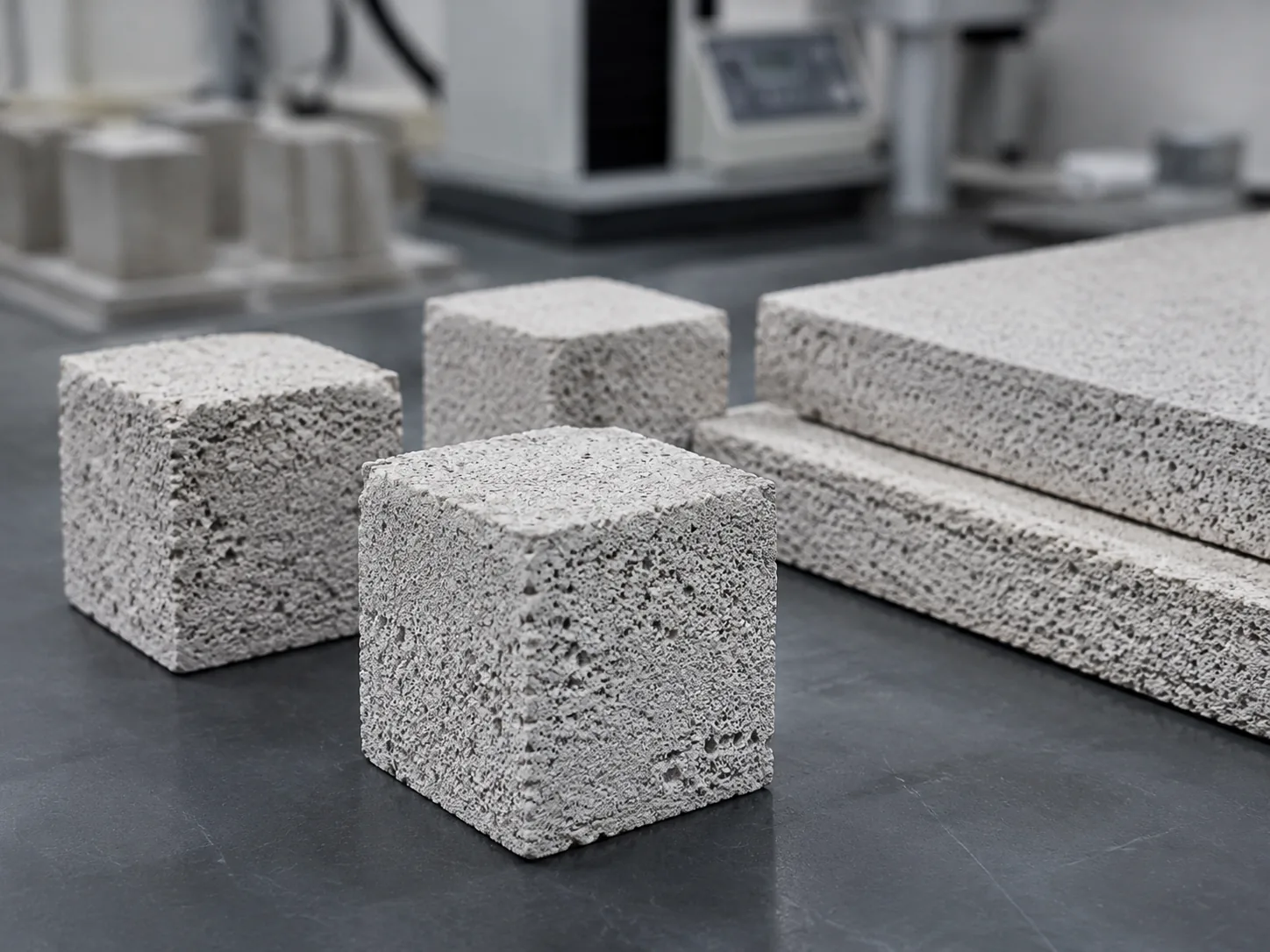
What Are the Performance Requirements by Grade?
GB/T 20473-2021 sets a combined set of mechanical, thermal, and durability thresholds that a batch must meet for its declared grade. The core indicators:
| Indicator | Unit | Typical requirement (by grade and application) |
|---|---|---|
| Dry bulk density (干表观密度) | kg/m³ | Type I < 350; Type II ≤ 400 |
| Thermal conductivity (导热系数, λ) | W/(m·K) | ≤ 0.085 (typical 0.060–0.085) |
| Compressive strength (抗压强度) | MPa | 0.20–0.40 by grade; local application codes may require ≥ 1.0 |
| Softening coefficient (软化系数) | — | ≥ 0.50 (strength-retention after water immersion) |
| Tensile bond strength (拉伸粘结强度) | MPa | ≥ 0.20 (to substrate) |
| Compressive shear bond strength (压剪粘结强度) | MPa | per Annex E method |
| Linear shrinkage (线性收缩率) | % | controlled to prevent cracking |
| Water absorption (体积吸水率) | % | controlled |
| Burning behavior (燃烧性能) | class | A1 (non-combustible) per GB 8624 |
Dry bulk density (干表观密度) is the headline classification parameter — Type I vs Type II is decided by it. The density governs the thermal conductivity (lighter = more insulating) and the mechanical strength (denser = stronger), so the grade choice is a deliberate trade between insulation and structural capacity. A Type I mortar for an interior insulation layer prioritises low λ at the cost of compressive strength; a Type II mortar for an exterior base render prioritises mechanical strength at the cost of some insulation.
Thermal conductivity (导热系数, λ) is the property the product is sold for. The ceiling under GB/T 20473-2021 is λ ≤ 0.085 W/(m·K), with typical products running 0.060–0.085. The measured λ is sensitive to dry density, moisture content, and test method — and this is the parameter most often mis-stated in declared-performance databases. Field-test evidence shows declared λ values in product databases can under-state the real laboratory-measured λ by 50% or more (one documented case: a declared 0.038 W/(m·K) EPS-bead mortar measured 0.0583 W/(m·K) in an independent test — a 53% discrepancy). This is why third-party λ verification, not the declared value, is the basis for building energy-performance calculations.
Compressive strength (抗压强度) for thermal insulation mortar is low compared to structural mortar — typically 0.20–0.40 MPa for the GB/T 20473 grades — because the product's first job is insulation, not load-bearing. Local application codes (e.g. Shanghai's specification for inorganic lightweight-aggregate mortar) may require ≥ 1.0 MPa for exterior-base applications where the render carries wind and impact loads. The test is run on 100 mm cube specimens cured 28 days per the GB/T 20473 method (clause 6.8.2).
Softening coefficient (软化系数) is the water-immersion strength-retention ratio — the ratio of saturated compressive strength to dry compressive strength. The threshold (typically ≥ 0.50) catches mortars whose binder matrix degrades on wetting — the failure mode that produces exterior-render spalling after rain cycles. A high softening coefficient is what separates a mortar that survives exterior exposure from one that must be limited to interior use.
How Is Thermal Conductivity Tested?
Thermal conductivity is the defining test for an insulation product — it is what the product is sold on and what the building energy calculation depends on. GB/T 20473 invokes GB/T 10295 (heat flow meter method) or, for some product types, GB/T 10294 (guarded hot plate). The transient plane source (TPS) method is also used in research and in some testing labs for faster screening.
Specimen preparation is the dominant source of test-result scatter for insulation mortar, and it is where most declared-vs-measured discrepancies originate. The test specimen is a 300 × 300 × 30 mm (or 300 × 300 × 300 mm for some methods) slab cast from the mixed mortar, cured under standard conditions (typically 20 °C, ≥ 95 % RH or water bath, 28 days), then dried to constant mass at 105 °C befOre testing. The drying step is critical — residual moisture in the specimen raises the measured λ because water conducts heat far better than the air it displaces in the pore structure.
The specimen-preparation literature for EPS-particle insulation mortar documents the specific pitfalls: the powder and EPS particles separate during transport due to density difference, producing inhomogeneous specimens; demoulding from glass plates damages the surface; uneven grinding introduces thickness error. A specimen prepared without strict control of mixing, moulding, and curing will produce a λ measurement that reflects the specimen preparation, not the product — and this is the root cause of the database-vs-laboratory discrepancy documented in the field-test literature.
Measurement method: in the heat flow meter (GB/T 10295), the specimen is placed between hot and cold plates at a defined temperature difference, and the steady-state heat flux through the specimen is measured by a heat-flux transducer. The thermal conductivity is calculated from the measured heat flux, specimen thickness, and temperature difference. The test runs until steady state (typically several hours). The guarded hot plate (GB/T 10294) is the absolute-reference method but is slower and requires larger specimens.
The test report must state: the test method, the specimen conditioning (drying temperature, duration), the mean test temperature, the measured λ, and the specimen density. A λ value without the density and conditioning history is not interpretable, because the same product tested at different moisture contents gives different λ.
How Is Compressive Strength Tested?
Compressive strength is tested on standard cube specimens cast from the mortar mix, cured, and loaded to failure in compression. GB/T 20473 specifies the specimen geometry (typically 100 mm cubes), the curing regime (28 days under standard conditions), and the loading rate.
Specimen preparation: the mixed mortar is cast into the cube moulds in layers, tamped (typically 25 times per layer with a tamping rod, working from outside to centre), and the top is scored and smoothed. The demoulding step is critical for insulation mortars — the 7-day-cured specimens are fragile, and rough demoulding cracks the cube. The cured cubes are then tested in compression at a controlled loading rate.
The result is sensitive to specimen density and homogeneity. Because insulation mortar is a lightweight-aggregate product, any segregation of the lightweight aggregate during mixing or moulding produces a non-uniform cube — and the compressive result reflects the weakest zone, not the average. This is why the test uses multiple specimens (typically 3 or 6) and reports the average — a single-cube result is not defensible.
The softening-coefficient test is a paired compressive test: cubes are tested dry and after water immersion, and the softening coefficient is the ratio. The water-immersion protocol (typically 48 hours immersed, or per the standard) must be followed exactly, because the immersion time and temperature affect the degree of saturation and therefore the measured ratio.
How Is Bond Strength Tested?
Bond strength — both tensile bond (to the substrate) and compressive shear bond — is the property that decides whether the insulation mortar stays on the wall. GB/T 20473 specifies the tensile bond strength method (typically ≥ 0.20 MPa) and Annex E specifies the compressive shear bond strength method.
Tensile bond strength (拉伸粘结强度): a defined-area mortar layer is applied to a standard substrate (concrete or masonry), cured, and a pull-off test is run with a defined loading rate. The failure mode is recorded — adhesive failure at the mortar-substrate interface (bond failure), cohesive failure within the mortar (mortar failure), or substrate failure (the substrate itself breaks before the bond). Adhesive failure at a load below the threshold is a bond problem; cohesive failure is a mortar-strength problem; substrate failure means the bond is stronger than the substrate and is a pass.
Compressive shear bond (压剪粘结强度, Annex E): the mortar is sandwiched between two substrate blocks in a lap-shear configuration, and the shear force to failure is measured. This test is the one that predicts whether the insulation layer will delaminate under the combination of thermal expansion, wind load, and gravity that it sees in exterior service.
Bond-strength testing after water immersion and after freeze-thaw cycling is what catches mortars that bond well in dry laboratory conditions but delaminate in exterior service — the dominant field-failure mode for insulation-mortar systems.
How Are Durability and Fire Performance Tested?
Freeze-thaw resistance (抗冻性能): specimens are subjected to defined freeze-thaw cycles (typically per GB/T 35164 or the application code), and the compressive-strength loss after cycling is measured — the loss should be ≤ 25 % of the pre-cycling strength. This is the test that catches mortars whose pore structure absorbs water, freezes, and cracks — the failure mode in cold-climate exterior applications.
Water absorption (体积吸水率): the volume of water the mortar absorbs under defined immersion. High water absorption raises the in-service λ (wet insulation insulates poorly) and accelerates freeze-thaw damage. The threshold is set by the grade.
Dimensional stability / linear shrinkage (线性收缩率): the shrinkage on drying. Excessive shrinkage produces the cracking that is the most visible defect in a finished insulation-mortar render. The threshold is controlled because shrinkage cracks are pathways for water ingress and are aesthetic defects.
Burning behavior (燃烧性能) — GB 8624 A1 class: for inorganic insulation mortars (perlite, vitrified-microsphere), the A1 non-combustible class is verified by:
- GB/T 5464 non-combustibility test (the furnace test measuring temperature rise, mass loss, and flame duration)
- GB/T 14402 calorific value (PCS, the heat of combustion)
The A1 class — non-combustible, no flame, no significant heat release — is what makes inorganic insulation mortar the specified product for fire-rated wall assemblies and for buildings where organic foams (EPS, XPS, polyurethane) are restricted by fire code. This is the regulatory reason the product category exists, and the A1 verification is the test that certifies it.
How Does Declared vs Measured Performance Discrepancy Arise?
The field-test literature documents a systematic gap between declared λ values in product databases and independently measured laboratory λ values — and for insulation mortar this gap can be 50% or more. The root causes:
Specimen preparation non-uniformity. Lightweight aggregates segregate during mixing and moulding, producing specimens that are not representative of the installed product. A specimen that has settled powder at the bottom and EPS particles at the top tests differently from a homogeneous specimen of the same nominal mix.
Moisture content. A specimen tested with residual moisture gives a higher λ than the same specimen properly dried — and the drying protocol (temperature, duration) is often not followed strictly. A product "tested wet" produces a higher λ that is closer to in-service performance but further from the declared value.
Test method differences. Heat flow meter (GB/T 10295), guarded hot plate (GB/T 10294), and transient plane source (TPS) give slightly different results on the same material. The declared value may have been obtained by a different method than the verification test.
Declared values from ideal-condition specimens. Manufacturers' declared values are often obtained from specimens prepared under ideal laboratory conditions with controlled mixing, moulding, and curing — conditions that are not reproduced on a building site. The in-situ product, mixed and applied by a crew, performs differently.
The operational implication for procurement and building energy calculation: the declared λ in the product datasheet or database is not the value to use for the energy calculation. The building energy calculation should use the third-party verified λ, and ideally with a safety margin that accounts for the in-situ moisture and density variation. This is why independent third-party verification, not the manufacturer's declared value, is the basis for building energy code compliance in most jurisdictions.
Our Testing Capabilities
Beijing ZKGX Research provides thermal insulation mortar testing against GB/T 20473-2021 and the companion application-code framework, for both the inorganic lightweight-aggregate (perlite / vitrified microsphere) and the EPS-particle product categories.
Classification and physical properties (GB/T 20473-2021):
- Dry bulk density (Type I / Type II classification)
- Linear shrinkage, water absorption
- Compressive strength (28-day cube)
Thermal performance:
- Thermal conductivity λ by heat flow meter (GB/T 10295) and guarded hot plate (GB/T 10294)
- Specimen conditioning (controlled drying) and density-λ correlation reporting
Mechanical and bond:
- Compressive strength, softening coefficient
- Tensile bond strength (to substrate)
- Compressive shear bond strength (Annex E)
Durability and fire:
- Freeze-thaw cycling (compressive-strength loss)
- Burning behavior — GB 8624 A1 class (GB/T 5464 + GB/T 14402)
Product-category scope: inorganic lightweight-aggregate mortars (GB/T 20473), EPS-particle insulation plasters (JG/T 158), and application-system verification per JGJ/T 253.
If you need a GB/T 20473 product-release report, an independent thermal-conductivity verification for a declared-value audit, a bond-strength and freeze-thaw durability qualification for an exterior insulation system, or a GB 8624 A1 fire-performance certificate — contact our laboratory with the product type (perlite / vitrified microsphere / EPS-particle), target grade (Type I / Type II), and applicable standard, and we will scope the test plan.
FAQ
What is the difference between GB/T 20473 (thermal insulation mortar) and JG/T 158 (EPS-particle plaster)?
GB/T 20473 covers inorganic lightweight-aggregate mortars — perlite, vitrified microsphere, vermiculite — bound with cement. JG/T 158 covers the EPS-particle (polystyrene-bead) insulation plaster, which uses expanded polystyrene particles as the lightweight aggregate and a composite cementitious binder. The two products have different fire performance (inorganic = A1 non-combustible; EPS-particle = typically lower fire class unless specially formulated), different λ ranges, and different test panels. A test report citing the wrong standard for the product is not defensible.
Why is the declared thermal conductivity in the product database often different from the independently measured value?
Because the declared value is typically obtained from a specimen prepared under ideal laboratory conditions, tested at controlled moisture and density, and may use a different test method than the verification. Specimen-preparation non-uniformity (aggregate segregation), residual moisture, and in-situ mixing variation all push the measured λ above the declared value. Documented cases show discrepancies of 50% or more. For building energy calculations, the independently verified λ — not the declared value — should be used.
What does the softening coefficient tell about an insulation mortar?
The softening coefficient is the ratio of the water-immersed compressive strength to the dry compressive strength. It measures how much of the mortar's strength is retained after water immersion — a property that predicts exterior-service durability. A mortar with a high softening coefficient (≥ 0.50) survives rain cycles without strength loss; one with a low softening coefficient degrades on wetting and is suitable only for interior or sheltered applications.
Why do insulation mortars need freeze-thaw testing?
Because the pore structure of a lightweight-aggregate mortar absorbs water, and when that water freezes it expands and cracks the matrix. In cold-climate exterior applications, freeze-thaw cycling is the dominant durability failure mode — the render cracks, spalls, and delaminates over successive winters. The freeze-thaw test cycles specimens through freezing and thawing and measures the residual compressive strength; a loss > 25 % indicates the mortar is not suitable for the freeze-thaw exposure.
Is GB 8624 A1 (non-combustible) testing required for all thermal insulation mortars?
Not literally required by GB/T 20473 for all products — but effectively required for exterior-wall applications in most jurisdictions, because the building fire code restricts the use of combustible insulation on exterior walls above defined heights. Inorganic mortars (perlite, vitrified microsphere) achieve A1 naturally because their aggregates and binder are non-combustible; EPS-particle products typically do not achieve A1 unless specially formulated. For any exterior-wall application, the GB 8624 class is a primary specification parameter, not an optional test.