What Is Shut-Off Valve Testing and Why Does It Matter?
Shut-off valve testing is the systematic evaluation of valves designed to stop the flow of fluids — gas, water, steam, fuel, or chemicals — in piping systems. These tests verify that valves seal completely under pressure, operate reliably when actuated, and perform as expected under both normal and emergency conditions. A single failing shut-off valve can cause gas explosions, water damage, fuel fires, chemical releases, or environmental contamination.
The consequences of valve failure are severe. In fuel gas systems, a leaking safety shut-off valve can allow gas to accumulate in a combustion chamber and explode. In marine applications, a failed emergency shut-off valve on a fuel line carrying 60,000 litres of diesel can turn an engine room fire into a catastrophic inferno. In industrial process plants, untested valves are among the leading causes of loss-of-containment incidents. Routine testing is not optional — it is mandated by code and driven by risk.
Types of Shut-Off Valves and Their Applications
Shut-off valves span a wide range of designs, each suited to specific media, pressures, and response-time requirements:
|
Valve Type |
Description |
Common Applications |
|---|---|---|
|
Ball valve |
Quarter-turn, bore-through ball; full-port or reduced-port |
Gas trains, water distribution, chemical isolation |
|
Gate valve |
Multi-turn, rising or non-rising stem; full-open/full-close only |
Main water service lines, large-diameter piping |
|
Globe valve |
Multi-turn, linear-motion disc against seat |
Throttling + shut-off in steam and process lines |
|
Butterfly valve |
Quarter-turn disc; wafer or lug body style |
HVAC, water treatment, large-diameter low-pressure |
|
Plug valve |
Quarter-turn tapered or cylindrical plug |
Gas service, chemical, sanitary applications |
|
Needle valve |
Multi-turn, small-orifice; precision flow control |
Instrumentation, sampling, low-flow shut-off |
|
Solenoid valve |
Electromagnetic actuation; normally closed or open |
Gas safety shut-off, automated process control |
|
Spring-loaded safety shut-off valve |
Pin-released spring mechanism; instant closure |
Marine fuel systems, emergency fuel isolation |
|
Diaphragm valve |
Flexible diaphragm compresses against weir |
Pharmaceutical, water treatment, corrosive media |
Key Standards and Regulations for Shut-Off Valve Testing
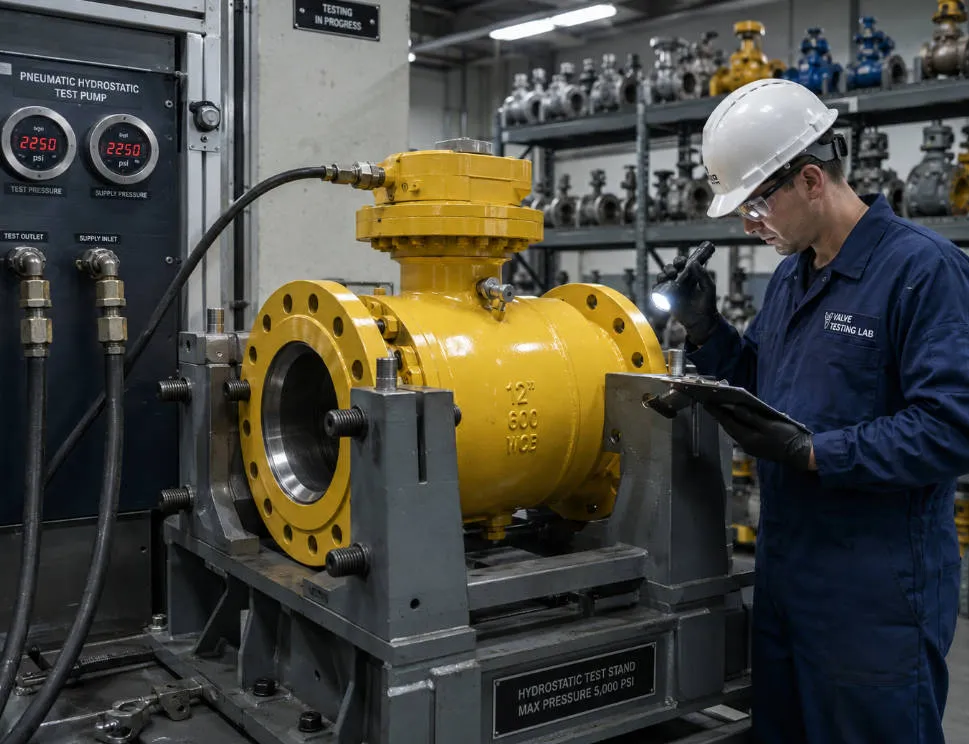
Shut-off valve testing is governed by multiple overlapping codes, standards, and regulations depending on the application:
|
Standard / Code |
Scope |
Key Testing Requirements |
|---|---|---|
|
API 598 |
Valve inspection and testing |
Shell and seat closure tests, hydrostatic and pneumatic pressure, leak rate measurement |
|
API 607 / ISO 10497 |
fire testing for soft-seated valves |
Fire exposure at 750–1000°C for 30 min, through-pressure and post-fire seat leakage |
|
MSS SP-61 |
Pressure testing of steel valves |
Hydrostatic shell test at 1.5× rated pressure, seat leakage measurement |
|
ASME B16.34 |
Valve pressure-temperature ratings |
Defines pressure classes, wall thickness, design requirements |
|
IEC 61508 / IEC 61511 |
Functional safety (SIL-rated valves) |
Proof testing intervals, diagnostic coverage, dangerous failure rates |
|
NFPA 85 |
Boiler and combustion systems |
Monthly leak testing of fuel gas safety shut-off valves |
|
NFPA 86 |
Ovens and furnaces |
Annual leak testing of safety shut-off valves |
|
FM 7400 / FM 7420 |
FM Global approved gas safety shut-off valves |
Double block and bleed, leak testing, valve actuator reliability |
|
EN 161 |
Automatic shut-off valves for gas burners |
Class A, B, C leakage rates; endurance, flow resistance, overpressure |
|
2021 IRC P2303.9 |
Residential water shutoff valves |
Valve accessibility, full-open requirement, location near service entrance |
|
SOLAS Chapter II-2 |
Marine fire safety |
Emergency fuel shut-off valve accessibility and remote operation |
Shut-Off Valve Leak Testing Procedures
Bubble Test Method (Gas Safety Shut-Off Valves)
The standard field method for testing fuel gas safety shut-off valves follows the AXA XL Risk Consulting (PRC.4.0.3) procedure:
Equipment Required:
-
Test cock with rubber hose
-
Bucket filled with water
-
Cap for test cock
Step-by-step procedure for a double block and bleed system:
-
Close the manual shutoff valve (Item 10) downstream of the second safety shut-off valve (Item 7).
-
Energize the vent line valve (Item 6) to close it. On multi-burner units, close the header vent valve as well.
-
Test upstream safety shut-off valve (Item 4): Remove the cap from the test cock (Item 5), attach a rubber hose, place the other end in a water bucket, and open the test cock. Keep the hose just below the water surface — gas pressure may be less than 1 inch (2.5 mbar) of water column. If bubbles appear, the valve is leaking.
-
Open the upstream safety shut-off valve (Item 4) by energizing or manually opening it, keeping the vent valve (Item 6) closed.
-
Test downstream safety shut-off valve (Item 7): Remove the cap from test cock (Item 8), attach hose to bucket, open test cock. If bubbles appear, the valve is leaking.
-
Close the upstream valve (Item 4), de-energize the vent valve (Item 6) to open it, and open the downstream manual valve (Item 10).
Frequency: Monthly for boilers (per NFPA 85); annually for ovens and furnaces (per NFPA 86).
Hydrostatic Seat Leakage Test
Per API 598, the seat closure test applies pressure to one side of the closed valve while measuring leakage on the opposite side:
|
Valve Size |
Test Medium |
Test Pressure |
Maximum Allowable Leakage |
|---|---|---|---|
|
≤ 2 in. (DN 50) |
Water or air |
1.1× rated pressure |
0 ml/min (water) / 0 bubbles/min (air) for metal-seated |
|
2–12 in. (DN 50–300) |
Water or air |
1.1× rated pressure |
(Drop/ml limits per API 598 Table 5) |
|
> 12 in. (DN 300) |
Water or air |
1.1× rated pressure |
(Drop/ml limits per API 598 Table 5) |
Pneumatic Seat Leakage Test
For valves in gas service, pneumatic testing at 60–100 psi (4–7 bar) is common. Acceptable leakage rates are defined by the applicable product standard (API 598, MSS SP-61, or EN 161 for gas burner valves).
Pressure Testing Methods for Shut-Off Valves
Shell (Body) Hydrostatic Test
Every valve must pass a shell test before leaving the manufacturer. Per API 598:
-
Test pressure: 1.5× the valve's rated pressure at 38°C (100°F)
-
Duration: Per API 598 Table 4 (varies by valve size, typically 15 seconds to 2 minutes)
-
Acceptance criterion: No visible leakage through the valve body, bonnet, or any pressure-boundary joint
Backseat Test
For valves with a backseat design (gate and globe valves), the backseat test verifies that the packing gland seals when the stem is fully opened:
-
Apply test pressure with the valve fully open and packing gland loosened
-
No leakage permitted at the packing area
High-Pressure Gas Testing
For valves in critical gas service, hydrostatic testing may not be sufficient due to the density difference between water and gas. High-pressure gas testing (nitrogen or helium) at operating pressure provides more sensitive leak detection, often using mass spectrometry for helium leak rates down to 10⁻⁹ mbar·L/s.
Functional and Operational Testing
Beyond leak tightness, shut-off valves must be tested for reliable operation:
|
Test |
Method |
Acceptance Criteria |
|---|---|---|
|
Opening/closing torque |
Torque wrench measurement |
Within manufacturer's specified range |
|
Stroke time |
Timed from full-open to full-close |
Per design specification (typically < 1 sec for safety shut-off) |
|
Position indication |
Verify limit switch feedback matches actual position |
100% correspondence |
|
Seat tightness after cycling |
Leak test after repeated open/close cycles (typically 100–1,000 cycles) |
Leakage within standard limits |
|
Failure mode verification |
De-energize actuator; verify valve moves to fail-safe position |
Valve reaches safe position within specified time |
|
Spring return test |
Release air supply; verify spring-driven closure |
Full closure, repeatable stroke time |
For Safety Instrumented Systems (SIS) valves rated to IEC 61511, proof testing must demonstrate that the valve can perform its safety function on demand. The proof test interval is determined by the required Safety Integrity Level (SIL) and the valve's calculated Probability of Failure on Demand (PFD).
Fire-Safe Valve Testing
Valves in hydrocarbon, petrochemical, and fuel gas service must maintain integrity during and after fire exposure. API 607 / ISO 10497 defines the standard fire test:
Test sequence:
-
Pre-fire seat test: Verify seat leakage at rated pressure
-
Fire exposure: Valve body immersed in flame at 750–1000°C (depending on standard) for 30 minutes, with internal pressure maintained
-
Through-fire seat leakage measurement: Measure leakage rate during fire
-
Cool-down: Cool valve to ambient temperature
-
Post-fire seat test: Verify seat leakage at reduced pressure (typically 2 bar / 30 psi)
-
Post-fire operability: Verify valve can be operated (one full cycle)
Acceptance criteria (API 607):
-
Through-fire leakage: ≤ 200 ml/min (for valves ≤ DN 100)
-
Post-fire leakage: ≤ 400 ml/min (for valves ≤ DN 100)
-
Valve must be operable after fire exposure
Emergency Shut-Off Valve Testing
Emergency shut-off valves (ESOVs) are designed for rapid isolation of fuel or hazardous fluid lines in crisis situations. They are common in:
-
Marine vessels: Engine room fuel systems (SOLAS compliance)
-
Fuel storage facilities: Tank farm isolation
-
Gas distribution: Emergency line isolation
-
Chemical plants: Emergency isolation of process units
Marine Emergency Shut-Off Valve Testing
On vessels, spring-loaded emergency shut-off valves are tested by:
-
Activating the remote release mechanism (pulling the pin at the remote lever station)
-
Verifying valve closure — listening for the alarm and confirming fuel flow stops
-
Resetting the valve — close fully by hand (clockwise), then open fully until the spring pin resets
Remote release stations should be located in accessible areas away from the hazard zone (e.g., on the main deck aft), with clear signage and unobstructed access.
Industrial Emergency Shut-Off Valve Testing
For automated ESOVs in process plants:
-
Full-stroke proof test: Actuate valve from full-open to full-close, verify limit switches, measure stroke time
-
Partial-stroke test (PST): Move valve 10–20% toward closed position and return, without disrupting process — enables online testing with minimal production impact
-
Test frequency: Determined by SIL calculation; typically quarterly (full-stroke) or monthly (partial-stroke)
Residential and Plumbing Shut-Off Valve Testing
Main Water Shut-Off Valve Inspection
Per the 2021 IRC (P2303.9) and InterNACHI® Standards of Practice, home inspectors must:
-
Locate the main water supply shutoff valve and describe its location
-
Identify the valve type (gate valve or ball valve required for full-open service)
-
Check for missing, loose, or damaged valve handles or handwheels
-
Inspect for water leaks at the valve stem, packing washer, and packing nut (wipe the bottom of the valve body and look for watermarks below)
-
Verify accessibility — the valve must be reachable for operation, inspection, and maintenance
-
Report any observed leaks as needing correction
Important: Home inspectors should NOT turn the valve during inspection — only observe its condition.
Individual Fixture Shut-Off Valve Testing
For sinks and toilets:
-
Locate the shut-off valve — beneath the basin (two valves: hot and cold) or at the wall near the toilet
-
Turn the handle all the way to the left (counter-clockwise) to close
-
Attempt to operate the fixture — water should cease completely
-
If the valve is stuck (frozen), it needs replacement
Upgrade recommendation: Replace conventional multi-turn valves with quarter-turn "quick-turn" ball valves, which are less prone to freezing and provide faster shut-off.
How to Choose a Shut-Off Valve Testing Laboratory
|
Criterion |
What to Look For |
|---|---|
|
Accreditation |
ISO 17025 accreditation for valve testing scope |
|
Standards coverage |
API 598, API 607/ISO 10497, MSS SP-61, EN 161, IEC 61511 |
|
Pressure capabilities |
Test pressure range covering your valve ratings (up to Class 2500 / PN 420) |
|
Fire test facility |
Purpose-built fire test furnace per API 607 / ISO 10497 |
|
Gas detection sensitivity |
Helium mass spectrometry for ultra-low leak rates |
|
Test media |
Water, air, nitrogen, helium, process-simulating fluids |
|
Reporting |
Full test reports with pressure-time charts, leak rate data, photographs |
|
Turnaround time |
Typical 2–4 weeks for standard tests; expedited options available |
Common Challenges and Failure Modes
-
Valve seat damage: Erosion, corrosion, or galling of seating surfaces causes increasing leakage over time. Common in abrasive slurries and high-temperature steam service.
-
Stem packing leakage: Packing degradation is the most frequent source of external valve leakage. Regular repacking or live-loaded packing designs mitigate this.
-
Actuator failure: Pneumatic or electric actuators can fail due to air supply loss, spring breakage, or motor burnout. Fail-safe (spring-return) design is essential for safety valves.
-
Frozen (seized) valves: Infrequently operated valves in residential plumbing and low-priority isolation service can seize due to mineral deposits, corrosion, or galling. Routine cycling prevents this.
-
Leak test false positives: In bubble testing, submerging the hose too deep in water can prevent bubble detection at very low gas pressures (< 1 inch water column). Keep the hose just below the surface.
-
Partial-stroke test limitations: PST only verifies actuator and valve stem movement — it does not confirm full seat tightness. Full-stroke proof testing remains essential at the prescribed interval.
-
Post-fire valve degradation: Even valves that pass fire testing may have degraded seats and reduced service life. Post-incident inspection and replacement are necessary.
Frequently Asked Questions
Q: How often should fuel gas safety shut-off valves be leak tested? A: Monthly for boiler systems (NFPA 85), annually for ovens and furnaces (NFPA 86). All tests and results should be documented.
Q: What is the bubble test and how sensitive is it? A: The bubble test uses a rubber hose from a test cock submerged in water. It can detect leaks at pressures as low as 1 inch (2.5 mbar) water column. Any visible bubbles indicate valve leakage.
Q: What is the difference between a proof test and a partial-stroke test? A: A proof test fully strokes the valve open-to-close and verifies seat tightness. A partial-stroke test moves the valve 10–20% toward closed and back, detecting actuator and stem problems without full process disruption.
Q: Do residential shut-off valves need to be tested? A: Yes. Homeowners should periodically test individual fixture shut-off valves (sinks, toilets) by closing them and verifying water stops. Seized valves should be replaced with quarter-turn ball valves.
Q: What is a fire-safe valve? A: A valve that has been tested per API 607 or ISO 10497 to maintain seat integrity and operability during and after exposure to temperatures of 750–1000°C for 30 minutes.
Q: What SIL rating is typical for safety shut-off valves? A: SIL 2 or SIL 3 is common for critical fuel gas and process isolation valves. The required SIL is determined by a Layer of Protection Analysis (LOPA) or similar risk assessment.
Q: Can valve testing be performed while the system is online? A: Partial-stroke testing can be performed online without process disruption. Full proof testing typically requires a controlled shutdown or bypass arrangement.
Summary
Shut-off valve testing spans leak tightness verification (bubble testing, hydrostatic/pneumatic seat tests), functional operation (stroke time, torque, fail-safe action), fire safety qualification (API 607/ISO 10497), and emergency response validation (remote release, alarm verification). Standards from API, NFPA, IEC, EN, and SOLAS define the requirements across industrial, residential, and marine applications. Monthly leak testing for boiler gas safety valves, annual testing for oven systems, and periodic proof testing for SIL-rated safety valves are the baseline obligations. A seized valve, a degraded seat, or a failed actuator can turn a routine isolation event into a catastrophic failure — testing is the only defense.