What Is Fire-Resistant Window Testing and Why Does It Matter
Fire-resistant window testing subjects a complete window assembly—frame, glass, seals, and hardware—to standardized fire exposure conditions in a laboratory furnace. The test measures how long the assembly maintains three critical performance criteria:
- Integrity (E): The assembly prevents flames and hot gases from passing through to the unexposed side. No cracks, holes, or sustained flaming on the non-fire side.
- Insulation (I): The unexposed face temperature does not exceed 140°C above ambient (average) or 180°C at any single point. This protects people and combustible materials on the safe side.
- Radiation Control (W): Radiant heat flux on the unexposed side stays below 15 kW/m² at a distance of 1.0 meter from the surface. This prevents ignition of nearby materials.
Testing matters because a window that fails during a fire creates an immediate path for flames, smoke, and radiant heat to spread between compartments—defeating the entire fire separation strategy of the building. Building codes worldwide mandate tested and rated fire windows for specific locations: stairwell enclosures, elevator lobbies, fire-rated partition walls, exterior curtain walls near property lines, and means-of-egress corridors.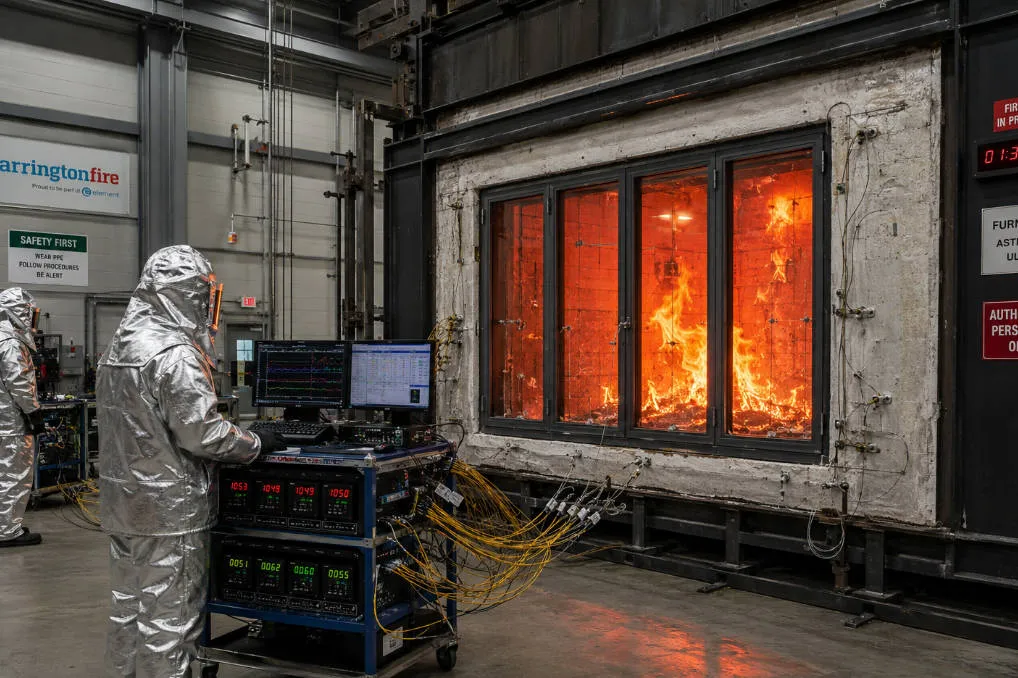
Fire-Resistant Glass Types and How They Work
The glass type is the single largest factor in determining a window assembly's fire rating. Understanding the four main categories is essential before diving into testing standards.
| Glass Type | Temperature Resistance | Typical Rating | Mechanism |
|---|---|---|---|
| Wired Glass (Georgian wire) | ~400–500°C | E30–E60 | Wire mesh holds cracked glass in place; provides integrity only |
| Borosilicate Glass | ~550–800°C (short-term) | E60–E120 | Low thermal expansion; resists thermal shock cracking |
| Ceramic Glass | Up to 1000°C+ | E60–E120, EW | Does not shatter; maintains transparency under extreme heat |
| Multi-layer Intumescent Laminated | Variable (depends on layers) | EI30–EI120 | Interlayers expand when heated, forming insulating char |
Multi-layer intumescent laminated glass is the most advanced option. It consists of multiple glass panes separated by hydrated sodium silicate interlayers. When exposed to fire, the interlayer activates at 120–150°C, expands up to 25–50mm, turns opaque white, and forms a dense insulating char that blocks both heat transfer and radiation. This is the only glass type that reliably achieves EI (integrity + insulation) ratings at 60 minutes and above.
Major manufacturers include Pilkington (Pyrostop for EI, Pyrodur for E), AGC (Fireprotect range), and Saint-Gobain/Vetrotech (Contraflam range for EI-rated assemblies).
North American Testing Standards: ASTM, NFPA, and UL
North America uses a distinct set of fire test standards. The three primary standard families are ASTM, NFPA, and UL.
ASTM E163: Standard Fire Test for Window Assemblies
ASTM E163 is the foundational fire test method for window assemblies in the United States. Key details:
- Scope: Fire resistance test for window assemblies, including frame, glass, and glazing system
- Specimen size: Full-size or representative sample, typically matching actual installation dimensions
- Fire exposure: Follows the standard time-temperature curve (same as ASTM E119), reaching approximately 538°C at 5 minutes, 704°C at 10 minutes, and 927°C at 30 minutes
- Rating increments: 20, 30, 45, 60, 90, 120 minutes
- Criteria: The specimen must not develop any opening that permits flames or hot gases to pass through. Temperature rise may or may not be measured depending on the specific test specification
NFPA 252: Fire Tests of Window Assemblies
NFPA 252 is the NFPA counterpart to ASTM E163 and is referenced by most North American building codes:
- Scope: Standard methods of fire tests for window assemblies
- Fire exposure: Standard time-temperature curve consistent with ASTM E163
- Hose stream test: After the fire exposure period, the assembly is subjected to a hose stream from a standard fire hose nozzle (approximately 30 psi water pressure) to test structural integrity under impact and cooling stress
- Rating: The assembly must survive both the fire exposure AND the hose stream test without developing openings that allow fire passage
NFPA 257: Standard on Fire Test for Window Assemblies (Limited Fire)
NFPA 257 covers a specific subset—windows that are not intended as full fire barriers but must resist fire exposure from one side:
- Application: Windows in exterior walls that may be exposed to fire from outside (e.g., from an adjacent building)
- Test: Measures whether the window resists fire penetration for a specified duration without requiring a hose stream test
- Typical use: Building code compliance for proximity to property lines
UL 9: Fire Test of Window Assemblies
UL 9 is Underwriters Laboratories' standard for fire testing window assemblies:
- Scope: Fire tests of window assemblies including all components (frame, glass, glazing compound, hardware)
- Test method: Similar to ASTM E163/NFPA 252 fire exposure
- Hose stream: Required after fire exposure (same as NFPA 252)
- Classification: UL assigns fire resistance ratings based on the test results; assemblies are listed in the UL Fire Resistance Directory
UL 10B: Fire Tests of Door Assemblies (with Vision Panels)
UL 10B is primarily for fire door assemblies but directly applies to windows (vision panels) within fire doors:
- Scope: Fire door assemblies including glazed vision panels up to a specified maximum area
- Fire exposure: Standard time-temperature curve
- Hose stream: Required after the fire endurance portion
- Ambient temperature rise: For assemblies also seeking a temperature rise rating, the unexposed side temperature is monitored
UL 10C: Positive Pressure Fire Test of Door Assemblies
UL 10C introduced positive pressure testing for door assemblies (including vision panel windows), reflecting real-world fire conditions more accurately:
- Key difference: The furnace applies positive pressure (typically 0.01 inch water gauge, or approximately 2.5 Pa) on the fire side, pushing hot gases through any gaps
- Rationale: In a real fire, the neutral pressure plane shifts. Positive pressure testing is more severe and realistic than the neutral/negative pressure conditions in older standards
- Impact on glazing: Positive pressure makes integrity failure more likely—gaps around glass edges and frame joints are stressed by hot gas flow
European Testing Standards: EN 1634 and EN 13501
Europe uses a two-document system: one for testing (EN 1634-1) and one for classification (EN 13501-2). This approach cleanly separates the test method from the rating system.
EN 1634-1: Fire Resistance Tests for Door and Shutter Assemblies
EN 1634-1 is the primary European fire test method for door, shutter, and window assemblies:
- Scope: Fire resistance tests for door, shutter, and window assemblies including all components
- Fire curve: ISO 834 standard time-temperature curve: T = 345 × log₁₀(8t + 1) + 20°C, reaching ~945°C at 60 min and ~986°C at 90 min
- Pressure conditions: The furnace applies a pressure differential—positive pressure at the top, neutral at mid-height, negative at the bottom (approximately 20 Pa positive at top)
- Specimen installation: The assembly is installed exactly as in practice, including all seals, fixings, and hardware
EN 13501-2: Fire Classification of Construction Products
EN 13501-2 takes EN 1634-1 test results and assigns classifications. The system uses letter codes:
| Classification | Integrity (E) | Radiation (W) | Insulation (I) | Description |
|---|---|---|---|---|
| E | Required | Not measured | Not measured | Prevents flame/gas passage |
| EW | Required | ≤15 kW/m² at 1m | Not measured | E + limits radiant heat flux |
| EI | Required | Not measured | ≤140°C avg / 180°C max | E + limits temperature rise |
Integrity (E) is verified using:
- Cotton pad test: A cotton pad held near any crack or opening must not ignite
- Gap gauge: A 6mm gap gauge must not pass through any opening; a 25mm gap gauge must not penetrate more than 150mm
- No sustained flaming on the unexposed face
Common ratings: E30, E60, E90, E120, EW30, EW60, EW90, EW120, EI30, EI60, EI90, EI120.
EN 16034: Product Standard for Fire-Resisting Windows
EN 16034 is the harmonized European product standard under which fire-rated windows receive CE/UKCA marking. It references EN 1634-1 for testing and EN 13501-2 for classification. Manufacturers must declare the fire resistance performance and mark products accordingly.
International and Other Regional Standards
| Standard | Region | Scope | Key Feature |
|---|---|---|---|
| ISO 834 | International | Defines the standard fire curve used globally | T = 345×log₁₀(8t+1)+20 |
| ISO 3008 | International | Fire resistance tests for door and shutter assemblies | Alternative to EN 1634-1 |
| BS 476 Part 20/22 | UK (legacy) | Fire resistance of building elements | Superseded by EN 1634/13501 but still referenced |
| AS 1530.4 | Australia/NZ | Fire resistance tests for building elements | Similar to ISO 834 curve |
| CAN/ULC-S134 | Canada | Fire tests of window assemblies | Canadian version of NFPA 252 with hose stream |
| GB/T 12513 | China | Fire resistance test for glazed elements | Follows ISO 834 curve |
Fire Resistance Classification Systems Compared
The classification criteria differ between North America and Europe, but the underlying principles are similar. Here is a side-by-side comparison:
| Criterion | North America (ASTM/NFPA/UL) | Europe (EN 13501-2) |
|---|---|---|
| Integrity | No openings allowing flame passage; hose stream after fire exposure | E rating: cotton pad test + gap gauge (6mm/25mm) |
| Insulation | Temperature rise measured on unexposed face (when applicable) | I rating: ≤140°C avg / 180°C max rise |
| Radiation | Not separately classified in most standards | W rating: ≤15 kW/m² at 1.0m |
| Hose stream | Required by NFPA 252, UL 9, UL 10B, CAN/ULC-S134 | Not required by EN 1634-1 (European practice) |
| Pressure | UL 10C uses positive pressure (2.5 Pa); others neutral | EN 1634-1 applies pressure gradient (20 Pa top) |
| Rating format | Numeric only: 20, 30, 45, 60, 90, 120 min | Letter + numeric: E60, EW60, EI60 |
The European system provides more granular information at a glance—a rating of "EI60" immediately tells you integrity AND insulation for 60 minutes. North American ratings require reading the test report to determine whether insulation or just integrity was achieved.
Fire Test Procedure: Step by Step
Regardless of the standard used, fire window testing follows a consistent workflow:
1. Specimen Preparation and Conditioning
The complete window assembly is installed in a test frame exactly as it would be in practice—including all intumescent seals, fixings, glazing beads, and hardware. The specimen is conditioned at 23±2°C and 50±5% relative humidity for a minimum period (typically 24–48 hours) befOre testing.
2. Instrumentation Setup
- Thermocouples: Placed on the unexposed face (typically 5+ points: center and corners/quarters for glass; additional on frame) to measure temperature rise
- Furnace thermocouples: Verify the standard time-temperature curve is maintained throughout the test
- Pressure taps: Monitor differential pressure across the specimen
- Radiometers: Positioned 1.0m from the unexposed face for EW classification testing
- Deflection gauges: Measure frame and glass deformation during fire exposure
3. Fire Exposure
The furnace follows the standard time-temperature curve (ISO 834 or ASTM equivalent). Key temperature milestones:
| Time | Furnace Temperature (ISO 834) |
|---|---|
| 5 min | ~576°C |
| 10 min | ~678°C |
| 20 min | ~784°C |
| 30 min | ~842°C |
| 60 min | ~945°C |
| 90 min | ~986°C |
| 120 min | ~1,013°C |
4. Continuous Monitoring
Throughout the fire exposure, technicians monitor:
- Cotton pad testing at regular intervals (every 5–10 minutes) to check for hot gas penetration
- Gap gauge measurements at any visible cracks or openings
- Visual observation for sustained flaming on the unexposed face
- Temperature readings from all thermocouples
- Radiometer readings (for EW classification)
- Deflection and deformation measurements
5. Hose Stream Test (North American Standards)
For NFPA 252, UL 9, UL 10B, and CAN/ULC-S134, the fire exposure is immediately followed by a hose stream test:
- Standard fire hose nozzle at approximately 30 psi water pressure
- The stream is directed at the specimen from a specified distance
- The specimen must not develop openings after the hose stream impact and thermal shock
This simulates firefighting conditions and is a uniquely North American requirement. European standards (EN 1634-1) do not include a hose stream test.
The Role of Intumescent Seals in Fire Windows
Intumescent seals are passive fire protection components that expand dramatically when exposed to heat. They are essential for maintaining fire resistance at vulnerable points in window assemblies.
Types of Intumescent Seals in Fire Windows
| Seal Type | Location | Material | Expansion Ratio |
|---|---|---|---|
| Strip seals (pallet/blade) | Frame grooves | Sodium silicate or graphite-based with PVC/silicone carrier | 3:1 to 10:1 |
| Glazing tape/seal | Glass-to-frame rebate | Intumescent material in tape form | 3:1 to 8:1 |
| Mastic/caulking | Frame-to-wall perimeter | Intumescent sealant | 3:1 to 5:1 |
| Pre-formed gaskets | Frame joints and corners | Intumescent + elastomeric | 3:1 to 10:1 |
Technical Performance Specifications
- Activation temperature: 140–250°C for perimeter seals; 120–150°C for laminated glass interlayers
- Expansion ratio: 3:1 to 10:1 by volume depending on material composition
- Gap filling: A typical 10mm × 5mm strip can expand to fill gaps of 25–50mm
- Char durability: The expanded char must maintain cohesion for the full rated fire duration—at 90+ minutes, some seals begin to degrade or erode under furnace pressure
Intumescent Glazing Interlayers
These are NOT perimeter seals—they are laminated between glass layers in EI-rated assemblies. Made of hydrated sodium silicate, they expand at 120–150°C, turn opaque, and form an insulating char up to 25–50mm thick. This interlayer is the primary mechanism for achieving EI ratings and can reduce heat transfer by 80–95% compared to plain glass.
Common Failure Modes in Fire Window Testing
Understanding why fire windows fail helps manufacturers improve designs and helps specifiers identify quality products:
| Failure Mode | When It Occurs | Affected Rating | Root Cause |
|---|---|---|---|
| Glass breakage | 20–60 min | All | Thermal shock, uneven heating, or mechanical stress from frame expansion |
| Glass softening | 60–90 min | All | Soda-lime glass softens at ~700–730°C; borosilicate and ceramic resist better |
| Seal burnout | 60–120 min | E, EW, EI | Intumescent seal degrades or erodes under sustained furnace pressure |
| Frame distortion | 30–90 min | All | Thermal expansion causes gapping at joints and corners |
| Glazing retention failure | 30–60 min | All | Glazing beads or mechanical fixings fail; glass falls out of frame |
| Radiation exceedance | 45–90 min | EW | Glass transmits increasing radiant heat as it heats through |
| Temperature exceedance | 45–90 min | EI | Unexposed face exceeds 140°C/180°C limits due to conductive/radiative transfer |
| Hose stream failure | Post-fire | NA (UL/NFPA only) | Assembly cracks under thermal shock and water impact |
Industry Applications and Code Requirements
Fire-rated windows are mandated in specific building locations by codes worldwide:
Stairwell and elevator lobby enclosures: Windows must typically carry a minimum 60-minute fire resistance rating (E60 or EI60). In high-rise buildings, 90-minute or 120-minute ratings may be required.
Fire-rated partition walls and corridors: Windows in fire separations between occupancy types must match the wall's fire resistance rating. A 2-hour fire wall requires 120-minute rated windows.
Exterior curtain walls: NFPA 257 governs exterior windows exposed to fire from adjacent buildings. Many jurisdictions require fire-resistance testing for curtain wall systems based on proximity to property lines.
Egress windows: In some jurisdictions, windows designated as emergency egress points must also meet fire resistance requirements when located in fire-resistance-rated walls.
Industrial and hazardous occupancies: Windows in chemical processing plants, warehouses with high combustible loads, and similar facilities often require fire-rated glazing with EI classifications.
How to Choose a Fire-Resistant Window System
Selecting the right fire-rated window involves matching the required classification to the correct product:
-
Determine the code-required rating: Check local building codes and fire codes for the minimum fire resistance rating at each window location. Note whether integrity only (E), integrity with radiation control (EW), or full insulation (EI) is required.
-
Select the correct classification: EI-rated windows are the most protective but also the most expensive and heaviest. E-rated windows may suffice for locations where radiant heat and temperature rise on the non-fire side are not critical concerns.
-
Verify third-party certification: Ensure the window assembly carries certification from a recognized body—UL, Intertek (ETL), FM Global, , or a notified body under EN 16034 for European products. Certification means the assembly was tested as a complete system, not just individual components.
-
Check the test report scope: Fire ratings apply to the specific tested configuration—frame material, glass type, seal type, and hardware. Substituting any component may void the rating.
-
Consider frame materials: Steel frames offer the highest fire resistance. Aluminum frames require thermal breaks and special fire-rated designs. Timber frames can achieve fire ratings through charring behavior but need verification.
Summary
Fire-resistant window testing is a multi-standard, multi-criteria discipline. North America relies on ASTM E163, NFPA 252/257, and UL 9/10B/10C with mandatory hose stream testing; Europe uses EN 1634-1 (testing) and EN 13501-2 (classification) with the granular E/EW/EI system. The fire resistance of any window assembly depends on the glass type—from basic wired glass (E30) to multi-layer intumescent laminated glass (EI120)—supported by properly rated intumescent seals, frames, and hardware. Certification covers the complete tested assembly, not individual components. Always verify the test report matches your exact configuration.